
California Black Media
L.A. Pilot Program Addressing Asian American Hate Could Be California Model
Californians who are Asian American or Pacific Islanders (AAPI) were the targets of an escalated number of hate crimes and hate incidents during the COVID-19 pandemic. Many AAPI people, particularly the elderly, reported being too scared to leave their homes. Others experienced firsthand hateful incidents stemming from deep-rooted prejudices and stereotypes — such as verbal or physical assaults in public.


By McKenzie Jackson, California Black Media
Californians who are Asian American or Pacific Islanders (AAPI) were the targets of an escalated number of hate crimes and hate incidents during the COVID-19 pandemic.
Many AAPI people, particularly the elderly, reported being too scared to leave their homes. Others experienced firsthand hateful incidents stemming from deep-rooted prejudices and stereotypes — such as verbal or physical assaults in public. Yet, too many of them were hesitant to voice their emotions, according to Yu Wang, an associate marriage and family therapist at the Asian Pacific Counseling and Treatment Center in Los Angeles.
“A space for healing is critically needed,” Wang said, also noting that some Asian cultures don’t put a heavy emphasis on sharing feelings and vulnerabilities. “It makes it difficult to talk about experiences related to racism. Also, many of us lack to the language to express emotions, which exacerbates feelings of isolation and fear.”
The Asian/Pacific Islanders (AAPI) Equity Alliance in collaboration with other Asian American community groups recently launched the Healing Our People through Engagement (HOPE) pilot program in Los Angeles County geared at healing racial trauma experienced by Asian American community members by providing healing spaces and reducing isolation. Based on the successes of the initiative, supporters and organizers believe the “culturally centered” program could become a model for other cities around the state.

Ethnic Media Services hosted an hourlong Zoom press conference on the last day of May, which was AAPI Heritage Month, to allow HOPE program facilitators and allies the opportunity to provide details of the initiative to the media.
HOPE is a healing space for five distinct Asian American communities — Cambodian, Chinese, Filipino, Japanese, and Korean — created to make sense of their experiences with racism and recent surges in hate crimes. The psychology of the program is radical healing, a framework that has aided Black people in dealing with years of prejudice-caused trauma. HOPE is funded by a grant from the California Department of Social Services.
More than 11,000 stories of hate have been reported to the California-based online resource, Stop AAPI Hate, since 2020.
AAPI Managing Director of Programs Michelle Sewrathan Wong called HOPE vital and said Asian Americans endured episodes of brutality on a scale not seen in generations.
“They were scapegoated by politicians for transmission of COVID-19, targeted for violent physical attacks, made to feel unsafe and unwelcome in their own communities and bullied and ridiculed by neighbors and strangers,” she stated.
HOPE opened healing spaces in Los Angeles County that offer six two-hour sessions conducted in groups by facilitators, who are staff from partner community organizations.
DePaul University Associate Professor of Psychology Dr. Anne Saw said the radical healing framework promotes healing over coping.
“Healing may be lifelong because racism is ongoing, yet a program like ours reminds people of the cultural, community, family, and individual strengths they have to resist racism,” Saw said. We believe that healing in a group can be more powerful than an individual engaging in healing on their own because of the support they receive.”
This resource is supported in whole or in part by funding provided by the State of California, administered by the California State Library in partnership with the California Department of Social Services and the California Commission on Asian and Pacific Islander American Affairs as part of the Stop the Hate program. To report a hate incident or hate crime and get support, go to CA vs Hate.












Activism
Oakland Post: Week of September 16 – 22, 2026
The printed Weekly Edition of the Oakland Post: Week of September 16 – 22, 2026
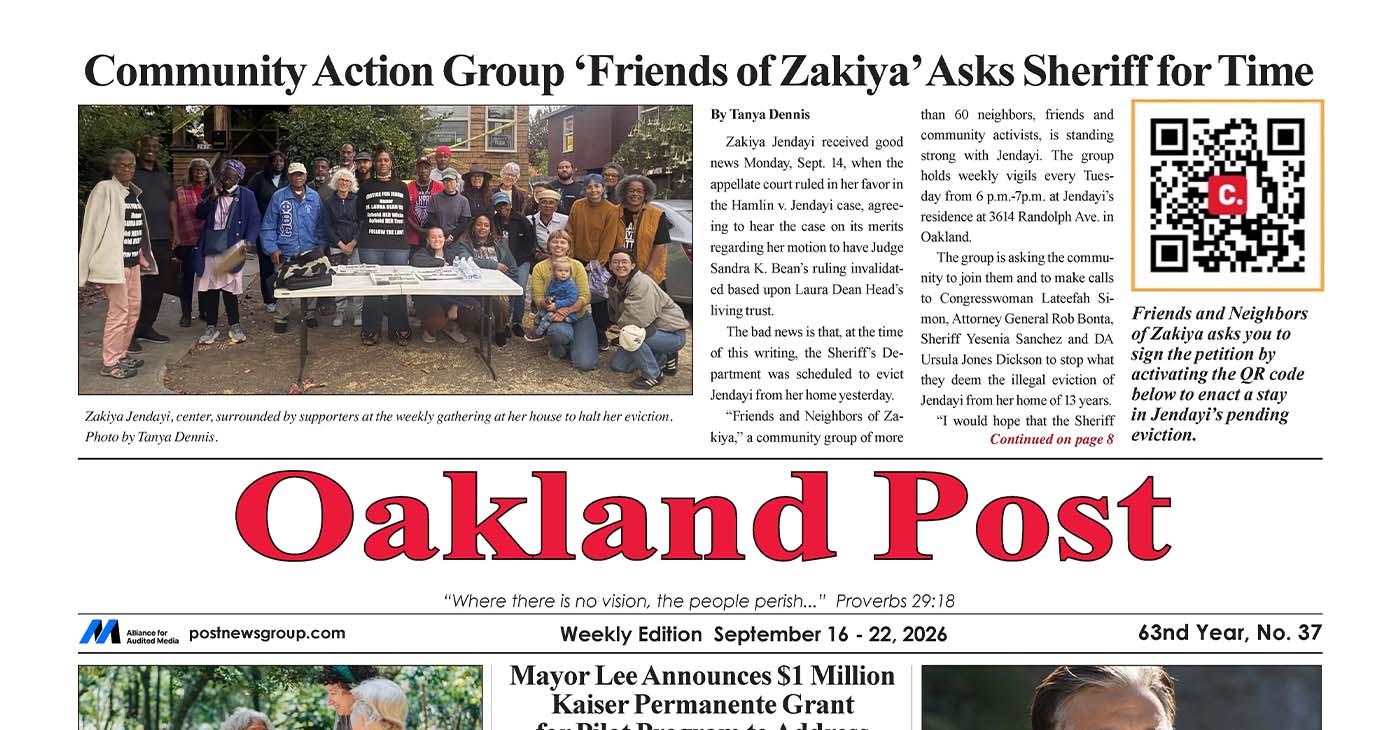
To enlarge your view of this issue, use the slider, magnifying glass icon or full page icon in the lower right corner of the browser window.
Activism
Oakland Post: Week of September 9 – 15, 2026
The printed Weekly Edition of the Oakland Post: Week of September 9 – 15, 2026

To enlarge your view of this issue, use the slider, magnifying glass icon or full page icon in the lower right corner of the browser window.
Activism
Oakland Post: Week of September 2 – 8, 2026
The printed Weekly Edition of the Oakland Post: Week of September 2 – 8, 2026
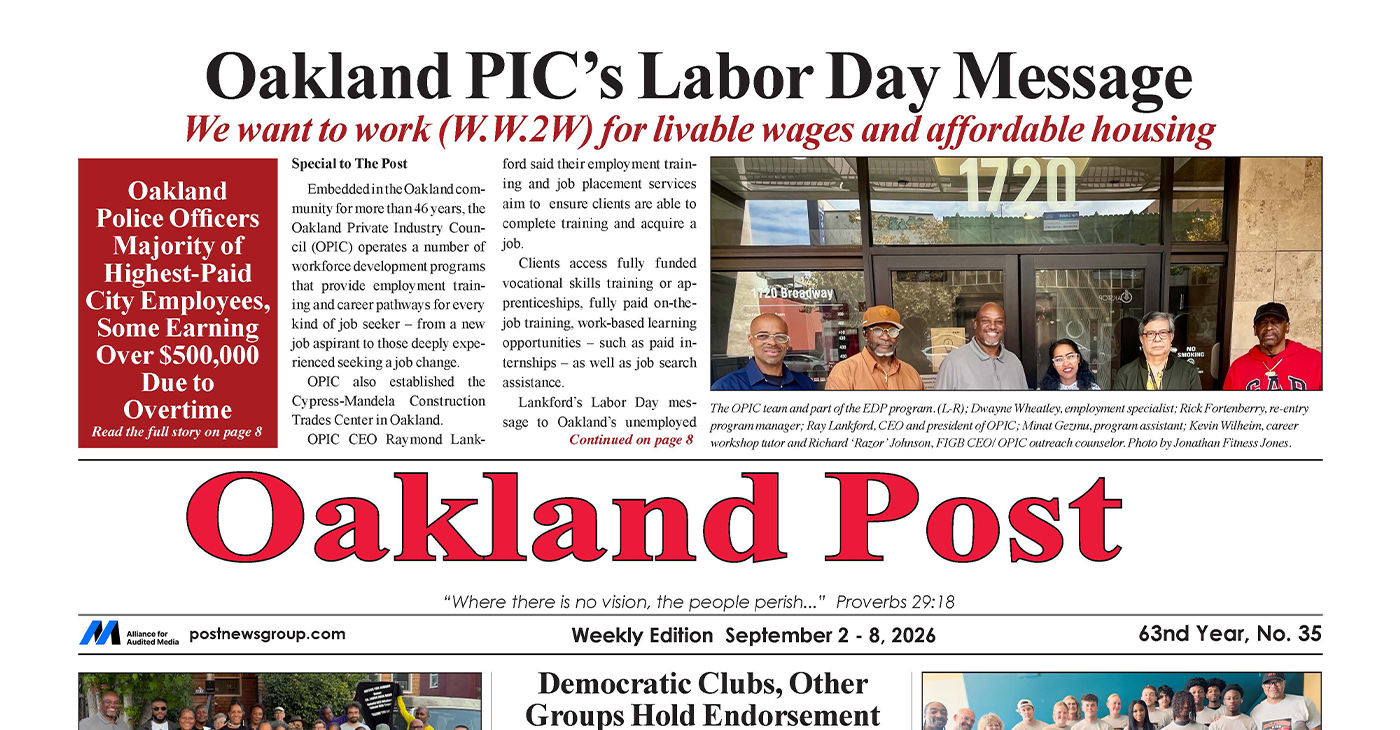
To enlarge your view of this issue, use the slider, magnifying glass icon or full page icon in the lower right corner of the browser window.



Doulas Are Helping Black California Moms Navigate Pregnancy–Even as High Mortality Rates Persist

Newsom Signs Addictive Social Media Law to Protect Kids

On Your November Ballot: Prop 38 Would Allocate $8.4 Billion to Immunology and Immunotherapy Funding

Ask California: Golden State Releases New AI Chatbot

Asm. Isaac Bryan’s Bill Banning California Police From ICE Side Jobs Reaches Newsom’s Desk

Assemblymember LaShae Sharp-Collins’s Bill Would Pause Law Enforcement’s Use of Shock Gloves Pending Study

BOOK REVIEW: ‘Laws of Solomon’ Reveals Tender Heart of Former Child Soldier

OPINION: The New American Fear – From 9-11 to AI

Passing for White, Fighting for Black America: The Courage of Walter White

Oakland People’s Arms Embargo Coalition Demands End to Military Shipments Thru Oakland

Barbara Lee Mourns Gloria Steinem, Remembers a Friendship Rooted in Equality

Event Preview: ‘Fashion v. Fascism’ – A Runway Revolution Is Coming to the Bay Area

Two Looming Threats Every Alameda County Elder Should Know About

Oakland Mayor Reads to Children at Bookout Block Party at Marcus Books Store

Tradition Comes to the Streets in 11th Annual Black-Eyed Pea Festival at the Freedom Farmers Market

Less Affluent School Districts, Including Sacramento City, Face Threat of State Takeover

ESSAY: California Can Close Its Colorectal Cancer Gap

California Hispanic Chambers of Commerce Unveils: ‘Powering the Future’ Theme for 47th Annual Statewide Convention

Four Candidates, Including Incumbent Barbara Lee, Qualify for Oakland Mayor’s Race

Oakland Post: Week of August 12 – 18, 2026

From Blueprint to Breakthrough: Tackling Affordable Housing in Oakland

Oakland Observes Black August with Block Parties, Film Showings, Workshops

COMMENTARY: Why Local School Tax Measure G1 Will Not Be on the November Ballot

Standoff for Justice: Our Homes Are Worth Fighting For

Returning to Its Roots, the Oakland Black-Eyed Pea Festival Partners with the Freedom Farmers Market Sept. 12

Oakland Post: Week of August 26 – September 1, 2026

NPRC Scores First Advocacy Victory: David Shaw Finally Gets His Wish to ‘Go Home’

Frontier Airlines’ Return to Oakland Airport Brings Flights, Jobs and Opportunity

Gubernatorial Candidate Steve Hilton Blasts California New Tire Rules; Newsom Hits Back

Chef Sharon Lee Blends Culinary Excellence, Education and Empowerment

The Conversation With Al McFarlane 6/23/26

Media Monday 6/22/26

LIVE! ASK ALMA! — TUES. 6.23.26 7PM EST

Car Buying Secrets: 4 Hidden Checks Before You Sign!

Is This 550 HP Charger Worth YOUR Money? AutoNetwork Review

Celebrating Juneteenth – Frederick Douglass on education and resistance

LIVE! — ASK ALMA! — TUES. 6.19.26 7PM EST

Hyundai Ioniq 5 Parking, Safety, and 360 View #shorts

2025 Ioniq 5 New Wiper & Powerful Performance! #shorts

Electric SUV Range: Is 259 Miles Enough? #shorts

EV Charging: How Fast Can You Charge an Electric Vehicle? #shorts

Biometric Cooling… Messaging Seats…Come on! 2025 Infiniti QX80 Autograph 4WD

Charged Up: Witness the Magic of a Fully Electric Car! #shorts

Range Rover Sport PHEV Included…: See What’s Inside This Luxury SUV! #shorts

Invisible Hood View: Perfect Parking with X-Ray Vision! #shorts
-
 Commentary4 weeks ago
Standoff for Justice: Our Homes Are Worth Fighting For
-
 Activism4 weeks ago
Oakland Post: Week of August 26 – September 1, 2026
-
 Business4 weeks ago
Frontier Airlines’ Return to Oakland Airport Brings Flights, Jobs and Opportunity
-
 Business4 weeks ago
Gubernatorial Candidate Steve Hilton Blasts California New Tire Rules; Newsom Hits Back
-
 Business4 weeks ago
Chef Sharon Lee Blends Culinary Excellence, Education and Empowerment
-

 Community4 weeks ago
Big City Mayors Ask for “Yes” Vote on Housing Bond Measure; Conservatives Say “No”
-

 Black History4 weeks ago
Jackie Wright Champions Bay Area Stories, Filmmakers and Cultural Institutions
-

 Education4 weeks ago
Gov. Newsom’s Latest Appointees Include Sacramento Advocate for Formerly Incarcerated Students; State’s New Tech Chief
