
Books
`Keep Your Hustle, But Change Your Product’
THE AFRO — Author Lamont Carey’s latest book, The Transition: From One Hellhole to Another, continues his searing narrative about the perils of mass incarceration, which impacts millions of Americans on both sides of the wall.

Author Lamont Carey’s latest book, The Transition: From One Hellhole to Another, continues his searing narrative about the perils of mass incarceration, which impacts millions of Americans on both sides of the wall.
Although Carey, a native of Washington, D.C. crafts fictionalized stories about life in prison, they are born of his very real experience as a young Black man who was once caught up in perhaps the most vicious system of incarceration on the planet.
“I was in prison, to keep…from being bored, I use to jump in rap battles and one of the guys challenged me to write a book, because he said I couldn’t battle,” said Carey during a phone interview. “And I wrote the book and I started being the institution favorite, everybody wanted to read the book. So, I kept writing books.”
All of Carey’s books (The Transition is his seventh), give readers an intimate and ultimately authentic immersion into life in prison. “So, the books that I released are a guy’s journey through one of the worst prisons in the world. So, you get to see how prison works, how relationships work, how individuals chose to navigate based off of their experiences,” Carey said. But, the author, motivational speaker and filmmaker revealed what he experienced inside the system when he first entered it was nothing like he expected.
“Prison was nothing like I thought it would be. I thought prison would be this constant battle of having to prove myself to protect me from being raped and all of that,” he said.
“But, what prison actually was, well, you had two roads you could take; you could take that road where you live a life of violence and aggression, or you could take the road of programming. And initially, I took the road of violence, but then it was working against me,” Carey added. “I was losing good days and going to the hole. And so, I chose the other path so I could get home. So, people go to prison and sometimes lose sight of freedom and when you lose sight of freedom that’s when you become institutionalized.”
Carey first hit the national stage as a spoken word artist in 2005 on HBO’s “Def Poetry Jam.” But, he said he had no expectation of where poetry would take him. “I wasn’t focused on being a change agent, I just was trying to infuse truth into the art, because a lot of people hadn’t come from that background and they were doing poems in the third person, so it wasn’t truth,” he said. “So, I just added, hard…straight from the streets kind of material and that material ended up having an impact because it gave other people, it made them see that their voice was being heard, and that somebody else shared their ideas,” Carey added.
“And so from there I started getting invited to speak in jails and prisons and their communities and so I just latched onto that. Because it gave me the opportunity, all those bad experiences I had this was an opportunity to use them for good. So, I turned my mistakes and roadblocks to success.”
Carey’s journey has taken him from seemingly divergent locations like Ames, Iowa to Africa. But, ultimately his message is universal, especially for people of color.
“There is poverty everywhere, there are Black people everywhere trying to figure out how to come up,” he said.
“There are Black people everywhere that succumb to the barriers. And then when I enter the room and talk about my challenges and how I overcame them, it gives hope.”
This article originally appeared in The Afro.











Activism
Oakland Post: Week of September 23 – 29, 2026
The printed Weekly Edition of the Oakland Post: Week of September 23 – 29, 2026

To enlarge your view of this issue, use the slider, magnifying glass icon or full page icon in the lower right corner of the browser window.
Books
BOOK REVIEW: ‘Laws of Solomon’ Reveals Tender Heart of Former Child Soldier
The monsters that came to him early in his sleep were the easy ones. It was the later demons that stole Solomon Nangobi’s sleep, the spirits of all the people he killed when he was a child soldier in Uganda, and when he was a fixer in New York as an adult. Their ghosts called to him with urgent voices, though he left that life behind long ago.


Author: Eriq La Salle, Copyright: c.2026, Publisher: Poisoned Pen Press, SRP: $18.99, Page Count: 304 pages
Finally, after so much work, you’ve left your past behind.
That’s what you tell yourself: what’s done is done and you can’t undo history. It’s over. You try not to think about last month, last year, a decade back because what does it matter? As in the new novel, “Laws of Solomon” by Eriq La Salle, remembering is too full of pain.
The monsters that came to him early in his sleep were the easy ones. It was the later demons that stole Solomon Nangobi’s sleep, the spirits of all the people he killed when he was a child soldier in Uganda, and when he was a fixer in New York as an adult. Their ghosts called to him with urgent voices, though he left that life behind long ago.
Now, his days were filled working the soil in gardens near Malibu, and he loved the quiet life.
Still, he kept his guns.

And he was glad: when Solomon recognized two Zeta gunmen stalking a well-dressed man, woman, and child through the gardens, he couldn’t walk away. He stopped the gangsters with bullets, but not before the adults and their bodyguards were dead. The child, an 8-year-old boy named Gaby, was safe, but Gaby couldn’t tell Solomon what was going on.
What became quickly certain, however, was that Solomon was now Gaby’s guardian, and the Zeta crime boss wanted them dead, too.
When he was the same age as Gaby, Solomon saw unspeakable things, the murder of his parents, the destruction of his homeland, and the atrocities that Uganda dictator Idi Amin’s soldiers committed. He learned to kill, he observed, and he was hardened, understanding as a small boy that revenge was often necessary and needed, and that blood would shed at those times.
But Gaby was pure, an innocent, a child.
Solomon reached out to his contacts to try to get the boy to safety, but being a contact of a marked man was likewise a dangerous thing: the monsters outside were worse than the ones inside him.
Two words for you: ‘Whoo weee.’ That’s what you’re going to say when you close the back cover of “Laws of Solomon,” knowing that you’ve just been taken on a wild up-and-down, around-and-round ride.
La Salle makes it impossible not to like Solomon, an African man who has, over time, lost nearly everything dear to him and who has no faith in much of anything. Readers get that part of the story eventually, and there’s historical authenticity in some of it, but we never really get to know Solomon, which makes the book feel dark and dangerous. Along the way, we meet and get to know his helpers, which buoys Solomon’s chase to find safety for the boy, and your heart won’t stop pounding.
Keep in mind that this is a thriller partially set in 1970s Uganda, so expect lots of violence but don’t expect a lot of people to live. If you’re up for that, find “Laws of Solomon.” You won’t be able to leave it behind.

Books
Oakland Mayor Reads to Children at Bookout Block Party at Marcus Books Store
Booths lined the street with arts and crafts, and children participated in hands-on art projects. A large display of books was on display and each child chose his/her free book to take home. Food and snacks were available, and free water was encouraged to keep all hydrated.
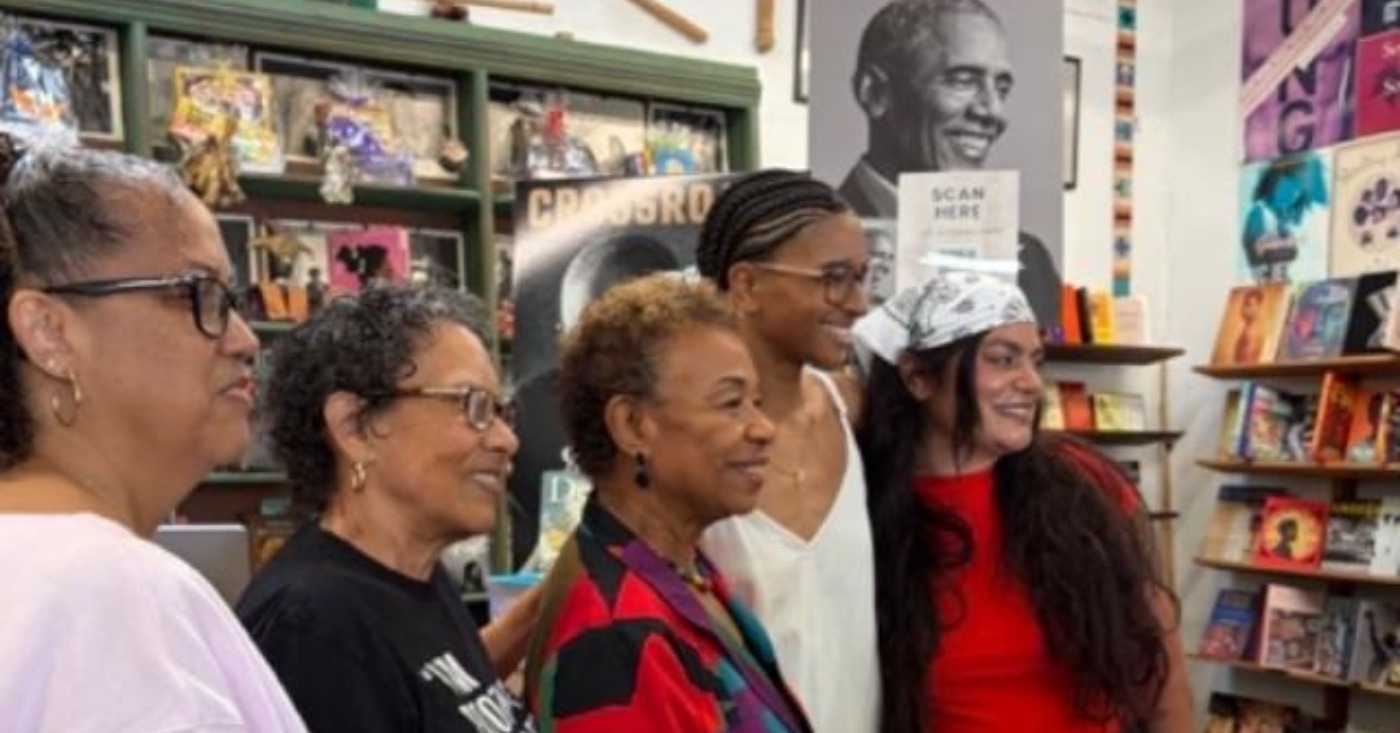
Floating bubbles greeted families on arrival at the Bookout Block Party held on Sat. Sept. 12 at 39th and MLK Blvd. in Oakland.
Sponsored by Marcus Books and Storyland Collective, a wonderland of activity for children stretched to Longfellow School while live music filled the air, courtesy of KWC Complex Jazz Group.
Booths lined the street with arts and crafts, and children participated in hands-on art projects. A large display of books was on display and each child chose his/her free book to take home. Food and snacks were available, and free water was encouraged to keep all hydrated.
A large area of turf was filled with huge bean bags for jumping, rolling, and sitting to listen as families crowded close to listen to Oakland Mayor Barbara Mayor Barbara Lee read a book out loud.
Of the numerous booths present were, “Claim Your Scholarship,” a program for Oakland Public School students and “VOLUNTEER NOW,” a program encouraging volunteers to help boost reading proficiency. Individuals sold their art and products. Free gifts were at many tables and a raffle was held.

The event with Marcus books culminated a summer-long program organized by Storyland Collective, a literacy arts organization bringing children’s ‘storytime,’ local authors, and art activities to Bay Area neighborhoods. Marcus Books is the oldest, independent Black-owned book store in the U.S., featuring books by and about Black people here and abroad.



Asm. Corey Jackson Announces Launch of 24-Hour Childcare in His District

IN MEMORIAM: The Rev. Leon “Sonny” Clark, Longtime Orange County Pastor and Community Leader, Dies at 72

Poll: Becerra Widens His Lead Over Hilton; Californians Split on Wealth Tax

From Historic Memories to New Possibilities: Oakland Celebrates Coliseum 60

County Office of Education Says OUSD Finances Are Getting Healthier, Materially Stronger

LIVE FREE Sunday Dinner Brings Faith, Fellowship and Civic Conversation to Oakland

Remembering Chauncey Bailey as Student Journalists Face Threats to Truth-Telling

BLACspace Cooperative Invites Bay Area to Experience Oakland’s Black Cultural Ecosystem Through a BLAC Map Tour + Party

In Wake of Death on Doorstep, Williams Chapel Baptist Church Calls for Better Care, Funding for Unhoused

Oakland Centenarian Nuna McKee Honored!

Caribbean Nations Produce Action Plan Calling for UK Reparations Over Slavery

Oakland Post: Week of September 23 – 29, 2026

Doulas Are Helping Black California Moms Navigate Pregnancy–Even as High Mortality Rates Persist

Newsom Signs Addictive Social Media Law to Protect Kids

On Your November Ballot: Prop 38 Would Allocate $8.4 Billion to Immunology and Immunotherapy Funding

Four Candidates, Including Incumbent Barbara Lee, Qualify for Oakland Mayor’s Race

Standoff for Justice: Our Homes Are Worth Fighting For

Oakland Post: Week of August 26 – September 1, 2026

Frontier Airlines’ Return to Oakland Airport Brings Flights, Jobs and Opportunity

Gubernatorial Candidate Steve Hilton Blasts California New Tire Rules; Newsom Hits Back

Chef Sharon Lee Blends Culinary Excellence, Education and Empowerment

Jackie Wright Champions Bay Area Stories, Filmmakers and Cultural Institutions

Big City Mayors Ask for “Yes” Vote on Housing Bond Measure; Conservatives Say “No”

Gov. Newsom’s Latest Appointees Include Sacramento Advocate for Formerly Incarcerated Students; State’s New Tech Chief

Oakland Coliseum Project Opens Door for Small Businesses to Build Bigger

Misnamed ‘Parent’ PAC Seeks to Influence Oakland School Board Elections

Longtime BWOPA Member Brendalyn Goodall Appointed to California Workforce Development Board

Gov. Newsom Signs Law Shielding Immigration Aid Workers From Doxing Threats

Secretary of State Shirley N. Weber Urges Californians to Vote Early as Voter ID Battle Intensifies

From Palestine to Oakland: Seeds for Liberation Examines Shared Struggles for Freedom

The Conversation With Al McFarlane 6/23/26

Media Monday 6/22/26

LIVE! ASK ALMA! — TUES. 6.23.26 7PM EST

Car Buying Secrets: 4 Hidden Checks Before You Sign!

Is This 550 HP Charger Worth YOUR Money? AutoNetwork Review

Celebrating Juneteenth – Frederick Douglass on education and resistance

LIVE! — ASK ALMA! — TUES. 6.19.26 7PM EST

Hyundai Ioniq 5 Parking, Safety, and 360 View #shorts

2025 Ioniq 5 New Wiper & Powerful Performance! #shorts

Electric SUV Range: Is 259 Miles Enough? #shorts

EV Charging: How Fast Can You Charge an Electric Vehicle? #shorts

Biometric Cooling… Messaging Seats…Come on! 2025 Infiniti QX80 Autograph 4WD

Charged Up: Witness the Magic of a Fully Electric Car! #shorts

Range Rover Sport PHEV Included…: See What’s Inside This Luxury SUV! #shorts

Invisible Hood View: Perfect Parking with X-Ray Vision! #shorts
-
 Business4 weeks ago
Frontier Airlines’ Return to Oakland Airport Brings Flights, Jobs and Opportunity
-
 Business4 weeks ago
Gubernatorial Candidate Steve Hilton Blasts California New Tire Rules; Newsom Hits Back
-
 Business4 weeks ago
Chef Sharon Lee Blends Culinary Excellence, Education and Empowerment
-
 Black History4 weeks ago
Jackie Wright Champions Bay Area Stories, Filmmakers and Cultural Institutions
-
 Community4 weeks ago
Big City Mayors Ask for “Yes” Vote on Housing Bond Measure; Conservatives Say “No”
-
 Community2 weeks ago
Misnamed ‘Parent’ PAC Seeks to Influence Oakland School Board Elections
-
 Business4 weeks ago
Longtime BWOPA Member Brendalyn Goodall Appointed to California Workforce Development Board
-
 Community4 weeks ago
Gov. Newsom Signs Law Shielding Immigration Aid Workers From Doxing Threats
