
Politics
It’s Not Just Right-to-Work: Bills Targeting Unions Multiply


In this Nov. 13, 2014 file photo, AFL-CIO President Richard Trumka speaks in Washington. Republicans lawmakers in statehouses nationwide are working to weaken organized labor, sometimes with efforts that directly shrink union membership. Walker’s signing of right-to-work legislation in Wisconsin on Monday puts his defiance of organized labor even more at the center of his nascent presidential campaign. And the inability of unions to exact a price for the first round of legislation targeting them in 2011 is encouraging even more proposals to limit their power. (AP Photo/Manuel Balce Ceneta, File)
JONATHAN MATTISE, Associated Press
NICHOLAS RICCARDI, Associated Press
CHARLESTON, W.Va. (AP) — It’s not just Gov. Scott Walker.
Republican lawmakers in statehouses nationwide are working to weaken organized labor, sometimes with efforts that directly shrink union membership. Walker’s signing of right-to-work legislation in Wisconsin on Monday puts his defiance of organized labor even more at the center of his nascent presidential campaign. And the inability of unions to exact a price for the first round of legislation targeting them in 2011 is encouraging even more proposals to limit their power.
The Republican wave in the November elections left many unions nationwide looking exceptionally vulnerable. In West Virginia, a union PAC spent $1.4 million trying to keep the statehouse in Democratic hands but couldn’t reverse the cultural trends turning the state red. Exit polls found that even union members were almost evenly split between the Republican and the Democrat in the major statewide race for U.S. Senate.
Now Republicans, in control of the state legislature for the first time since 1931, are taking advantage of their opportunity, pushing measures to expand non-union charter schools and scale back requirements that public projects pay higher, union-scale wages.
In Wisconsin, Walker beat back attempts to recall him after he signed a law limiting collective bargaining by public sector workers in 2011. His signature on the right-to-work law now makes Wisconsin the 25th state to ban contracts that force all workers to pay union dues. Both he and Michigan Gov. Rick Snyder, who signed a right-to-work law in 2012 and was also opposed by unions, won re-election in November.
“Their examples were inspiring,” said Victor Joecks of the Nevada Policy Research Institute, a conservative think tank whose ideas for limiting labor power have been embraced by Republicans who have taken over that state’s legislature for the first time since 1929. The message, he said, was, “Hey, this is possible, and it’s better for the state, and the taxpayers appreciate it.”
With many legislative sessions just beginning, nearly 800 union-related bills have been proposed in statehouses, according to the National Conference of State Legislatures.
President Barack Obama expressed his concern about the latest Wisconsin move and the general assault on unions.
“It’s inexcusable that, over the past several years, just when middle-class families and workers need that kind of security the most, there’s been a sustained, coordinated assault on unions, led by powerful interests and their allies in government,” Obama said in a statement Monday. “I’m deeply disappointed that a new anti-worker law in Wisconsin will weaken, rather than strengthen workers in the new economy.”
A right-to-work bill passed the lower house of the Missouri Legislature, though it’s likely to be vetoed by the state’s Democratic governor. Indiana is also moving to eliminate requiring union-level wages on public projects. Nevada is considering a wide range of proposals, including legislation that would let local governments dissolve collective bargaining agreements in times of economic hardship. Illinois’ new Republican governor, Bruce Rauner, signed an order prohibiting government unions from automatically collecting dues from members.
Even local governments are getting in on the action — several Kentucky counties are implementing right-to-work measures even though the state, with its House still controlled by Democrats, does not have such a law.
The proposals’ sponsors say they want to save taxpayers money and create jobs. There is also a political consequence.
Labor provides Democrats with crucial cash and volunteers in campaigns, but its political value to the party extends even farther. Belonging to a union increases the odds of a voter supporting Democrats, and labor increases the participation of lower-income voters who tend to back Democrats, said Roland Zullo of the University of Michigan’s Institute of Labor and Industrial Relations. “If you have more unions, you have higher rates of voting, especially in places that are poor,” he said.
Much of the impact of new laws has come in the vote-rich rust belt, where Republicans hope states with whiter and older populations, such as Wisconsin and Michigan, will eventually side with them in presidential elections to counter the loss of states in the South and West with younger and more diverse populations. In Wisconsin, public-sector union membership shriveled after Walker’s 2010 law and the proportion of workers in unions shrank from 14 percent to 11 percent. Hundreds of union members protested against the right-to-work legislation in the state capitol recently but admitted most were demoralized.
“People have lost faith,” said Eric Gates, a union member from the town of Menasha, 35 miles southwest of Green Bay.
Michigan experienced the sharpest loss of union members in the nation in the last two years, when its right-to-work law went into effect, according to federal data. But union officials also trace the loss to another 2012 measure, which received less attention: a law declaring that 42,000 in-home health care workers were no longer eligible to be represented by a union. Unions were unable to overturn the measure at the ballot box.
“They’re decreasing our ability to back supporters of our issues, whether they’re Democrats or Republicans,” said Marge Robinson, president of SEIU Health Care Michigan, which lost four-fifths of its membership as a result but still tries to communicate with many of the aides. “Even though we try to keep them as much engaged as possible, they’re all on their own, they’re not in an organization that works together.”
In Ohio, where unions reversed an effort to eliminate collective bargaining by government workers, GOP Gov. John Kasich still cruised to re-election last year.
Union membership has been steadily declining since the 1980s, when it measured at 20 percent of all workers. In 2014, only 11.1 percent nationally belonged to a union. James Sherk, a labor economist at the conservative Heritage Foundation, said the shrinkage in membership in Michigan may be due to trends other rather than the recent legislation. He noted that Democrats have joined Republicans on some measures that unions oppose, like pension reform and tougher standards for teachers.
If there’s a bright side for labor, it’s that things could be even worse. Given how many states Republicans control, Sherk said, there could be many more challenges to labor than have emerged.
___
Associated Press reporter Dana Ferguson in Madison, Wis., contributed to this report.
Copyright 2015 The Associated Press. All rights reserved. This material may not be published, broadcast, rewritten or redistributed.






Business
OP-ED: Proposition 44 Would Put a Price on Trust
The danger in Proposition 44 is not only its 90 percent figure. It is that the meaning of “qualifying” spending will be worked out later. A clinic preparing a budget today may not know whether a navigator, health educator, transportation program, outreach worker, technology upgrade, or other patient-support service will be counted the way it expects. Yet the financial consequence of getting it wrong could be immediate.



Business
OP-ED: Proposition 40: It’s Time to Play Chess, Not Checkers
Proposition 40 would impose a one-time 5 percent tax on the wealth of Californians with more than $1 billion in assets. Most of that money would go toward health care, with the remainder supporting food assistance and education-related programs.

Activism
Oakland Post: Week of September 30 – October 6, 2026
The printed Weekly Edition of the Oakland Post: Week of September 30 – October 6, 2026
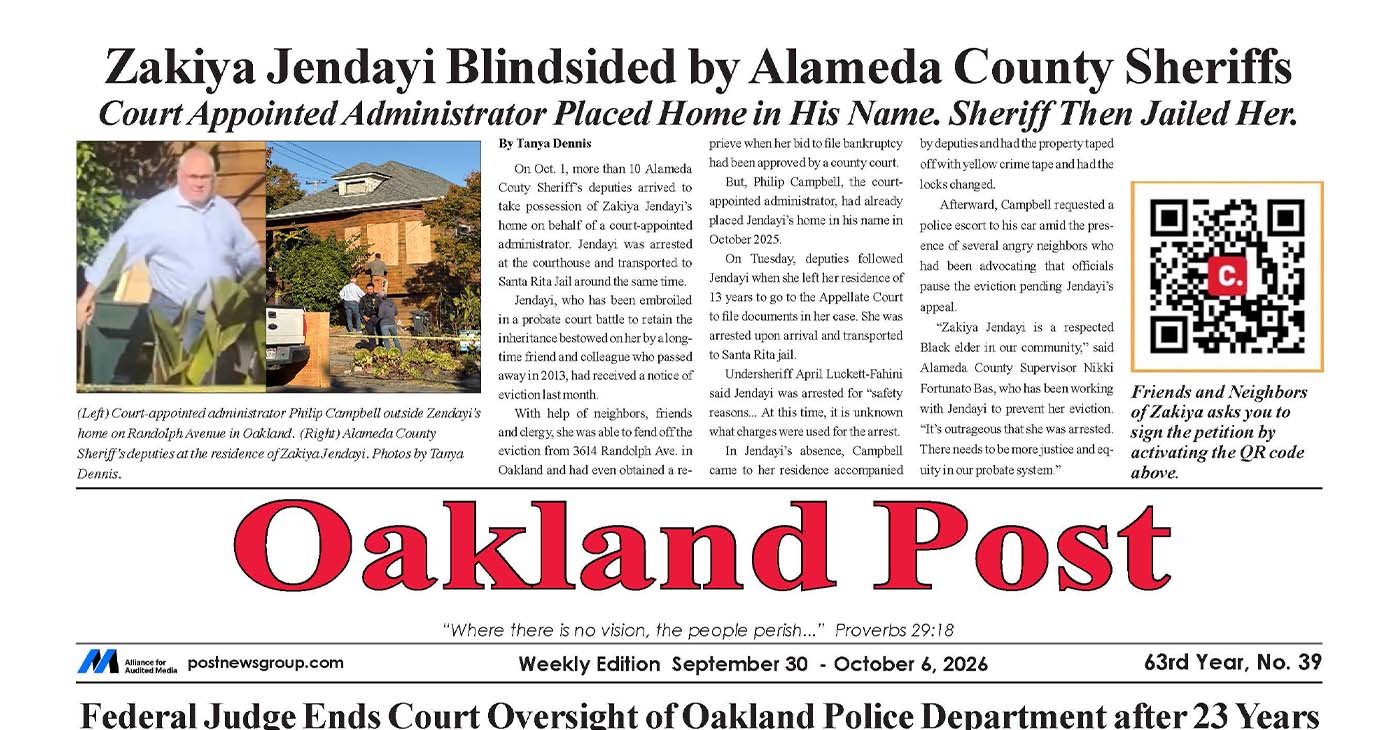
To enlarge your view of this issue, use the slider, magnifying glass icon or full page icon in the lower right corner of the browser window.



OP-ED: Proposition 44 Would Put a Price on Trust

OP-ED: Proposition 40: It’s Time to Play Chess, Not Checkers

Listening as a Lifeline: A Doula’s Witness to Black Maternal Health

New Protections for Ticket Buyers: Gov. Newsom Signs Assemblymember Isaac Bryan’s Bill

‘We Don’t Talk Trash — We Pick Up Trash!’

Zakiya Jendayi Arrested, Locked Out of Home by Sheriff’s Deputies

Oakland Post: Week of September 30 – October 6, 2026

Asm. Corey Jackson Announces Launch of 24-Hour Childcare in His District

IN MEMORIAM: The Rev. Leon “Sonny” Clark, Longtime Orange County Pastor and Community Leader, Dies at 72

Poll: Becerra Widens His Lead Over Hilton; Californians Split on Wealth Tax

From Historic Memories to New Possibilities: Oakland Celebrates Coliseum 60

County Office of Education Says OUSD Finances Are Getting Healthier, Materially Stronger

LIVE FREE Sunday Dinner Brings Faith, Fellowship and Civic Conversation to Oakland

Remembering Chauncey Bailey as Student Journalists Face Threats to Truth-Telling

BLACspace Cooperative Invites Bay Area to Experience Oakland’s Black Cultural Ecosystem Through a BLAC Map Tour + Party

Standoff for Justice: Our Homes Are Worth Fighting For

Oakland Post: Week of August 26 – September 1, 2026

Frontier Airlines’ Return to Oakland Airport Brings Flights, Jobs and Opportunity

Gubernatorial Candidate Steve Hilton Blasts California New Tire Rules; Newsom Hits Back

Chef Sharon Lee Blends Culinary Excellence, Education and Empowerment

Jackie Wright Champions Bay Area Stories, Filmmakers and Cultural Institutions

Misnamed ‘Parent’ PAC Seeks to Influence Oakland School Board Elections

Oakland Coliseum Project Opens Door for Small Businesses to Build Bigger

Gov. Newsom’s Latest Appointees Include Sacramento Advocate for Formerly Incarcerated Students; State’s New Tech Chief

Big City Mayors Ask for “Yes” Vote on Housing Bond Measure; Conservatives Say “No”

Longtime BWOPA Member Brendalyn Goodall Appointed to California Workforce Development Board

Gov. Newsom Signs Law Shielding Immigration Aid Workers From Doxing Threats

Oakland Post: Week of September 2 – 8, 2026

Secretary of State Shirley N. Weber Urges Californians to Vote Early as Voter ID Battle Intensifies

IN MEMORIAM: Dolly Parton Dead at 80 — How She Built a Legacy of Love and Earned Her Place in Black Culture

The Conversation With Al McFarlane 6/23/26

Media Monday 6/22/26

LIVE! ASK ALMA! — TUES. 6.23.26 7PM EST

Car Buying Secrets: 4 Hidden Checks Before You Sign!

Is This 550 HP Charger Worth YOUR Money? AutoNetwork Review

Celebrating Juneteenth – Frederick Douglass on education and resistance

LIVE! — ASK ALMA! — TUES. 6.19.26 7PM EST

Hyundai Ioniq 5 Parking, Safety, and 360 View #shorts

2025 Ioniq 5 New Wiper & Powerful Performance! #shorts

Electric SUV Range: Is 259 Miles Enough? #shorts

EV Charging: How Fast Can You Charge an Electric Vehicle? #shorts

Biometric Cooling… Messaging Seats…Come on! 2025 Infiniti QX80 Autograph 4WD

Charged Up: Witness the Magic of a Fully Electric Car! #shorts

Range Rover Sport PHEV Included…: See What’s Inside This Luxury SUV! #shorts

Invisible Hood View: Perfect Parking with X-Ray Vision! #shorts
-
 Community3 weeks ago
Misnamed ‘Parent’ PAC Seeks to Influence Oakland School Board Elections
-

 Activism3 weeks ago
Oakland Post: Week of September 9 – 15, 2026
-

 Community3 weeks ago
Richmond Tiny House Village Farm & Garden Set to Open Gates on Sept. 26
-

 Black History3 weeks ago
Latest Massacre in Haiti Reveals Cruelty U.S. Deportations
-

 Black History3 weeks ago
OPINION: Nolan Wells’ Death One of Several Signifying Racial Terror Lives on in U.S. South
-

 Business2 weeks ago
Mayor Lee Announces $1 Million Kaiser Permanente Grant for Pilot Program to Address Homelessness, Clean Up Public Spaces throughout Oakland
-

 Community3 weeks ago
Democratic Clubs Interview Candidates for Oakland School Board
-

 Uncategorized3 weeks ago
NBA All-Star Damian Lillard Returns Home for 15th Annual Backpack Giveaway
