
Business
Investor Peter Thiel’s Fund Buys Into Marijuana Business


In this March 8, 2012 file photo, Peter Thiel, a founder of Founders Fund, speaks in San Francisco. (AP Photo/Ben Margot, File)
JONATHAN FAHEY, AP Business Writer
NEW YORK (AP) — The pros are getting into pot.
Founders Fund, the $2 billion San Francisco venture capital firm run by Silicon Valley stars including Peter Thiel, co-founder and former CEO of Paypal, is investing in Privateer Holdings, a marijuana company that owns several pot-related brands.
The companies declined to disclose the size of the investment Thursday, but described it as a “multi-million dollar” participation in a $75 million fundraising effort by Privateer. The deal had been rumored last year.
Privateer, based in Seattle, owns the Canadian medical marijuana producer Tilray and the pot information service Leafly. It is also launching a brand of marijuana and products with the family of Bob Marley called Marley Natural.

Founders Fund partner Geoff Lewis, who is leading the firm’s investment in Privateer, said in an interview that he believes the broader legalization of marijuana is inevitable.
“Public sentiment is there, and it crosses political lines,” Lewis said.
There are 23 states that allow the use of marijuana for medical purposes and Colorado has legalized its recreational use.
There has been some pushback, however, despite growing public support. The states of Nebraska and Oklahoma have filed a lawsuit seeking to overturn the legalization of marijuana in Colorado, saying that they are being overrun with marijuana from across their borders.
And Founders Fund does not expect a quick turnaround on its investment in Privateer, Lewis said. Founders is investing in Privateer because it believes Privateer can eventually establish mainstream brands that will be recognized and trusted as marijuana becomes legal and socially acceptable, he said.
Privateer was founded in 2010 and has previously landed $22 million in funding.
Before the announcement Thursday, Privateer’s funding came mostly through wealthy individuals and investment offices that steer private family funds.
Privateer CEO Brendan Kennedy thinks the Founders investment will lead to more professional investment into marijuana-related businesses and help advance the push toward legalization.
“One of the important milestones for this business is having access to capital, and significant capital,” he said. “There will be a lot of people who wake up (now) and realize they need to look at this industry just as they have looked at other emerging industries around the world.”
Founders Fund was an early investor in Facebook and has current investments in SpaceX, Spotify and Airbnb.
Copyright 2015 The Associated Press. All rights reserved. This material may not be published, broadcast, rewritten or redistributed.












Business
Council Gives Approval for $125 Million Oakland Coliseum Sale to AASEG
OAKLAND POST — Providing financial protections to the city, the final deal removes the city’s obligation to pay millions of dollars to maintain the property. It also requires a bond to protect the city if payments on the property are not made when they are due.

The Oakland City Council cast its final vote this week approving the sale of the Oakland Coliseum complex to Oakland-based African American Sports and Entertainment Group (AASEG) for $125 million, which supporters say will bring immense benefits to city residents, including billions of dollars in future development, new jobs and housing to East Oakland, and generate much-needed income for the city.
Mayor Barbara Lee thanked the City Council for approving the deal and city staff for the hard work negotiating the final agreement.
“This agreement is one step forward toward creating jobs and economic opportunity in East and Deep East Oakland… communities that have been historically underserved,” Mayor Lee said in a video statement.
The city owns a 50% interest in the complex, and Alameda County, which owns the remaining half, has already approved its part of the deal.
Under the terms of the sale of the Coliseum complex to Oakland Acquisition Company, affiliated with the AASEG, the $125 million agreement will provide the city with 6% of ticket revenue from events at the complex.
The deal also allows a $50 million all-cash sale of the Oakland Arena to a third party, the Oak View Group (OVG). According to OVG co-founder Irving Azoff, the company will invest $40 million in upgrades to the arena.
Councilmember Noel Gallo, who made the motion, said: “This $50 million payment will be immediately assigned for the retirement benefits for our police, fire and city employees, since we are three years behind in making our payments to the state retirement fund.”
Providing financial protections to the city, the final deal removes the city’s obligation to pay millions of dollars to maintain the property. It also requires a bond to protect the city if payments on the property are not made when they are due.
The 112-acre Oakland-Alameda County Coliseum Complex is one of the city’s largest development sites. The city’s agreement culminates several years of negotiations with AASEG, an Oakland-based, Black-led developer that partnered with Loop Capital, one of the largest Black-owned investment banks in the world.
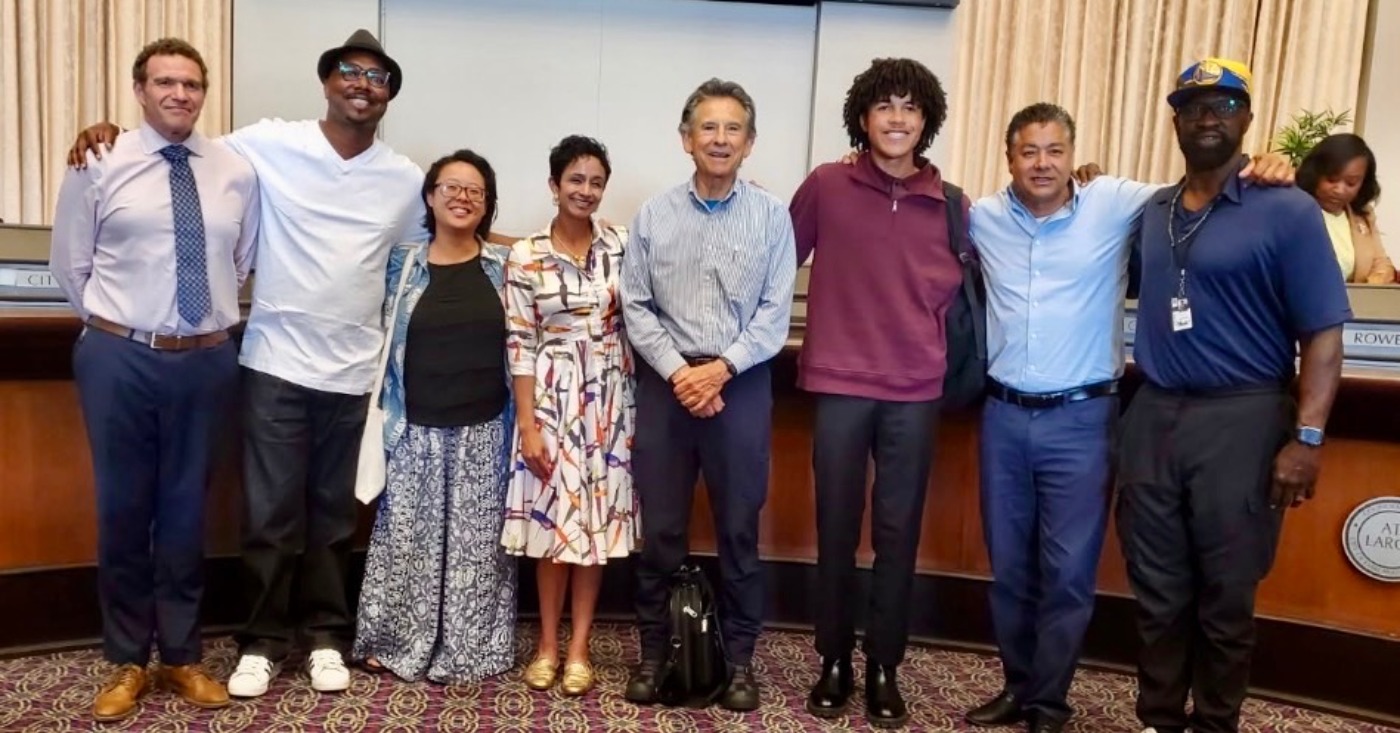
Gallo also invited a student volunteer named Mateo Ridge to join in the photo celebration to help send a message that Oakland’s future rests “with our youth who will volunteer to help keep our parks, recreation areas and neighborhood streets clean.”
Ridge, who is the grandson of Jane Garcia from La Clinica La Raza, will be entering as a freshman in Middle College High School in Contra Costa County.
Gallo also has agreed to work with the Oakland Post and El Mundo newspapers to expand a city-wide movement of volunteers to help expand his pioneering efforts to remove the trash from the streets.
Paul Cobb said he would take up Gallo’s offer by scheduling meetings with neighborhood groups, churches and the Oakland Metropolitan Chamber of Commerce to provide business leadership to help build pride in Oakland.

Business
Job Readiness, Housing Resources Among Services Provided at Coliseum Job Fair
OAKLAND POST — “Many individuals are eager to work, but face significant barriers,” said Rochelle Baxter-Green, a career development specialist at the Eastmont Self-Sufficiency Center and coordinator of the event. “Through collaboration, we can help remove those barriers and support lasting change,” she wrote in the invitation to event participants.

The Bi-Annual Alameda County Community Connect Summer Resource and Job Fair for the Unhoused was held Wednesday at the Oakland Coliseum, drawing nearly 800 guests and 72 vendors.
In addition to housing assistance, vendors provided coaching, haircuts, headshots, and resume assistance for employment readiness; medical and dental services; veterinary services; food; clothing; gift cards; and more.
It was supported by Alameda County Supervisor Nate Miley, the Alameda County Work Development Board, Alameda County Probation Department, Social Services Agency, Oakland-Alameda Coliseum, and the Oakland Private Industry Council.
Their shared goal was to help create pathways to self-sufficiency while shifting perceptions of Alameda County’s unhoused residents.
“Many individuals are eager to work, but face significant barriers,” said Rochelle Baxter-Green, a career development specialist at the Eastmont Self-Sufficiency Center and coordinator of the event. “Through collaboration, we can help remove those barriers and support lasting change,” she wrote in the invitation to event participants.
As seasonal challenges like colder weather and increased need approach, community support is especially important. This event serves as a central hub where attendees can access wraparound services, connect with employers, and take meaningful steps toward stability. The fair supporters also provided hygiene packs and shoes and socks, anticipating colder weather ahead.
In May, Oaklandside reported that Alameda County’s biennial Point in Time count had found a 13% drop in overall homelessness and an 18% drop in unsheltered homelessness since 2024, bringing the proportion of unhoused people outside to its lowest point in more than a decade. Despite Oakland’s 20% decrease in the number of unhoused, the city can be seen as the ‘epicenter’ of the crisis by accounting for more than half of the county’s unhoused individuals, despite representing just 22% of the population.
Business
Gov. Gavin Newsom Signs Law Streamlining Affordable Housing Rules
The legislation builds on the governor’s efforts that have reversed decades of inaction on housing and homelessness — creating more homes and the largest reduction in unsheltered homelessness in more than 15 years.

In Oakland on July 13, Gov. Newsom signed AB 179 — the state’s new housing budget trailer bill that cuts red tape, modernizes how California finances affordable housing, and lowers the cost of building a unit by up to $70,000.
The legislation builds on the governor’s efforts that have reversed decades of inaction on housing and homelessness — creating more homes and the largest reduction in unsheltered homelessness in more than 15 years.
Oakland is the first pro-housing city in the Bay Area, and it’s not slowing down. Oakland is cutting through bureaucracy, unlocking new financing, and clearing the path for more affordable homes to get built faster.
Special thanks to East Bay Asian Local Development Corporation (EBADC), State Assemblymember Sharon Quirk Silva, and California Housing and Community Development Director Gustavo Velasquez.

WORK FROM HOME
Home-based business with potential monthly income of $10K+ per month. A proven training system and website provided to maximize business effectiveness. Perfect job to earn side and primary income. Contact Lynne for more details: Lynne4npusa@gmail.com 800-334-0540


Rep. Garamendi, House Democrats Demand Trump Administration Abandon Illegal Plans to Dismantle Civil Rights, Special Ed Offices

Council Gives Approval for $125 Million Oakland Coliseum Sale to AASEG

Job Readiness, Housing Resources Among Services Provided at Coliseum Job Fair

Free Back-to-School Summer Family and Community Event Is Coming to Richmond

New State Law Limits Student’s Cell Phone Use During School Hours

Why Trade Show Success Depends On Standing Out (Not Just Showing Up)

Gov. Gavin Newsom Signs Law Streamlining Affordable Housing Rules

Smart Home Technology is Becoming a Tool for Preventing Property Damage

Volunteer Work for Black Americans Pays Off By Helping Others and Building Portfolios

Discover What IT Technicians Do: A Complete Guide

Staying Sober: Your Guide to a Joyful Life

Top Strategies to Resolve Operational Issues Effectively

The Part of Buying a Home That No Real Estate Show Ever Prepares You For

When to Say Goodbye: The Unmistakable Signs Your Old Car Has Had Its Last Good Day

COMMENTARY: Property Is Power! Why the Dream Booker T. Washington Preached in 1905 Still Matters Today

Saving Black Mothers Starts Outside the Hospital

Oakland Celebrates $125 Million Coliseum Sale
Gov. Gavin Newsom Signs Law Streamlining Affordable Housing Rules


IN MEMORIAM: Oakland Dance Legend Reginald Ray-Savage, 67

Oakland Post: Week of June 17 – 23, 2026

Agricultural Engineer Effie Gant Plans Bay Area Farmers Market Initiative
The Part of Buying a Home That No Real Estate Show Ever Prepares You For

UC Berkeley Named Top Public University in the U.S. and No. 7 in the World by ‘U.S. News’

NCBW-OBAC Champions Black Women Entrepreneurs at Business en Blaque Expo

Ferry Fares to Increase July 1 as Ridership Hits Record Highs

NPRC Heads to Washington to Elevate Adult Guardianship Reform at National Whistleblower Summit

Oakland Post: Week of July 1 – 7, 2026

Oakland Post: Week of June 10 – 16, 2026

Sale of Coliseum to African American Developers Moves Toward Completion

The Conversation With Al McFarlane 6/23/26

Media Monday 6/22/26

LIVE! ASK ALMA! — TUES. 6.23.26 7PM EST

Car Buying Secrets: 4 Hidden Checks Before You Sign!

Is This 550 HP Charger Worth YOUR Money? AutoNetwork Review

Celebrating Juneteenth – Frederick Douglass on education and resistance

LIVE! — ASK ALMA! — TUES. 6.19.26 7PM EST

Hyundai Ioniq 5 Parking, Safety, and 360 View #shorts

2025 Ioniq 5 New Wiper & Powerful Performance! #shorts

Electric SUV Range: Is 259 Miles Enough? #shorts

EV Charging: How Fast Can You Charge an Electric Vehicle? #shorts

Biometric Cooling… Messaging Seats…Come on! 2025 Infiniti QX80 Autograph 4WD

Charged Up: Witness the Magic of a Fully Electric Car! #shorts

Range Rover Sport PHEV Included…: See What’s Inside This Luxury SUV! #shorts

Invisible Hood View: Perfect Parking with X-Ray Vision! #shorts
-
 Black History4 days ago
Saving Black Mothers Starts Outside the Hospital
-
 Black History7 days ago
Oakland Celebrates $125 Million Coliseum Sale
-
 Business2 days ago
Gov. Gavin Newsom Signs Law Streamlining Affordable Housing Rules
-
 Activism1 week ago
Agricultural Engineer Effie Gant Plans Bay Area Farmers Market Initiative
-
 Business3 days ago
The Part of Buying a Home That No Real Estate Show Ever Prepares You For
-
 Community1 week ago
NPRC Heads to Washington to Elevate Adult Guardianship Reform at National Whistleblower Summit
-
 Activism3 weeks ago
Oakland Post: Week of July 1 – 7, 2026
-
 Black History4 days ago
COMMENTARY: Property Is Power! Why the Dream Booker T. Washington Preached in 1905 Still Matters Today
