
Activism
Incidents of Hate Crimes Against Blacks Highest in California
Historically, hate crime data has been underreported. DOJ recognizes that the data presented in its report may not adequately reflect the actual number of hate crime events that have occurred in the state. Nevertheless, the total number of hate crime events reported in 2021 is the sixth-highest ever recorded, and the highest since 2001 in the aftermath of the September 11 terrorist attacks, noted State Attorney General Rob Bonta.

By Antonio Ray Harvey, California Black Media
A report released by the California Department of Justice (DOJ) last month revealed that hate crimes targeting Black people in the state “remain the most prevalent” violations regarding a recent increase in violence motivated by race.
On June 28, State Attorney General Rob Bonta hosted a press conference announcing the DOJ’s release of the 2021 Hate Crime in California Report (HCCR). The report presents hate crime statistics such as the number of hate crime events, hate crime offenses, hate crimes victims, and hate crimes suspects.
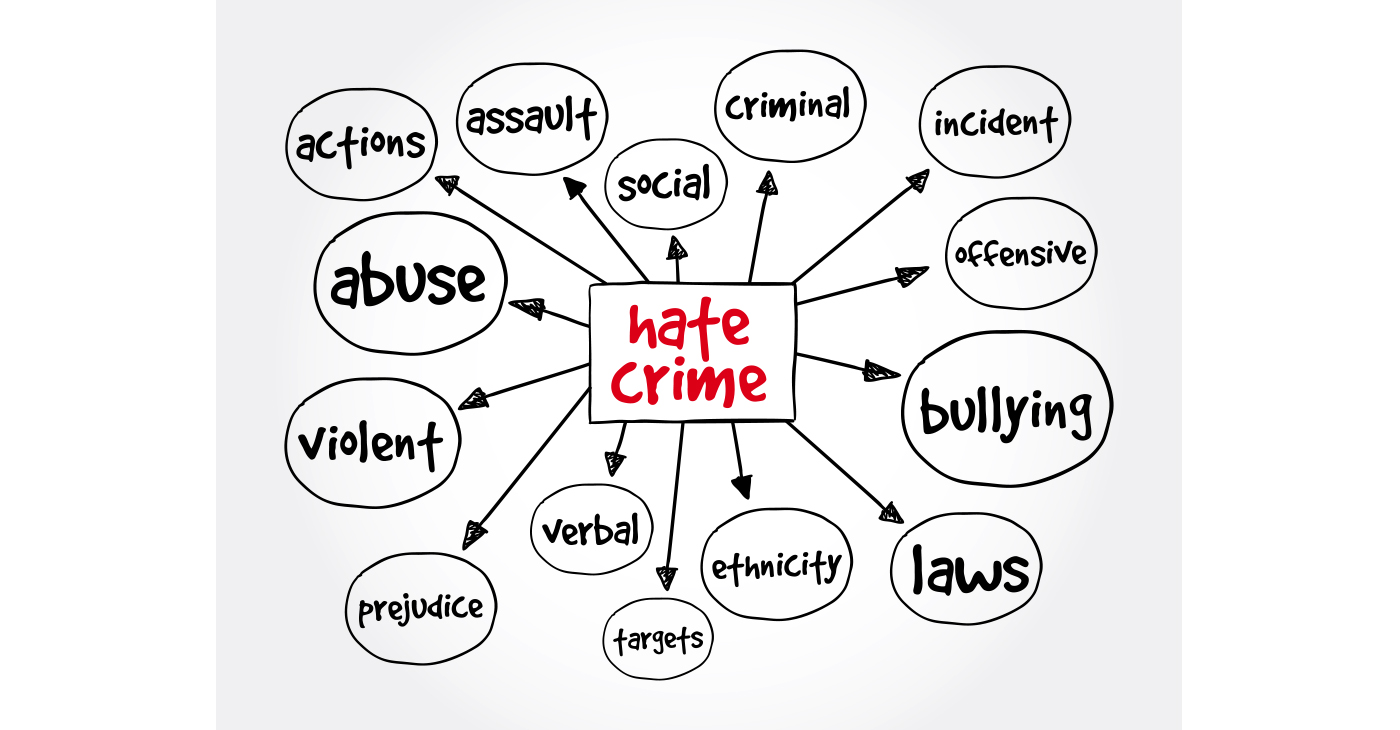
California law defines a hate crime as a criminal act committed in whole or in part because of a victim’s actual or perceived disability, gender, nationality, race or ethnicity, religion, sexual orientation, or association with someone with one or more of these actual or perceived characteristics.
Aggressions toward the Black community increased 12.5% from 456 incidents in 2020 to 513 in 2021.
“Today’s report undeniably shows that the epidemic of hate we saw spurred on during the pandemic remains a clear and present threat,” Bonta stated. “In fact, reported hate crime has reached a level we haven’t seen in California since the aftermath of the terrorist attacks of September 11. As our state’s top law enforcement officer, I will continue to use the full authority of my office to fight back.”
A breakdown of victims by “bias motivation,” shows that 589 Black or African American persons or entities were victimized in 2021, and that 468 suspects perpetrated the crimes. There were 507 Black or African American individual victims of hate crimes while 42 business or financial institutions, 34 government agencies, and five religious organizations were affected.
At Bonta’s press conference, Jimmie Jackson, the Bay Area representative of the California-Hawaii State Conference of the NAACP and Vallejo branch president spoke in support of DOJ’s efforts to combat hate crimes statewide.
“We are all tired of seeing our brothers and sisters of color being targets of hatred, discrimination, and racism,” said Jackson. “We are working (with the DOJ) on a project to stop the hate and to move us all towards collective justice across communities of color through preventive services with funding awarded by the Department of Social Services.”
According to Jackson, the Vallejo NAACP has seen an increase in hate mail and hate-filled messages since the 2016 presidential election. In the Bay Area, the Black community is experiencing increased bullying tactics, physical assaults, and threats of deportation reports the Bay Area News Group.
In Los Angeles County, which is home to the largest population of Black people in the state, African Americans were disproportionately targeted in hate crimes (42%) involving race, according to a 2020 Los Angeles County Hate Crime Report. In 2020, the Black community in the county was 810,286 or 9% of the population.
There was a total of 1,763 bias events in California in 2021. Overall hate crimes increased 32.6% from 2020 to 2021, and they are at their highest reported level since 2001, the HCCR found.
Anti-Asian hate crime increased dramatically, rising 177.5% from 2020 to 2021, and reported hate crimes involving a sexual orientation bias also increased significantly, rising 47.8% from 2020 to 2021.
Amid the surge in documented hate crime events, Bonta urged local partners and law enforcement to review the statistics provided in the 42-page HCCR report and to recommit themselves to taking action against offenses motivated by racial or other biases.
At the press conference, Bonta announced the creation of a statewide hate crime coordinator position within the DOJ’s Criminal Law Division to support state and local law enforcement efforts to combat hate crime.
“We will keep working with our local law enforcement partners and community organizations to make sure every Californian is seen, heard, and protected,” Bonta stated. “Now, more than ever, it is critical that we stand united — there is no place for hate in California.”
Two days after DOJ released its report, U.S. Attorney Randy Grossman held a press briefing in San Diego that included an assessment of hate crime threats, an overview of pre-attack indicators, and the best ways to report and mitigate threats of hate.
Grossman gathered key law enforcement and community leaders as a response to recent violent shootings, online white supremacist rhetoric, and a significant increase in hate crimes.
“Violent remarks by online extremists have resulted in public ‘tip’ reports to law enforcement, followed by a gun violence restraining order and successful federal prosecution. To ensure this prevention strategy is repeated, it is essential to arm our community leaders with information,” Grossman stated. “It’s important that the community members know they are not alone in this battle against radical extremism, hateful threats and targeted gun violence.”
Hate crimes are distinct from hate incidents, which are actions or behaviors motivated by hate that may be protected by the First Amendment right to freedom of expression. Examples of hate incidents include name calling, insults, and distributing hate material in public places. If a hate incident starts to threaten a person or property, it may become a hate crime, according to DOJ officials.
Historically, hate crime data has been underreported. DOJ recognizes that the data presented in its report may not adequately reflect the actual number of hate crime events that have occurred in the state.
Nevertheless, the total number of hate crime events reported in 2021 is the sixth-highest ever recorded, and the highest since 2001 in the aftermath of the September 11 terrorist attacks, Bonta noted.
Jackson said that the NAACP California-Hawaii State Conference will work with California Black radio, print, and online media outlets to educate ethnic populations to raise awareness of hate and bigotry in the state.
“These kinds of projects to combat hate are well overdue and the NAACP is proud to be taking a leadership position in the communities of color,” Jackson said. “We cannot continue to allow the forces of hate, racism, and discrimination to continue to run rampant without a fight.”
A copy of the 2021 Hate Crime in California Report is available here or at https://oag.ca.gov/system/files/attachments/press-docs/Hate%20Crime%20In%20CA%202021%20FINAL.pdf














Activism
Oakland Post: Week of September 23 – 29, 2026
The printed Weekly Edition of the Oakland Post: Week of September 23 – 29, 2026

To enlarge your view of this issue, use the slider, magnifying glass icon or full page icon in the lower right corner of the browser window.
Activism
Oakland Post: Week of September 16 – 22, 2026
The printed Weekly Edition of the Oakland Post: Week of September 16 – 22, 2026

To enlarge your view of this issue, use the slider, magnifying glass icon or full page icon in the lower right corner of the browser window.
Activism
Oakland Post: Week of September 9 – 15, 2026
The printed Weekly Edition of the Oakland Post: Week of September 9 – 15, 2026

To enlarge your view of this issue, use the slider, magnifying glass icon or full page icon in the lower right corner of the browser window.



Asm. Corey Jackson Announces Launch of 24-Hour Childcare in His District

IN MEMORIAM: The Rev. Leon “Sonny” Clark, Longtime Orange County Pastor and Community Leader, Dies at 72

Poll: Becerra Widens His Lead Over Hilton; Californians Split on Wealth Tax

From Historic Memories to New Possibilities: Oakland Celebrates Coliseum 60

County Office of Education Says OUSD Finances Are Getting Healthier, Materially Stronger

LIVE FREE Sunday Dinner Brings Faith, Fellowship and Civic Conversation to Oakland

Remembering Chauncey Bailey as Student Journalists Face Threats to Truth-Telling

BLACspace Cooperative Invites Bay Area to Experience Oakland’s Black Cultural Ecosystem Through a BLAC Map Tour + Party

In Wake of Death on Doorstep, Williams Chapel Baptist Church Calls for Better Care, Funding for Unhoused

Oakland Centenarian Nuna McKee Honored!

Caribbean Nations Produce Action Plan Calling for UK Reparations Over Slavery

Oakland Post: Week of September 23 – 29, 2026

Doulas Are Helping Black California Moms Navigate Pregnancy–Even as High Mortality Rates Persist

Newsom Signs Addictive Social Media Law to Protect Kids

On Your November Ballot: Prop 38 Would Allocate $8.4 Billion to Immunology and Immunotherapy Funding

Less Affluent School Districts, Including Sacramento City, Face Threat of State Takeover

ESSAY: California Can Close Its Colorectal Cancer Gap

California Hispanic Chambers of Commerce Unveils: ‘Powering the Future’ Theme for 47th Annual Statewide Convention

Four Candidates, Including Incumbent Barbara Lee, Qualify for Oakland Mayor’s Race

Oakland Post: Week of August 12 – 18, 2026

From Blueprint to Breakthrough: Tackling Affordable Housing in Oakland

Oakland Observes Black August with Block Parties, Film Showings, Workshops

COMMENTARY: Why Local School Tax Measure G1 Will Not Be on the November Ballot

Standoff for Justice: Our Homes Are Worth Fighting For

Returning to Its Roots, the Oakland Black-Eyed Pea Festival Partners with the Freedom Farmers Market Sept. 12

Oakland Post: Week of August 26 – September 1, 2026

NPRC Scores First Advocacy Victory: David Shaw Finally Gets His Wish to ‘Go Home’

Frontier Airlines’ Return to Oakland Airport Brings Flights, Jobs and Opportunity

Gubernatorial Candidate Steve Hilton Blasts California New Tire Rules; Newsom Hits Back

Chef Sharon Lee Blends Culinary Excellence, Education and Empowerment

The Conversation With Al McFarlane 6/23/26

Media Monday 6/22/26

LIVE! ASK ALMA! — TUES. 6.23.26 7PM EST

Car Buying Secrets: 4 Hidden Checks Before You Sign!

Is This 550 HP Charger Worth YOUR Money? AutoNetwork Review

Celebrating Juneteenth – Frederick Douglass on education and resistance

LIVE! — ASK ALMA! — TUES. 6.19.26 7PM EST

Hyundai Ioniq 5 Parking, Safety, and 360 View #shorts

2025 Ioniq 5 New Wiper & Powerful Performance! #shorts

Electric SUV Range: Is 259 Miles Enough? #shorts

EV Charging: How Fast Can You Charge an Electric Vehicle? #shorts

Biometric Cooling… Messaging Seats…Come on! 2025 Infiniti QX80 Autograph 4WD

Charged Up: Witness the Magic of a Fully Electric Car! #shorts

Range Rover Sport PHEV Included…: See What’s Inside This Luxury SUV! #shorts

Invisible Hood View: Perfect Parking with X-Ray Vision! #shorts
-
 Commentary4 weeks ago
Standoff for Justice: Our Homes Are Worth Fighting For
-
 Activism4 weeks ago
Oakland Post: Week of August 26 – September 1, 2026
-
 Business4 weeks ago
Frontier Airlines’ Return to Oakland Airport Brings Flights, Jobs and Opportunity
-
 Business4 weeks ago
Gubernatorial Candidate Steve Hilton Blasts California New Tire Rules; Newsom Hits Back
-
 Business4 weeks ago
Chef Sharon Lee Blends Culinary Excellence, Education and Empowerment
-

 Community4 weeks ago
Big City Mayors Ask for “Yes” Vote on Housing Bond Measure; Conservatives Say “No”
-

 Black History4 weeks ago
Jackie Wright Champions Bay Area Stories, Filmmakers and Cultural Institutions
-

 Education4 weeks ago
Gov. Newsom’s Latest Appointees Include Sacramento Advocate for Formerly Incarcerated Students; State’s New Tech Chief
