
Politics
In a Bind, Republicans Offer Vote on Homeland Security Bill


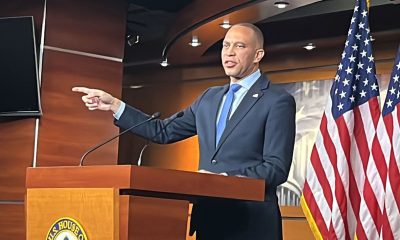
Senate Minority Leader Harry Reid of Nev. pauses during a news conference on Capitol Hill, Tuesday, Feb. 24, 2015, to urge Republicans to support a “clean bill” to fund the Homeland Security Department as that agencies budget expires later this week. The DHS budget is at a standstill over provisions attached to a Homeland Security spending bill aimed at blocking President Barack Obama’s executive actions on immigration. (AP Photo/J. Scott Applewhite)
DAVID ESPO, Associated Press
ERICA WERNER, Associated Press
WASHINGTON (AP) — A partial agency shutdown looming, Senate Republicans offered Tuesday to permit a vote on Homeland Security funding legislation stripped of immigration provisions backed by conservatives but strongly opposed by President Barack Obama and fellow Democrats.
“We could have that vote very quickly,” Majority Leader Mitch McConnell, R-Ky., said as his party struggled to escape a political predicament of their own making involving an agency with major anti-terrorism responsibilities.
McConnell said he did not know how the Republican-controlled House would respond if a stand-alone spending bill passed the Senate. Underscoring the realities of divided government, Senate Democratic leader Harry Reid of Nevada initially said he wouldn’t agree to the proposal unless it had the backing of House Speaker John Boehner, in a sign it would be likely to clear the House.
With House Republicans scheduled to meet privately Wednesday to discuss the issue, Boehner’s office issued a statement that neither accepted nor rejected the proposal McConnell outlined to end weeks of gridlock.
“The speaker has been clear: The House has acted, and now Senate Democrats need to stop hiding. Will they continue to block funding for the Department of Homeland Security or not?” said Boehner spokesman Michael Steel.
Some House conservatives criticized the proposal, but one lawmaker allied with the leadership predicted it might win approval. Noting that a federal judge in Texas has issued an order blocking implementation of Obama’s plan to shield millions of immigrants from deportation, Rep. Tom Cole of Oklahoma said the court had “effectively stopped the president’s executive action,” at least for now. “So I don’t think we’d run the risk of shutting down Homeland Security,” he added.
Even in the Senate, though, McConnell’s plan had its GOP critics.
Texas Sen. Ted Cruz, a tea party favorite and potential 2016 presidential contender, called it a mistake. “Congress is obliged to use every constitutional check and balance we have to rein in President Obama’s lawlessness,” he said in a statement.
Senate Republican officials said McConnell’s offer of a vote on a stand-alone funding bill also envisions a vote on a separate measure to repeal a directive from Obama last fall that shields about 4 million immigrants from deportation even though they live in the United States illegally. That measure would almost certainly fail in the Senate at the hands of Democrats.
At the same time, the proposal would eliminate an attempt by the House to repeal an earlier presidential order that allows tens of thousands of immigrants to remain in the country if they were brought here illegally as youngsters by their parents. Officials said Boehner’s office had been informed of McConnell’s plans before they were made public.
The maneuvering occurred as the president’s party raised the specter of terrorism and the Republicans countered that it was the Democrats who were preventing an orderly renewal of funding for the Homeland Security Department.
At a news conference a few hours before McConnell spoke, Sen. Amy Klobuchar, D-Minn., urged Republicans to “fund our security and not to send a message to al-Shabab that we’re going to shut down Homeland Security.”
Klobuchar’s state is home to the Mall of America, an enormous facility that was singled out as a potential terror target in a video released by al-Shabab, an Islamic militant group linked to the al-Qaida terrorist network. Homeland Security Secretary Jeh Johnson has urged anyone considering a trip to the shopping mall to be particularly careful.
For their part, Republicans sought to pin the blame on Democrats, pointing out they blocked Senate action four times on the combined funding-immigration bill.
They also accused Reid of shifting his demands after first seeking a vote on a stand-alone spending bill, then refraining from accepting McConnell’s offer.
In response, Democrats seemed to backtrack, suggesting they may well sign on to McConnell’s offer whether or not Boehner does.
But even Republicans said privately that they needed to put an end to a controversy that was likely to turn out badly for them.
The current stand-off dates to last fall, when Boehner told fellow Republicans they should allow the funding of Homeland Security without conditions until after the elections. By then, he said, Republicans would have more leverage to force a rollback in the president’s immigration policy.
Republicans won control of the Senate, but they lack the 60 votes needed to overcome Democratic blocking actions. As a result, they have been unable to force a vote on House-passed DHS funding legislation that includes the repeal of the immigration policies Obama put into effect in 2012 and last fall.
Among some Republicans, there was recognition that McConnell was offering as graceful a way out as possible.
“I just don’t know how we do it any other way,” said Sen. Lindsey Graham, R-S.C.
___
Associated Press writers Andrew Taylor, Steven Ohlemacher and Chuck Babington contributed to this report.
Copyright 2015 The Associated Press. All rights reserved. This material may not be published, broadcast, rewritten or redistributed.









Activism
Oakland Post: Week of March 18 – 24, 2026
The printed Weekly Edition of the Oakland Post: Week of March 18 – 24, 2026

To enlarge your view of this issue, use the slider, magnifying glass icon or full page icon in the lower right corner of the browser window.
Activism
Oakland Post: Week of March 11 -17, 2026
The printed Weekly Edition of the Oakland Post: Week of March 11 – 17, 2026

To enlarge your view of this issue, use the slider, magnifying glass icon or full page icon in the lower right corner of the browser window.
Activism
Oakland Post: Week of March 4 – 10, 2026
The printed Weekly Edition of the Oakland Post: Week of March 4 – 10, 2026

To enlarge your view of this issue, use the slider, magnifying glass icon or full page icon in the lower right corner of the browser window.


WORK FROM HOME
Home-based business with potential monthly income of $10K+ per month. A proven training system and website provided to maximize business effectiveness. Perfect job to earn side and primary income. Contact Lynne for more details: Lynne4npusa@gmail.com 800-334-0540


Black Artists in America, Installation Three Wraps at the Dixon Gallery and Gardens

Grief, Advocacy, and Education: A Counselor Reflects on Black Maternal Health

Future of Florida’s Black History Museum in Limbo

New Research Shows the Many Benefits of Early Learning

South Hampton K-8 Students Among Top 10 Finalists for Samsung’s ‘Solve for Tomorrow’ Competition

Cuba: No Negotiation with US on the President or Political System

Brooklyn Academy of Music Names Jamaican-Born Tamara McCaw as President

Trinidad & Tobego – U.S. Launches WhatsApp Channel for American Citizens in the Country

Oakland Post: Week of March 18 – 24, 2026

AI Innovation vs. Ethics and Environmental Impact

AI, Web3, and Digital Reparations

What If You Owned Your AI Agent?

Season 7, Episode 3 – January Reporter’s Roundtable 📱

Season 7, Episode 3 – January Reporter’s Roundtable

AI, Media, and Power | Part 2, Real-World Impacts and Tradeoffs

Oakland Post: Week of February 11 – 17, 2026

Reflecting on Black History Milestones in Birmingham AL

CITY OF SAN LEANDRO STATE OF CALIFORNIA PUBLIC WORKS DEPARTMENT ENGINEERING DIVISION NOTICE TO BIDDERS FOR ANNUAL STREET OVERLAY/REHABILITATION 2019-21 – PHASE III

Oakland Post: Week of February 18 – 24, 2026

PRESS ROOM: NBA Hall of Fame Nominee Terry Cummings Joins 100 Black Men of DeKalb County to Launch Victory & Values Initiative

Oakland Post: Week of February 25 – March 3, 2026

Trump’s MAGA Allies are Creating Executive Order Plan to Steal the 2026 Midterms

U.S. manufacturing rebounds – how foundry services are adapting to rising demand

OP-ED: One Hundred Years of Black Workers Telling the Truth

Advancements in solar technology that are changing the way we power the world

Chase Oakland Community Center Hosts Alley-Oop Accelerator Building Community and Opportunity for Bay Area Entrepreneurs

Poll Shows Support for Policies That Help Families Afford Child Care

Oakland Post: Week of March 4 – 10, 2026

PRESS ROOM: Civil Rights TV Launches in Selma as the World’s First 24/7 Civil Rights Television Network

Ghana Mourns a Son of the African World

Hyundai Ioniq 5 Parking, Safety, and 360 View #shorts

2025 Ioniq 5 New Wiper & Powerful Performance! #shorts

Electric SUV Range: Is 259 Miles Enough? #shorts

EV Charging: How Fast Can You Charge an Electric Vehicle? #shorts

Biometric Cooling… Messaging Seats…Come on! 2025 Infiniti QX80 Autograph 4WD

Charged Up: Witness the Magic of a Fully Electric Car! #shorts

Range Rover Sport PHEV Included…: See What’s Inside This Luxury SUV! #shorts

Invisible Hood View: Perfect Parking with X-Ray Vision! #shorts

AI Is Reshaping Black Healthcare: Promise, Peril, and the Push for Improved Results in California

ESSAY: Technology and Medicine, a Primary Care Point of View

Sanctuary Cities

The RESISTANCE – FREEDOM NOW

STATE OF THE PEOPLE: Freddie

ECONOMIC BOYCOTT DAY!!!!!

I told You So
-
 #NNPA BlackPress4 weeks ago
Poll Shows Support for Policies That Help Families Afford Child Care
-
 Activism3 weeks ago
Oakland Post: Week of March 4 – 10, 2026
-

 #NNPA BlackPress3 weeks ago
Woman’s Search for Family’s Roots Leads to Ancestor John T. Ward – A Successful Entrepreneur and Conductor on the Underground Railroad
-

 #NNPA BlackPress4 weeks ago
OP-ED: NNPA Launches 2026 “Leadership Matters” Video Series
-

 #NNPA BlackPress3 weeks ago
Advocates Raise Alarm Over ICE Operation, MOU and Detention Risks in Baltimore County
-

 #NNPA BlackPress3 weeks ago
COMMENTARY: Women of Color Shape Our Past and Future
-

 #NNPA BlackPress3 weeks ago
Pete Buttigieg to Join Mayor Randall Woodfin for Community Town Hall in Birmingham
-

 Activism2 weeks ago
Oakland Post: Week of March 11 -17, 2026
Politics
In a Bind, Republicans Offer Vote on Homeland Security Bill
Senate Minority Leader Harry Reid of Nev. pauses during a news conference on Capitol Hill, Tuesday, Feb. 24, 2015, to urge Republicans to support a “clean bill” to fund the Homeland Security Department as that agencies budget expires later this week. The DHS budget is at a standstill over provisions attached to a Homeland Security spending bill aimed at blocking President Barack Obama’s executive actions on immigration. (AP Photo/J. Scott Applewhite)
DAVID ESPO, Associated Press
ERICA WERNER, Associated Press
WASHINGTON (AP) — A partial agency shutdown looming, Senate Republicans offered Tuesday to permit a vote on Homeland Security funding legislation stripped of immigration provisions backed by conservatives but strongly opposed by President Barack Obama and fellow Democrats.
“We could have that vote very quickly,” Majority Leader Mitch McConnell, R-Ky., said as his party struggled to escape a political predicament of their own making involving an agency with major anti-terrorism responsibilities.
McConnell said he did not know how the Republican-controlled House would respond if a stand-alone spending bill passed the Senate. Underscoring the realities of divided government, Senate Democratic leader Harry Reid of Nevada initially said he wouldn’t agree to the proposal unless it had the backing of House Speaker John Boehner, in a sign it would be likely to clear the House.
With House Republicans scheduled to meet privately Wednesday to discuss the issue, Boehner’s office issued a statement that neither accepted nor rejected the proposal McConnell outlined to end weeks of gridlock.
“The speaker has been clear: The House has acted, and now Senate Democrats need to stop hiding. Will they continue to block funding for the Department of Homeland Security or not?” said Boehner spokesman Michael Steel.
Some House conservatives criticized the proposal, but one lawmaker allied with the leadership predicted it might win approval. Noting that a federal judge in Texas has issued an order blocking implementation of Obama’s plan to shield millions of immigrants from deportation, Rep. Tom Cole of Oklahoma said the court had “effectively stopped the president’s executive action,” at least for now. “So I don’t think we’d run the risk of shutting down Homeland Security,” he added.
Even in the Senate, though, McConnell’s plan had its GOP critics.
Texas Sen. Ted Cruz, a tea party favorite and potential 2016 presidential contender, called it a mistake. “Congress is obliged to use every constitutional check and balance we have to rein in President Obama’s lawlessness,” he said in a statement.
Senate Republican officials said McConnell’s offer of a vote on a stand-alone funding bill also envisions a vote on a separate measure to repeal a directive from Obama last fall that shields about 4 million immigrants from deportation even though they live in the United States illegally. That measure would almost certainly fail in the Senate at the hands of Democrats.
At the same time, the proposal would eliminate an attempt by the House to repeal an earlier presidential order that allows tens of thousands of immigrants to remain in the country if they were brought here illegally as youngsters by their parents. Officials said Boehner’s office had been informed of McConnell’s plans before they were made public.
The maneuvering occurred as the president’s party raised the specter of terrorism and the Republicans countered that it was the Democrats who were preventing an orderly renewal of funding for the Homeland Security Department.
At a news conference a few hours before McConnell spoke, Sen. Amy Klobuchar, D-Minn., urged Republicans to “fund our security and not to send a message to al-Shabab that we’re going to shut down Homeland Security.”
Klobuchar’s state is home to the Mall of America, an enormous facility that was singled out as a potential terror target in a video released by al-Shabab, an Islamic militant group linked to the al-Qaida terrorist network. Homeland Security Secretary Jeh Johnson has urged anyone considering a trip to the shopping mall to be particularly careful.
For their part, Republicans sought to pin the blame on Democrats, pointing out they blocked Senate action four times on the combined funding-immigration bill.
They also accused Reid of shifting his demands after first seeking a vote on a stand-alone spending bill, then refraining from accepting McConnell’s offer.
In response, Democrats seemed to backtrack, suggesting they may well sign on to McConnell’s offer whether or not Boehner does.
But even Republicans said privately that they needed to put an end to a controversy that was likely to turn out badly for them.
The current stand-off dates to last fall, when Boehner told fellow Republicans they should allow the funding of Homeland Security without conditions until after the elections. By then, he said, Republicans would have more leverage to force a rollback in the president’s immigration policy.
Republicans won control of the Senate, but they lack the 60 votes needed to overcome Democratic blocking actions. As a result, they have been unable to force a vote on House-passed DHS funding legislation that includes the repeal of the immigration policies Obama put into effect in 2012 and last fall.
Among some Republicans, there was recognition that McConnell was offering as graceful a way out as possible.
“I just don’t know how we do it any other way,” said Sen. Lindsey Graham, R-S.C.
___
Associated Press writers Andrew Taylor, Steven Ohlemacher and Chuck Babington contributed to this report.
Copyright 2015 The Associated Press. All rights reserved. This material may not be published, broadcast, rewritten or redistributed.
Activism
Oakland Post: Week of March 18 – 24, 2026
The printed Weekly Edition of the Oakland Post: Week of March 18 – 24, 2026
To enlarge your view of this issue, use the slider, magnifying glass icon or full page icon in the lower right corner of the browser window.
Activism
Oakland Post: Week of March 11 -17, 2026
The printed Weekly Edition of the Oakland Post: Week of March 11 – 17, 2026
To enlarge your view of this issue, use the slider, magnifying glass icon or full page icon in the lower right corner of the browser window.
Activism
Oakland Post: Week of March 4 – 10, 2026
The printed Weekly Edition of the Oakland Post: Week of March 4 – 10, 2026
To enlarge your view of this issue, use the slider, magnifying glass icon or full page icon in the lower right corner of the browser window.
-
#NNPA BlackPress4 weeks ago
Poll Shows Support for Policies That Help Families Afford Child Care
-
Activism3 weeks ago
Oakland Post: Week of March 4 – 10, 2026
-
#NNPA BlackPress3 weeks ago
Woman’s Search for Family’s Roots Leads to Ancestor John T. Ward – A Successful Entrepreneur and Conductor on the Underground Railroad
-
#NNPA BlackPress4 weeks ago
OP-ED: NNPA Launches 2026 “Leadership Matters” Video Series
-
#NNPA BlackPress3 weeks ago
Advocates Raise Alarm Over ICE Operation, MOU and Detention Risks in Baltimore County
-
#NNPA BlackPress3 weeks ago
COMMENTARY: Women of Color Shape Our Past and Future
-
#NNPA BlackPress3 weeks ago
Pete Buttigieg to Join Mayor Randall Woodfin for Community Town Hall in Birmingham
-
Activism2 weeks ago
Oakland Post: Week of March 11 -17, 2026

Leave a Reply