
Activism
‘In 2024, We Had a Decrease in Shootings and Killings,’ Says Oakland Mayor Nikki Bas and Ceasefire Leaders
“The Ceasefire Strategy is once again being properly implemented and fully executed by all its partners as a data-driven gun violence reduction strategy. It is reducing gun violence in the City of Oakland with remarkable results and tangible improvements. The leadership of Rev. Damita Davis- Howard, Ceasefire director, Dr. Joshi of the Department of Violence Prevention, and the Ceasefire Strategy partners must be commended for this incredible work in ensuring public safety,” said Pastor Michael Wallace, Oakland Public Safety and Services Oversight Commission member.


From Oakland City News Sources
Oakland’s Ceasefire partners, including representatives from the City of Oakland Department of Violence Prevention (DVP), Faith in Action East Bay, and other community leaders held a press conference Monday to discuss year-end reductions in gun violence and share community support for the Ceasefire Strategy.
“Our communities have never wavered from our support of the Ceasefire Strategy. We knew in the beginning that Ceasefire saves the lives of Oakland’s most vulnerable,” said Alba Hernandez, Faith in Action East Bay.
According to the DVP, Oakland will finish 2024 as the safest year since the start of the COVID pandemic. As of Dec. 23, there has been a 35% decrease in murders accompanied by a 33% reduction in nonfatal shootings compared to 2023.
As Oakland’s primary violence reduction strategy, Ceasefire seeks to identify individuals at very high risk of being involved in gun violence. Those high-risk individuals who are arrestable are prioritized for law enforcement action. Others at the highest-risk are informed of their risk and offered intensive community-based services such as life coaching, workforce development, and mental health care.
Ceasefire operates through close coordination and collaboration between the Mayor’s Office, DVP, the Ceasefire director, Oakland Police Department, and the Alameda County Probation Department, with the National Institute for Criminal Justice Reform (NICJR) and California Partnership for Safe Communities (CPSC) providing training and technical assistance.

“I am extremely grateful for the successful resurrection of the Ceasefire Strategy and for the historic declines in shootings and homicides that followed in just one year. I am proud to have worked with [former] Mayor Sheng Thao to reinvest in Ceasefire, and I commend the leadership of Brooklyn Williams in the Mayor’s Office, who has assembled a committed team that is saving lives every day,” said Mayor Nikki Fortunato Bas.
Said Pastor Hopkins, Lakeshore Avenue Baptist Church, “I have been a pastor in Oakland for 36 years, and for each of those years the number of homicides has been a crisis in our community. Ceasefire is an answer to prayer because it serves to save lives by stopping the shooting and serving as a lifeline to healing,”
“The Department of Violence Prevention is grateful for the on-going support of Faith in Action East Bay and committed community leaders,” said Dr. Holly Joshi, chief of the DVP.
“Their vision to bring the Ceasefire strategy to Oakland over a decade ago, advocacy for its initial implementation, and determination to see it successfully re-rooted are commendable. With Ceasefire fully up and running, DVP life coaches and violence interrupters are in communities every day working with high-risk individuals, mediating conflicts, and preventing retaliatory violence. Through hard work, focus, and partnership, we have made significant progress this year in reducing gun violence,” said Joshi.
“The Ceasefire Strategy is once again being properly implemented and fully executed by all its partners as a data-driven gun violence reduction strategy. It is reducing gun violence in the City of Oakland with remarkable results and tangible improvements. The leadership of Rev. Damita Davis-Howard, Ceasefire director, Dr. Joshi of the Department of Violence Prevention, and the Ceasefire Strategy partners must be commended for this incredible work in ensuring public safety,” said Pastor Michael Wallace, Oakland Public Safety and Services Oversight Commission member.
“The Oakland Ceasefire Strategy is one of the most comprehensive, intelligence-led violence reduction initiatives I have had the privilege to be a part of and fully support,” said Oakland Police Department Chief Floyd Mitchell.
“The 2024 violent crime reduction data realized by the City of Oakland underscores the effectiveness of our unwavering focus, strategic emphasis, and strong collaborative partnerships within the Ceasefire framework,” Mitchell continued. “Thanks to the dedicated efforts of the Oakland Police Department, and the invaluable contributions of our community, county, state, and federal partners, Oakland has achieved a 34% decrease in homicides, a 33% decline in firearm-related assaults, and a 25% reduction in robberies.”
“Oakland is once again a national leader in gun violence reduction,” said David Muhammad, executive director of NICJR. “Through the hard work of community violence intervention workers in partnership with city staff, police officers, Alameda County Probation, and others, many lives were saved in Oakland this year.”









Activism
Oakland Post: Week of March 18 – 24, 2026
The printed Weekly Edition of the Oakland Post: Week of March 18 – 24, 2026

To enlarge your view of this issue, use the slider, magnifying glass icon or full page icon in the lower right corner of the browser window.
Activism
Oakland Post: Week of March 11 -17, 2026
The printed Weekly Edition of the Oakland Post: Week of March 11 – 17, 2026
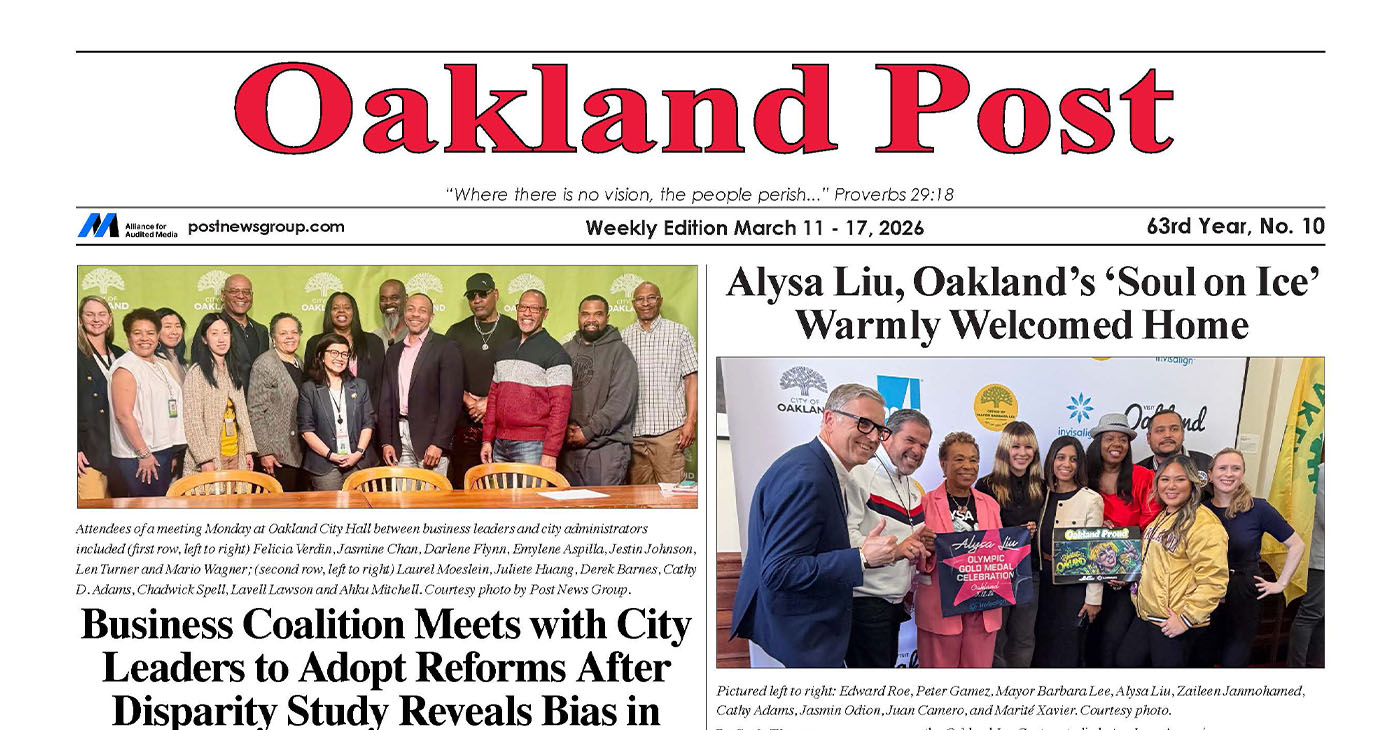
To enlarge your view of this issue, use the slider, magnifying glass icon or full page icon in the lower right corner of the browser window.
Activism
Oakland Post: Week of March 4 – 10, 2026
The printed Weekly Edition of the Oakland Post: Week of March 4 – 10, 2026

To enlarge your view of this issue, use the slider, magnifying glass icon or full page icon in the lower right corner of the browser window.


WORK FROM HOME
Home-based business with potential monthly income of $10K+ per month. A proven training system and website provided to maximize business effectiveness. Perfect job to earn side and primary income. Contact Lynne for more details: Lynne4npusa@gmail.com 800-334-0540


Black Artists in America, Installation Three Wraps at the Dixon Gallery and Gardens

Grief, Advocacy, and Education: A Counselor Reflects on Black Maternal Health

Future of Florida’s Black History Museum in Limbo

New Research Shows the Many Benefits of Early Learning

South Hampton K-8 Students Among Top 10 Finalists for Samsung’s ‘Solve for Tomorrow’ Competition

Cuba: No Negotiation with US on the President or Political System

Brooklyn Academy of Music Names Jamaican-Born Tamara McCaw as President

Trinidad & Tobego – U.S. Launches WhatsApp Channel for American Citizens in the Country

Oakland Post: Week of March 18 – 24, 2026

AI Innovation vs. Ethics and Environmental Impact

AI, Web3, and Digital Reparations

What If You Owned Your AI Agent?

Season 7, Episode 3 – January Reporter’s Roundtable 📱

Season 7, Episode 3 – January Reporter’s Roundtable

AI, Media, and Power | Part 2, Real-World Impacts and Tradeoffs

Oakland Post: Week of February 11 – 17, 2026

Reflecting on Black History Milestones in Birmingham AL

CITY OF SAN LEANDRO STATE OF CALIFORNIA PUBLIC WORKS DEPARTMENT ENGINEERING DIVISION NOTICE TO BIDDERS FOR ANNUAL STREET OVERLAY/REHABILITATION 2019-21 – PHASE III

Oakland Post: Week of February 18 – 24, 2026

PRESS ROOM: NBA Hall of Fame Nominee Terry Cummings Joins 100 Black Men of DeKalb County to Launch Victory & Values Initiative

Oakland Post: Week of February 25 – March 3, 2026

Trump’s MAGA Allies are Creating Executive Order Plan to Steal the 2026 Midterms

U.S. manufacturing rebounds – how foundry services are adapting to rising demand

OP-ED: One Hundred Years of Black Workers Telling the Truth

Advancements in solar technology that are changing the way we power the world

Chase Oakland Community Center Hosts Alley-Oop Accelerator Building Community and Opportunity for Bay Area Entrepreneurs

Poll Shows Support for Policies That Help Families Afford Child Care

Oakland Post: Week of March 4 – 10, 2026

PRESS ROOM: Civil Rights TV Launches in Selma as the World’s First 24/7 Civil Rights Television Network

Ghana Mourns a Son of the African World

Hyundai Ioniq 5 Parking, Safety, and 360 View #shorts

2025 Ioniq 5 New Wiper & Powerful Performance! #shorts

Electric SUV Range: Is 259 Miles Enough? #shorts

EV Charging: How Fast Can You Charge an Electric Vehicle? #shorts

Biometric Cooling… Messaging Seats…Come on! 2025 Infiniti QX80 Autograph 4WD

Charged Up: Witness the Magic of a Fully Electric Car! #shorts

Range Rover Sport PHEV Included…: See What’s Inside This Luxury SUV! #shorts

Invisible Hood View: Perfect Parking with X-Ray Vision! #shorts

AI Is Reshaping Black Healthcare: Promise, Peril, and the Push for Improved Results in California

ESSAY: Technology and Medicine, a Primary Care Point of View

Sanctuary Cities

The RESISTANCE – FREEDOM NOW

STATE OF THE PEOPLE: Freddie

ECONOMIC BOYCOTT DAY!!!!!

I told You So
-
 #NNPA BlackPress4 weeks ago
Poll Shows Support for Policies That Help Families Afford Child Care
-
 Activism3 weeks ago
Oakland Post: Week of March 4 – 10, 2026
-

 #NNPA BlackPress3 weeks ago
Woman’s Search for Family’s Roots Leads to Ancestor John T. Ward – A Successful Entrepreneur and Conductor on the Underground Railroad
-

 #NNPA BlackPress4 weeks ago
OP-ED: NNPA Launches 2026 “Leadership Matters” Video Series
-

 #NNPA BlackPress3 weeks ago
Advocates Raise Alarm Over ICE Operation, MOU and Detention Risks in Baltimore County
-

 #NNPA BlackPress3 weeks ago
COMMENTARY: Women of Color Shape Our Past and Future
-

 #NNPA BlackPress3 weeks ago
Pete Buttigieg to Join Mayor Randall Woodfin for Community Town Hall in Birmingham
-

 Activism2 weeks ago
Oakland Post: Week of March 11 -17, 2026
