
Politics
How Obama Reversed Course on Federal College Ratings


President Barack Obama speaks at the University of Wisconsin at La Crosse, in La Crosse, Wis., Thursday, July 2, 2015, about the economy and to promote a proposed Labor Department rule that would make more workers eligible for overtime. (AP Photo/Morry Gash)
JOSH LEDERMAN, Associated Press
WASHINGTON (AP) — President Barack Obama dearly wanted to get the government in the business of rating colleges and universities based on value and affordability, promising a new system by 2015. Now that goal is shriveling under the weight of a concerted opposition from universities, lawmakers and bureaucrats in Obama’s own administration.
Nearly two years after the president, standing before a crowd of 7,000 at the University at Buffalo, unveiled the bold proposal as a way to curb soaring college costs, his administration has quietly but drastically scaled back the initiative. No longer does the federal government intend to use a formula to score schools based on factors like price, average student debt and graduation rates, as Obama had envisioned.
Instead, the new tool will allow prospective students to decide which factors are important to them, then draw their own conclusions from the statistics. But the Education Department declined to say which new statistics the tool will offer that aren’t already available on existing government websites.
Abandoning the original plan marked the latest in a series of stumbles for Obama’s education priorities. In his 2013 State of the Union address, Obama called for expanding access to pre-kindergarten to all American children, and in his 2015 address, he pushed a $60 billion plan to offer two years of free community college. Neither proposal has gained any traction.
The Education Department said it’s still determining what the revised college tool will look like, but that it’s still on track to roll it out by the start of the 2015-2016 academic year, roughly two months from now.
“It is anything but a retreat,” Education Department Undersecretary Ted Mitchell said in an interview. “It’s a retooling and, we think, an advance on the original concept.”
Yet Obama’s goal, as he described when he announced the plan in August 2013, was to create an alternative to private rankings like U.S. News and World Report whose formulas incentivize schools to “game the numbers” and even raise costs. Instead, Obama sought a system that prioritized whether schools are enrolling and graduating poorer students and whether their graduates succeed in the workforce.
“I think we should rate colleges based on opportunity — are they helping students from all kinds of backgrounds succeed — and on outcomes, on their value to students and parents,” Obama said. He took it a step further by proposing that Congress eventually tie a school’s eligibility for federal financial aid to its score in the new ratings system.
Resistance to Obama’s plan was swift, vehement and nearly universal.
Associations representing colleges with traditionally conflicting interests — such as community colleges and private universities — all lined up in opposition, warning the project was too complex, too subjective and too dependent on shoddy data to ever work fairly. As the Education Department mounted an extensive, lengthy listening tour across the country, college presidents warned of dire unintended consequences and implored the government to reconsider.
On Capitol Hill, the proposal drew pushback not only from the president’s traditional Republican foes, but also some Democrats. Sen. Lamar Alexander, R-Tenn., a former education secretary and chair of the Senate’s education panel, took to the Senate floor to threaten an amendment blocking the ratings system. And in the House, Republican Rep. Bob Goodlatte of Virginia and Democratic Rep. Michael Capuano of Massachusetts — two states with large numbers of colleges — joined forces to sponsor a resolution opposing Obama’s plan.
“Do I think they would have continued if no one had pushed back? Of course I do,” Capuano said.
But for nearly two years, the administration stuck to the original plan. In a blog post in December 2014, the Education Department said it was considering rating schools as high-performing, medium-performing or low-performing and outlined a few potential metrics, but disappointed many by failing to flesh out the formula it would use to assign ratings.
Driving the decision to stick with a ratings system was Obama, who was dead-set on carrying out his original vision for the project, according to interviews with nearly a dozen congressional aides, administration officials and college association leaders. Many of them spoke on condition of anonymity to avoid criticizing the president publicly.
From the start, career bureaucrats and data experts at the Education Department said the idea wasn’t feasible, but met continued White House resistance, those officials said. Technical experts in the education industry that the administration consulted offered similar warnings. Eventually, higher-level Education Department officials grew convinced the plan was unworkable, and persuaded the White House to allow a scaled-back approach devoid of hard-and-fast ratings.
“We are right where the president wanted us to be in terms of making progress toward his vision,” said James Kvaal, deputy director of the White House’s Domestic Policy Council.
University associations that had fought the proposal praised the Obama administration for taking their concerns seriously and eventually agreeing to abandon the initial plan, calling it a rare example of the government acknowledging its own missteps.
“They really did listen on this,” said Sarah Flanagan, the top lobbyist for the National Association of Independent Colleges and Universities. “The more they looked into it, they realized it wasn’t doable.”
___
Reach Josh Lederman on Twitter at http://twitter.com/joshledermanAP
Copyright 2015 The Associated Press. All rights reserved. This material may not be published, broadcast, rewritten or redistributed.


Activism
Oakland Post: Week of March 18 – 24, 2026
The printed Weekly Edition of the Oakland Post: Week of March 18 – 24, 2026

To enlarge your view of this issue, use the slider, magnifying glass icon or full page icon in the lower right corner of the browser window.
Activism
Oakland Post: Week of March 11 -17, 2026
The printed Weekly Edition of the Oakland Post: Week of March 11 – 17, 2026
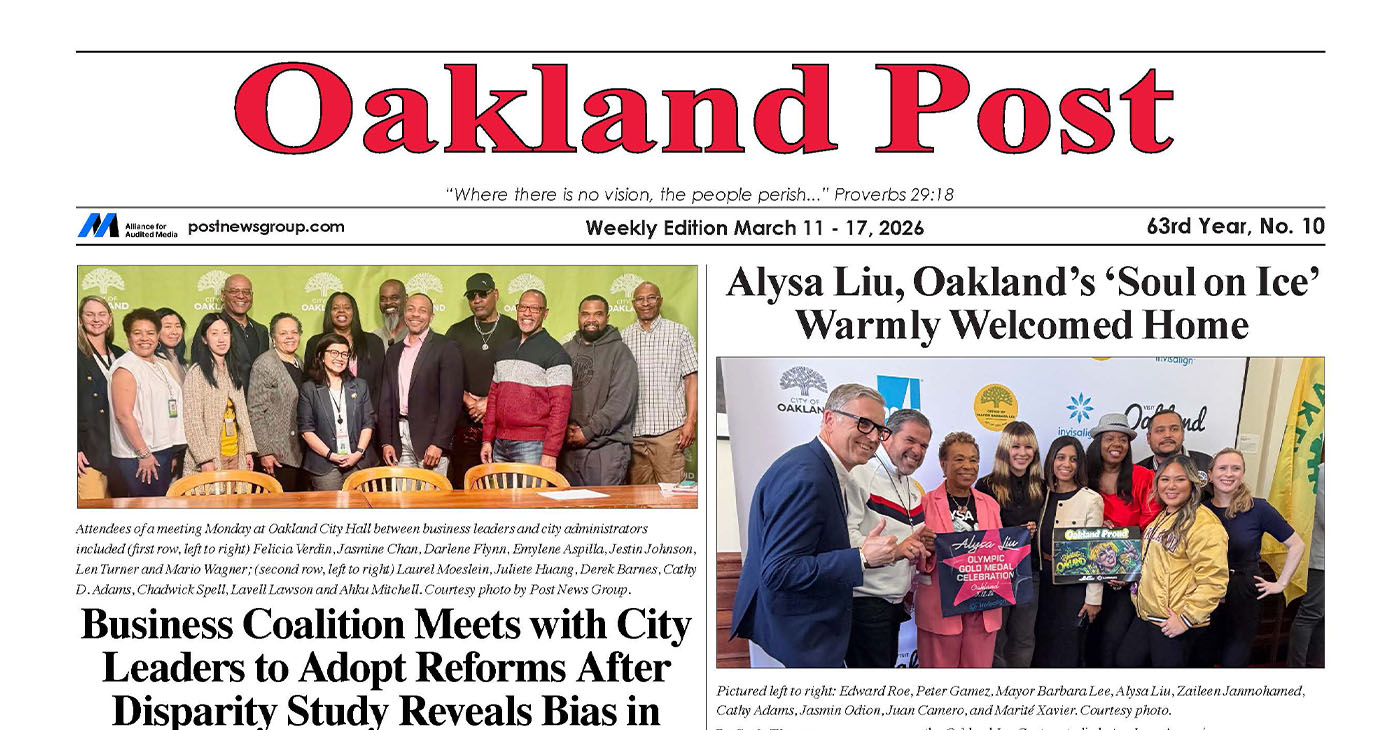
To enlarge your view of this issue, use the slider, magnifying glass icon or full page icon in the lower right corner of the browser window.
Activism
Oakland Post: Week of March 4 – 10, 2026
The printed Weekly Edition of the Oakland Post: Week of March 4 – 10, 2026

To enlarge your view of this issue, use the slider, magnifying glass icon or full page icon in the lower right corner of the browser window.

WORK FROM HOME
Home-based business with potential monthly income of $10K+ per month. A proven training system and website provided to maximize business effectiveness. Perfect job to earn side and primary income. Contact Lynne for more details: Lynne4npusa@gmail.com 800-334-0540


Black Artists in America, Installation Three Wraps at the Dixon Gallery and Gardens

Grief, Advocacy, and Education: A Counselor Reflects on Black Maternal Health

Future of Florida’s Black History Museum in Limbo

New Research Shows the Many Benefits of Early Learning

South Hampton K-8 Students Among Top 10 Finalists for Samsung’s ‘Solve for Tomorrow’ Competition

Cuba: No Negotiation with US on the President or Political System

Brooklyn Academy of Music Names Jamaican-Born Tamara McCaw as President

Trinidad & Tobego – U.S. Launches WhatsApp Channel for American Citizens in the Country

Oakland Post: Week of March 18 – 24, 2026

AI Innovation vs. Ethics and Environmental Impact

AI, Web3, and Digital Reparations

What If You Owned Your AI Agent?

Season 7, Episode 3 – January Reporter’s Roundtable 📱

Season 7, Episode 3 – January Reporter’s Roundtable

AI, Media, and Power | Part 2, Real-World Impacts and Tradeoffs

Oakland Post: Week of February 11 – 17, 2026

Reflecting on Black History Milestones in Birmingham AL

Rising Optimism Among Small And Middle Market Business Leaders Suggests Growth for California

CITY OF SAN LEANDRO STATE OF CALIFORNIA PUBLIC WORKS DEPARTMENT ENGINEERING DIVISION NOTICE TO BIDDERS FOR ANNUAL STREET OVERLAY/REHABILITATION 2019-21 – PHASE III

Oakland Post: Week of February 18 – 24, 2026

PRESS ROOM: NBA Hall of Fame Nominee Terry Cummings Joins 100 Black Men of DeKalb County to Launch Victory & Values Initiative

Oakland Post: Week of February 25 – March 3, 2026

Trump’s MAGA Allies are Creating Executive Order Plan to Steal the 2026 Midterms

U.S. manufacturing rebounds – how foundry services are adapting to rising demand

OP-ED: One Hundred Years of Black Workers Telling the Truth

Advancements in solar technology that are changing the way we power the world

Chase Oakland Community Center Hosts Alley-Oop Accelerator Building Community and Opportunity for Bay Area Entrepreneurs

Poll Shows Support for Policies That Help Families Afford Child Care

PRESS ROOM: Civil Rights TV Launches in Selma as the World’s First 24/7 Civil Rights Television Network

Oakland Post: Week of March 4 – 10, 2026

Hyundai Ioniq 5 Parking, Safety, and 360 View #shorts

2025 Ioniq 5 New Wiper & Powerful Performance! #shorts

Electric SUV Range: Is 259 Miles Enough? #shorts

EV Charging: How Fast Can You Charge an Electric Vehicle? #shorts

Biometric Cooling… Messaging Seats…Come on! 2025 Infiniti QX80 Autograph 4WD

Charged Up: Witness the Magic of a Fully Electric Car! #shorts

Range Rover Sport PHEV Included…: See What’s Inside This Luxury SUV! #shorts

Invisible Hood View: Perfect Parking with X-Ray Vision! #shorts

AI Is Reshaping Black Healthcare: Promise, Peril, and the Push for Improved Results in California

ESSAY: Technology and Medicine, a Primary Care Point of View

Sanctuary Cities

The RESISTANCE – FREEDOM NOW

STATE OF THE PEOPLE: Freddie

ECONOMIC BOYCOTT DAY!!!!!

I told You So
-
 Activism4 weeks ago
Oakland Post: Week of February 25 – March 3, 2026
-
 #NNPA BlackPress4 weeks ago
Poll Shows Support for Policies That Help Families Afford Child Care
-
 Activism3 weeks ago
Oakland Post: Week of March 4 – 10, 2026
-

 #NNPA BlackPress3 weeks ago
Woman’s Search for Family’s Roots Leads to Ancestor John T. Ward – A Successful Entrepreneur and Conductor on the Underground Railroad
-

 #NNPA BlackPress3 weeks ago
OP-ED: NNPA Launches 2026 “Leadership Matters” Video Series
-

 #NNPA BlackPress3 weeks ago
Advocates Raise Alarm Over ICE Operation, MOU and Detention Risks in Baltimore County
-

 #NNPA BlackPress3 weeks ago
COMMENTARY: Women of Color Shape Our Past and Future
-

 #NNPA BlackPress3 weeks ago
Pete Buttigieg to Join Mayor Randall Woodfin for Community Town Hall in Birmingham
