
Activism
Holy Names University Says it Will Close; Local Leaders Want Campus to Remain Center for Higher Ed
“We have been doing our best to find a partner to keep the university functioning and continue HNU’s mission,” said HNU Board Chairperson Steven Borg in the press release. “While we’ve had interest in long-term collaboration from potential partners, we do not have the type of interest that would sustain HNU in continuing to offer its own programs and services, so we are forced to make the difficult decision to close and designate a transfer institution in the best interest of our students.”


HNU’s site could become a Historically Black College or University (HBCU) campus, said Post Publisher Paul Cobb
By Ken Epstein
Holy Names University (HNU), which has served Oakland for 154 years, earning deep respect as one of the nation’s most diverse post-secondary educational centers, offering bachelors’ degrees, training teachers, social workers, and nurses, announced this week it will close permanently at the end of next semester, leaving the city with no major university since the recent loss of Mills College.
Responding to the news, HNU students and staff spoke at Tuesday’s Oakland City Council meeting, seeking to rescue the city’s higher-education pipeline. The council, passing a resolution authored by Councilmember Carroll Fife and Vice Mayor Rebecca Kaplan, went on record calling for the university to work with the Oakland community to ensure that the beautiful 60-acre campus can become a home for another university, rather than be sold to a real estate developer to build an exclusive residential enclave.
HNU’s administration, mostly silent as news and rumors about the university swirled around campus for the past few months, deeply worrying staff and students, made the announcement after the school closed last Friday for a holiday break, and no students were around.

The university’s Board of Trustees revealed their plans Monday in a press release produced by Sam Singer public relations. Singer has a long history as an aggressive representative of corporate clients, including Chevron in its legal battle with indigenous communities in Ecuador’s Amazon forests, and Wedgewood, the real estate company that owned the home in West Oakland taken over by Moms for Housing.
According to the press release, the Board of Trustees blamed COVID-19 and an economic downturn that disproportionately impacted HNU students for the university’s predicament.
“HNU has worked tirelessly to find pathways to help continue its mission but was forced by financial circumstances to cancel its NCAA sports programs as of the end of spring season, issue WARN ACT notices to staff beginning Dec. 1, and give layoff notices to 32 employees effective at the end of January/early February,” the press release said.
“We have been doing our best to find a partner to keep the university functioning and continue HNU’s mission,” said HNU Board Chairperson Steven Borg in the press release. “While we’ve had interest in long-term collaboration from potential partners, we do not have the type of interest that would sustain HNU in continuing to offer its own programs and services, so we are forced to make the difficult decision to close and designate a transfer institution in the best interest of our students.”
The press release said HNU is working with Dominican College in San Rafael to offer “specific pathways for students to complete their degrees at Dominican.”
HNU is also talking to other institutions to support the school’s Kodály Music Program and the Raskob Learning Institute and Day School, which “will either operate independently or in partnership with a new institution after this school year,” the press release said.
Explaining the financial hole that is crippling HNU’s operations, Borg said that there is “$49 million in debt on HNU’s property, but as a 65-year-old campus, the costs of deferred maintenance and compliance upgrades could be over $200 million.”
Tuesday’s City Council resolution, written originally while Council members and community leaders still hoped to reach out to the HNU administration to help avert the school’s closure, was modified to emphasize the need to save the campus as a site for a different institution that will graduate Oakland students and provide trained staff for local employers that need well-trained workers who are culturally competent.
The revised resolution said the Council and the community would work with HNU “to ensure that higher education continues at the current site.”
So far, the HNU administration has not responded to city leaders who have reached out with offers to help.
Many HNU staff and students as well as local residents spoke at the council meeting calling for the university to work with the community to continue higher education at the site.
Student Kayla Argueta said, “(Closing HNU) is uprooting lives. I am urging the Council and the community to make sure this stays an education institution. To see HNU closed down or sold to developers is terrifying to think of. It is an incredibly important part of Oakland, and something must be done to make sure the legacy lives on.”
Jim Stryker, chair of the HNU Faculty Senate, told the Council, “Thank you for the resolution. It is deeply appreciated by the faculty, staff, and students.”
Polly Mayer, vice chair of HNU ‘s Faculty Senate, said she was “saddened by the opportunities we are taking away from our students and faculty. It’s really a tragedy to see this educational institution close.”
Oakland Post Publisher Paul Cobb said, “I would hope the City Council and City of Oakland would work closely with the County of Alameda to support the educational infrastructure of the City of Oakland with hundreds of millions of dollars, like they are now spending on infrastructure for a stadium.”
He suggested they could partner with a Historically Black College or University at the site, “since HNU is the most integrated university in the country right now.”
Rev. Cheryl Ward called for the facility and property to be used for higher education purposes. “We all know there is a lack of education institutions that provide housing. The number of students who are unhoused is unconscionable in this city. Should we consider dismantling higher education in that space, since it provides housing?”
HNU staffer Nancy Schulz said “HNU is a university that really walks its talk. We have community partners and discounted tuition.” It has also provided the region with trained mental health workers.
In her remarks, Councilmember Fife, who attended HNU, said, “It’s an amazing school. It was a safe place and sanctuary for me as a working mom.”
In September, Fife was recognized as the institution’s Alumni of the Year.
Vice Mayor Kaplan said, “It would be incredibly problematic for the community to lose access” to the institution that provides the city with educational opportunities and a well-trained workforce.










Activism
Oakland Post: Week of September 16 – 22, 2026
The printed Weekly Edition of the Oakland Post: Week of September 16 – 22, 2026
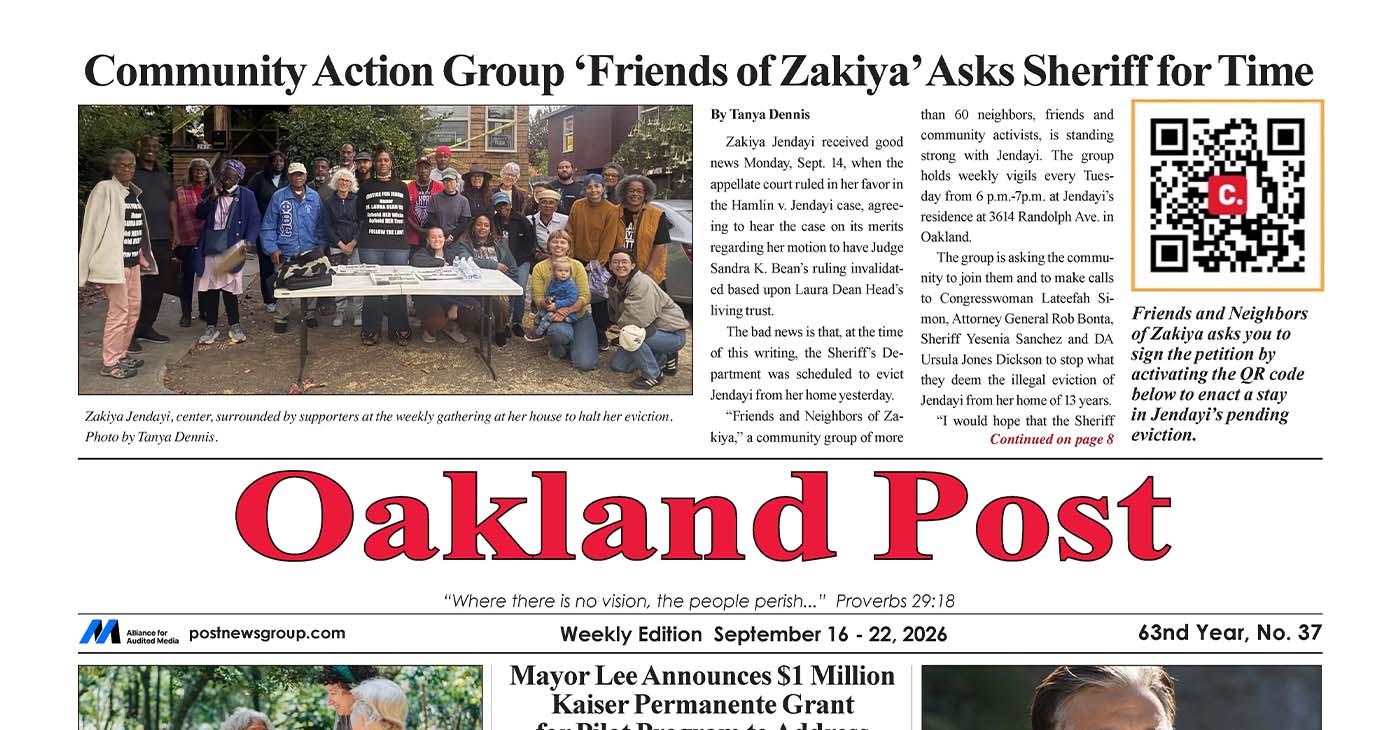
To enlarge your view of this issue, use the slider, magnifying glass icon or full page icon in the lower right corner of the browser window.
Activism
Oakland Post: Week of September 9 – 15, 2026
The printed Weekly Edition of the Oakland Post: Week of September 9 – 15, 2026

To enlarge your view of this issue, use the slider, magnifying glass icon or full page icon in the lower right corner of the browser window.
Activism
Oakland Post: Week of September 2 – 8, 2026
The printed Weekly Edition of the Oakland Post: Week of September 2 – 8, 2026

To enlarge your view of this issue, use the slider, magnifying glass icon or full page icon in the lower right corner of the browser window.



Doulas Are Helping Black California Moms Navigate Pregnancy–Even as High Mortality Rates Persist

Newsom Signs Addictive Social Media Law to Protect Kids

On Your November Ballot: Prop 38 Would Allocate $8.4 Billion to Immunology and Immunotherapy Funding

Ask California: Golden State Releases New AI Chatbot

Asm. Isaac Bryan’s Bill Banning California Police From ICE Side Jobs Reaches Newsom’s Desk

Assemblymember LaShae Sharp-Collins’s Bill Would Pause Law Enforcement’s Use of Shock Gloves Pending Study

BOOK REVIEW: ‘Laws of Solomon’ Reveals Tender Heart of Former Child Soldier

OPINION: The New American Fear – From 9-11 to AI

Passing for White, Fighting for Black America: The Courage of Walter White

Oakland People’s Arms Embargo Coalition Demands End to Military Shipments Thru Oakland

Barbara Lee Mourns Gloria Steinem, Remembers a Friendship Rooted in Equality

Event Preview: ‘Fashion v. Fascism’ – A Runway Revolution Is Coming to the Bay Area

Two Looming Threats Every Alameda County Elder Should Know About

Oakland Mayor Reads to Children at Bookout Block Party at Marcus Books Store

Tradition Comes to the Streets in 11th Annual Black-Eyed Pea Festival at the Freedom Farmers Market

Less Affluent School Districts, Including Sacramento City, Face Threat of State Takeover

ESSAY: California Can Close Its Colorectal Cancer Gap

California Hispanic Chambers of Commerce Unveils: ‘Powering the Future’ Theme for 47th Annual Statewide Convention

Four Candidates, Including Incumbent Barbara Lee, Qualify for Oakland Mayor’s Race

Oakland Post: Week of August 12 – 18, 2026

From Blueprint to Breakthrough: Tackling Affordable Housing in Oakland

Oakland Observes Black August with Block Parties, Film Showings, Workshops

COMMENTARY: Why Local School Tax Measure G1 Will Not Be on the November Ballot

Standoff for Justice: Our Homes Are Worth Fighting For

Returning to Its Roots, the Oakland Black-Eyed Pea Festival Partners with the Freedom Farmers Market Sept. 12

NPRC Scores First Advocacy Victory: David Shaw Finally Gets His Wish to ‘Go Home’

Oakland Post: Week of August 26 – September 1, 2026

Frontier Airlines’ Return to Oakland Airport Brings Flights, Jobs and Opportunity

Gubernatorial Candidate Steve Hilton Blasts California New Tire Rules; Newsom Hits Back

Chef Sharon Lee Blends Culinary Excellence, Education and Empowerment

The Conversation With Al McFarlane 6/23/26

Media Monday 6/22/26

LIVE! ASK ALMA! — TUES. 6.23.26 7PM EST

Car Buying Secrets: 4 Hidden Checks Before You Sign!

Is This 550 HP Charger Worth YOUR Money? AutoNetwork Review

Celebrating Juneteenth – Frederick Douglass on education and resistance

LIVE! — ASK ALMA! — TUES. 6.19.26 7PM EST

Hyundai Ioniq 5 Parking, Safety, and 360 View #shorts

2025 Ioniq 5 New Wiper & Powerful Performance! #shorts

Electric SUV Range: Is 259 Miles Enough? #shorts

EV Charging: How Fast Can You Charge an Electric Vehicle? #shorts

Biometric Cooling… Messaging Seats…Come on! 2025 Infiniti QX80 Autograph 4WD

Charged Up: Witness the Magic of a Fully Electric Car! #shorts

Range Rover Sport PHEV Included…: See What’s Inside This Luxury SUV! #shorts

Invisible Hood View: Perfect Parking with X-Ray Vision! #shorts
-
 Commentary4 weeks ago
Standoff for Justice: Our Homes Are Worth Fighting For
-
 Activism4 weeks ago
Oakland Post: Week of August 26 – September 1, 2026
-
 Business4 weeks ago
Frontier Airlines’ Return to Oakland Airport Brings Flights, Jobs and Opportunity
-
 Business4 weeks ago
Gubernatorial Candidate Steve Hilton Blasts California New Tire Rules; Newsom Hits Back
-
 Business4 weeks ago
Chef Sharon Lee Blends Culinary Excellence, Education and Empowerment
-

 Education4 weeks ago
Gov. Newsom’s Latest Appointees Include Sacramento Advocate for Formerly Incarcerated Students; State’s New Tech Chief
-

 Community4 weeks ago
Big City Mayors Ask for “Yes” Vote on Housing Bond Measure; Conservatives Say “No”
-

 Business4 weeks ago
Oakland Coliseum Project Opens Door for Small Businesses to Build Bigger
