
Activism
Finding the Right Doctor: Black Californians Weigh the Burden and Benefits
A California Health Care Foundation study published in May 2024 on heath disparities by race and ethnicity in the state found that Black Californians had the shortest life expectancy at 74.6 years. One in four Black respondents in the California Health Interview Survey (CHIS) felt they could have received better care if they were a different race/ethnicity.


By Edward Henderson, California Black Media
Living in California has been a dream come true for screenwriter Imani Quinn. She counts the Los Angeles-area weather, professional opportunities and proximity to close friends as some of the things that have made the experience especially rewarding for her.
However, when Quinn discovered she was pregnant, finding a good physician to help guide her along that journey became her number one priority – and greatest pain point.
Like many African Americans in California, Quinn said she found it difficult to find a physician who relates to her culturally, considers her lived experiences, and acknowledges the deep-seated racial biases that have been imbued in the health care delivery system historically in the United States.
“It was important because Black women have one of the highest mortality rates with childbirth, childbearing,” said Quinn. “I wanted to make sure that I was in the hands of somebody who knew how to prioritize my health as a Black woman — someone who knows the statistics and knows what to look for and makes me feel safe and comfortable.”
In 2021, the percentage of Black infants in California who were born preterm (12.7%) or who had low birthweight (12.4%) was higher than those of other races/ethnicities. Black mothers/birthing people experienced the highest maternal mortality rate among all races/ethnicities between 2018 and 2020.
A California Health Care Foundation study published in May 2024 on heath disparities by race and ethnicity in the state found that Black Californians had the shortest life expectancy at 74.6 years. One in four Black respondents in the California Health Interview Survey (CHIS) felt they could have received better care if they were a different race/ethnicity.
Given these staggering statistics, Dr. Glenda Newell-Harris, an internal physician and medical advocate based in Oakland, says it is urgent for Black physicians to provide the extra care and attention to improve these numbers.
A 2023 research study published by the Journal of the American Medical Association (JAMA) that evaluated all 1618 counties in the United States found that the life expectancy for Blacks was higher in areas where there were higher concentrations of Black doctors.
But how can Black Californians find them? California Black Media spoke with Newell-Harris about some strategies.
“The best recommendations come from patients, not doctors,” she said “At the end of the day, your physician has to be a professional that meets your needs. Somebody that’s willing to listen to you. Somebody that’s going to be available to see you. Somebody who works with you — whatever your situation is.”
Newell-Harris recommends consulting the National Medical Association in addition to seeking counsel from other Black organizations like churches, fraternities/sororities and local chapters of the NAACP to network and get doctor recommendations from other patients.
Another useful resource for Black Californians seeking the right doctor is myblacktelehealth.com, Newell says. For Black women, there is asktia.com.
Newell says the process may take a little more time, but it is a way to get access to a network of physicians of color and others who have a proven record of success working with Black patients.
In South L.A., where there is one of the highest concentrations of Black Californians in the state — 28% of a population of about 271,000 – the shortage of doctors is acute. Therefore, the chance of finding an available Black doctor or culturally competent one is even more challenging.
“It’s a starting point if you are completely at your wit’s end,” she added.
Quinn says her search for a Black physician in the Los Angeles area began online, consulting social media groups and women’s wellness spaces in Los Angeles.
“They referred me to some OB’s. But they were all White, majority of them were men. I was surprised at how much these institutions don’t have these resources to help people find the kind of OB that they want. So, I ended up doing a lot of my own research just by, like, Googling people.”
According to a 2020 study, only 3% of California’s physicians are Black.
According to Dr. Elaine Batchlor, CEO of the MLK Community Health Center hospital in South LA, the region needs more doctors.
“There are 39 physicians per 100,000 residents in South LA,” Batchlor said in a statement. “Compare that with 1,000 physicians for the same population in Los Angeles’s west side. The physician gap in this community is the next mountain we must move.”
An additional option, experts say, to work around the shortage of Black physicians in California is Telehealth. The medium, which gained popularity during the pandemic, has many benefits when it comes to consulting Black physicians across the state – or even the country — if one is not available in your city.
“Telehealth can be utilized for so many ways,” said Newell-Harris. “If you’re in a rural area and the specialist is far, then it helps to be able to get a telehealth visit. It can be a lifeline.”
However, Newell-Harris only recommends using telehealth for specialists and emphasizes that it is not a substitution for a primary care physician. She stressed the importance of seeing an in-person physician for important heath concerns that need to be diagnosed in person.
Some PCPs also offer telehealth visits for some routine checkups and other services.
For Quinn and many other Black Californians, sometimes finding the right doctor for you might be driving a little farther to another city or community in your region.
Luckily, Quinn said she saved a contact she made while hosting a podcast and was able to get a referral to a Black physician based in Los Angeles.
“I’ve gone to her for a visit so far and had communication with her. There’s an alignment just from a lifestyle place. And then just, yeah, her being a Black woman and being knowledgeable about, different genetic things that we can get that are more race specific, Quinn shared. “The experience was warm and welcoming.”
This article is supported by the California Black Health Journalism Project, a program created by California Black Media, that addresses the top health challenges African Americans in California face. It relies on the input of community and practitioners; an awareness of historical factors, social contexts and root causes; and a strong focus on solutions as determined by policymakers, advocates and patients.












Activism
Oakland Post: Week of April 8 – 14, 2026
The printed Weekly Edition of the Oakland Post: Week of April 8 – 14, 2026

To enlarge your view of this issue, use the slider, magnifying glass icon or full page icon in the lower right corner of the browser window.
Activism
Oakland Post: Week of April 1 – 7, 2026
The printed Weekly Edition of the Oakland Post: Week of April 1 – 7, 2026
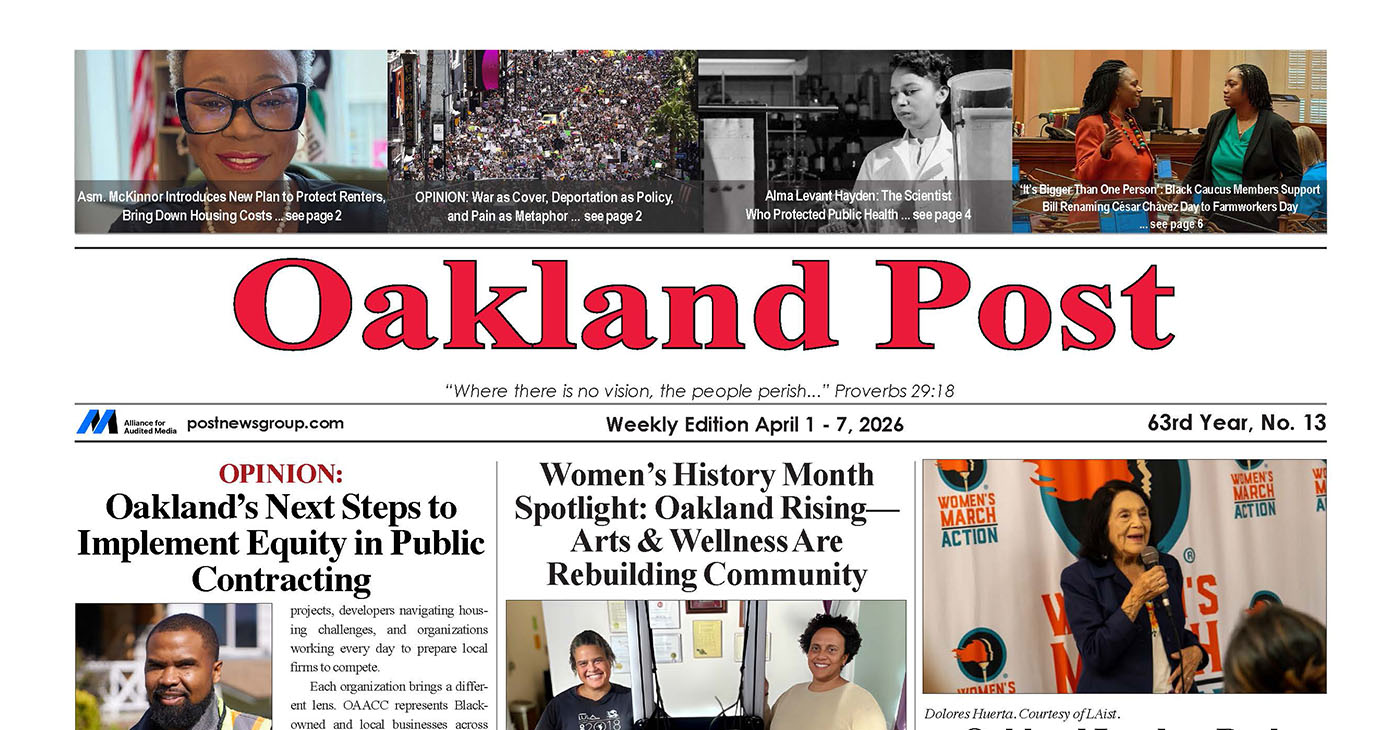
To enlarge your view of this issue, use the slider, magnifying glass icon or full page icon in the lower right corner of the browser window.
Activism
Oakland Post: Week of March 18 – 24, 2026
The printed Weekly Edition of the Oakland Post: Week of March 18 – 24, 2026

To enlarge your view of this issue, use the slider, magnifying glass icon or full page icon in the lower right corner of the browser window.

WORK FROM HOME
Home-based business with potential monthly income of $10K+ per month. A proven training system and website provided to maximize business effectiveness. Perfect job to earn side and primary income. Contact Lynne for more details: Lynne4npusa@gmail.com 800-334-0540


Oakland Post: Week of April 8 – 14, 2026

Oakland Post: Week of April 1 – 7, 2026

Black Artists in America, Installation Three Wraps at the Dixon Gallery and Gardens

Grief, Advocacy, and Education: A Counselor Reflects on Black Maternal Health

Future of Florida’s Black History Museum in Limbo

New Research Shows the Many Benefits of Early Learning

South Hampton K-8 Students Among Top 10 Finalists for Samsung’s ‘Solve for Tomorrow’ Competition

Cuba: No Negotiation with US on the President or Political System

Brooklyn Academy of Music Names Jamaican-Born Tamara McCaw as President

Trinidad & Tobego – U.S. Launches WhatsApp Channel for American Citizens in the Country

Oakland Post: Week of March 18 – 24, 2026

AI Innovation vs. Ethics and Environmental Impact

AI, Web3, and Digital Reparations

What If You Owned Your AI Agent?

Season 7, Episode 3 – January Reporter’s Roundtable 📱

Reflecting on Black History Milestones in Birmingham AL

Oakland Post: Week of February 25 – March 3, 2026

Oakland Post: Week of March 4 – 10, 2026

PRESS ROOM: NBA Hall of Fame Nominee Terry Cummings Joins 100 Black Men of DeKalb County to Launch Victory & Values Initiative

Trump’s MAGA Allies are Creating Executive Order Plan to Steal the 2026 Midterms
Oakland Post: Week of March 18 – 24, 2026

Oakland Post: Week of March 11 -17, 2026

Poll Shows Support for Policies That Help Families Afford Child Care

OP-ED: One Hundred Years of Black Workers Telling the Truth

Financial Wellness and Mental Health: Managing Money Stress in College

Woman’s Search for Family’s Roots Leads to Ancestor John T. Ward – A Successful Entrepreneur and Conductor on the Underground Railroad
New Research Shows the Many Benefits of Early Learning
Brooklyn Academy of Music Names Jamaican-Born Tamara McCaw as President
Grief, Advocacy, and Education: A Counselor Reflects on Black Maternal Health

COMMENTARY: Women of Color Shape Our Past and Future

Hyundai Ioniq 5 Parking, Safety, and 360 View #shorts

2025 Ioniq 5 New Wiper & Powerful Performance! #shorts

Electric SUV Range: Is 259 Miles Enough? #shorts

EV Charging: How Fast Can You Charge an Electric Vehicle? #shorts

Biometric Cooling… Messaging Seats…Come on! 2025 Infiniti QX80 Autograph 4WD

Charged Up: Witness the Magic of a Fully Electric Car! #shorts

Range Rover Sport PHEV Included…: See What’s Inside This Luxury SUV! #shorts

Invisible Hood View: Perfect Parking with X-Ray Vision! #shorts

AI Is Reshaping Black Healthcare: Promise, Peril, and the Push for Improved Results in California

ESSAY: Technology and Medicine, a Primary Care Point of View

Sanctuary Cities

The RESISTANCE – FREEDOM NOW

STATE OF THE PEOPLE: Freddie

ECONOMIC BOYCOTT DAY!!!!!

I told You So

-
 Activism3 weeks ago
Oakland Post: Week of March 18 – 24, 2026
-
 Activism4 weeks ago
Oakland Post: Week of March 11 -17, 2026
-
 Advice4 weeks ago
Financial Wellness and Mental Health: Managing Money Stress in College
-
 #NNPA BlackPress3 weeks ago
New Research Shows the Many Benefits of Early Learning
-
 #NNPA BlackPress3 weeks ago
Brooklyn Academy of Music Names Jamaican-Born Tamara McCaw as President
-
 #NNPA BlackPress3 weeks ago
Grief, Advocacy, and Education: A Counselor Reflects on Black Maternal Health
-
 #NNPA BlackPress3 weeks ago
Black Artists in America, Installation Three Wraps at the Dixon Gallery and Gardens
-
 #NNPA BlackPress3 weeks ago
Future of Florida’s Black History Museum in Limbo
