
Entertainment
Film Review: ‘The Second Best Exotic Marigold Hotel’


Tina Desai and Dev Patel in The Second Best Exotic Marigold Hotel (Courtesy Photo)
By Dwight Brown
NNPA Film Critic
The original Best Exotic Marigold Hotel was so magical: British retirees looking for a place to nest were hoodwinked by fancy brochures into taking up residence in a boutique hotel in Jaipur, India. It turned out to be a dump. Yet, they made that hovel a home and became an extended family. That film had charm and lots of fans ($136 million at the box office). This follow-up takes those endearing pensioners a bit farther down the road.
Sonny Kapoor (Dev Patel), the over-excited 20-something manager of The Best Exotic Marigold Hotel and Muriel Donnelly (Maggie Smith), the elder co-manager, head to the States to wrangle financing for a new hotel. They make their pitch to a hospitality chain and are warned that before investment dollars can flow their way, a representative will visit their first property for an inspection.
Back in Jaipur, Sonny and Muriel are on pins and needles waiting for the inspector. They have one room left to rent and two guests show up. An Englishwomen named Lavinia (Tamsin Greig) books that last room. But when a gray-haired, distinguishing looking American named Guy (Richard Gere) arrives, Sonny thinks he is the advance man and gives Lavina’s room to him. He treats the Yank like a king, and the Brit like a vagrant. But could Sonny be wrong?
Ol Parker is back as the screenwriter, and John Madden returns as the director. Both try to give this sequel the same feel as the first, but they’ve run out of ideas. Buying a new hotel seems like a giddy capitalistic exploit. Tossing in an impending marriage for Sonny to his sweetheart Sunaina (Tina Desai) is not more than a distraction. The ongoing relationships between the other retirees evolve: Evelyn (Judi Dench) buys and sells fabric, Douglas (Bill Nighy) gives guided tours and the two still flirt. Norman (Ronald Pickup) and Carol (Diana Hardcastle) are negotiating their monogamous relationship while cruising anyone who gives them attention. And Madge (Celia Imrie) is dating (bedding) two wealthy Indian men, unable to choose either.
The hotel inspector mix-up is a red herring. Sonny’s anxiety over his wedding and a romantic rival is convoluted hype. The relationships between the hotel guests have run out of gas. The only subplot that catches fire has Guy courting Sonny’s overbearing mom (Lillete Dubey), but their shenanigans are largely kept off screen.
Madden’s direction, this time around, tends toward high-pitched romantic comedy of errors. What’s lacking from the script and his guidance is real drama, an element that gave the first Exotic Hotel depth. Also, the original production was so gritty you could feel the dust on your skin. This film is so glossy looking (cinematographer Ben Smithard, production designer Martin Childs) half the footage looks like it was filmed on a Hollywood lot.
Minus a script with gravitas, Dev Patel’s once charming animated portrayal of Sonny, feels like desperate, swing-for-the-rafters acting. Smith is too subdued and her verbal barbs at Dench have lost their bite. Gere’s performance doesn’t jazz up the cast, except he gives Celia Imrie, as the always-in-heat Madge, the opportunity to blurt out, “Be still my ovaries.” Overall, the ensemble cast still includes top-notch actors, but the material fails them.
Nonetheless, this film has its moments and it builds to a crescendo that is fun. The obligatory Bollywood dance scene works its magic. The Indian setting is still charming and off the beaten path. If the producers are contemplating a third chapter they would be wise to bring back some life-and-death situations that will give the characters a pulse.
This Exotic Hotel is likable. The first Exotic Hotel was lovable. That’s the difference.
Visit NNPA Film Critic Dwight Brown at DwightBrownInk.com


Alameda County
The Marin City Flea Market Is Back
The Marin City Flea Market returns on May 23, offering arts, crafts, vintage items, and collectibles. The market aims to uplift local vendors and celebrate cultural diversity.

By Godfrey Lee
After a long absence, Marin City will once again hold its flea market. The market will have its grand opening on Saturday, May 23, from 8 a.m. to 2 p.m. at the St. Andrew Presbyterian Church parking lot on 101 Donahue St. It will be held every fourth Saturday of the month
The market will be free to the public
There will be arts, crafts, vintage, collectibles, and other items on sale at the market. Interested vendors can contact info@marincityflea.org or text (415) 484-2984 for more information.
“The Marin City Flea Market’s mission is to uplift local vendors, celebrate cultural diversity, and provide an accessible community space where creativity, entrepreneurship, and connection can thrive,” says their website, marincityflea.org.
The flea market is sponsored and run by the Rotary Club of Marin City.
For more information, contact info@marincityflea.org. Or text to (415) 484-2984
Alameda County
Mayor Barbara Lee Declares ‘Delroy Lindo Day,’ Presents Acclaimed Actor with Key to the City
Oakland Mayor Barbara Lee honored acclaimed actor Delroy Lindo with the Key to the City and declared “Delroy Lindo Day” to celebrate his contributions to film, television, and theater.
By Carla Thomas
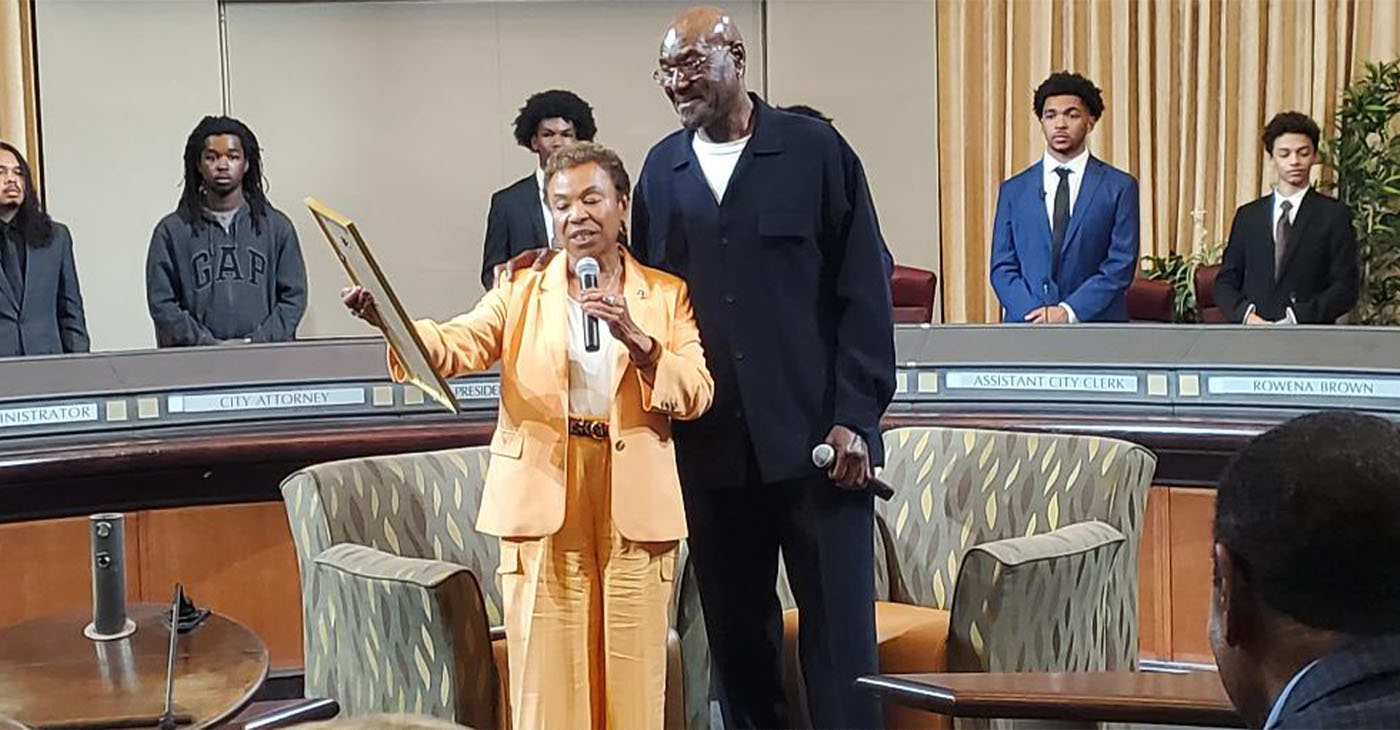
Oakland honored one of its most distinguished residents on May 6 as Mayor Barbara Lee presented acclaimed actor Delroy Lindo with the Key to the City and an official proclamation declaring “Delroy Lindo Day.”
The event, titled “Rooted in Legacy: Honoring Delroy Lindo,” took place at Oakland City Hall and brought together community leaders, artists, and young people for an evening centered on storytelling, cultural pride, and intergenerational connection.
Lindo, a critically acclaimed artist who lives in Oakland, was recognized for his extensive contributions to film, television, and theater, as well as his impact on the global African diaspora. Most recently the Oscar-nominated artist was recognized for his phenomenal role as a bluesman in Ryan Coogler’s “Sinners,” a winner both critically and at the box office.
His celebrated body of work included roles in “Unprisoned,” “Malcolm X”, “Clockers,” “Get Shorty,” and ”Da 5 Bloods,” among others.
“He’s brought depth, inspiration, and authenticity to the screen,” said Lee.
The program highlighted both Lindo’s artistic legacy and his influence as a mentor. A centerpiece of the evening was an intimate fireside conversation between MLee and Lindo.
“I am a living, breathing example of somebody who has achieved the American Dream,” said Lindo. “The other side of that is I walk through the world as a Black man of African descent.”
At 5 years of age, Lindo played King Balthazar in a Nativity play. And years later on Easter of 1973 in New York the Negro Ensemble Company’s play, “The River Niger” left a great impact on him.
“Seeing that production and so many Blacks in the audience, gave me an understanding that maybe I could have a career as an actor,” said Lindo.
Students from the Oakland School for the Arts delivered powerful monologues, adding a dynamic and emotional layer to the program. The students’ instructor, Tavia Percia, chairman of the school’s theatre department, watched the performance proudly. Their performances emphasized the importance of arts education and demonstrated the next generation of talent inspired by figures like Lindo.
Five young men from All Tied Up Academy had the honor of presenting the “Rooted in Legacy” plaque to Lindo with Lee.
The evening also featured a cinematic showcase of Lindo’s work, offering a retrospective glimpse into his decades-long career.
The Golden State Warriors presented Lindo with a custom jersey, symbolizing the city’s appreciation for his contributions both on and off the screen.
The highlight of the evening came as Lee formally presented Lindo with the Key to the City and read the proclamation establishing “Delroy Lindo Day.” The recognition marked not only his artistic achievements but also his enduring connection to Oakland and his commitment to community engagement.
Celebrities, including filmmaker Ryan Coogler, congratulated Lindo via a video presentation. Lindo did not hold back the tears of gratitude. “I carry Oakland with me wherever I go,” said. Lindo, who is Jamaican via the UK, said he chose the Bay Area to call home with his wife and raise his son.
When young men who grew up with his son entered the council chambers, Lindo welcomed them to the stage for a hug and acknowledgement. “These young men are all honorable. I’ve watched them grow up, and they are the future,” he said. “These are three people that give me hope for this country.”
Addressing the audience, Lindo said, “You are part of the infrastructure of my life. My life would not be as it is without you. You give me more than I give you. Wherever I go, I bring Oakland with me.”
advised everyone to push past negativity of the world.
“Hold onto your dreams, particularly now in this country being fed the constant narrative that ‘we are less than,’ because we know we are more than. And kudos to Mayor Lee at the forefront for decades repping us for Oakland and America.”
“Everyone, hold fast to your purpose and charge as a human being and to the young; go for yours!”
Lindo thanked his many fans, friends, and family in the audience. Attendees included broadcaster Dave Clark, attorney John Burris, former Alameda County Supervisor Keith Carson, Dr. Albert Brooks who delivered his son, and First African Methodist Episcopal Church Rev. Rodney Smith. Screenwriter David Webb Peoples, who gave him his first film role in Australia, “The Blood of Heroes, was also in attendance.
Activism
Oakland Post: Week of May 13 – 19, 2026
The printed Weekly Edition of the Oakland Post: Week of May 13 – 19, 2026
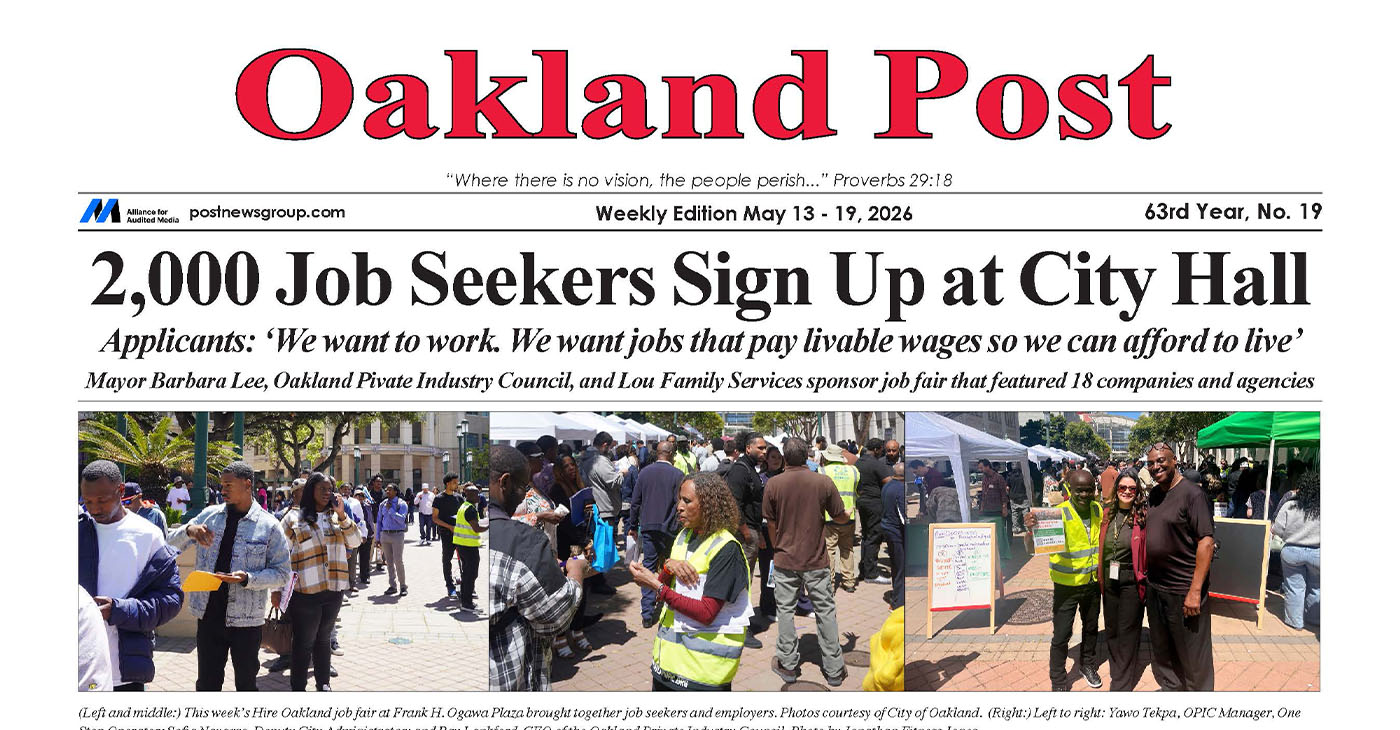
To enlarge your view of this issue, use the slider, magnifying glass icon or full page icon in the lower right corner of the browser window.


WORK FROM HOME
Home-based business with potential monthly income of $10K+ per month. A proven training system and website provided to maximize business effectiveness. Perfect job to earn side and primary income. Contact Lynne for more details: Lynne4npusa@gmail.com 800-334-0540


Oakland Mayor Pushes Charter Overhaul to Clarify Roles in City Government, Increase Accountability and Improve Service Delivery

The Ladies of Delta Sigma Theta Hold Day of Advocacy at the Capitol in Sacramento

Rep. Kamlager-Dove Introduces Bill to Protect Women in Custody After Reports Detailing Miscarriages and Neglect

Q&A with Steven Bradford: Why He Wants Your Vote for California Insurance Commissioner

OPINION: The Fire of Oakland’s Justin Jones

How Is AI Affecting California? The State Wants You to Share Your Story

California Launches Free Diaper Program for Newborns Statewide

Book Review: Books for College-Bound Students

Asm. Jackson Bill Requiring Anti-Hate Speech Training for Calif. Public Officials Sent to “Suspense File”

More and More, Black Californians Are Worried About Rising Costs of Housing, Energy, Food and Gas

Advocates Rally at State Capitol to Demand Heat Protections for Incarcerated People; More Funding for DV Survivors

Coming to Orinda: A Lecture on Finding the Strength to Heal and Move Past Fear With Divine Love

EBMUD Enshrines the Legacy of its First Black Board Member William ‘Bill’ Patterson

Against All Odds: Mary Jackson’s Journey to NASA Engineer

Supreme Court Voting Rights Ruling Reverberates From the South to California

Stanford Health Care Collaborates with Alameda Health System Affiliate, Expanding Access to Care in East Bay

Mayor Barbara Lee Proclaims April 9 as ‘100 Black Men of the Bay Area Day’

Oakland Post: Week of April 15 – 21, 2026

Up to the Job: How San Francisco’s PRC Is Providing Work Opportunities That Turn Into Lasting Stability

Building Bridges of Support: How AAPI Equity Alliance Is Strengthening California’s Anti-Hate Network

Oakland Post: Week of April 22 – 28, 2026

IN MEMORIAM: Rest in Power — Minnesota Loses a True Warrior in Yusef Mgeni

Up to the Job: How San Francisco’s PRC Is Providing Work Opportunities That Turn Into Lasting Stability

Mamdani Plans City Grocery Store in East Harlem

2026 Mazda CX‑90 PHEV Premium Plus — Luxury SUV or Overpriced Plug‑In? | Walkaround Review

Revolve Fund to Provide $20,000 to Support Food Access Efforts in Alabama Black Belt

OP-ED: Small Businesses Need Minnesota to Act on Pass-Through Tax Policy

Cuban President Vows to Defend the Country Against US Invasion

Snoop Dogg Celebrates 10 Til’ Midnight at the Compound

2026 Lucid Air Grand Touring Review — Is This $136K EV Sedan Worth It?

Hyundai Ioniq 5 Parking, Safety, and 360 View #shorts

2025 Ioniq 5 New Wiper & Powerful Performance! #shorts

Electric SUV Range: Is 259 Miles Enough? #shorts

EV Charging: How Fast Can You Charge an Electric Vehicle? #shorts

Biometric Cooling… Messaging Seats…Come on! 2025 Infiniti QX80 Autograph 4WD

Charged Up: Witness the Magic of a Fully Electric Car! #shorts

Range Rover Sport PHEV Included…: See What’s Inside This Luxury SUV! #shorts

Invisible Hood View: Perfect Parking with X-Ray Vision! #shorts

AI Is Reshaping Black Healthcare: Promise, Peril, and the Push for Improved Results in California

ESSAY: Technology and Medicine, a Primary Care Point of View

Sanctuary Cities

The RESISTANCE – FREEDOM NOW

STATE OF THE PEOPLE: Freddie

ECONOMIC BOYCOTT DAY!!!!!

I told You So

-
 Activism4 weeks ago
Up to the Job: How San Francisco’s PRC Is Providing Work Opportunities That Turn Into Lasting Stability
-
#NNPA BlackPress4 weeks ago
2026 Mazda CX‑90 PHEV Premium Plus — Luxury SUV or Overpriced Plug‑In? | Walkaround Review
-
 #NNPA BlackPress3 weeks ago
OP-ED: Small Businesses Need Minnesota to Act on Pass-Through Tax Policy
-
 #NNPA BlackPress3 weeks ago
Snoop Dogg Celebrates 10 Til’ Midnight at the Compound
-
 #NNPA BlackPress3 weeks ago
2026 Lucid Air Grand Touring Review — Is This $136K EV Sedan Worth It?
-

 #NNPA BlackPress3 weeks ago
LA28 Olympic Tickets: Register by July
-
 Activism2 weeks ago
Marin City Public Housing Residents Demand a Voice in County’s Renovation Plans
-
 #NNPA BlackPress3 weeks ago
Huffman High School’s Carlos Smith Jr. Wins Esports State Championship for Madden ’26
Entertainment
Film Review: ‘The Second Best Exotic Marigold Hotel’
Tina Desai and Dev Patel in The Second Best Exotic Marigold Hotel (Courtesy Photo)
By Dwight Brown
NNPA Film Critic
The original Best Exotic Marigold Hotel was so magical: British retirees looking for a place to nest were hoodwinked by fancy brochures into taking up residence in a boutique hotel in Jaipur, India. It turned out to be a dump. Yet, they made that hovel a home and became an extended family. That film had charm and lots of fans ($136 million at the box office). This follow-up takes those endearing pensioners a bit farther down the road.
Sonny Kapoor (Dev Patel), the over-excited 20-something manager of The Best Exotic Marigold Hotel and Muriel Donnelly (Maggie Smith), the elder co-manager, head to the States to wrangle financing for a new hotel. They make their pitch to a hospitality chain and are warned that before investment dollars can flow their way, a representative will visit their first property for an inspection.
Back in Jaipur, Sonny and Muriel are on pins and needles waiting for the inspector. They have one room left to rent and two guests show up. An Englishwomen named Lavinia (Tamsin Greig) books that last room. But when a gray-haired, distinguishing looking American named Guy (Richard Gere) arrives, Sonny thinks he is the advance man and gives Lavina’s room to him. He treats the Yank like a king, and the Brit like a vagrant. But could Sonny be wrong?
Ol Parker is back as the screenwriter, and John Madden returns as the director. Both try to give this sequel the same feel as the first, but they’ve run out of ideas. Buying a new hotel seems like a giddy capitalistic exploit. Tossing in an impending marriage for Sonny to his sweetheart Sunaina (Tina Desai) is not more than a distraction. The ongoing relationships between the other retirees evolve: Evelyn (Judi Dench) buys and sells fabric, Douglas (Bill Nighy) gives guided tours and the two still flirt. Norman (Ronald Pickup) and Carol (Diana Hardcastle) are negotiating their monogamous relationship while cruising anyone who gives them attention. And Madge (Celia Imrie) is dating (bedding) two wealthy Indian men, unable to choose either.
The hotel inspector mix-up is a red herring. Sonny’s anxiety over his wedding and a romantic rival is convoluted hype. The relationships between the hotel guests have run out of gas. The only subplot that catches fire has Guy courting Sonny’s overbearing mom (Lillete Dubey), but their shenanigans are largely kept off screen.
Madden’s direction, this time around, tends toward high-pitched romantic comedy of errors. What’s lacking from the script and his guidance is real drama, an element that gave the first Exotic Hotel depth. Also, the original production was so gritty you could feel the dust on your skin. This film is so glossy looking (cinematographer Ben Smithard, production designer Martin Childs) half the footage looks like it was filmed on a Hollywood lot.
Minus a script with gravitas, Dev Patel’s once charming animated portrayal of Sonny, feels like desperate, swing-for-the-rafters acting. Smith is too subdued and her verbal barbs at Dench have lost their bite. Gere’s performance doesn’t jazz up the cast, except he gives Celia Imrie, as the always-in-heat Madge, the opportunity to blurt out, “Be still my ovaries.” Overall, the ensemble cast still includes top-notch actors, but the material fails them.
Nonetheless, this film has its moments and it builds to a crescendo that is fun. The obligatory Bollywood dance scene works its magic. The Indian setting is still charming and off the beaten path. If the producers are contemplating a third chapter they would be wise to bring back some life-and-death situations that will give the characters a pulse.
This Exotic Hotel is likable. The first Exotic Hotel was lovable. That’s the difference.
Visit NNPA Film Critic Dwight Brown at DwightBrownInk.com
Alameda County
The Marin City Flea Market Is Back
The Marin City Flea Market returns on May 23, offering arts, crafts, vintage items, and collectibles. The market aims to uplift local vendors and celebrate cultural diversity.
By Godfrey Lee
After a long absence, Marin City will once again hold its flea market. The market will have its grand opening on Saturday, May 23, from 8 a.m. to 2 p.m. at the St. Andrew Presbyterian Church parking lot on 101 Donahue St. It will be held every fourth Saturday of the month
The market will be free to the public
There will be arts, crafts, vintage, collectibles, and other items on sale at the market. Interested vendors can contact info@marincityflea.org or text (415) 484-2984 for more information.
“The Marin City Flea Market’s mission is to uplift local vendors, celebrate cultural diversity, and provide an accessible community space where creativity, entrepreneurship, and connection can thrive,” says their website, marincityflea.org.
The flea market is sponsored and run by the Rotary Club of Marin City.
For more information, contact info@marincityflea.org. Or text to (415) 484-2984
Alameda County
Mayor Barbara Lee Declares ‘Delroy Lindo Day,’ Presents Acclaimed Actor with Key to the City
Oakland Mayor Barbara Lee honored acclaimed actor Delroy Lindo with the Key to the City and declared “Delroy Lindo Day” to celebrate his contributions to film, television, and theater.
By Carla Thomas
Oakland honored one of its most distinguished residents on May 6 as Mayor Barbara Lee presented acclaimed actor Delroy Lindo with the Key to the City and an official proclamation declaring “Delroy Lindo Day.”
The event, titled “Rooted in Legacy: Honoring Delroy Lindo,” took place at Oakland City Hall and brought together community leaders, artists, and young people for an evening centered on storytelling, cultural pride, and intergenerational connection.
Lindo, a critically acclaimed artist who lives in Oakland, was recognized for his extensive contributions to film, television, and theater, as well as his impact on the global African diaspora. Most recently the Oscar-nominated artist was recognized for his phenomenal role as a bluesman in Ryan Coogler’s “Sinners,” a winner both critically and at the box office.
His celebrated body of work included roles in “Unprisoned,” “Malcolm X”, “Clockers,” “Get Shorty,” and ”Da 5 Bloods,” among others.
“He’s brought depth, inspiration, and authenticity to the screen,” said Lee.
The program highlighted both Lindo’s artistic legacy and his influence as a mentor. A centerpiece of the evening was an intimate fireside conversation between MLee and Lindo.
“I am a living, breathing example of somebody who has achieved the American Dream,” said Lindo. “The other side of that is I walk through the world as a Black man of African descent.”
At 5 years of age, Lindo played King Balthazar in a Nativity play. And years later on Easter of 1973 in New York the Negro Ensemble Company’s play, “The River Niger” left a great impact on him.
“Seeing that production and so many Blacks in the audience, gave me an understanding that maybe I could have a career as an actor,” said Lindo.
Students from the Oakland School for the Arts delivered powerful monologues, adding a dynamic and emotional layer to the program. The students’ instructor, Tavia Percia, chairman of the school’s theatre department, watched the performance proudly. Their performances emphasized the importance of arts education and demonstrated the next generation of talent inspired by figures like Lindo.
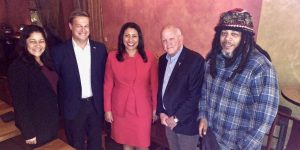
Five young men from All Tied Up Academy had the honor of presenting the “Rooted in Legacy” plaque to Lindo with Lee.
The evening also featured a cinematic showcase of Lindo’s work, offering a retrospective glimpse into his decades-long career.
The Golden State Warriors presented Lindo with a custom jersey, symbolizing the city’s appreciation for his contributions both on and off the screen.
The highlight of the evening came as Lee formally presented Lindo with the Key to the City and read the proclamation establishing “Delroy Lindo Day.” The recognition marked not only his artistic achievements but also his enduring connection to Oakland and his commitment to community engagement.
Celebrities, including filmmaker Ryan Coogler, congratulated Lindo via a video presentation. Lindo did not hold back the tears of gratitude. “I carry Oakland with me wherever I go,” said. Lindo, who is Jamaican via the UK, said he chose the Bay Area to call home with his wife and raise his son.
When young men who grew up with his son entered the council chambers, Lindo welcomed them to the stage for a hug and acknowledgement. “These young men are all honorable. I’ve watched them grow up, and they are the future,” he said. “These are three people that give me hope for this country.”
Addressing the audience, Lindo said, “You are part of the infrastructure of my life. My life would not be as it is without you. You give me more than I give you. Wherever I go, I bring Oakland with me.”
advised everyone to push past negativity of the world.
“Hold onto your dreams, particularly now in this country being fed the constant narrative that ‘we are less than,’ because we know we are more than. And kudos to Mayor Lee at the forefront for decades repping us for Oakland and America.”
“Everyone, hold fast to your purpose and charge as a human being and to the young; go for yours!”
Lindo thanked his many fans, friends, and family in the audience. Attendees included broadcaster Dave Clark, attorney John Burris, former Alameda County Supervisor Keith Carson, Dr. Albert Brooks who delivered his son, and First African Methodist Episcopal Church Rev. Rodney Smith. Screenwriter David Webb Peoples, who gave him his first film role in Australia, “The Blood of Heroes, was also in attendance.
Activism
Oakland Post: Week of May 13 – 19, 2026
The printed Weekly Edition of the Oakland Post: Week of May 13 – 19, 2026
To enlarge your view of this issue, use the slider, magnifying glass icon or full page icon in the lower right corner of the browser window.
-
Activism4 weeks ago
Up to the Job: How San Francisco’s PRC Is Providing Work Opportunities That Turn Into Lasting Stability
-
#NNPA BlackPress4 weeks ago
2026 Mazda CX‑90 PHEV Premium Plus — Luxury SUV or Overpriced Plug‑In? | Walkaround Review
-
#NNPA BlackPress3 weeks ago
OP-ED: Small Businesses Need Minnesota to Act on Pass-Through Tax Policy
-
#NNPA BlackPress3 weeks ago
Snoop Dogg Celebrates 10 Til’ Midnight at the Compound
-
#NNPA BlackPress3 weeks ago
2026 Lucid Air Grand Touring Review — Is This $136K EV Sedan Worth It?
-
#NNPA BlackPress3 weeks ago
LA28 Olympic Tickets: Register by July
-
Activism2 weeks ago
Marin City Public Housing Residents Demand a Voice in County’s Renovation Plans
-
#NNPA BlackPress3 weeks ago
Huffman High School’s Carlos Smith Jr. Wins Esports State Championship for Madden ’26

Leave a Reply