
Environment
Dr. Washington Receives Tyler Prize for His Contributions to Climate Change Research

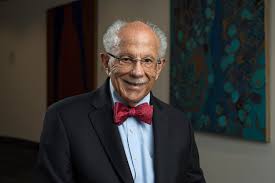
On May 3, Dr. Warren Washington became the 77th Tyler Prize Laureate for his contributions to climate change research. The Tyler Prize which is often referred to as the Nobel Prize for environmental achievement comes with a $200,000 award.
Dr. Washington shares the prize with Dr. Michael Mann, who has also done outstanding climate change research.
Dr. Washington is among the first scientists to develop computer models that demonstrates human activities contribute to changes in climate.
A distinguished scholar at the National Center for Atmospheric Research (NCAR) , he is considered a global leader in climate modeling. He has advised six U.S. Presidents on Climate Change: Carter, Reagan, Bush Sr., Clinton, Bush Jr., and Obama. Dr. Washington’s public service was recognized by President Obama, who awarded him the 2010 National Medal of Science, the highest scientific award given in the United States.
Dr. Washington holds a bachelor’s degree in physics and a master’s degree in meteorology both from Oregon State University, as well as a Ph.D. in meteorology from Pennsylvania State University. Washington’s pioneering work on global climate models has influenced decades of research into climate change. He was honored for his crucial contributions to climate science and his tireless dedication to communicating his research to policymakers and the public. The Tyler Prize recognizes his efforts in explaining key tenets of climate science to policymakers and other top level scientists. He was the first African American to serve as President of the National Meteorological Society. He has served on the National Science Board.
In making this award to Dr. Washington, the Tyler Prize Executive Committee said that “he has not only advanced our knowledge of climate change but also demonstrated exceptional courage and commitment to public policy.”

Business
Gubernatorial Candidate Steve Hilton Blasts California New Tire Rules; Newsom Hits Back
Newsom defended the regulations Aug. 19, citing the commission’s projected savings for consumers. “I think it was a good choice,” said Newsom. “Save a billion dollars a year in fuel. Talk about an affordability agenda, that makes sense to me.”

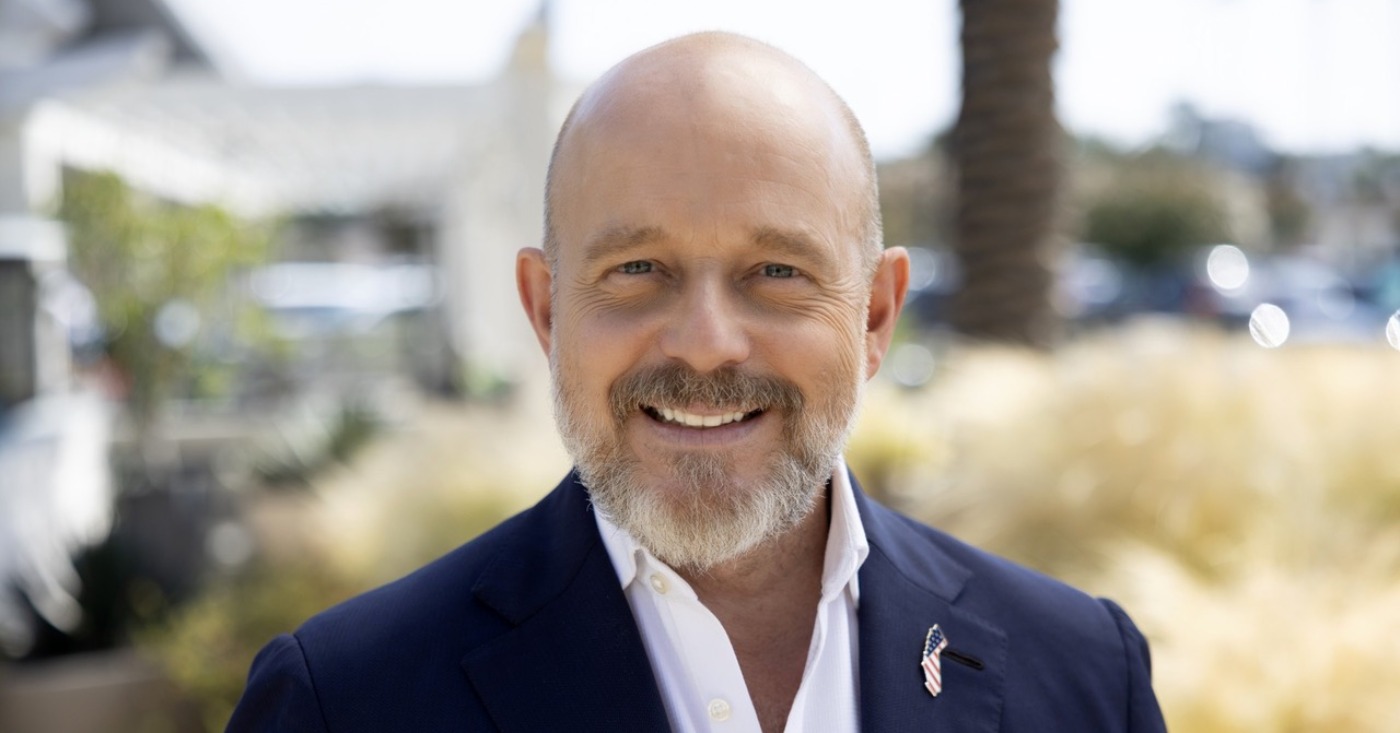
Republican gubernatorial candidate Steve Hilton is criticizing California’s new replacement-tire efficiency standards, arguing they will limit consumer choice and increase costs for drivers.
Gov. Gavin Newsom, however, says the regulations will save consumers money.
Hilton protested the standards Aug. 20 outside the California Energy Commission in Sacramento, where he and supporters chanted, “Hands off our tires.” The commission unanimously approved the regulations Aug. 17, making California the first state to adopt energy-efficiency standards for replacement tires.
“We are done with these bureaucrats and these politicians in our state, making everything so insanely expensive,” Hilton said at the protest.
Hilton said that, if elected governor, he would eliminate or defund the Energy Commission. His opposition to the tire standards is part of his broader criticism of California’s high cost of living.
Newsom defended the regulations Aug. 19, citing the commission’s projected savings for consumers.
“I think it was a good choice,” said Newsom. “Save a billion dollars a year in fuel. Talk about an affordability agenda, that makes sense to me.”

The Replacement Tire Efficiency Program sets limits on rolling resistance, which measures how much energy a tire requires to move along a road. Tires with lower rolling resistance can improve a gasoline-powered vehicle’s fuel economy or extend an electric vehicle’s driving range.
The first phase will take effect in 2029, setting a maximum rolling resistance of 9.1 newtons per kilonewton. A stricter limit of 7.2 newtons per kilonewton will take effect in 2033.
The Energy Commission says the standards will ensure that replacement tires are, on average, at least as energy efficient as those installed on new vehicles. The agency estimates the regulations will save Californians nearly $1 billion annually in gasoline and electricity costs while reducing carbon dioxide emissions by two million metric tons a year.
Some tire manufacturers, however, have raised concerns about the effect on prices and product availability. Goodyear estimates that about 70% of replacement tires currently sold in California would not meet the 2033 standard and argues that the regulations could increase costs for consumers.
The Energy Commission estimates the standards will add about $1.50 to the cost of each tire during the first phase and $6.50 per tire beginning in 2033. The commission projects that a driver with a gasoline-powered vehicle could save about $179 in fuel costs over the life of a set of tires meeting the 2033 standard.
The regulations exempt several specialty products, including competition, winter, used, retreaded, motorcycle and certain off-road tires.

Black History
$5 Billion Coliseum Vision Puts Oakland Jobs, Businesses at Center
Reynolds said Black and Brown contractors have historically lacked the bonding, insurance, equipment and staffing required to compete for large contracts because they were denied opportunities to expand.

OAKLAND – A sweeping, multiphase redevelopment of the Oakland Coliseum site led by Ray Bobbitt, president of the African American Sports and Entertainment Group (AASEG), and businessman James “Jim” Reynolds Jr., could eventually attract between $3 billion and $5 billion in investment.
Reynolds said the first phase, estimated at $1 billion to $1.5 billion, could include housing, hotels, restaurants, entertainment venues, open space and opportunities for local small businesses.
“We are going to transform the entire area with housing, hotels, with an infrastructure that benefits the community,” Reynolds said.
He also wants to attract major entertainment partners and position Oakland to compete with venues in San Francisco and San Jose. Reynolds said the city already possesses natural assets that other cities spend fortunes trying to create.
“One of the most naturally beautiful cities I’ve ever been to,” he said. “In Oakland, if you do nothing, it’s beautiful naturally: lakes, the mountains, the scenery, the open space, the weather.”
Reynolds’ vision, however, extends beyond buildings and entertainment. He is also focused on which businesses receive contracts and which residents benefit from the jobs and economic opportunities the project creates.

Reynolds said Black and Brown contractors have historically lacked the bonding, insurance, equipment and staffing required to compete for large contracts because they were denied opportunities to expand.
“Why would you build a big business when you know no one was going to hire you to do the job?” Reynolds asked.
He recalled working with longtime business partner Earvin “Magic” Johnson to encourage minority-owned firms to compete for larger contracts. About 1,000 businesses attended one outreach event after receiving assurances that opportunities to serve as prime contractors were real.
Reynolds wants to bring the same approach to Oakland.
“I don’t need goals and set-asides to figure out how to give Black companies a chance to be a prime,” he said.
He also wants Black businesses to move beyond seeking only small portions of projects or subcontracting roles.

“When we run the concessions, we pick who has a concession,” Reynolds said, citing partnerships involving Johnson, LL Cool J and Stephen A. Smith.
The same principle should apply to construction, entrepreneurship and workforce development, he said.
“Job training and opportunities to have Blacks lead something like this matter,” Reynolds said.
Reynolds also wants young Oakland residents connected to the jobs and career pathways created by the redevelopment.
“They’re going to have jobs, job training, and opportunities to work,” Reynolds said.
He rejects assumptions that Black youth and Black-owned companies cannot manage major responsibilities.
“I’m not going to sit here like others who have been in positions like this and doubt that Black people can do certain things,” Reynolds said.
For Reynolds and Bobbitt, the Coliseum redevelopment is an opportunity to create more than a replacement for the professional sports teams Oakland lost. Bobbitt contributes deep Oakland roots, community relationships and years of persistence, while Reynolds brings capital-market experience, global business relationships and a record of structuring enormous transactions.
Together, they envision a destination that attracts visitors while creating jobs, businesses and ownership opportunities for Oakland residents.
“Thank you, Jim, for believing in Oakland and investing,” Bobbitt said.
CEO of the Oakland African American Chamber of Commerce Cathy Adams, who wrote a letter of support for AASEG at a time when many doubted the feasibility of their goals, said the Coliseum area development plan will become the example of how Black-owned businesses and contractors can help close the disparity gap in Oakland.
Next week, Part 2: Len Turner and local business owners can benefit.
Business
Returning to Its Roots, the Oakland Black-Eyed Pea Festival Partners with the Freedom Farmers Market Sept. 12
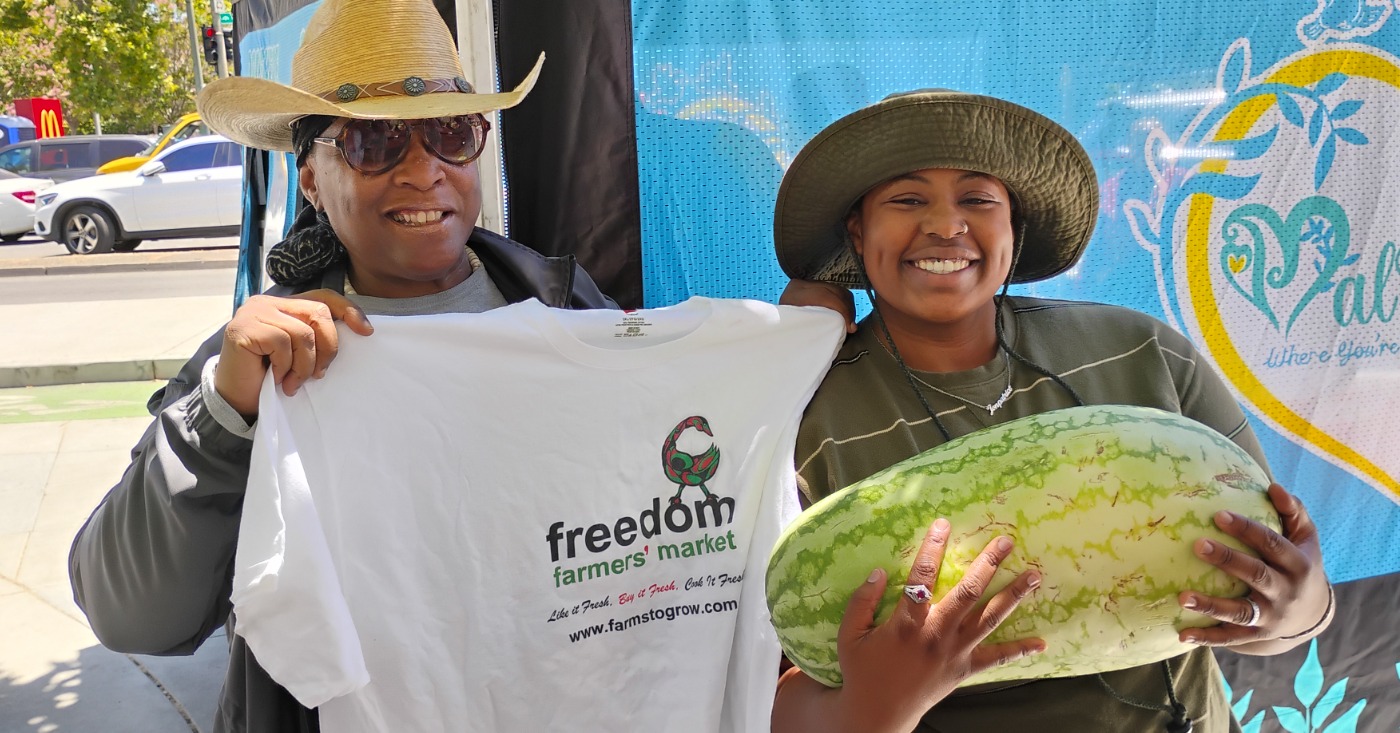
POST NEWS GROUP — Freedom Farmers’ Market (FFM) vendors sell produce and promote wellness and nutrition through organic herbs, massage, and other gift items from July through October on the second and fourth Saturdays at a dozen canopies in the last block of Shattuck Avenue, where it merges with Telegraph Avenue.
By
The Oakland Black-Eyed Pea Festival (BEPF), a celebration of African American traditional music, food and art, will return to its roots through a partnership with Farms to Grow, Inc., the hosts of the Freedom Farmers’ Market on Sept. 12.
Now in its 11th year, the downsized festival sponsored by Omnira Institute will open with presentations by Wakan Wiya Two-Spirit Drum, a drum invocation for the ancestors by Awon Ohun Omnira, a performance by Andre Thierry of Accordion Soul, and most importantly, fresh black-eyed peas for sale.
Freedom Farmers’ Market (FFM) vendors sell produce and promote wellness and nutrition through organic herbs, massage, and other gift items from July through October on the second and fourth Saturdays at a dozen canopies in the last block of Shattuck Avenue, where it merges with Telegraph Avenue.
Over the years, FFM vendors have appeared at the Black-Eyed Pea Festival and vice versa, so this collaboration is like a family reunion.
Farms to Grow, Inc. Executive Director Elaine Smith said the collaboration with Omnira Institute was an opportunity she couldn’t refuse. “People talk about community and unity for Black people – I always want to be an example of what has to be done,” Smith said. “Anyway that we can partner with our people, we want to do that.”

Charlotte Jackson, a longtime vendor with FFM and the festival, had been known for her jellies, jams and chow-chow through Pots n’ Jars. For the last several years, she hasn’t been able to find a commercial kitchen she can afford, so she began selling vegan soap and skin care products that her son and his partner produce under the name Lather and More.
“It’s been a blessing,” said Jackson, who will tell her customers that although they can order the wares from the website, there’s no such thing as ‘smell-avision.” From her table, she encourages passers-by to take a sniff of the soaps, then directs them to the nearby booths.
Jackson functions as a sort of ‘town crier’ of ‘buying Black,’ never failing to encourage Black people to take their mule or Pontiac or Chevrolet and steer it toward Black businesses like Mandela Market.
Likewise, the Black-Eyed Pea Festival was established to encourage Black entrepreneurship by providing a space for Black creatives to sell their handmade or original designs and products without competing with commercially produced goods.
It also served as a way to both commemorate and invigorate memory of the once-thriving Black community of West/North Oakland before it was divided by highways, BART, and then ravaged by the crack cocaine epidemic.
“For one day, I wanted to invoke the success of that community through the sound of music, the taste of soul food and black-eyed peas and the beauty of our art,” Ravernell said.
Once deciding to follow through on the idea of holding a festival celebrating African American traditions, Ravernell settled on using the black-eyed pea as its symbol because of its pride of place in Black people’s consciousness on New Year’s Day and because the peas were originally cultivated in Africa.
Learning that Fresno farmer Wil Scott, former president of the California African American Farmers Association, grew black-eyed peas as well as other legacy crops that are the foundation of a soul food menu, Ravernell was intent on ensuring Scott’s presence at the first festival in 2014. Whenever he could, and whenever the weather yielded a bountiful crop, Scott would bring his black-eyed peas to the festival, shelled or on the pods.
Originally cultivated in Africa, the black-eyed pea is believed to have been brought to the U.S. hidden in the hair of African captives brought to the Western Hemisphere during the holocaust of the Atlantic Slave Trade.
Known to grow plentifully even in poor soil, the pea was associated with abundance in Africa and later, in the U.S., with good luck.
She also learned that black-eyed peas nourish poor soil, that they are a very good source of nutrition, and that they probably contributed to the longevity of the enslaved.
“I thought the black-eyed pea, its story and its significance for Black people made it a great symbol to represent Black culture,” she said. In spite of everything they endured, Black people emerged from slavery and Jim Crow as masters of making a lot from a little, creating a culture that would be emulated and imitated at home and abroad.
Feeling that many people know only the most recent iterations of Black music – Hip Hop and R&B – she created the festival to promote the music of earlier eras, which reflect the thoughts and feelings of Black people over time.
That’s why the festival highlights straight-ahead jazz, gospel, zydeco and the Second Line of the New Orleans jazz funeral.
“It’s not enough to remember,” Ravernell said. “We need to actively nourish the roots of our culture.”



Don’t Let scammers Crash Your School Year

BOOK REVIEW — Curved Air: A Biography of Sickle Cell Anemia and the Quest to Cure the First Molecular Disease

California’s Legal Cannabis Market Hits $8 Billion as State Touts Progress on Fighting Drugs, Crime

Blacks and Latinos Clash Over LA’s Barrio Run; Mayor Karen Bass Calls for Dialogue Across Racial, Neighborhood Lines

Asm. Smallwood-Cuevas’s Bill Repealing ‘Racist’ CalWORKs ‘Man-in-the-House’ Rule Clears Legislature

Asm. Smallwood-Cuevas’s Bill Repealing ‘Racist’ CalWORKs ‘Man-in-the-House’ Rule Clears Legislature

‘Ready to See These Bills Become Law’: Sen. Weber’s Package of 15 Bills Advance to Gov. Newsom’s Desk

‘Ready to See These Bills Become Law’: Sen. Weber’s Package of 15 Bills Advance to Gov. Newsom’s Desk

Tarsha Jordan’s Bonita the Bumble Bee Brings STEAM Learning to Life

On Your November Ballot: Prop 45 Would Speed Up Environmental and Public Project Reviews

Henry O. Flipper: A Trailblazer at West Point and Beyond

California Legislature Sends Historic Native American Apology Bill to Gov. Newsom’s Desk

NBA All-Star Damian Lillard Returns Home for 15th Annual Backpack Giveaway

Alameda County DA Sees Gun Violence Greatest Threat to Black Community

Richmond Tiny House Village Farm & Garden Set to Open Gates on Sept. 26

Department of Homeland Security Demands California Secretary of State Shirley N. Weber Scrub Voter Rolls

New Judge Could Decide if Karmelo Anthony Gets a New Trial

“The Power to See Threats Sooner”: Gov. Newsom, Safety Officials Showcase California’s Investments in Hi-Tech Wildfire Prevention

Alpha Kappa Alpha Sorority, Inc. Celebrates New North Atlantic Regional Director

California Sen. Padilla Joins Colleagues to Introduce Bill Imposing Term Limits on Supreme Court Justices

Less Affluent School Districts, Including Sacramento City, Face Threat of State Takeover

Car Wash Workers Cope with Lingering Impacts of ICE Raids

Oakland Post: Week of July 29 – August 4, 2026

How Oakland’s Courtsmith is Scaling its Business and Local Impact

ESSAY: California Can Close Its Colorectal Cancer Gap

Oakland Post: Week of August 5 – 11, 2026

As Part of Your Back-to- School Checklist, Vaccinate

Oakland ‘Port Serves as a Powerful Engine for Good Jobs and Economic Development

Gov. Newsom Signs New Affordable Housing Legislation

Gov. Newsom Announces $109.6 Million in Funding for 278 Supportive Homes in Bakersfield, Contra Costa, Sacramento and Fresno

The Conversation With Al McFarlane 6/23/26

Media Monday 6/22/26

LIVE! ASK ALMA! — TUES. 6.23.26 7PM EST

Car Buying Secrets: 4 Hidden Checks Before You Sign!

Is This 550 HP Charger Worth YOUR Money? AutoNetwork Review

Celebrating Juneteenth – Frederick Douglass on education and resistance

LIVE! — ASK ALMA! — TUES. 6.19.26 7PM EST

Hyundai Ioniq 5 Parking, Safety, and 360 View #shorts

2025 Ioniq 5 New Wiper & Powerful Performance! #shorts

Electric SUV Range: Is 259 Miles Enough? #shorts

EV Charging: How Fast Can You Charge an Electric Vehicle? #shorts

Biometric Cooling… Messaging Seats…Come on! 2025 Infiniti QX80 Autograph 4WD

Charged Up: Witness the Magic of a Fully Electric Car! #shorts

Range Rover Sport PHEV Included…: See What’s Inside This Luxury SUV! #shorts

Invisible Hood View: Perfect Parking with X-Ray Vision! #shorts
-
 Community4 weeks ago
Less Affluent School Districts, Including Sacramento City, Face Threat of State Takeover
-
 Commentary4 weeks ago
ESSAY: California Can Close Its Colorectal Cancer Gap
-

 Business4 weeks ago
California Hispanic Chambers of Commerce Unveils: ‘Powering the Future’ Theme for 47th Annual Statewide Convention
-
 Community4 weeks ago
Four Candidates, Including Incumbent Barbara Lee, Qualify for Oakland Mayor’s Race
-

 Activism4 weeks ago
Oakland Post: Week of August 12 – 18, 2026
-

 Business4 weeks ago
From Blueprint to Breakthrough: Tackling Affordable Housing in Oakland
-

 Black History4 weeks ago
Oakland Observes Black August with Block Parties, Film Showings, Workshops
-

 Commentary4 weeks ago
COMMENTARY: Why Local School Tax Measure G1 Will Not Be on the November Ballot
