
Politics
Democrats Seek Relief from Health Law Penalties


President Barack Obama speaks during the Organizing for America National Health Care Forum at the Democratic National Committee headquarters in Washington on Thursday, Aug. 20, 2009. (AP Photo/Alex Brandon)
Ricardo Alonso-Zaldivar, ASSOCIATED PRESS
WASHINGTON (AP) — The official sign-up season for President Barack Obama’s health care law may be over, but leading congressional Democrats say millions of Americans facing new tax penalties deserve a second chance.
Three senior House members strongly urged the administration Monday to grant a special sign-up opportunity for uninsured taxpayers who will be facing fines under the law for the first time this year.
The three are Michigan’s Sander Levin, the ranking Democrat on the Ways and Means Committee, and Democratic Reps. Jim McDermott of Washington, and Lloyd Doggett of Texas. All worked to help steer Obama’s law through rancorous congressional debates from 2009-2010.
The lawmakers say they are concerned that many of their constituents will find out about the penalties after it’s already too late for them to sign up for coverage, since open enrollment ended Sunday.
That means they could wind up uninsured for another year, only to owe substantially higher fines in 2016. The fines are collected through the income tax system.
“For the many families who may now be about to pay a penalty, there should be an opportunity to avoid both further penalties and to obtain affordable health insurance,” said Doggett.
This year is the first time ordinary Americans will experience the complicated interactions between the health care law and taxes. Based on congressional analysis, tax preparation giant H&R Block says roughly 4 million uninsured people will pay penalties.
The IRS has warned that health-care related issues will make its job harder this filing season and taxpayers should be prepared for long call-center hold times, particularly since the GOP-led Congress has been loath to approve more money for the agency.
“Open enrollment period ended before many Americans filed their taxes,” the three lawmakers said in a statement. “Without a special enrollment period, many people (who will be paying fines) will not have another opportunity to get health coverage this year.
“A special enrollment period will not only help many Americans avoid making an even larger payment next year, but, more importantly, it will help them gain quality health insurance for 2015,” the lawmakers added.
So far, administration officials have deflected questions about whether an extension will be granted. Health and Human Services Secretary Sylvia M. Burwell has authority to grant special enrollment periods under certain circumstances.
Supporters of the law say an extension would mainly help low- to middle-income uninsured people, the same group that Obama’s coverage expansion was intended to serve. But Republicans may criticize it as another tweak to what they see as unworkable “Obamacare.”
The health care law imposes fines on uninsured people whose incomes are deemed high enough to enable them to afford coverage. The goal is to broaden the pool of insured people, helping to keep premiums in check for everybody.
The law also offers subsidies to lower the cost of private coverage for people who don’t have job-based health care. That financial assistance is provided through a new tax credit.
Although the tax credit subsidies cover most of the premiums for many people, the coverage requirement and the fines that enforce it remain deeply unpopular.
And the cost of being uninsured in America is going up significantly.
For 2014, the fine was the greater of $95 per person or 1 percent of household income above the threshold for filing taxes. That fine will be collected when taxpayers file their 2014 returns.
But this year the fine will jump to the greater of 2 percent of income or $325. By 2016, the average fine will be about $1,100, based on government figures.
Polls show that many taxpayers are unaware of the potential financial exposure.
Floyd Cable, a real estate agent from Wichita Falls, Texas, said the escalating fines were part of the motivation for him and his wife to sign up last week. Both are self-employed, and stretching to pay health insurance premiums has been a struggle.
“We have been going without insurance the last couple of years just because the rates are so astronomical,” Cable said.
But they were also concerned they could wind up on the wrong side of rising penalties. And, being in his early 60s, Cable said he recognizes the value of having health insurance against unexpected illness.
An extension would probably help people still on the fence, like he was.
“Anything that could be done to give people more time to sort through this, is not only a good move for the administration, but just makes common sense,” Cable said.
Since both the subsidies and penalties under the health law are administered through the tax system, some experts have urged the Obama administration to permanently schedule sign-up season to overlap with tax-filing season.
Copyright 2015 The Associated Press. All rights reserved. This material may not be published, broadcast, rewritten or redistributed.
###








Activism
Oakland Post: Week of April 1 – 7, 2026
The printed Weekly Edition of the Oakland Post: Week of April 1 – 7, 2026

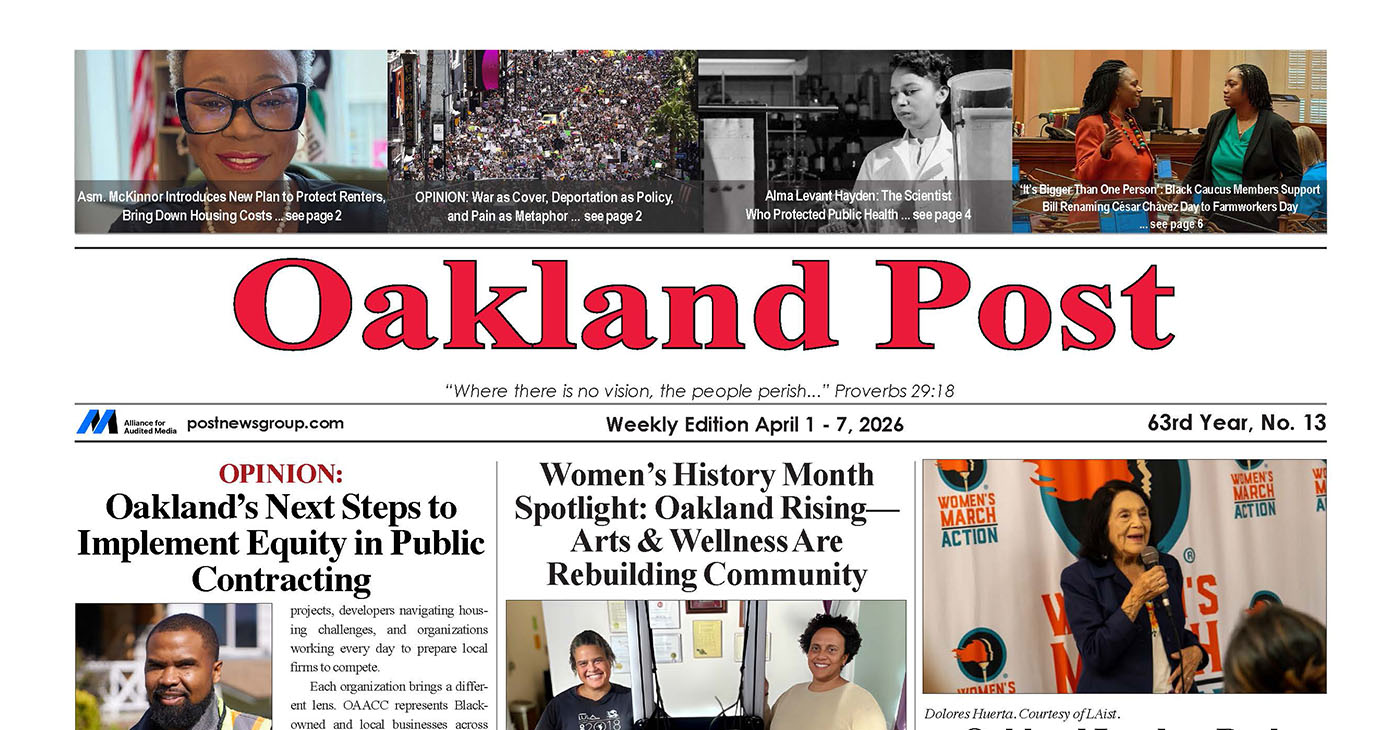
To enlarge your view of this issue, use the slider, magnifying glass icon or full page icon in the lower right corner of the browser window.

Activism
Oakland Post: Week of March 18 – 24, 2026
The printed Weekly Edition of the Oakland Post: Week of March 18 – 24, 2026

To enlarge your view of this issue, use the slider, magnifying glass icon or full page icon in the lower right corner of the browser window.
Activism
Oakland Post: Week of March 11 -17, 2026
The printed Weekly Edition of the Oakland Post: Week of March 11 – 17, 2026

To enlarge your view of this issue, use the slider, magnifying glass icon or full page icon in the lower right corner of the browser window.

WORK FROM HOME
Home-based business with potential monthly income of $10K+ per month. A proven training system and website provided to maximize business effectiveness. Perfect job to earn side and primary income. Contact Lynne for more details: Lynne4npusa@gmail.com 800-334-0540


Oakland Post: Week of April 1 – 7, 2026

Black Artists in America, Installation Three Wraps at the Dixon Gallery and Gardens

Grief, Advocacy, and Education: A Counselor Reflects on Black Maternal Health

Future of Florida’s Black History Museum in Limbo

New Research Shows the Many Benefits of Early Learning

South Hampton K-8 Students Among Top 10 Finalists for Samsung’s ‘Solve for Tomorrow’ Competition

Cuba: No Negotiation with US on the President or Political System

Brooklyn Academy of Music Names Jamaican-Born Tamara McCaw as President

Trinidad & Tobego – U.S. Launches WhatsApp Channel for American Citizens in the Country

Oakland Post: Week of March 18 – 24, 2026

AI Innovation vs. Ethics and Environmental Impact

AI, Web3, and Digital Reparations

What If You Owned Your AI Agent?

Season 7, Episode 3 – January Reporter’s Roundtable 📱

Season 7, Episode 3 – January Reporter’s Roundtable

Reflecting on Black History Milestones in Birmingham AL

Oakland Post: Week of February 25 – March 3, 2026

PRESS ROOM: NBA Hall of Fame Nominee Terry Cummings Joins 100 Black Men of DeKalb County to Launch Victory & Values Initiative

Oakland Post: Week of March 4 – 10, 2026

Trump’s MAGA Allies are Creating Executive Order Plan to Steal the 2026 Midterms

U.S. manufacturing rebounds – how foundry services are adapting to rising demand

Poll Shows Support for Policies That Help Families Afford Child Care

OP-ED: One Hundred Years of Black Workers Telling the Truth

Oakland Post: Week of March 11 -17, 2026

Advancements in solar technology that are changing the way we power the world
Oakland Post: Week of March 18 – 24, 2026

Woman’s Search for Family’s Roots Leads to Ancestor John T. Ward – A Successful Entrepreneur and Conductor on the Underground Railroad

COMMENTARY: Women of Color Shape Our Past and Future

PRESS ROOM: Civil Rights TV Launches in Selma as the World’s First 24/7 Civil Rights Television Network

Financial Wellness and Mental Health: Managing Money Stress in College

Hyundai Ioniq 5 Parking, Safety, and 360 View #shorts

2025 Ioniq 5 New Wiper & Powerful Performance! #shorts

Electric SUV Range: Is 259 Miles Enough? #shorts

EV Charging: How Fast Can You Charge an Electric Vehicle? #shorts

Biometric Cooling… Messaging Seats…Come on! 2025 Infiniti QX80 Autograph 4WD

Charged Up: Witness the Magic of a Fully Electric Car! #shorts

Range Rover Sport PHEV Included…: See What’s Inside This Luxury SUV! #shorts

Invisible Hood View: Perfect Parking with X-Ray Vision! #shorts

AI Is Reshaping Black Healthcare: Promise, Peril, and the Push for Improved Results in California

ESSAY: Technology and Medicine, a Primary Care Point of View

Sanctuary Cities

The RESISTANCE – FREEDOM NOW

STATE OF THE PEOPLE: Freddie

ECONOMIC BOYCOTT DAY!!!!!

I told You So
-
 Activism3 weeks ago
Oakland Post: Week of March 11 -17, 2026
-
 Activism2 weeks ago
Oakland Post: Week of March 18 – 24, 2026
-
 #NNPA BlackPress4 weeks ago
Woman’s Search for Family’s Roots Leads to Ancestor John T. Ward – A Successful Entrepreneur and Conductor on the Underground Railroad
-
 #NNPA BlackPress4 weeks ago
COMMENTARY: Women of Color Shape Our Past and Future
-
 Advice3 weeks ago
Financial Wellness and Mental Health: Managing Money Stress in College
-

 #NNPA BlackPress4 weeks ago
Advocates Raise Alarm Over ICE Operation, MOU and Detention Risks in Baltimore County
-

 #NNPA BlackPress4 weeks ago
Pete Buttigieg to Join Mayor Randall Woodfin for Community Town Hall in Birmingham
-
 #NNPA BlackPress2 weeks ago
Brooklyn Academy of Music Names Jamaican-Born Tamara McCaw as President
