
Environment
Communities of color speak out in push for Green New Deal
LOUISIANA WEEKLY — On Tuesday, May 7, hundreds gathered at Congo Square and marched to Mahalia Jackson Theater as part of the national Green New Deal tour. The Gulf Coast Center for Law and Policy and more than forty other local organizations sponsored the event, in conjunction with the Sunrise Movement, a group of youth advocates dedicated to advancing climate change legislation.

By Meghan Holmes
On Tuesday, May 7, hundreds gathered at Congo Square and marched to Mahalia Jackson Theater as part of the national Green New Deal tour.
The Gulf Coast Center for Law and Policy and more than forty other local organizations sponsored the event, in conjunction with the Sunrise Movement, a group of youth advocates dedicated to advancing climate change legislation.
Indigenous and Black community leaders anchored the proceedings, with speakers highlighting the disproportionate impact environmental degradation and climate change have on communities of color, as well as insisting that future solutions to climate change honor Black and Indigenous communities.
“The purpose of this event is simple,” said Colette Pichon Battle, executive director with the Gulf Coast Center for Law and Policy. “We are here to honor Indigenous and Black leadership around caring for each other and caring for this earth; we are here to create a safe, inclusive, space so we can connect the dots between climate change, disaster and jobs, and we are here to launch Gulf South for the Green New Deal, a multi-state effort rooted in the unique reality of the Gulf South.”
The event began with drumming at Congo Square. Members of the Houma nation, as well as Mardi Gras Indians from the Golden Feather Hunters tribe both, participated, and Principal Chief August Creppell spoke first. “We are standing on sacred ground,” he said. “We did ceremonial dances here in the 1700s. We were the first people here, but we are all here as one people. We have so much power when we are together.”
After speeches honoring both Indigenous and Black traditions, event-goers marched to Mahalia Jackson Theater, where several speakers as well, as a panel of youth activists, discussed the Green New Deal and its potential impacts on the Gulf South. Several short films also played, one of which highlighted the impacts of industry in St. James Parish.
“This is not just about reducing carbon emissions,” Pichon Battle said. “We are at the intersection of climate change and environmental justice, and we want good jobs and restitution and reparations to the communities forced to live in this. We have to look at what oil and gas in Louisiana does to our communities. We do not just get to be proud of the jobs. We have to stand with the people of St. James Parish.”
At the national level, more than 90 congressional representatives and 13 senators support Green New Deal legislation. Current policy is nebulous but focuses on mitigating future impacts of climate change while also creating high-paying, sustainable jobs. Republicans and many moderate Democrats dismiss the plans, but youth advocates and more than 600 organizations across the country insist that action must be taken to stop the impacts of climate change.
“We want to make climate action rooted in racial and economic justice a national priority in every corner of this country,” said Varshini Prakash, co-founder and executive director of the Sunrise Movement, who spoke at the event. “We have known about climate issues for twice as long as the people on this panel have been alive, and our politicians have failed us, and are collecting profits from industries that are jeopardizing our future.”
Last fall, members of the Sunrise Movement went to Nancy Pelosi’s office along with Alexandria Ocasio-Cortez, demanding that the Democratic party embrace Green New Deal legislation. The movement has since begun traveling across the country and hosting events like the one at Mahalia Jackson Theater, encouraging communities to organize and demand action from local leaders.
“We have been here before,” said Flozell Daniels, executive director of Foundation for Louisiana. “This isn’t just Hurricane Katrina; this isn’t just the BP oil spill; this is decades of oppression and centuries of divestment and underinvestment in Black and Indigenous communities. Specific policies, especially those surrounding disaster recovery, make rich people richer, and poor people poorer. But, the good news is, because of this we have a history of resistance, and we know we have to protect marginalized people. Climate change isn’t just an environmental issue, there are consequences to tourism, transit, food access, and housing, as well as other sectors of our economy.”
Speakers stressed the Gulf South’s unique position in the fight to mitigate climate change and called on the community to advocate for Green New Deal policies to their local and national leaders.
“We rebuilt New Orleans and the Gulf Coast after Katrina, and we have learned what to do and what not to do,” Pichon Battle said. “We should be a leader rebuilding this country’s infrastructure, and creating millions of jobs while we do it.”
This article originally appeared in the Louisiana Weekly.











Business
Returning to Its Roots, the Oakland Black-Eyed Pea Festival Partners with the Freedom Farmers Market Sept. 12
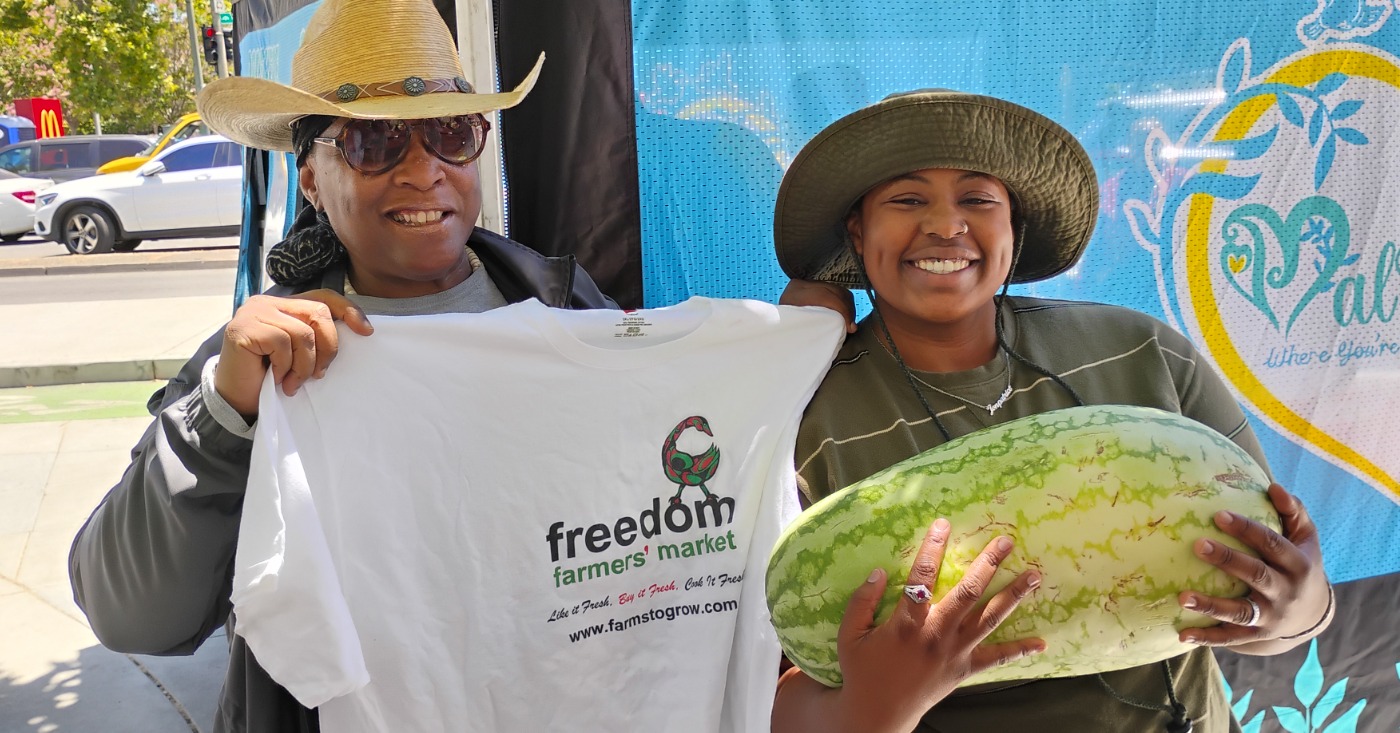
POST NEWS GROUP — Freedom Farmers’ Market (FFM) vendors sell produce and promote wellness and nutrition through organic herbs, massage, and other gift items from July through October on the second and fourth Saturdays at a dozen canopies in the last block of Shattuck Avenue, where it merges with Telegraph Avenue.

By
The Oakland Black-Eyed Pea Festival (BEPF), a celebration of African American traditional music, food and art, will return to its roots through a partnership with Farms to Grow, Inc., the hosts of the Freedom Farmers’ Market on Sept. 12.
Now in its 11th year, the downsized festival sponsored by Omnira Institute will open with presentations by Wakan Wiya Two-Spirit Drum, a drum invocation for the ancestors by Awon Ohun Omnira, a performance by Andre Thierry of Accordion Soul, and most importantly, fresh black-eyed peas for sale.
Freedom Farmers’ Market (FFM) vendors sell produce and promote wellness and nutrition through organic herbs, massage, and other gift items from July through October on the second and fourth Saturdays at a dozen canopies in the last block of Shattuck Avenue, where it merges with Telegraph Avenue.
Over the years, FFM vendors have appeared at the Black-Eyed Pea Festival and vice versa, so this collaboration is like a family reunion.
Farms to Grow, Inc. Executive Director Elaine Smith said the collaboration with Omnira Institute was an opportunity she couldn’t refuse. “People talk about community and unity for Black people – I always want to be an example of what has to be done,” Smith said. “Anyway that we can partner with our people, we want to do that.”

Charlotte Jackson, a longtime vendor with FFM and the festival, had been known for her jellies, jams and chow-chow through Pots n’ Jars. For the last several years, she hasn’t been able to find a commercial kitchen she can afford, so she began selling vegan soap and skin care products that her son and his partner produce under the name Lather and More.
“It’s been a blessing,” said Jackson, who will tell her customers that although they can order the wares from the website, there’s no such thing as ‘smell-avision.” From her table, she encourages passers-by to take a sniff of the soaps, then directs them to the nearby booths.
Jackson functions as a sort of ‘town crier’ of ‘buying Black,’ never failing to encourage Black people to take their mule or Pontiac or Chevrolet and steer it toward Black businesses like Mandela Market.
Likewise, the Black-Eyed Pea Festival was established to encourage Black entrepreneurship by providing a space for Black creatives to sell their handmade or original designs and products without competing with commercially produced goods.
It also served as a way to both commemorate and invigorate memory of the once-thriving Black community of West/North Oakland before it was divided by highways, BART, and then ravaged by the crack cocaine epidemic.
“For one day, I wanted to invoke the success of that community through the sound of music, the taste of soul food and black-eyed peas and the beauty of our art,” Ravernell said.
Once deciding to follow through on the idea of holding a festival celebrating African American traditions, Ravernell settled on using the black-eyed pea as its symbol because of its pride of place in Black people’s consciousness on New Year’s Day and because the peas were originally cultivated in Africa.
Learning that Fresno farmer Wil Scott, former president of the California African American Farmers Association, grew black-eyed peas as well as other legacy crops that are the foundation of a soul food menu, Ravernell was intent on ensuring Scott’s presence at the first festival in 2014. Whenever he could, and whenever the weather yielded a bountiful crop, Scott would bring his black-eyed peas to the festival, shelled or on the pods.
Originally cultivated in Africa, the black-eyed pea is believed to have been brought to the U.S. hidden in the hair of African captives brought to the Western Hemisphere during the holocaust of the Atlantic Slave Trade.
Known to grow plentifully even in poor soil, the pea was associated with abundance in Africa and later, in the U.S., with good luck.
She also learned that black-eyed peas nourish poor soil, that they are a very good source of nutrition, and that they probably contributed to the longevity of the enslaved.
“I thought the black-eyed pea, its story and its significance for Black people made it a great symbol to represent Black culture,” she said. In spite of everything they endured, Black people emerged from slavery and Jim Crow as masters of making a lot from a little, creating a culture that would be emulated and imitated at home and abroad.
Feeling that many people know only the most recent iterations of Black music – Hip Hop and R&B – she created the festival to promote the music of earlier eras, which reflect the thoughts and feelings of Black people over time.
That’s why the festival highlights straight-ahead jazz, gospel, zydeco and the Second Line of the New Orleans jazz funeral.
“It’s not enough to remember,” Ravernell said. “We need to actively nourish the roots of our culture.”

Environment
“The Power to See Threats Sooner”: Gov. Newsom, Safety Officials Showcase California’s Investments in Hi-Tech Wildfire Prevention
On July 21, Gov. Gavin Newsom held a presentation in Sacramento, alongside state emergency officials, to showcase California’s major investments in cutting-edge firefighting technology and wildfire prevention. The media event took place at McClellan Airport in Sacramento County,

On July 21, Gov. Gavin Newsom held a presentation in Sacramento, alongside state emergency officials, to showcase California’s major investments in cutting-edge firefighting technology and wildfire prevention.
The media event took place at McClellan Airport in Sacramento County, a primary hub for state aerial firefighting operations. Newsom used the presentation to highlight the state’s modern, tech-driven strategy to combat increasingly severe wildfires.
“California leads with science, innovation, and grit. We are meeting this moment with urgency and building 21st-century solutions for a 21st-century crisis,” Newsom stated. “And through it all, our extraordinary firefighters continue to step up, stand in harm’s way, and protect our communities.”
California Natural Resources Agency Secretary Wade Crowfoot, CAL FIRE Chief Joe Tyler, and California Governor’s Office of Emergency Services Director Caroline Thomas Jacobs appeared with Newsom and provided updates about their respective agencies.
Under the Newsom administration, California’s fire protection budget has nearly doubled since 2019 — from $2 billion to $3.8 billion, including more than $2.5 billion in wildfire resilience and forest health projects.
Newsom detailed the expansion of artificial intelligence (AI) programs, predictive analytics, and sophisticated software used to detect fires at their earliest stages. He also highlighted the launch of FireSat satellites, a dedicated space network designed to dramatically improve early wildfire detection and tracking.
“Every innovation we adopt supports our people on the front lines who work tirelessly to protect our communities when wildfire strikes,” Tyler stated. “Technology and innovation help us do our jobs more quickly and safely; however, we still need all Californians to stay vigilant, support our firefighters, and work together to build a safer, more resilient California.”
In addition, CAL Fire showcased a fleet of more than 100 AI-guided firefighting drones positioned strategically across California to provide real-time mapping and aerial monitoring.
The presentation stated that California operates the nation’s largest state-owned aerial firefighting fleet, including the impending addition of two more C-130 aircraft by the end of the year, alongside a workforce of over 11,000 personnel.
“Technology is transforming how California prepares for wildfire, giving us the power to see threats sooner, position resources before fires start and move mutual aid faster when every second counts,” Thomas Jacobs said. “Governor Newsom’s investments are helping us turn real-time intelligence into action, so firefighters and local communities have the people, equipment and information needed to save lives and keep fires from becoming major disasters.”
Business
Starting This Summer, California Car Buyers Can Get an Instant $3500 Off the Cost of Electric Vehicles
OAKLAND POST — Beginning later this summer, eligible Californians can receive a $3,500 rebate on new zero-emission vehicles with a manufacturer’s suggested retail price of up to $50,000. Buyers purchasing qualifying used electric vehicles priced at up to $25,000 can receive a $1,750 rebate. The rebate will be applied directly at participating dealerships, allowing buyers to receive the discount immediately instead of waiting for reimbursement.

California residents purchasing their first zero-emission vehicle will soon be eligible for an instant rebate of up to $3,500 under a new state program aimed at making electric vehicles more affordable.
Gov. Gavin Newsom signed Senate Bill (SB) 168 on July 16, creating the MyFirstEV program as part of California’s 2026-27 state budget. The initiative dedicates $135.5 million in state funding for point-of-sale rebates, which participating automakers will match dollar for dollar. State officials said the combined investment will provide $270 million in savings for first-time electric vehicle buyers.
Beginning later this summer, eligible Californians can receive a $3,500 rebate on new zero-emission vehicles with a manufacturer’s suggested retail price of up to $50,000. Buyers purchasing qualifying used electric vehicles priced at up to $25,000 can receive a $1,750 rebate. The rebate will be applied directly at participating dealerships, allowing buyers to receive the discount immediately instead of waiting for reimbursement.
“With our new instant rebate program for electric vehicles, we’re making it easier for families to drive clean, breathe clean, and keep more money in their pockets,” Newsom said in a statement.
The MyFirstEV program is part of a broader $600 million investment in California’s clean transportation economy included in the state budget. The funding package also provides $150 million for the Community Air Protection Program, $19.8 million for the Clean Cars 4 All program for lower-income residents, $35 million for clean off-road equipment through the Air Quality Improvement Program, $135.5 million for the Clean Truck and Bus Voucher Incentive Project, and $130 million for the Carl Moyer Program to replace older heavy-duty engines with cleaner alternatives.
According to the governor’s office, the transportation investments are funded through Cap-and-Invest revenue and smog-abatement fees while maintaining a balanced state budget.
California continues to expand its zero-emission transportation network. The state surpassed 2.5 million cumulative zero-emission vehicle sales earlier this year, exceeding its original goal of 1.5 million sales by 2025. Officials also reported that California has more than 200,000 public and shared electric vehicle charging plugs statewide, in addition to an estimated 800,000 home charging stations.

WORK FROM HOME
Home-based business with potential monthly income of $10K+ per month. A proven training system and website provided to maximize business effectiveness. Perfect job to earn side and primary income. Contact Lynne for more details: Lynne4npusa@gmail.com 800-334-0540


Four Candidates, Including Incumbent Barbara Lee, Qualify for Oakland Mayor’s Race

Oakland Observes Black August with Block Parties, Film Showings, Workshops

Oakland Post: Week of August 12 – 18, 2026

COMMENTARY: Why Local School Tax Measure G1 Will Not Be on the November Ballot

California Hispanic Chambers of Commerce Unveils: ‘Powering the Future’ Theme for 47th Annual Statewide Convention

Returning to Its Roots, the Oakland Black-Eyed Pea Festival Partners with the Freedom Farmers Market Sept. 12

Less Affluent School Districts, Including Sacramento City, Face Threat of State Takeover

From Blueprint to Breakthrough: Tackling Affordable Housing in Oakland

NPRC Scores First Advocacy Victory: David Shaw Finally Gets His Wish to ‘Go Home’

ESSAY: California Can Close Its Colorectal Cancer Gap

Car Wash Workers Cope with Lingering Impacts of ICE Raids

Misty Copeland Shapes Ballet’s Tomorrow

As Part of Your Back-to- School Checklist, Vaccinate

As Part of Your Back-to- School Checklist, Vaccinate

Congresswoman Simon Demands Investigation into Trump’s Abuse of Emergency Powers for Coal Export Terminal in West Oakland

Department of Homeland Security Demands California Secretary of State Shirley N. Weber Scrub Voter Rolls

Oakland Children’s Hospital Workers and Patients Rally for Pediatric Medical Care

New Judge Could Decide if Karmelo Anthony Gets a New Trial

“The Power to See Threats Sooner”: Gov. Newsom, Safety Officials Showcase California’s Investments in Hi-Tech Wildfire Prevention

Alpha Kappa Alpha Sorority, Inc. Celebrates New North Atlantic Regional Director

Surveillance Pricing Fight: State Senate Debates Bill Banning Retailers from Using AI to Set Prices Based on a Buyer’s Profile

Mount Zion MBC, Church of Jesus Christ of Latter-day Saints Partner to Bring 29,000 Meals to Alameda County

California Sen. Padilla Joins Colleagues to Introduce Bill Imposing Term Limits on Supreme Court Justices
Less Affluent School Districts, Including Sacramento City, Face Threat of State Takeover

Starting This Summer, California Car Buyers Can Get an Instant $3500 Off the Cost of Electric Vehicles

COMMENTARY: You Are Already Paying for the AI Boom
Car Wash Workers Cope with Lingering Impacts of ICE Raids

California Bill Would Let Abuse Victims Use Trauma as Legal Defense for Violent Crime

Fed Court to Decide Landmark First Amendment Case

Gov. Gavin Newsom Signs Law Streamlining Affordable Housing Rules

The Conversation With Al McFarlane 6/23/26

Media Monday 6/22/26

LIVE! ASK ALMA! — TUES. 6.23.26 7PM EST

Car Buying Secrets: 4 Hidden Checks Before You Sign!

Is This 550 HP Charger Worth YOUR Money? AutoNetwork Review

Celebrating Juneteenth – Frederick Douglass on education and resistance

LIVE! — ASK ALMA! — TUES. 6.19.26 7PM EST

Hyundai Ioniq 5 Parking, Safety, and 360 View #shorts

2025 Ioniq 5 New Wiper & Powerful Performance! #shorts

Electric SUV Range: Is 259 Miles Enough? #shorts

EV Charging: How Fast Can You Charge an Electric Vehicle? #shorts

Biometric Cooling… Messaging Seats…Come on! 2025 Infiniti QX80 Autograph 4WD

Charged Up: Witness the Magic of a Fully Electric Car! #shorts

Range Rover Sport PHEV Included…: See What’s Inside This Luxury SUV! #shorts

Invisible Hood View: Perfect Parking with X-Ray Vision! #shorts
-
 Featured1 week ago
Department of Homeland Security Demands California Secretary of State Shirley N. Weber Scrub Voter Rolls
-
 Business3 weeks ago
Oakland Children’s Hospital Workers and Patients Rally for Pediatric Medical Care
-
 #NNPA BlackPress3 weeks ago
New Judge Could Decide if Karmelo Anthony Gets a New Trial
-
 Environment1 week ago
“The Power to See Threats Sooner”: Gov. Newsom, Safety Officials Showcase California’s Investments in Hi-Tech Wildfire Prevention
-
 Black History2 weeks ago
Alpha Kappa Alpha Sorority, Inc. Celebrates New North Atlantic Regional Director
-
 Business3 weeks ago
Surveillance Pricing Fight: State Senate Debates Bill Banning Retailers from Using AI to Set Prices Based on a Buyer’s Profile
-
 Business3 weeks ago
Mount Zion MBC, Church of Jesus Christ of Latter-day Saints Partner to Bring 29,000 Meals to Alameda County
-
 Featured1 week ago
California Sen. Padilla Joins Colleagues to Introduce Bill Imposing Term Limits on Supreme Court Justices
