
Activism
COMMENTARY: From MLK’s Alma Mater and John Lewis’ District, Reminders of the Power of Direct Action
I believe that the president’s call to action was a reminder of the power of direct action. And a reminder of the power of the people — that when it comes to preserving voting rights and our democracy, we must all remain vigilant and willing to act with what Dr. King called “the fierce urgency of now.”

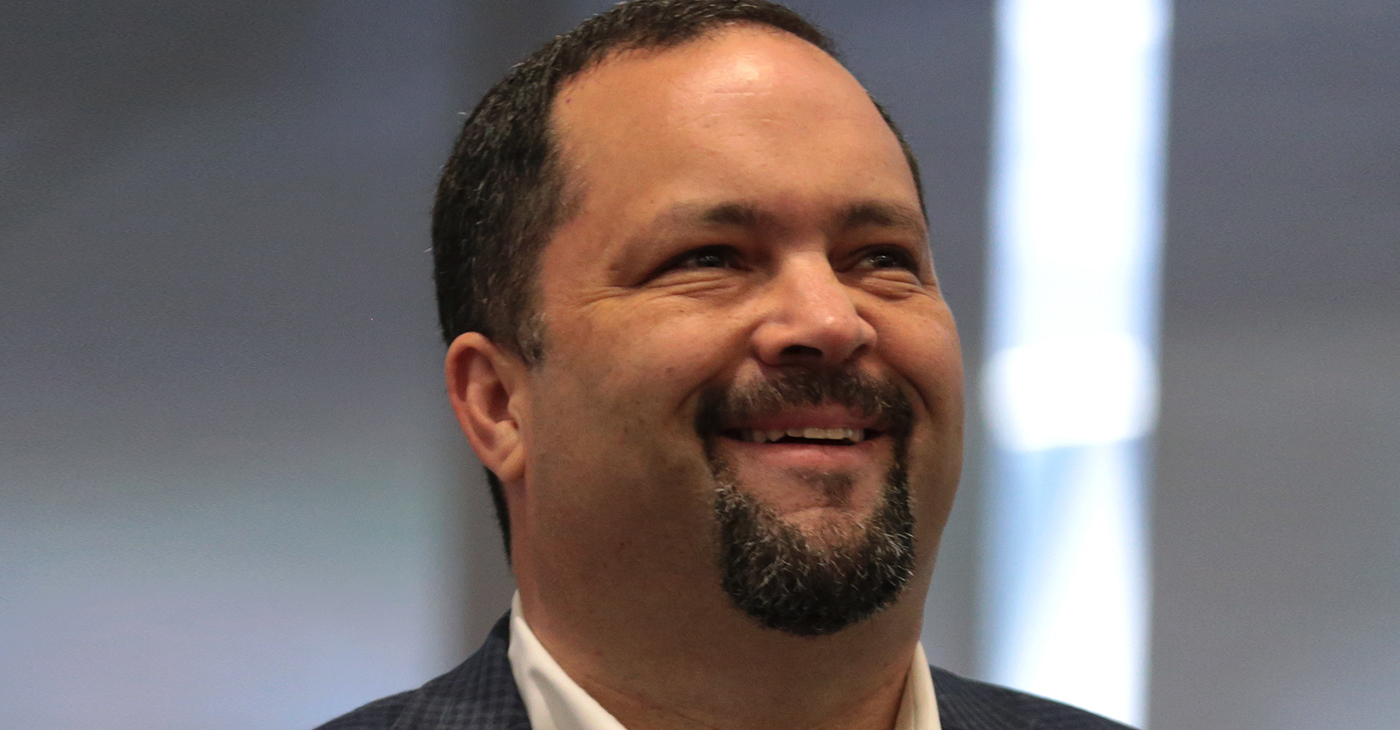
By Ben Jealous, President of People For the American Way
President Joe Biden could have delivered his recent voting rights message to U.S. senators from the White House just down Pennsylvania Avenue from the Capitol. Instead, he and Vice President Kamala Harris traveled to Atlanta a few days before Martin Luther King Jr. Day. It was the perfect place for the president’s powerful message urging senators to be on the right side of history by doing whatever it takes to get voting rights legislation passed and put on the president’s desk.
The president and vice president visited King’s church before traveling to Morehouse College, King’s alma mater. They spoke in a place represented long and nobly by the late civil rights champion and congressman John Lewis.
I was honored to be in attendance, surrounded by friends and colleagues in the voting rights movement. History was all around us. I could feel the presence of so many witnesses, including those who gave their very lives to the cause.
I had to think that Dr. King and the late Rep. John Lewis would appreciate that some of us sitting in the front row for the president’s speech had been on the front lines just a few weeks earlier. We were arrested outside the White House while urging the president to put the full power of the presidency behind a push for voting rights protections.

King and Lewis had great strategic understanding of the power of nonviolent direct action to highlight injustice, to motivate supporters, to stir the conscience of those on the sidelines — and sometimes to light a fire under allies
The invitation extended by the White House to those of us arrested outside its gates in November was a sign that the president appreciates the urgency that drove our direct action.
President Lyndon Johnson and Martin Luther King were partners in passing civil and voting rights laws, and each understood that movement leaders had a different role to play than the politicians.
Some voting rights advocates held a sit-in inside the White House itself just days before President Johnson made his famous “We Shall Overcome” speech calling on Congress to uphold American ideals by passing voting rights legislation.
Voting rights advocates have known all along that Biden was an ally. He has publicly criticized the wave of voting restrictions passed by Republican states after record voter turnout in 2022 led to former President Donald Trump’s defeat. We respected the importance of other items on the president’s legislative agenda, including investments in infrastructure and the American people.
But we watched with increasing alarm as Republicans in the U.S. senate used filibuster rules to repeatedly block action on federal voting rights bills that are needed to override voter suppression and brazen election subversion schemes being put in place in key states. We saw time running out to reverse these changes before the 2022 elections.
So, we took to the streets and called on the president to make the case to U.S. senators that the right to vote is far more important to our democracy than the current version of the Senate’s filibuster rules.
Biden rose to the occasion in Atlanta. “To protect our democracy, I support changing the Senate rules, whichever way they need to be changed, to prevent a minority of senators from blocking action on voting rights,” he said. “When it comes to protecting majority rule in America, the majority should rule in the United States Senate.”
“I will not yield,” Biden said. “I will not flinch. I will defend the right to vote and our democracy against all enemies, foreign, and yes, domestic.”
I believe that the president’s call to action was a reminder of the power of direct action. And a reminder of the power of the people — that when it comes to preserving voting rights and our democracy, we must all remain vigilant and willing to act with what Dr. King called “the fierce urgency of now.”
Ben Jealous serves as president of People For the American Way. Jealous has decades of experience as a leader, coalition builder, campaigner for social justice and seasoned nonprofit executive.







Activism
Oakland Post: Week of March 18 – 24, 2026
The printed Weekly Edition of the Oakland Post: Week of March 18 – 24, 2026

To enlarge your view of this issue, use the slider, magnifying glass icon or full page icon in the lower right corner of the browser window.
Activism
Oakland Post: Week of March 11 -17, 2026
The printed Weekly Edition of the Oakland Post: Week of March 11 – 17, 2026
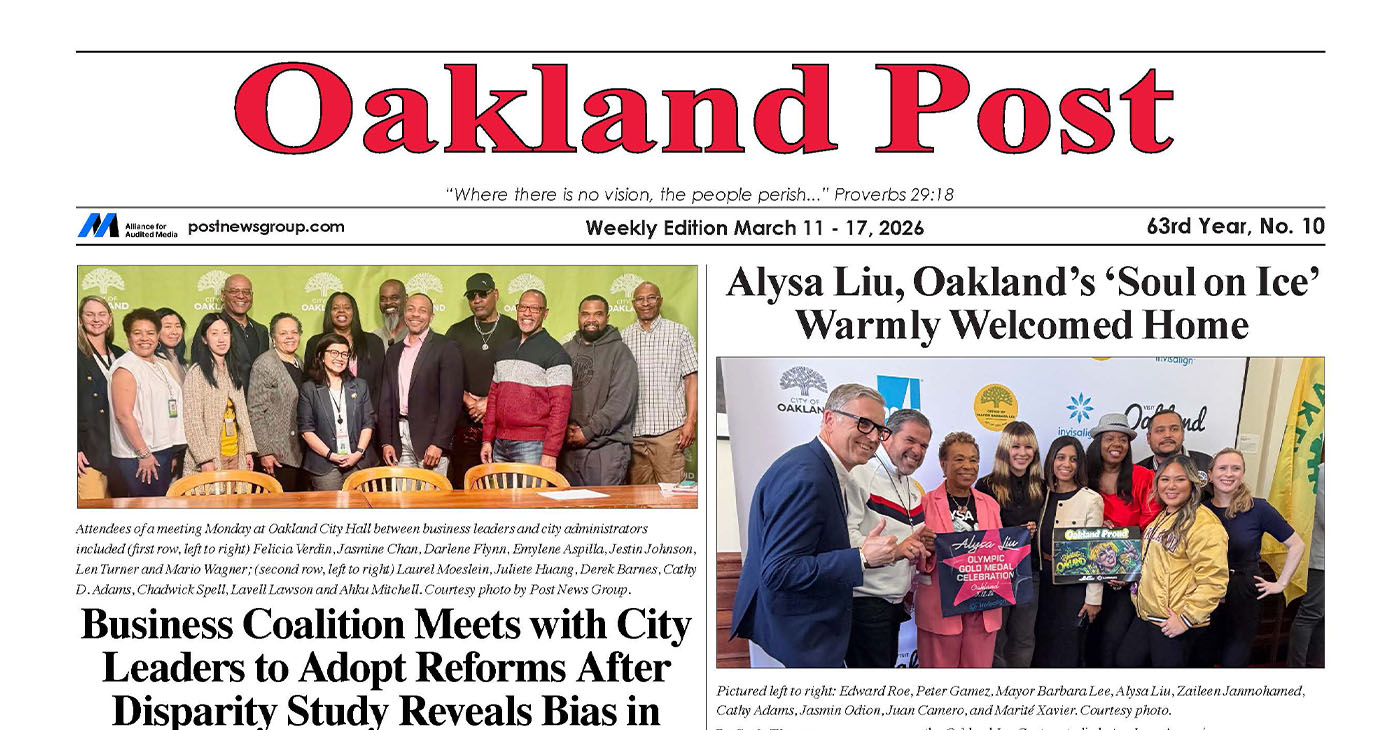
To enlarge your view of this issue, use the slider, magnifying glass icon or full page icon in the lower right corner of the browser window.
Activism
Oakland Post: Week of March 4 – 10, 2026
The printed Weekly Edition of the Oakland Post: Week of March 4 – 10, 2026

To enlarge your view of this issue, use the slider, magnifying glass icon or full page icon in the lower right corner of the browser window.

WORK FROM HOME
Home-based business with potential monthly income of $10K+ per month. A proven training system and website provided to maximize business effectiveness. Perfect job to earn side and primary income. Contact Lynne for more details: Lynne4npusa@gmail.com 800-334-0540


Black Artists in America, Installation Three Wraps at the Dixon Gallery and Gardens

Grief, Advocacy, and Education: A Counselor Reflects on Black Maternal Health

Future of Florida’s Black History Museum in Limbo

New Research Shows the Many Benefits of Early Learning

South Hampton K-8 Students Among Top 10 Finalists for Samsung’s ‘Solve for Tomorrow’ Competition

Cuba: No Negotiation with US on the President or Political System

Brooklyn Academy of Music Names Jamaican-Born Tamara McCaw as President

Trinidad & Tobego – U.S. Launches WhatsApp Channel for American Citizens in the Country

Oakland Post: Week of March 18 – 24, 2026

AI Innovation vs. Ethics and Environmental Impact

AI, Web3, and Digital Reparations

What If You Owned Your AI Agent?

Season 7, Episode 3 – January Reporter’s Roundtable 📱

Season 7, Episode 3 – January Reporter’s Roundtable

AI, Media, and Power | Part 2, Real-World Impacts and Tradeoffs

Discrimination in City Contracts

Oakland Post: Week of February 11 – 17, 2026

Reflecting on Black History Milestones in Birmingham AL

Rising Optimism Among Small And Middle Market Business Leaders Suggests Growth for California

CITY OF SAN LEANDRO STATE OF CALIFORNIA PUBLIC WORKS DEPARTMENT ENGINEERING DIVISION NOTICE TO BIDDERS FOR ANNUAL STREET OVERLAY/REHABILITATION 2019-21 – PHASE III

Oakland Post: Week of February 18 – 24, 2026

PRESS ROOM: NBA Hall of Fame Nominee Terry Cummings Joins 100 Black Men of DeKalb County to Launch Victory & Values Initiative

Oakland Post: Week of February 25 – March 3, 2026

U.S. manufacturing rebounds – how foundry services are adapting to rising demand

Trump’s MAGA Allies are Creating Executive Order Plan to Steal the 2026 Midterms

OP-ED: One Hundred Years of Black Workers Telling the Truth

Advancements in solar technology that are changing the way we power the world

Chase Oakland Community Center Hosts Alley-Oop Accelerator Building Community and Opportunity for Bay Area Entrepreneurs

Poll Shows Support for Policies That Help Families Afford Child Care

PRESS ROOM: Civil Rights TV Launches in Selma as the World’s First 24/7 Civil Rights Television Network

Hyundai Ioniq 5 Parking, Safety, and 360 View #shorts

2025 Ioniq 5 New Wiper & Powerful Performance! #shorts

Electric SUV Range: Is 259 Miles Enough? #shorts

EV Charging: How Fast Can You Charge an Electric Vehicle? #shorts

Biometric Cooling… Messaging Seats…Come on! 2025 Infiniti QX80 Autograph 4WD

Charged Up: Witness the Magic of a Fully Electric Car! #shorts

Range Rover Sport PHEV Included…: See What’s Inside This Luxury SUV! #shorts

Invisible Hood View: Perfect Parking with X-Ray Vision! #shorts

AI Is Reshaping Black Healthcare: Promise, Peril, and the Push for Improved Results in California

ESSAY: Technology and Medicine, a Primary Care Point of View

Sanctuary Cities

The RESISTANCE – FREEDOM NOW

STATE OF THE PEOPLE: Freddie

ECONOMIC BOYCOTT DAY!!!!!

I told You So
-
 #NNPA BlackPress4 weeks ago
Reflecting on Black History Milestones in Birmingham AL
-
 #NNPA BlackPress4 weeks ago
PRESS ROOM: NBA Hall of Fame Nominee Terry Cummings Joins 100 Black Men of DeKalb County to Launch Victory & Values Initiative
-
 Activism4 weeks ago
Oakland Post: Week of February 25 – March 3, 2026
-
 #NNPA BlackPress4 weeks ago
Trump’s MAGA Allies are Creating Executive Order Plan to Steal the 2026 Midterms
-
 #NNPA BlackPress4 weeks ago
Poll Shows Support for Policies That Help Families Afford Child Care
-

 Activism3 weeks ago
Oakland Post: Week of March 4 – 10, 2026
-

 #NNPA BlackPress3 weeks ago
Woman’s Search for Family’s Roots Leads to Ancestor John T. Ward – A Successful Entrepreneur and Conductor on the Underground Railroad
-

 #NNPA BlackPress3 weeks ago
OP-ED: NNPA Launches 2026 “Leadership Matters” Video Series
