
Politics
Clinton Faces Promise, Risk of Being Seen as 3rd Obama Term


Democratic presidential candidate Hillary Rodham Clinton, center, speaks during a small business roundtable, Wednesday, April 15, 2015, in Norwalk, Iowa. (AP Photo/Charlie Neibergall)
LISA LERER, Associated Press
KEN THOMAS, Associated Press
NORWALK, Iowa (AP) — Hillary Rodham Clinton came to Iowa to give voters an intimate glance of who she’d be as president. What they got instead was a glimpse into the complicated relationship between the current inhabitant of the White House and the woman who hopes to follow in his path.
On a two-day swing through Iowa, the opening act of her 2016 campaign, Clinton embraced two of the most politically fraught planks of President Barack Obama’s legacy: the health care law and the push for an immigration overhaul. But even as she cast herself as continuing the Obama administration’s domestic policies, Clinton carefully drew a subtle contrast between her leadership and that of the president.
“I want to fix our political system. I want to get things done,” she told small business owners, sitting between cardboard fruit cartons at a produce company warehouse in Norwalk. “We have to start breaking down the divisions that have paralyzed our politics.”
The roundtable with small business owners reflected the pull-and-tug that Clinton will face as she attempts to extend Democrats’ control over the White House to three straight terms, should she win the nomination.
It won’t be easy: Historically, Americans have rewarded change after a party controls the presidency for two straight terms — Republicans Ronald Reagan and George H.W. Bush were the only presidents to maintain control for three terms during the past half-century.
Her success will depend, at least in part, on how she walks the fine line between praising Obama enough to maintain the support of his loyal coalition, particularly the black and millennial voters who overwhelmingly backed his candidacy, and putting enough distance to woo independents frustrated with Washington partisanship.
Just days into her early campaign, that strategy is already on display.
While Clinton’s kickoff video was an upbeat appeal to inherit the diverse coalition that twice elected Obama, at events in Iowa she took a more downbeat tone, describing the middle-class dream as slipping away from many Americans.
“Unfortunately the deck is still stacked in favor of those at the top,” Clinton said on Wednesday. “We need to reshuffle the cards and begin to play a different hand.”
And she’s cast herself as consensus builder, eager to seek political agreement, a gentle rebuke of the harsh partisanship that’s characterized the Obama era. “We’ve learned a lot in the last few years,” she said. “We’re all just going to have to get around the table and get back to work.”
In a remark Tuesday that could have come from a Republican, she said: “We’ve got to figure out in our country how to get back on the right track.” Indeed, her campaign highlighted the comment in a press release later in the day.
Yet, she also vowed to “defend all those important changes” in the health care law and lamented the lack of immigration legislation, saying the U.S. is “turning down people who really want to work” — two key priorities of the Obama administration that Clinton, as secretary of state, had little hand in advocating.
Such comments are catnip for Republicans, who see Obama as the nightmare haunting her presidential dreams.
In polling conducted by CNN last month, 57 percent of Americans said their “perfect candidate” would be someone who changed most policies of the Obama administration. Already, Republicans are stressing the deep ties between the two, describing Clinton’s candidacy as a “third Obama term.” Shortly before Clinton entered the race on Sunday, former Florida Gov. Jeb Bush released a video message deriding the “Obama-Clinton foreign policy.”
On foreign policy, Clinton has magnified the differences between her positions and those of the president she served. She expressed public disagreement with the administration’s early position against arming the Syrian opposition. Earlier this month, Clinton voiced cautious support for Obama’s nuclear deal with Iran, though she remarked that the “devil was in the details.” Previously, she said she was skeptical that Iran would abide by any deal struck with the U.S.
So far, the relationship with Obama has loomed far larger in Clinton’s early campaign than an even more intimate tie. Former President Bill Clinton did not appear in her launch video and stayed in New York while his wife embarked on her road trip to Iowa. On Tuesday, he made no mention of her candidacy at a fundraiser for a health organization in New York City.
Obama, too, has kept largely mum about the details of Clinton’s campaign, describing her to reporters simply as someone who would be “an excellent president.”
Copyright 2015 The Associated Press. All rights reserved. This material may not be published, broadcast, rewritten or redistributed.







Activism
Oakland Post: Week of March 18 – 24, 2026
The printed Weekly Edition of the Oakland Post: Week of March 18 – 24, 2026
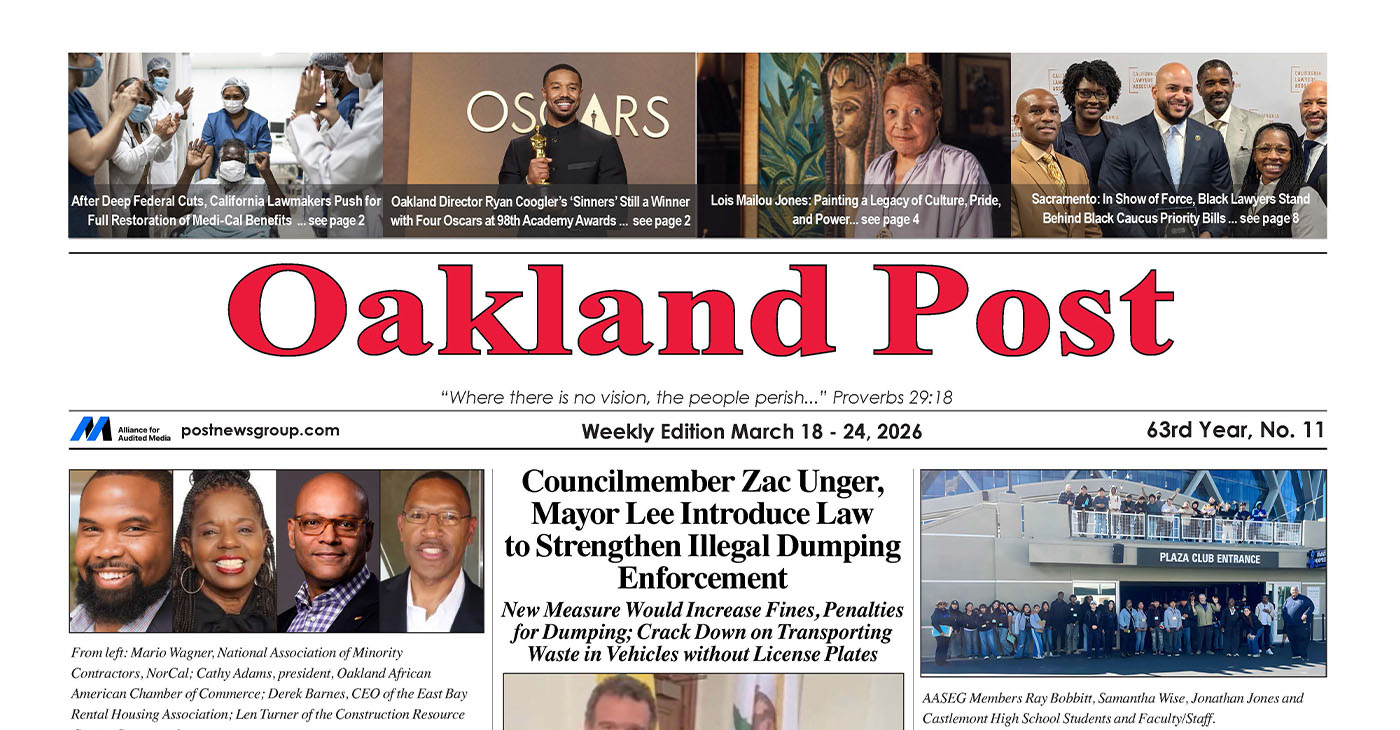
To enlarge your view of this issue, use the slider, magnifying glass icon or full page icon in the lower right corner of the browser window.
Activism
Oakland Post: Week of March 11 -17, 2026
The printed Weekly Edition of the Oakland Post: Week of March 11 – 17, 2026
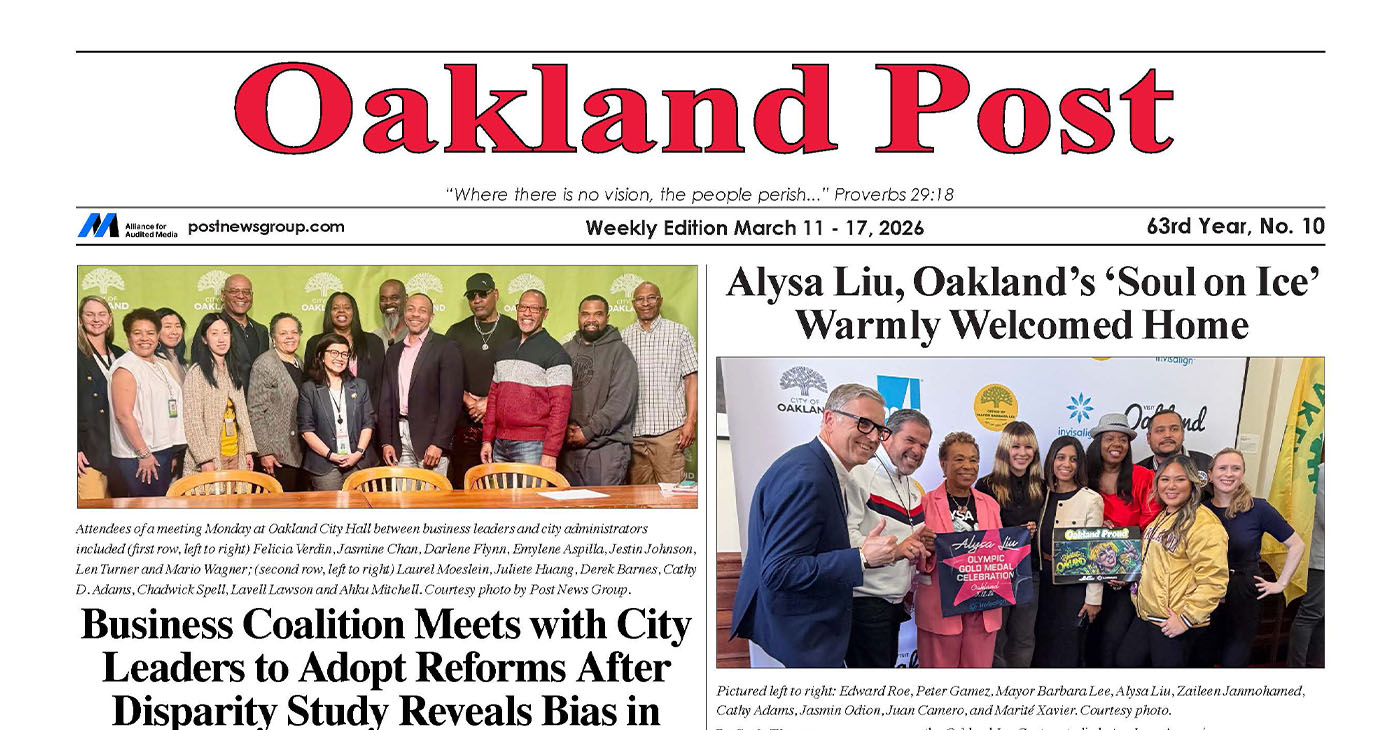
To enlarge your view of this issue, use the slider, magnifying glass icon or full page icon in the lower right corner of the browser window.
Activism
Oakland Post: Week of March 4 – 10, 2026
The printed Weekly Edition of the Oakland Post: Week of March 4 – 10, 2026
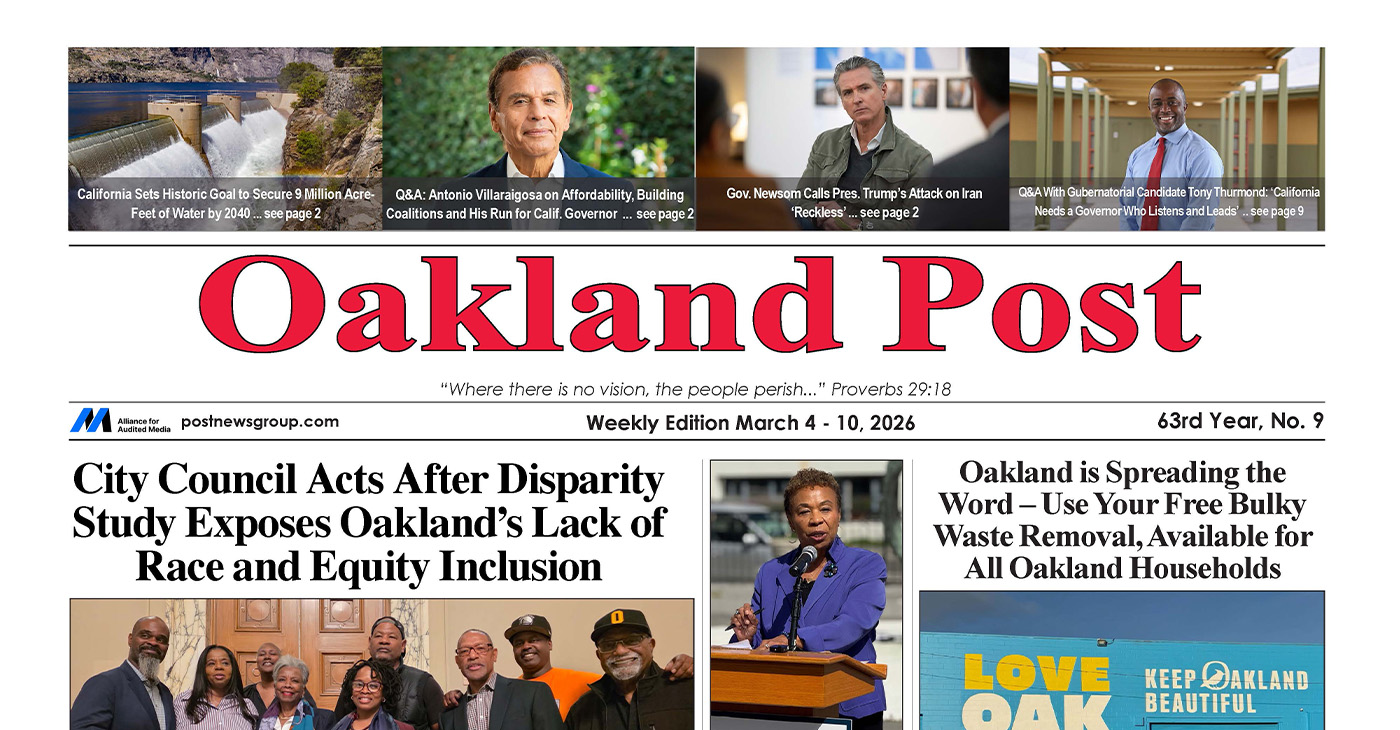
To enlarge your view of this issue, use the slider, magnifying glass icon or full page icon in the lower right corner of the browser window.

WORK FROM HOME
Home-based business with potential monthly income of $10K+ per month. A proven training system and website provided to maximize business effectiveness. Perfect job to earn side and primary income. Contact Lynne for more details: Lynne4npusa@gmail.com 800-334-0540


Black Artists in America, Installation Three Wraps at the Dixon Gallery and Gardens

Grief, Advocacy, and Education: A Counselor Reflects on Black Maternal Health

Future of Florida’s Black History Museum in Limbo

New Research Shows the Many Benefits of Early Learning

South Hampton K-8 Students Among Top 10 Finalists for Samsung’s ‘Solve for Tomorrow’ Competition

Cuba: No Negotiation with US on the President or Political System

Brooklyn Academy of Music Names Jamaican-Born Tamara McCaw as President

Trinidad & Tobego – U.S. Launches WhatsApp Channel for American Citizens in the Country

Oakland Post: Week of March 18 – 24, 2026

AI Innovation vs. Ethics and Environmental Impact

AI, Web3, and Digital Reparations

What If You Owned Your AI Agent?

Season 7, Episode 3 – January Reporter’s Roundtable 📱

Season 7, Episode 3 – January Reporter’s Roundtable

AI, Media, and Power | Part 2, Real-World Impacts and Tradeoffs

Oakland Post: Week of February 11 – 17, 2026

Reflecting on Black History Milestones in Birmingham AL

CITY OF SAN LEANDRO STATE OF CALIFORNIA PUBLIC WORKS DEPARTMENT ENGINEERING DIVISION NOTICE TO BIDDERS FOR ANNUAL STREET OVERLAY/REHABILITATION 2019-21 – PHASE III

Oakland Post: Week of February 18 – 24, 2026

PRESS ROOM: NBA Hall of Fame Nominee Terry Cummings Joins 100 Black Men of DeKalb County to Launch Victory & Values Initiative

Oakland Post: Week of February 25 – March 3, 2026

Trump’s MAGA Allies are Creating Executive Order Plan to Steal the 2026 Midterms

U.S. manufacturing rebounds – how foundry services are adapting to rising demand

OP-ED: One Hundred Years of Black Workers Telling the Truth

Advancements in solar technology that are changing the way we power the world

Chase Oakland Community Center Hosts Alley-Oop Accelerator Building Community and Opportunity for Bay Area Entrepreneurs

Poll Shows Support for Policies That Help Families Afford Child Care

Oakland Post: Week of March 4 – 10, 2026

PRESS ROOM: Civil Rights TV Launches in Selma as the World’s First 24/7 Civil Rights Television Network

Ghana Mourns a Son of the African World

Hyundai Ioniq 5 Parking, Safety, and 360 View #shorts

2025 Ioniq 5 New Wiper & Powerful Performance! #shorts

Electric SUV Range: Is 259 Miles Enough? #shorts

EV Charging: How Fast Can You Charge an Electric Vehicle? #shorts

Biometric Cooling… Messaging Seats…Come on! 2025 Infiniti QX80 Autograph 4WD

Charged Up: Witness the Magic of a Fully Electric Car! #shorts

Range Rover Sport PHEV Included…: See What’s Inside This Luxury SUV! #shorts

Invisible Hood View: Perfect Parking with X-Ray Vision! #shorts

AI Is Reshaping Black Healthcare: Promise, Peril, and the Push for Improved Results in California

ESSAY: Technology and Medicine, a Primary Care Point of View

Sanctuary Cities

The RESISTANCE – FREEDOM NOW

STATE OF THE PEOPLE: Freddie

ECONOMIC BOYCOTT DAY!!!!!

I told You So
-
 #NNPA BlackPress4 weeks ago
Poll Shows Support for Policies That Help Families Afford Child Care
-
 Activism4 weeks ago
Oakland Post: Week of March 4 – 10, 2026
-

 #NNPA BlackPress3 weeks ago
Woman’s Search for Family’s Roots Leads to Ancestor John T. Ward – A Successful Entrepreneur and Conductor on the Underground Railroad
-

 #NNPA BlackPress4 weeks ago
OP-ED: NNPA Launches 2026 “Leadership Matters” Video Series
-

 #NNPA BlackPress3 weeks ago
Advocates Raise Alarm Over ICE Operation, MOU and Detention Risks in Baltimore County
-

 #NNPA BlackPress3 weeks ago
COMMENTARY: Women of Color Shape Our Past and Future
-

 #NNPA BlackPress3 weeks ago
Pete Buttigieg to Join Mayor Randall Woodfin for Community Town Hall in Birmingham
-
 Activism2 weeks ago
Oakland Post: Week of March 11 -17, 2026
