
City Government
City Officials Encourage Residents to Get Vaccinated to Combat COVID-19 Variants
San Francisco, along with all Bay Area counties, is seeing trend of rising COVID-19 cases due to delta variant

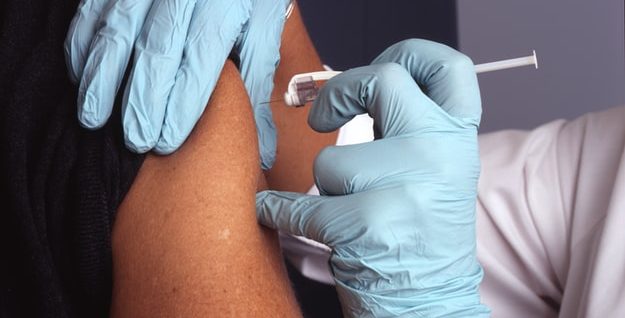
San Francisco Mayor London N. Breed, Board of Supervisors President Shamann Walton, and the Department of Public Health (DPH) encouraged residents to get vaccinated as the delta variant of COVID-19 is now the dominant strain in the United States and California.
This variant spreads more easily than the original virus and poses new risks to communities in San Francisco. Vaccines continue to be highly effective at preventing severe illness and death.
Over the last three weeks, all Bay Area counties have seen at least a doubling of new COVID-19 cases, causing concern that unvaccinated people are more at risk than ever.
“Vaccinating as many people as possible, as soon as possible, is our best defense against COVID-19, the delta variant, and the harm it can do to our communities,” said Breed. “In particular, the Black community has the lowest vaccination rate compared to the citywide rate, which means more people who are already struggling with significant disparities in this City might get sick.
“While we beat back three surges in San Francisco, the delta variant brings new challenges that will continue to increase the disparities we see in communities of color. We need everyone to do their part to get vaccinated and encourage their friends and family to do the same,” Breed said.
San Francisco’s response to the COVID-19 pandemic has resulted in low case rates and hospitalizations, and relatively high vaccination rates, with 83% of the eligible population with at least one dose and 76% of the eligible population fully vaccinated as of July 13.

Over the week ending July 7, for which there is full data, average daily new cases have increased four-fold to 42 new cases/day from a low of 9.9 cases/day on June 19. Forward-looking data through July 12 indicates that new cases will increase to at least 73 cases/day, a seven-fold increase since June 19.
“As we have seen since the beginning of the pandemic, COVID-19 infections are not distributed evenly throughout all neighborhoods and communities in San Francisco,” said Dr. Grant Colfax, director of Public Health. “Our focus and work to achieve vaccine equity and access continues in partnership with the communities that are most impacted. Get vaccinated – hospitalizations and deaths due to COVID-19 are preventable through vaccines.”
Those who are not yet vaccinated should continue to follow the health precautions that work to help curtail the spread of COVID-19 and to prevent new variants from emerging: wear a mask that covers your nose and mouth when you have to go outside; stay at least six feet away from others; when able choose outdoor settings versus indoor; and wash your hands frequently after touching your face or touching shared objects. People who develop or show any symptoms should get tested, even if they are fully vaccinated.
“Bayview Hunters Point is still one of the hardest hit areas with COVID-19 infections, particularly in the African American community. With the new delta variant that is more transmissible, it is critical that our community gets vaccinated as soon as possible,” said Walton, president of the Board of Supervisors.
San Francisco continues to make vaccines accessible to all residents through sites located in neighborhoods and through mobile vaccine efforts. In the Bayview, the Southeast Health Center at 2401 Keith St. is offering vaccines – no appointment needed – Mondays, Tuesdays, Wednesdays, and Fridays from 9:00 a.m. to 7:00 p.m., and Saturdays from 9:00 a.m. to 4:00 p.m. Vaccines are also available at 1800 Oakdale, with drop-ins available on Fridays and Saturday from 9:30 a.m. to 3:00 p.m. For more information on COVID-19 vaccines, visit sf.gov/getvaccinated.
The San Francisco Mayor’s Office of Communications provided this story.













Activism
Oakland Post: Week of August 12 – 18, 2026
The printed Weekly Edition of the Oakland Post: Week of August 12 – 18, 2026


To enlarge your view of this issue, use the slider, magnifying glass icon or full page icon in the lower right corner of the browser window.

Activism
Oakland Post: Week of August 5 – 11, 2026
The printed Weekly Edition of the Oakland Post: Week of August 5 – 11, 2026
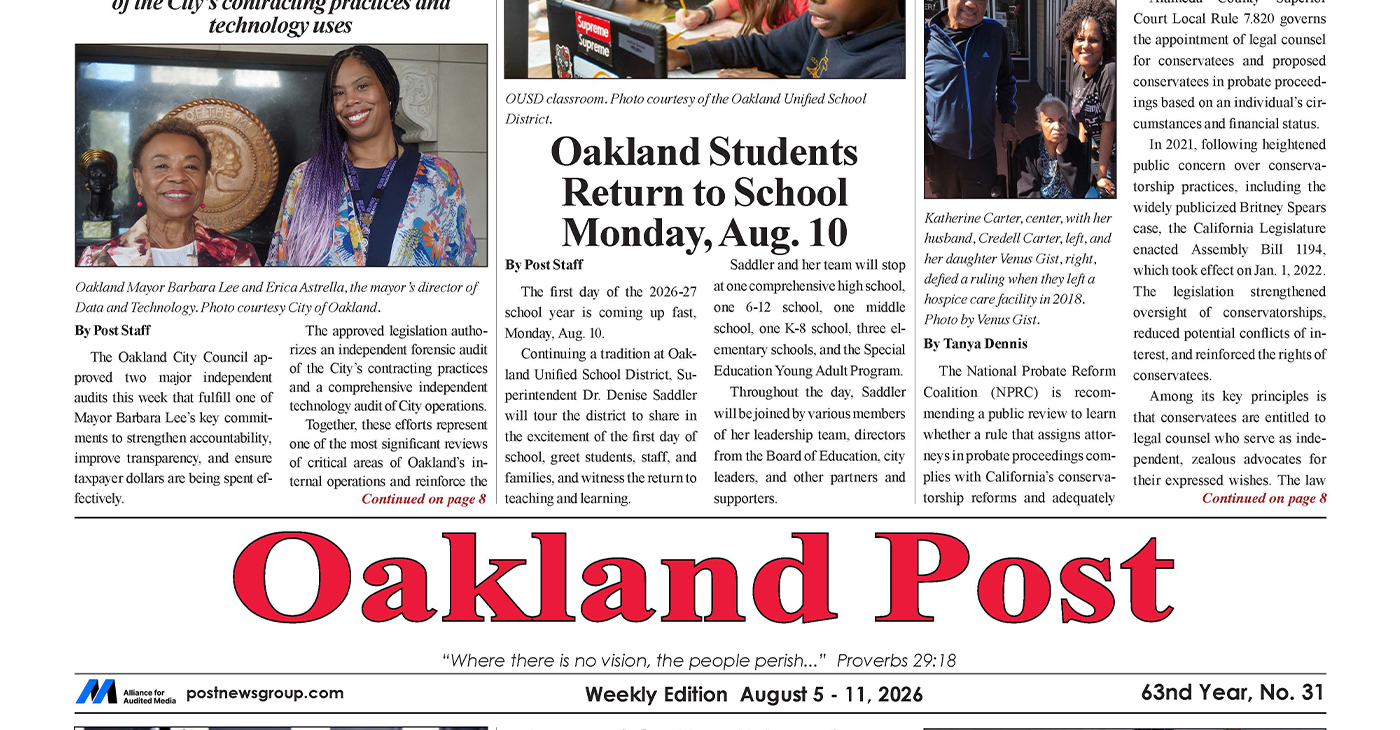
To enlarge your view of this issue, use the slider, magnifying glass icon or full page icon in the lower right corner of the browser window.
Activism
Oakland Post: Week of July 29 – August 4, 2026
The printed Weekly Edition of the Oakland Post: Week of July 29 – August 4, 2026
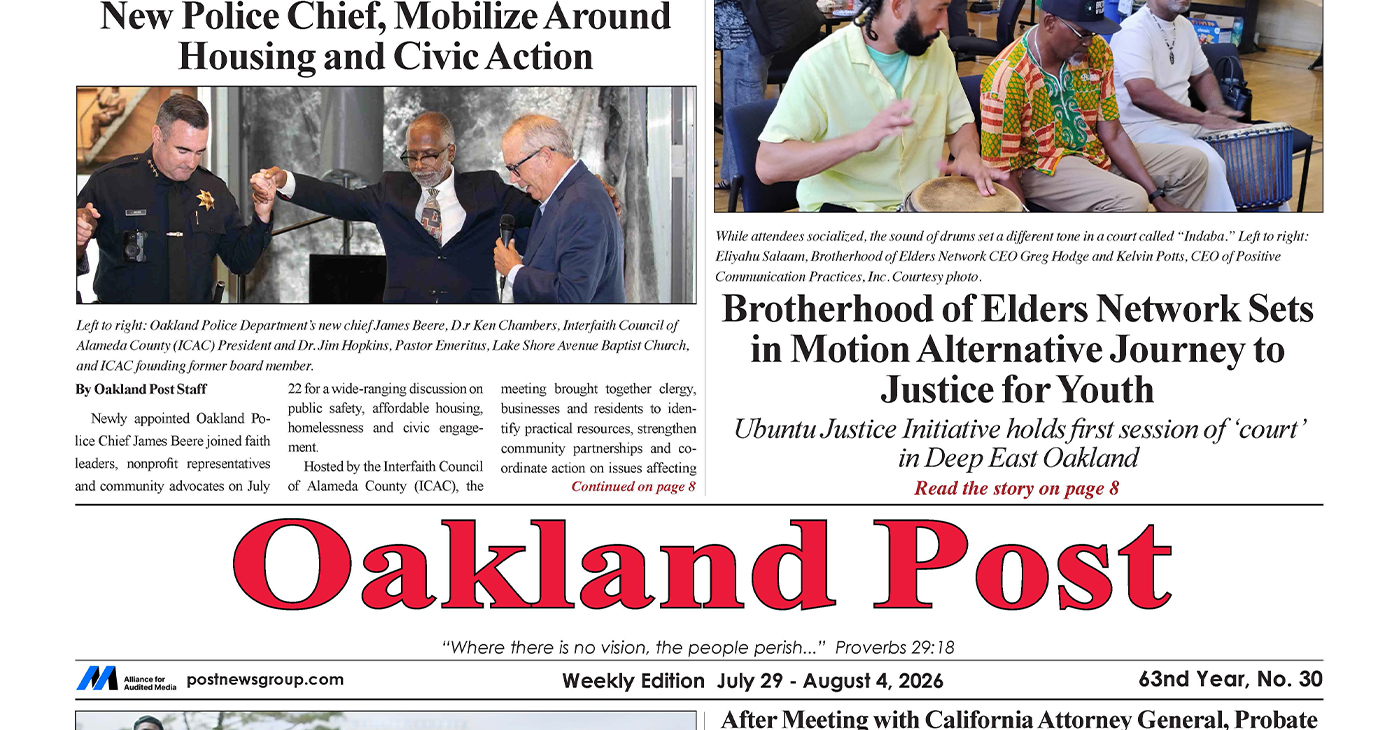
To enlarge your view of this issue, use the slider, magnifying glass icon or full page icon in the lower right corner of the browser window.

WORK FROM HOME
Home-based business with potential monthly income of $10K+ per month. A proven training system and website provided to maximize business effectiveness. Perfect job to earn side and primary income. Contact Lynne for more details: Lynne4npusa@gmail.com 800-334-0540


Four Candidates, Including Incumbent Barbara Lee, Qualify for Oakland Mayor’s Race

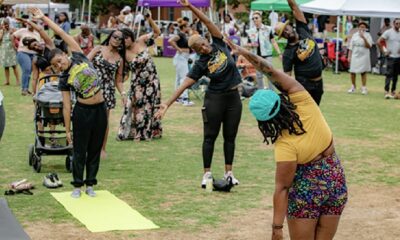
Oakland Observes Black August with Block Parties, Film Showings, Workshops

Oakland Post: Week of August 12 – 18, 2026

COMMENTARY: Why Local School Tax Measure G1 Will Not Be on the November Ballot

California Hispanic Chambers of Commerce Unveils: ‘Powering the Future’ Theme for 47th Annual Statewide Convention

Returning to Its Roots, the Oakland Black-Eyed Pea Festival Partners with the Freedom Farmers Market Sept. 12

Less Affluent School Districts, Including Sacramento City, Face Threat of State Takeover

From Blueprint to Breakthrough: Tackling Affordable Housing in Oakland

NPRC Scores First Advocacy Victory: David Shaw Finally Gets His Wish to ‘Go Home’

ESSAY: California Can Close Its Colorectal Cancer Gap

Car Wash Workers Cope with Lingering Impacts of ICE Raids

Misty Copeland Shapes Ballet’s Tomorrow

As Part of Your Back-to- School Checklist, Vaccinate

As Part of Your Back-to- School Checklist, Vaccinate

Congresswoman Simon Demands Investigation into Trump’s Abuse of Emergency Powers for Coal Export Terminal in West Oakland

Department of Homeland Security Demands California Secretary of State Shirley N. Weber Scrub Voter Rolls

Oakland Children’s Hospital Workers and Patients Rally for Pediatric Medical Care

New Judge Could Decide if Karmelo Anthony Gets a New Trial

“The Power to See Threats Sooner”: Gov. Newsom, Safety Officials Showcase California’s Investments in Hi-Tech Wildfire Prevention

Alpha Kappa Alpha Sorority, Inc. Celebrates New North Atlantic Regional Director

Surveillance Pricing Fight: State Senate Debates Bill Banning Retailers from Using AI to Set Prices Based on a Buyer’s Profile

Mount Zion MBC, Church of Jesus Christ of Latter-day Saints Partner to Bring 29,000 Meals to Alameda County

California Sen. Padilla Joins Colleagues to Introduce Bill Imposing Term Limits on Supreme Court Justices

Starting This Summer, California Car Buyers Can Get an Instant $3500 Off the Cost of Electric Vehicles

COMMENTARY: You Are Already Paying for the AI Boom
Less Affluent School Districts, Including Sacramento City, Face Threat of State Takeover

California Bill Would Let Abuse Victims Use Trauma as Legal Defense for Violent Crime
Car Wash Workers Cope with Lingering Impacts of ICE Raids

Fed Court to Decide Landmark First Amendment Case

Gov. Gavin Newsom Signs Law Streamlining Affordable Housing Rules

The Conversation With Al McFarlane 6/23/26

Media Monday 6/22/26

LIVE! ASK ALMA! — TUES. 6.23.26 7PM EST

Car Buying Secrets: 4 Hidden Checks Before You Sign!

Is This 550 HP Charger Worth YOUR Money? AutoNetwork Review

Celebrating Juneteenth – Frederick Douglass on education and resistance

LIVE! — ASK ALMA! — TUES. 6.19.26 7PM EST

Hyundai Ioniq 5 Parking, Safety, and 360 View #shorts

2025 Ioniq 5 New Wiper & Powerful Performance! #shorts

Electric SUV Range: Is 259 Miles Enough? #shorts

EV Charging: How Fast Can You Charge an Electric Vehicle? #shorts

Biometric Cooling… Messaging Seats…Come on! 2025 Infiniti QX80 Autograph 4WD

Charged Up: Witness the Magic of a Fully Electric Car! #shorts

Range Rover Sport PHEV Included…: See What’s Inside This Luxury SUV! #shorts

Invisible Hood View: Perfect Parking with X-Ray Vision! #shorts
-
 Featured1 week ago
Department of Homeland Security Demands California Secretary of State Shirley N. Weber Scrub Voter Rolls
-
 Business3 weeks ago
Oakland Children’s Hospital Workers and Patients Rally for Pediatric Medical Care
-
 #NNPA BlackPress2 weeks ago
New Judge Could Decide if Karmelo Anthony Gets a New Trial
-
 Environment1 week ago
“The Power to See Threats Sooner”: Gov. Newsom, Safety Officials Showcase California’s Investments in Hi-Tech Wildfire Prevention
-
 Black History2 weeks ago
Alpha Kappa Alpha Sorority, Inc. Celebrates New North Atlantic Regional Director
-
 Business3 weeks ago
Surveillance Pricing Fight: State Senate Debates Bill Banning Retailers from Using AI to Set Prices Based on a Buyer’s Profile
-
 Business3 weeks ago
Mount Zion MBC, Church of Jesus Christ of Latter-day Saints Partner to Bring 29,000 Meals to Alameda County
-
 Featured1 week ago
California Sen. Padilla Joins Colleagues to Introduce Bill Imposing Term Limits on Supreme Court Justices
