
Activism
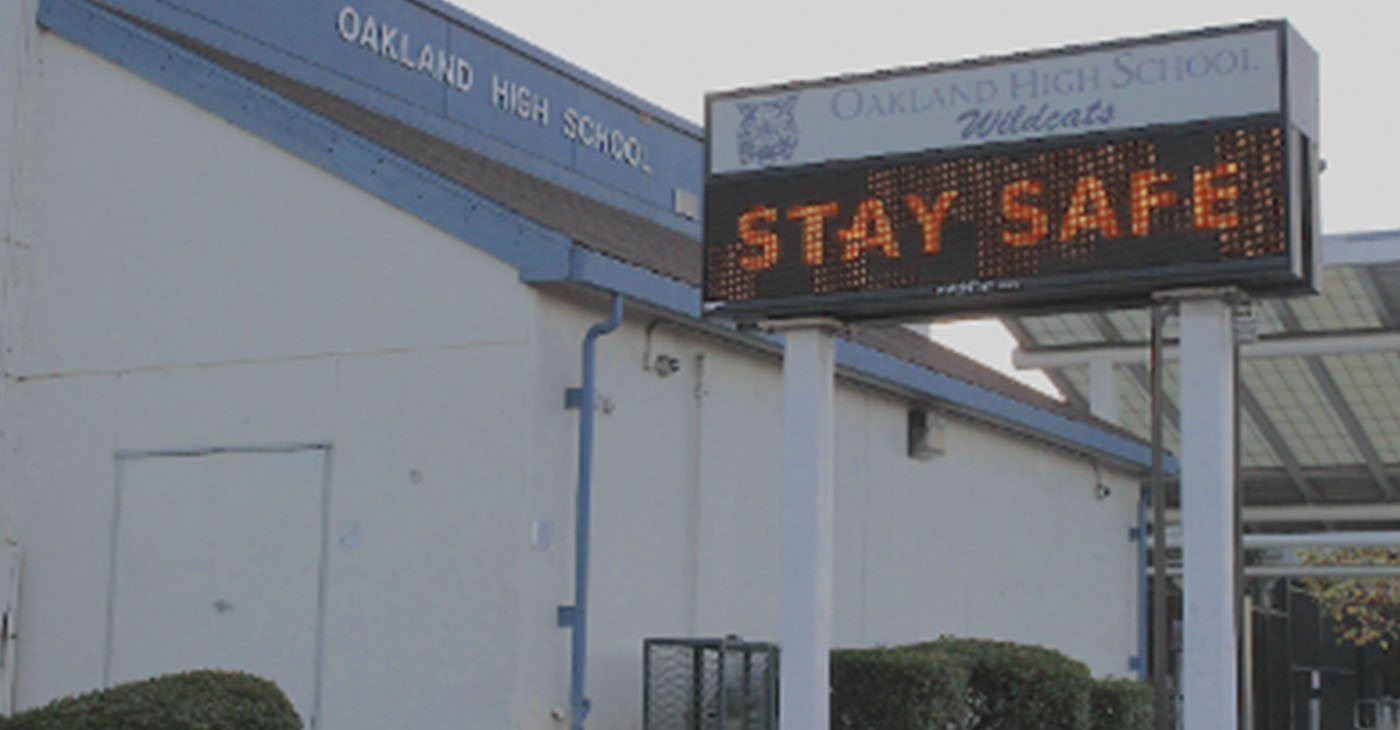
Citing COVID Safety Needs, Oakland High Teachers Limit Encounters with Students
According to Le’Lani Walker, a senior at OHS, teachers explained the work to rule action to students shortly before it began. Although she felt it was “kind of frustrating” when she needed a little extra help with chemistry, she “sees the bigger picture” and feels that the action will help students in the long run.

By Zack Haber
Due to concerns about COVID safety issues, many teachers at Oakland High School have been engaging in ‘work to rule,’ a labor action tactic where workers only do the tasks specified in their contract, since January 6.
“It means is we don’t do anything extra,” said Cole Margen who teaches history at the school.
Teachers at Oakland High have been keeping their doors closed to students before and after school, as well as during lunch and their lesson planning periods.
According to David Byrd, a music teacher and union site representative at Oakland High, over 40 teachers out of 89 in the school have come to meetings related to the action and have committed to ‘work to rule,’ but he suspects more teachers are involved. Throughout the school, teachers have hung flyers on their doors indicating their support that say “To encourage greater COVID safety on our site this teacher is working to rule!”
Typically, most teachers at Oakland High School (OHS) would welcome students into their classroom for extra academic help and/or to socialize during non-classroom hours, even though their contract doesn’t require them to do so. English Immersion teacher Miles Murray thinks this extra work’s absence immediately becomes noticeable.
“There are extra hours we’re expected to work, and must work, in order to keep the school functioning,” said Murray. “We need to remind the public of that.”
While teachers interviewed for this article mentioned a variety of improved COVID safety measures they’d like to see OUSD implementing at OHS, they all stressed their demand for a safer environment for students to eat lunch, including more tables for the large cafeteria and more outdoor dining facilities. They report that the lack of spaces to eat safely and comfortably has forced students to eat in unsafe places, like the hallways.
“When I do work to rule and hold the line by saying ‘you can’t lunch in my classroom,’” said English teacher Marika Iyer, “I hope to make it clear to the admin, district and the community that these are not safe conditions.”
Oakland students also want safer options for eating lunch.
“I’m not sure where to go and I don’t feel like there’s anywhere safe to eat,” said Trey Shanklin, an OHS senior. “If OUSD provided more outside eating options I would definitely be eating outside more than inside.”
In an e-mail to The Oakland Post, OUSD director of communications John Sasaki stated that the district had built “covered outdoor structures at numerous schools since the fall,” and that they plan to continue to do so, but supply chain issues have slowed the process at some schools.
“Whenever [the materials] come in, our staff quickly gets them installed,” he wrote. “That will happen soon at Oakland High School.”
But until the facilities are installed at their school, OHS teachers say they plan to continue to work to rule.
In the meantime, the Omicron surge has affected OHS and other district schools. Murray, who was quarantining when he did his interview for this article due to becoming sick with the virus, said that in the days before his isolation period started, about a third of his students were out for reasons related to COVID-19.
A “no-go” list sent from OHS administrators to staff shows that between January 3 and 12, over 325 of the school’s approximately 1,550 students were absent at some point, usually multiple days, due to testing positive for COVID or COVID related quarantining.
OUSD’s data shows that, across the district, about 1,550 combined students and staff tested positive for COVID during the first two weeks back from school after winter break out of a total population of about 39,000.
As COVID cases have surged since coming back from break, students and staff at various OUSD schools have engaged in a variety of actions that they’ve labeled sickouts, strikes, and/or boycotts, that have involved them not coming to school out of protest.
These actions have been neither sanctioned nor denounced by Oakland Education Association, the teachers’ union for OUSD. A teacher-led sickout action for better COVID safety measures announced on January 6 and executed on January 7 caused a dozen schools to effectively close for a day.
According to music teacher David Byrd, OHS teachers were inspired when they heard about the January 6 sickout but since their school has many newly hired teachers, they felt an action involving teachers calling in sick en masse could be too risky for those who weren’t tenured to want to engage in.
“We said we’re acting in solidarity, and we support these other sites,” said Byrd. “But how can we expect these new teachers to put so much on the line so quickly?”
OHS teachers were successful in getting both long-term and new teachers on board for the action. One non-tenured OHS teacher who asked not to be named due to fearing that speaking to media might make it less likely they get rehired next year, said they were participating because it showed the unpaid work teachers do and the unsafe conditions students and staff eat lunch in.
“I feel safe participating in the action because of the solidarity shared by my fellow staff,” they said. “Almost all doors now have the work-to-rule sign posted on them, so I am much less likely of being singled out.”
Byrd described work to rule as an easy action to start with and that he hoped it could unify the staff for more actions down the line. Murray feels work to rule has been effective and is putting the staff in a good position to consider more radical actions.
“Now everyone is activated on our campus and looking for the next action,” he said.
According to Le’Lani Walker, a senior at OHS, teachers explained the work to rule action to students shortly before it began. Although she felt it was “kind of frustrating” when she needed a little extra help with chemistry, she “sees the bigger picture” and feels that the action will help students in the long run.
“I strongly support it,” Walker said. “The fact that they’re doing everything within their power to get the attention of the district to address COVID safety issues is comforting.”
OHS students like Shanklin and Walker have been organizing their own actions and have been in communication with teachers about them. When the students did a sickout action on January 13 to demand better COVID safety measures such as more outdoor spaces to eat and twice weekly PCR and rapid tests, they asked OHS staff to join them.
“If you are able to participate,” students wrote in their letter. “Please call in sick, stay home, and send a message updating families about our demands and current events.”
The day before the sickout, Oakland High’s administration sent a message to parents asking them to keep their children at home during the sickout day, and that students wouldn’t be “adversely affected for not attending school” that day. Byrd and history teacher Cole Margen, who were on campus that day said the vast majority of students weren’t present. Substitute teacher request logs show 52 teachers were absent from school that day.
On Tuesday, January 18, OHS students again engaged in a boycott for the same demands as their January 13 sickout. This time students across the district also did not attend school.
The petition for the January 18 boycott that has over 1200 student signatures from over 20 schools, states “If these demands are not met, we will be striking by not attending school. We will be striking until we get what we need to be safe.”
While The Oakland Post was unable to get official numbers for absent students across the district during the boycott, six different OHS teachers estimated that between a third and just over half of the students at their site were absent on January 18 and 19.
To support the student boycott, teachers at three OUSD schools — Bridges Academy, Acorn Woodland Elementary School and United for Success Academy — all engaged in a sickout action that shut down their campuses on January 18. Murray thinks students and staff are increasingly coming together to demand better COVID safety measures from OUSD.
“It feels like there’s momentum across the whole district,” he said.







Activism
Oakland Post: Week of March 18 – 24, 2026
The printed Weekly Edition of the Oakland Post: Week of March 18 – 24, 2026

To enlarge your view of this issue, use the slider, magnifying glass icon or full page icon in the lower right corner of the browser window.
Activism
Oakland Post: Week of March 11 -17, 2026
The printed Weekly Edition of the Oakland Post: Week of March 11 – 17, 2026

To enlarge your view of this issue, use the slider, magnifying glass icon or full page icon in the lower right corner of the browser window.
Activism
Oakland Post: Week of March 4 – 10, 2026
The printed Weekly Edition of the Oakland Post: Week of March 4 – 10, 2026

To enlarge your view of this issue, use the slider, magnifying glass icon or full page icon in the lower right corner of the browser window.


WORK FROM HOME
Home-based business with potential monthly income of $10K+ per month. A proven training system and website provided to maximize business effectiveness. Perfect job to earn side and primary income. Contact Lynne for more details: Lynne4npusa@gmail.com 800-334-0540


Black Artists in America, Installation Three Wraps at the Dixon Gallery and Gardens

Grief, Advocacy, and Education: A Counselor Reflects on Black Maternal Health

Future of Florida’s Black History Museum in Limbo

New Research Shows the Many Benefits of Early Learning

South Hampton K-8 Students Among Top 10 Finalists for Samsung’s ‘Solve for Tomorrow’ Competition

Cuba: No Negotiation with US on the President or Political System

Brooklyn Academy of Music Names Jamaican-Born Tamara McCaw as President

Trinidad & Tobego – U.S. Launches WhatsApp Channel for American Citizens in the Country

Oakland Post: Week of March 18 – 24, 2026

AI Innovation vs. Ethics and Environmental Impact

AI, Web3, and Digital Reparations

What If You Owned Your AI Agent?

Season 7, Episode 3 – January Reporter’s Roundtable 📱

Season 7, Episode 3 – January Reporter’s Roundtable

AI, Media, and Power | Part 2, Real-World Impacts and Tradeoffs

Oakland Post: Week of February 11 – 17, 2026

Reflecting on Black History Milestones in Birmingham AL

CITY OF SAN LEANDRO STATE OF CALIFORNIA PUBLIC WORKS DEPARTMENT ENGINEERING DIVISION NOTICE TO BIDDERS FOR ANNUAL STREET OVERLAY/REHABILITATION 2019-21 – PHASE III

Oakland Post: Week of February 18 – 24, 2026

PRESS ROOM: NBA Hall of Fame Nominee Terry Cummings Joins 100 Black Men of DeKalb County to Launch Victory & Values Initiative

Oakland Post: Week of February 25 – March 3, 2026

Trump’s MAGA Allies are Creating Executive Order Plan to Steal the 2026 Midterms

U.S. manufacturing rebounds – how foundry services are adapting to rising demand

OP-ED: One Hundred Years of Black Workers Telling the Truth

Advancements in solar technology that are changing the way we power the world

Chase Oakland Community Center Hosts Alley-Oop Accelerator Building Community and Opportunity for Bay Area Entrepreneurs

Poll Shows Support for Policies That Help Families Afford Child Care

Oakland Post: Week of March 4 – 10, 2026

PRESS ROOM: Civil Rights TV Launches in Selma as the World’s First 24/7 Civil Rights Television Network

Ghana Mourns a Son of the African World

Hyundai Ioniq 5 Parking, Safety, and 360 View #shorts

2025 Ioniq 5 New Wiper & Powerful Performance! #shorts

Electric SUV Range: Is 259 Miles Enough? #shorts

EV Charging: How Fast Can You Charge an Electric Vehicle? #shorts

Biometric Cooling… Messaging Seats…Come on! 2025 Infiniti QX80 Autograph 4WD

Charged Up: Witness the Magic of a Fully Electric Car! #shorts

Range Rover Sport PHEV Included…: See What’s Inside This Luxury SUV! #shorts

Invisible Hood View: Perfect Parking with X-Ray Vision! #shorts

AI Is Reshaping Black Healthcare: Promise, Peril, and the Push for Improved Results in California

ESSAY: Technology and Medicine, a Primary Care Point of View

Sanctuary Cities

The RESISTANCE – FREEDOM NOW

STATE OF THE PEOPLE: Freddie

ECONOMIC BOYCOTT DAY!!!!!

I told You So
-
 #NNPA BlackPress4 weeks ago
Poll Shows Support for Policies That Help Families Afford Child Care
-
 Activism4 weeks ago
Oakland Post: Week of March 4 – 10, 2026
-

 #NNPA BlackPress3 weeks ago
Woman’s Search for Family’s Roots Leads to Ancestor John T. Ward – A Successful Entrepreneur and Conductor on the Underground Railroad
-

 #NNPA BlackPress4 weeks ago
OP-ED: NNPA Launches 2026 “Leadership Matters” Video Series
-

 #NNPA BlackPress3 weeks ago
Advocates Raise Alarm Over ICE Operation, MOU and Detention Risks in Baltimore County
-

 #NNPA BlackPress3 weeks ago
COMMENTARY: Women of Color Shape Our Past and Future
-

 #NNPA BlackPress3 weeks ago
Pete Buttigieg to Join Mayor Randall Woodfin for Community Town Hall in Birmingham
-

 Activism2 weeks ago
Oakland Post: Week of March 11 -17, 2026
