
Activism
California Reparations Task Force Votes to Replace Economic Advisor
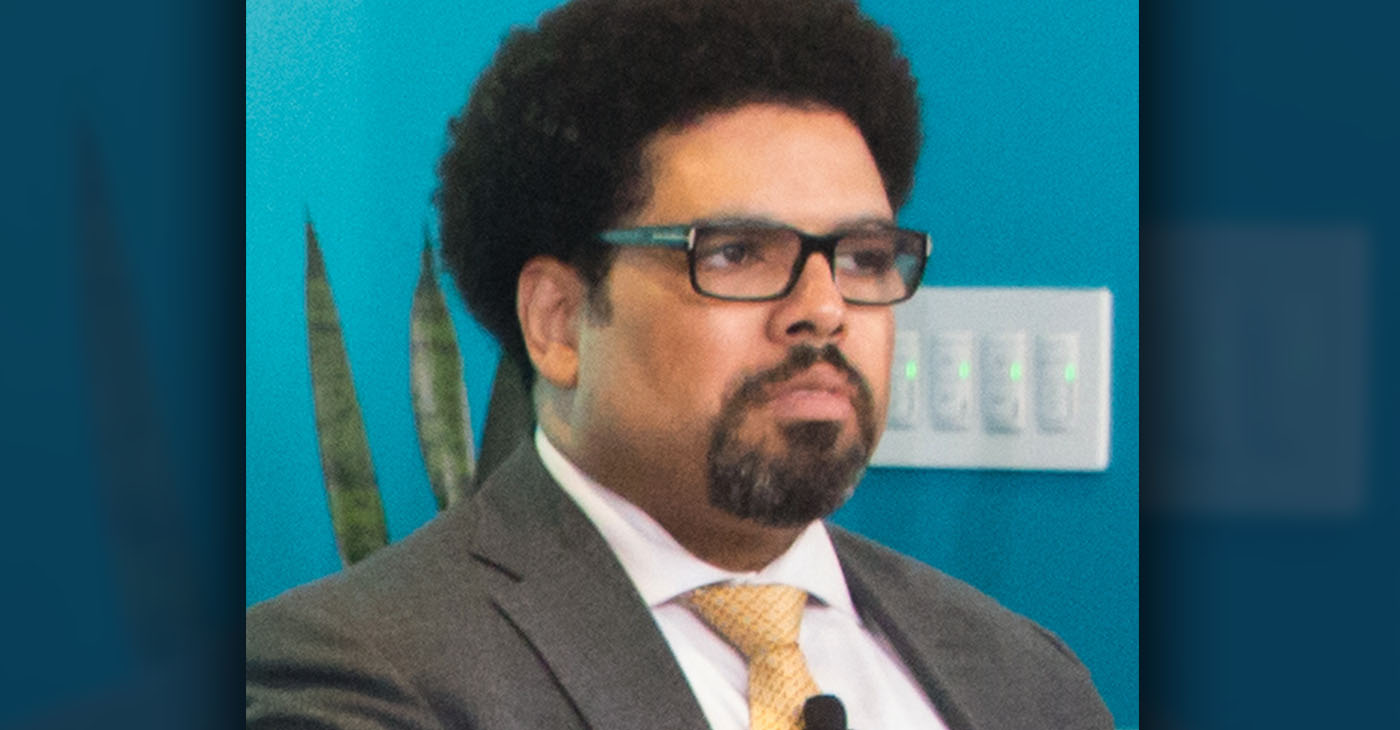
Darrick Hamilton, who was expected to bring an economic perspective to the work the group is doing, told the task force that there was some misunderstanding about the work he could provide. “I don’t think we had complete clarity at the time the (Department of Justice) made its presentation in October or September,” Hamilton said. “With F, I have great clarity given the time constraints as well as the potential budgets that are available.”

By Antonio Ray Harvey | California Black Media
One day after Darrick Hamilton testified before California’s Task Force to Study and Develop Reparation Proposals for African Americans, the panel decided that it would not enter into a contractual agreement with the noted economist.
Seven members of the nine-member panel voted to move forward without Hamilton. Two appointees, Loyola-Marymount psychology professor Dr. Cheryl Grills and UCLA law professor Lisa Holder, abstained.
The group’s chair Kamilah Moore said Hamilton informed the task force that he would have to narrow the responsibilities of his role, from advising on both calculations and methodology, to a “renewed or narrower scope of work.”
“I feel that the work is inseparable,” Moore said before the vote.
Hamilton was expected to bring an economic perspective to the work the group is doing, helping to quantify past economic injustices African Americans faced in the state and elsewhere, and determining what or how much compensation should be for Black people living in California.
California Gov. Gavin Newsom signed the state’s historic reparations bill into law, Assembly Bill (AB) 3121, in 2020. Former Assemblymember Dr. Shirley Weber (D-San Diego) authored the bill before she was appointed and sworn in as the state’s first African American Secretary of State in January 2021.
AB 3121, titled “The Task Force to Study and Develop Reparation Proposals for African Americans,” created a nine-member commission to investigate the history of slavery in the United States, the extent of California’s involvement in slavery, segregation, and the denial of Black citizens their constitutional rights.
In October, the task force approved the appointment of Hamilton, who is an economics and urban policy professor at The New School in New York City.
According to Section F of Article 2, 8301.1, of the legislation, Hamilton would have been charged with affixing “what form of compensation should be awarded, through what instrumentalities, and who should be eligible for such compensation.”
The contract would have paid Hamilton $90,000 for the scope and term of his work, Moore said. But the reduced assignment the economist requested decreases his compensation to $45,000.
“Fast forward to (Decemer 7), Dr. Hamilton essentially communicated to the task force that while he’s still able to deliver on Section F, he will no longer be able to deliver on Section E,” Moore said. “That would be doing the actual calculations for what any compensation should be. He meant that there weren’t enough resources present in the given contract, he felt that he didn’t have enough time, and he also pointed out issues of clarity on how to tackle that part of the bill.”
Hamilton told the task force that there was some misunderstanding about the work he could provide.
“I don’t think we had complete clarity at the time the (Department of Justice) made its presentation in October or September,” Hamilton said. “With F, I have great clarity given the time constraints as well as the potential budgets that are available.”
Michael Newman, the Senior Assistant Attorney General of the California Department of Justice’s Civil Rights Enforcement Section, said the DOJ was still in negotiation with Hamilton before the task force’s fifth meeting and no contracts had been signed.
“To my knowledge, he has not done any reimbursable work under the contract. The contract has not been signed,” Newman said. “Other than sort of scoping out the project, doing the initial evaluation, or preparing for his testimony, he hasn’t done anything on the project. I think he’s accrued probably reimbursable time in his initial preparation, but we’ll have to talk about that.”
Hamilton, a leading national authority on race and public policy, has been involved in crafting progressive policy proposals, such as Baby Bonds, which are trust accounts for low-income kids funded by taxpayers.
Hamilton is also a proponent of the Federal Job Guarantee, a policy that would mandate the government to provide a job for any person that needs one. Those initiatives have garnered national media attention and served as inspiration for legislative proposals across the country at the federal, state, and local levels.
In his defense, Grills said Hamilton’s knowledge, intellect and skill set are absolutely not “limited.” Hamilton is more than capable of performing the task, she explained, and said that he wanted to make sure both Section E and F would be completed thoroughly.
“I think he’s trying to caution us about what it really takes to do a careful set of calculations that are aligned with how we are defining some of the factors and understanding the costs,” Grills said. “He’s offering caution about what it takes and to do it in a way that minimizes the negative feedback that we will get on everything we do.”
With five meetings left on the agenda, Moore said that the task force will consider the services of William A. “Sandy” Darity Jr., the director of the Samuel DuBois Cook Center on Social Equity at Duke University. He is also the Samuel DuBois Cook professor of public policy, African and African American studies, and economics at Duke University.
Darity’s research focuses on racial, class and ethnic inequality and stratification economics; education and the racial achievement gap; North-South theories of trade and development; and the economics of reparations.
Darity and Kirsten Mullen, co-authors of the book, “From Here to Equality: Reparations for Black Americans in the 21st Century,” testified before the task force during the first meeting in June.
Task Force member Don Tamaki said that Darity absolutely has the “stature” in terms of notoriety and has arrived at a number in his and Mullen’s book “anywhere from $9 trillion to $14 trillion” in terms of reparations.
As did Grills, Tamaki also warned that it doesn’t matter who does the work for 8301.1 Sections E and F. The report will get backlash, he said.
“The report is going to get criticized, scrutinized, and really taken apart,” Tamaki said. “So, it really has to be a first-rate expert in this area.








Activism
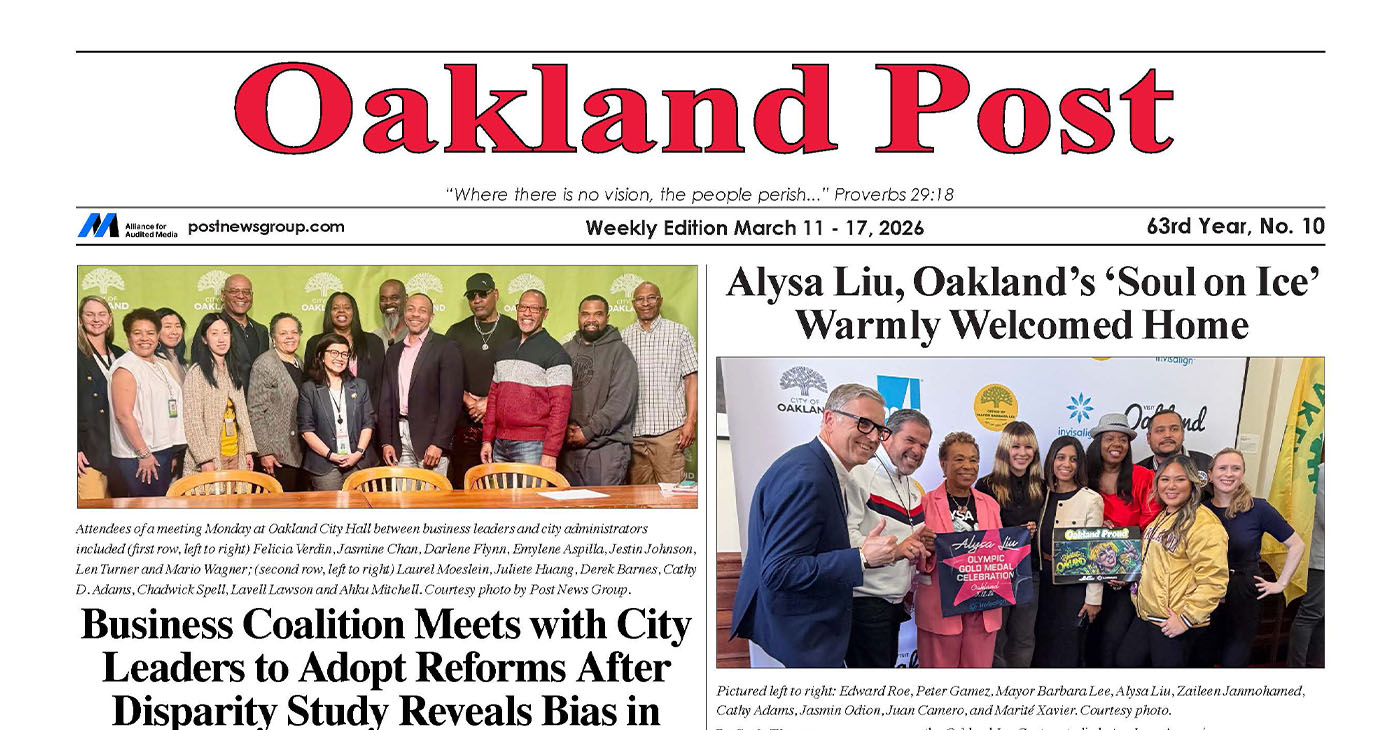
Oakland Post: Week of March 11 -17, 2026
The printed Weekly Edition of the Oakland Post: Week of March 11 – 17, 2026
To enlarge your view of this issue, use the slider, magnifying glass icon or full page icon in the lower right corner of the browser window.
Activism
Oakland Post: Week of March 4 – 10, 2026
The printed Weekly Edition of the Oakland Post: Week of March 4 – 10, 2026

To enlarge your view of this issue, use the slider, magnifying glass icon or full page icon in the lower right corner of the browser window.
Activism
Oakland Post: Week of February 25 – March 3, 2026
The printed Weekly Edition of the Oakland Post: Week of – February 25 – March 3, 2026

To enlarge your view of this issue, use the slider, magnifying glass icon or full page icon in the lower right corner of the browser window.
WORK FROM HOME
Home-based business with potential monthly income of $10K+ per month. A proven training system and website provided to maximize business effectiveness. Perfect job to earn side and primary income. Contact Lynne for more details: Lynne4npusa@gmail.com 800-334-0540


Financial Wellness and Mental Health: Managing Money Stress in College

Oakland Post: Week of March 11 -17, 2026

Women & Wealth: Tips for Navigating Your Lifelong Financial Journey

COMMENTARY: Women of Color Shape Our Past and Future

Woman’s Search for Family’s Roots Leads to Ancestor John T. Ward – A Successful Entrepreneur and Conductor on the Underground Railroad

Advocates Raise Alarm Over ICE Operation, MOU and Detention Risks in Baltimore County

Pete Buttigieg to Join Mayor Randall Woodfin for Community Town Hall in Birmingham

WATCH: Week One – NNPA’s “Leadership Matters” Video Series

Oakland Post: Week of March 4 – 10, 2026

OP-ED: NNPA Launches 2026 “Leadership Matters” Video Series

PRESS ROOM: PMG and Cranbrook Horizons-Upward Bound Launch Journey Fellowship Cohort 2

Los Angeles Summit Brings Together Leaders to Tackle Poverty and Affordability

Civil Rights TV Launches 24/7 Network Focused on Black History, Education and Equity

REVIEW: The Ultimate Hot Girl Summer Getaway: Sunseeker Resort Florida

COMMENTARY: How You Stop a Prescription Medicine is as Important as How You Start

Book Review: Books on Black History and Black Life for Kids

Community Celebrates Turner Group Construction Company as Collins Drive Becomes Turner Group Drive

Discrimination in City Contracts

California Launches Study on Mileage Tax to Potentially Replace Gas Tax as Republicans Push Back

COMMENTARY: The Biases We Don’t See — Preventing AI-Driven Inequality in Health Care

Black History Events in the East Bay

Post Newspaper Invites NNPA to Join Nationwide Probate Reform Initiative

Art of the African Diaspora Celebrates Legacy and Community at Richmond Art Center

New Bill, the RIDER Safety Act, Would Support Transit Ambassadors and Safety on Public Transit

COMMENTARY: The National Protest Must Be Accompanied with Our Votes

Oakland Post: Week of February 4 – 10, 2026

Oakland Post: Week of February 11 – 17, 2026

Dorothy Lee Bolden: Uniting Domestic Workers

After Don Lemon’s Arrest, Black Officials Raise Concerns About Independent Black Media

Reflecting on Black History Milestones in Birmingham AL

Hyundai Ioniq 5 Parking, Safety, and 360 View #shorts

2025 Ioniq 5 New Wiper & Powerful Performance! #shorts

Electric SUV Range: Is 259 Miles Enough? #shorts

EV Charging: How Fast Can You Charge an Electric Vehicle? #shorts

Biometric Cooling… Messaging Seats…Come on! 2025 Infiniti QX80 Autograph 4WD

Charged Up: Witness the Magic of a Fully Electric Car! #shorts

Range Rover Sport PHEV Included…: See What’s Inside This Luxury SUV! #shorts

Invisible Hood View: Perfect Parking with X-Ray Vision! #shorts

AI Is Reshaping Black Healthcare: Promise, Peril, and the Push for Improved Results in California

ESSAY: Technology and Medicine, a Primary Care Point of View

Sanctuary Cities

The RESISTANCE – FREEDOM NOW

STATE OF THE PEOPLE: Freddie

ECONOMIC BOYCOTT DAY!!!!!

I told You So
-
 #NNPA BlackPress3 weeks ago
Reflecting on Black History Milestones in Birmingham AL
-
 #NNPA BlackPress3 weeks ago
PRESS ROOM: NBA Hall of Fame Nominee Terry Cummings Joins 100 Black Men of DeKalb County to Launch Victory & Values Initiative
-

 #NNPA BlackPress4 weeks ago
U.S. manufacturing rebounds – how foundry services are adapting to rising demand
-

 #NNPA BlackPress4 weeks ago
OP-ED: One Hundred Years of Black Workers Telling the Truth
-

 Activism3 weeks ago
Oakland Post: Week of February 25 – March 3, 2026
-

 #NNPA BlackPress4 weeks ago
Advancements in solar technology that are changing the way we power the world
-

 #NNPA BlackPress3 weeks ago
Trump’s MAGA Allies are Creating Executive Order Plan to Steal the 2026 Midterms
-
 #NNPA BlackPress4 weeks ago
PRESS ROOM: Civil Rights TV Launches in Selma as the World’s First 24/7 Civil Rights Television Network
