
Bay Area
California Agencies Say They Want More Black Californians to Access Jobs, Training
Equity has become a national buzzword. But what does it mean when it comes to labor and employment? The state says it aims to make that definition clear and make it work for all Californians, particularly African Americans.


By Aldon Thomas Stiles, California Black Media
Last week, the California Labor and Workforce Development Agency, San Bernardino County Workforce Development Board, and the Riverside County Workforce Development Board held a summit at the March Field Air Museum in Riverside to discuss persistent employment and labor challenges.
The main challenge, they say, is achieving equity.
“A vital component for the equitable economic and sustainable future of California will be determined on the vision and strategic investments in fast-growing regions like the Inland Empire,” said Angelo Farooq, chairman of the California Workforce Development Board.
“We are proud of the multitude of High Road apprenticeship grants for employers/workers that our board has been making in the region and its continued impact to support quality jobs for the local economy,” Farooq added.
Equity has become a national buzzword. But what does it mean when it comes to labor and employment? The state says it aims to make that definition clear and make it work for all Californians, particularly African Americans.
“Inclusive and equitable. Let’s talk about those two words because I love them and I hate them,” said the event’s keynote speaker Secretary Natalie Palugyai of the California Labor and Workforce Development Agency. “I hate them because they get watered down and thrown around, and people really don’t even know what they’re talking about anymore and when people throw those words out, I want to know exactly what they mean because if they don’t mean something behind it, we’re actually not going to get to those lofty goals.”
Palugyai provided her own definition for what these goals should look like.
“Getting people in the door, that’s equity,” said Palugyai. “If I have an African American population and they aren’t participating in my program, but they represent 10% of my region, what am I doing?”
Palugyai said that the state, traditionally, has not invested in these efforts in an equitable way.
“Let’s just be really frank about this; economic development, state investments, infrastructure, [and] workforce training and development has been done the same way for a long time and what has really changed?” Palugyai asked the room full of workforce officials and sponsors.
The summit panel consisted of workforce representatives from the state and both Inland Empire counties, as well as community leaders throughout the region.
They all spoke about the importance of equity while acknowledging the systemic challenges they’ve faced in that pursuit.
The Economic Policy Institute, and other sources tracking job data, say Black unemployment in California remains higher than the statewide average.
At the state level, the California Labor & Workforce Development Agency wants regional offices to maintain some independence to help encourage participation from the Black community.
“We haven’t been great at outreach,” Palugyai admitted. “During COVID, we learned that the only proper way to do outreach is through community organizations that are connected to the people we’re trying to serve. The old ways of us doing it are just not cutting it anymore.”
She brought up an example of the state supporting regional equity efforts: the Community Economic Resilience Fund (CERF) which would provide aid to counties based on their needs following the COVID-19 pandemic.
“You want outreach from the people who look like you that are probably going to understand you more,” Palugyai said.
In Riverside County, these challenges are prevalent, according to Leslie Trainor, deputy director of the Riverside County Workforce Development Centers.
However, she reports that they have been working on said challenges.
“One of the things we did was look at the numbers of the customers that we’re serving because we wanted to make sure that we were at least serving the number of African Americans in proportion to the number of African Americans in the general population of Riverside County and we are in fact serving a slightly higher percentage,” said Trainor.
She admitted there are “systemic issues to tackle.”
Patrick Ellis, chairman of the Riverside County Workforce Development Board, emphasizes that just getting Black people jobs is not enough to solve the problem.
“I don’t think we can achieve equity if we don’t pay a lot of attention to job quality,” said Ellis. “We have a lot of poor people in California, and we have a lot of poor people in the Inland Empire. Most poor people work, often more than one job.”
Trainor said that the Riverside County Workforce Development Centers can offer help with upskilling, resume updating, mock interviews, and job searches but some people are not aware of these services.
Because of this, Riverside County Workforce Development Centers are looking to connect with the Black community through Black-led community-based organizations, as is the plan for the state’s workforce development programs.
The state and the two Inland Empire counties plan to make this summit an annual event.









Activism
Oakland Post: Week of April 8 – 14, 2026
The printed Weekly Edition of the Oakland Post: Week of April 8 – 14, 2026

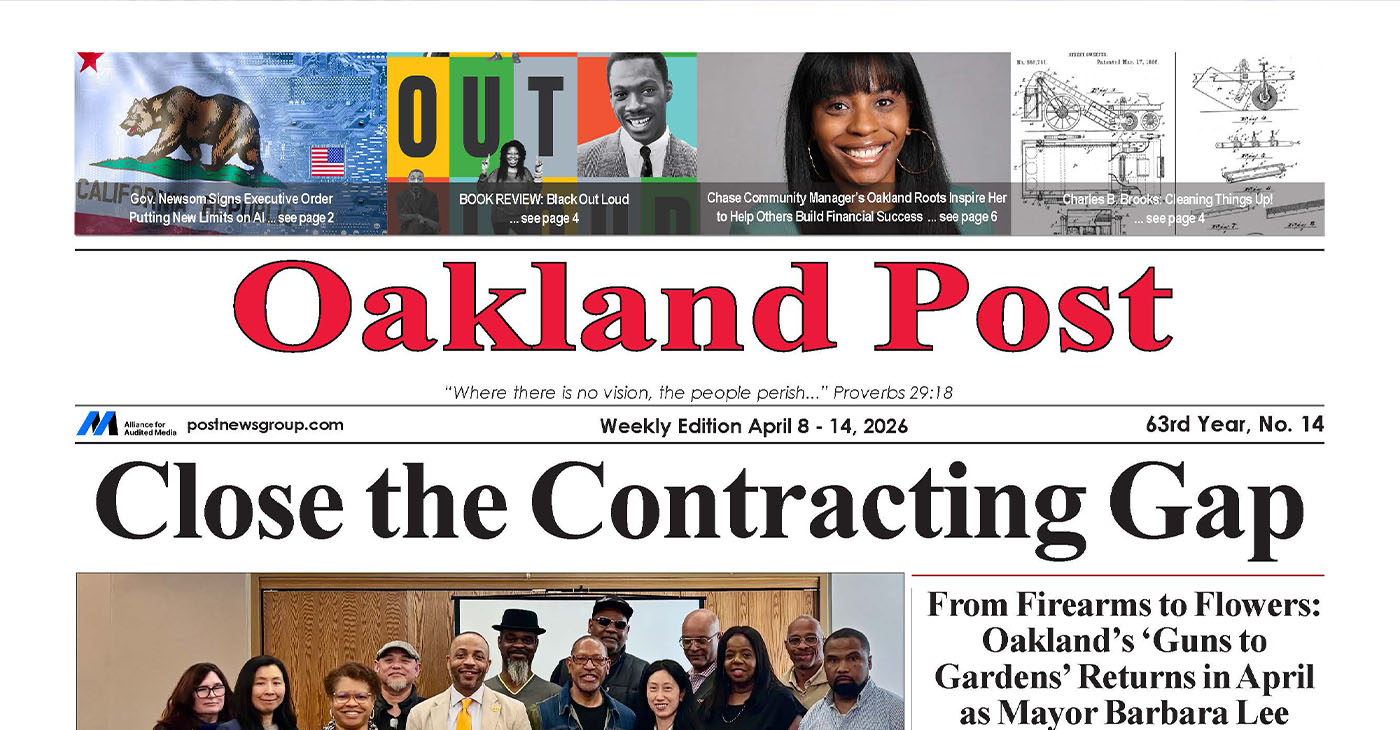
To enlarge your view of this issue, use the slider, magnifying glass icon or full page icon in the lower right corner of the browser window.

Activism
Oakland Post: Week of April 1 – 7, 2026
The printed Weekly Edition of the Oakland Post: Week of April 1 – 7, 2026
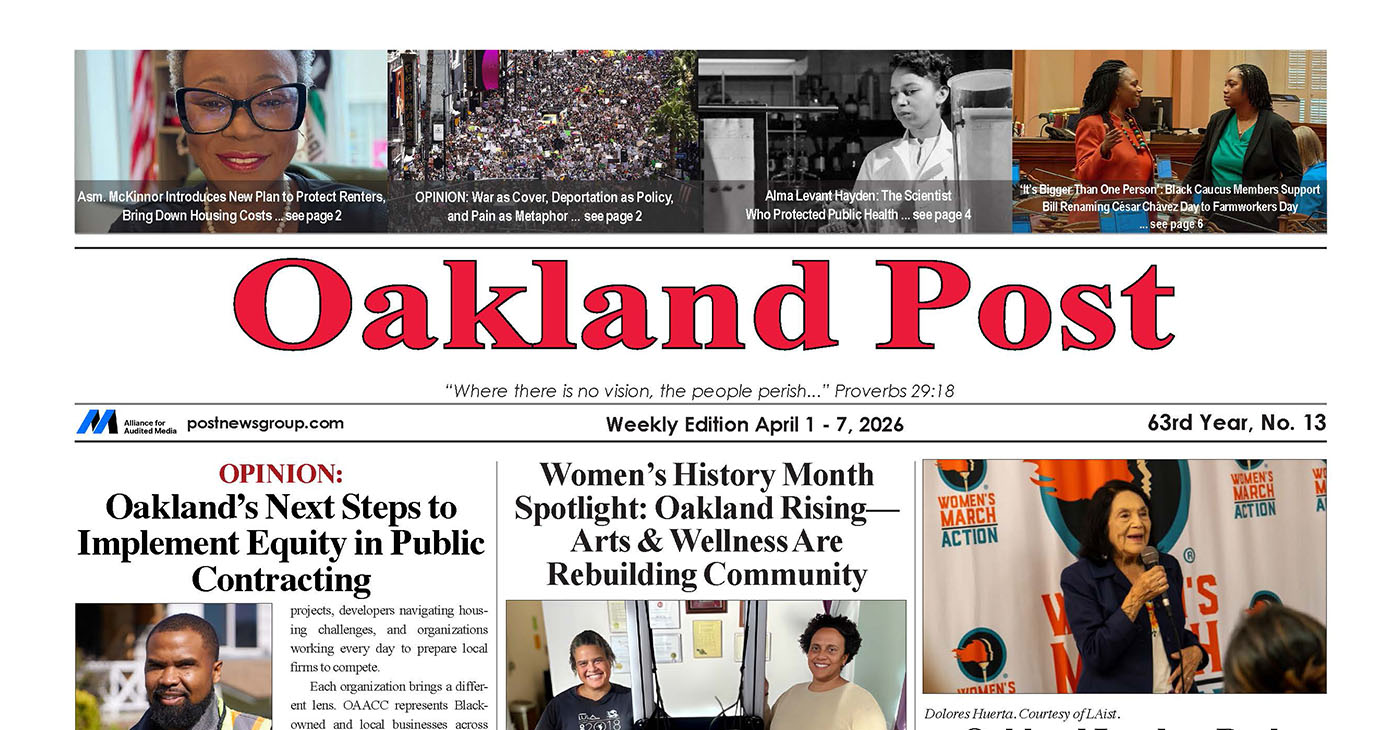
To enlarge your view of this issue, use the slider, magnifying glass icon or full page icon in the lower right corner of the browser window.
Activism
Oakland Post: Week of March 18 – 24, 2026
The printed Weekly Edition of the Oakland Post: Week of March 18 – 24, 2026
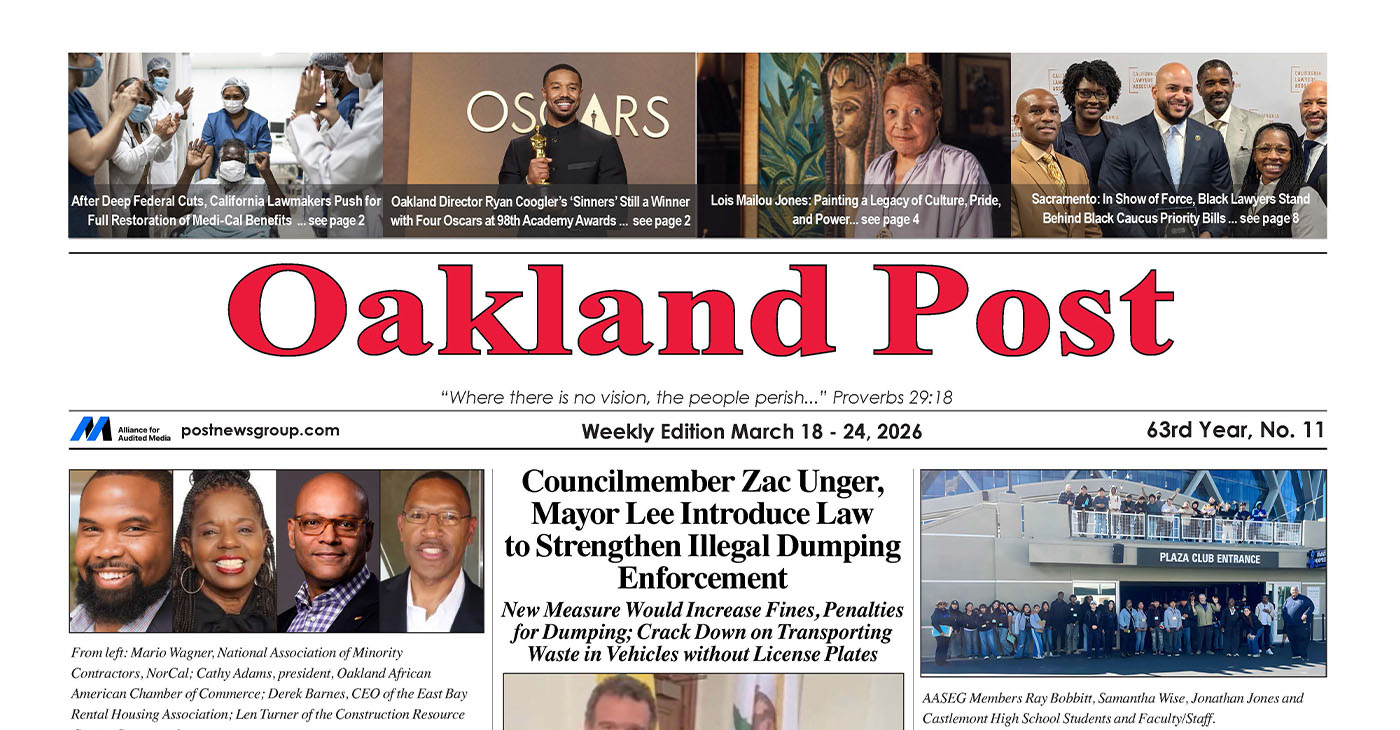
To enlarge your view of this issue, use the slider, magnifying glass icon or full page icon in the lower right corner of the browser window.

WORK FROM HOME
Home-based business with potential monthly income of $10K+ per month. A proven training system and website provided to maximize business effectiveness. Perfect job to earn side and primary income. Contact Lynne for more details: Lynne4npusa@gmail.com 800-334-0540


Oakland Post: Week of April 8 – 14, 2026

Oakland Post: Week of April 1 – 7, 2026

Black Artists in America, Installation Three Wraps at the Dixon Gallery and Gardens

Grief, Advocacy, and Education: A Counselor Reflects on Black Maternal Health

Future of Florida’s Black History Museum in Limbo

New Research Shows the Many Benefits of Early Learning

South Hampton K-8 Students Among Top 10 Finalists for Samsung’s ‘Solve for Tomorrow’ Competition

Cuba: No Negotiation with US on the President or Political System

Brooklyn Academy of Music Names Jamaican-Born Tamara McCaw as President

Trinidad & Tobego – U.S. Launches WhatsApp Channel for American Citizens in the Country

Oakland Post: Week of March 18 – 24, 2026

AI Innovation vs. Ethics and Environmental Impact

AI, Web3, and Digital Reparations

What If You Owned Your AI Agent?

Season 7, Episode 3 – January Reporter’s Roundtable 📱

Reflecting on Black History Milestones in Birmingham AL

Oakland Post: Week of February 25 – March 3, 2026

Oakland Post: Week of March 4 – 10, 2026

PRESS ROOM: NBA Hall of Fame Nominee Terry Cummings Joins 100 Black Men of DeKalb County to Launch Victory & Values Initiative

Trump’s MAGA Allies are Creating Executive Order Plan to Steal the 2026 Midterms
Oakland Post: Week of March 18 – 24, 2026

Oakland Post: Week of March 11 -17, 2026

Poll Shows Support for Policies That Help Families Afford Child Care

OP-ED: One Hundred Years of Black Workers Telling the Truth

Financial Wellness and Mental Health: Managing Money Stress in College

Woman’s Search for Family’s Roots Leads to Ancestor John T. Ward – A Successful Entrepreneur and Conductor on the Underground Railroad

COMMENTARY: Women of Color Shape Our Past and Future
Brooklyn Academy of Music Names Jamaican-Born Tamara McCaw as President
New Research Shows the Many Benefits of Early Learning
Grief, Advocacy, and Education: A Counselor Reflects on Black Maternal Health

Hyundai Ioniq 5 Parking, Safety, and 360 View #shorts

2025 Ioniq 5 New Wiper & Powerful Performance! #shorts

Electric SUV Range: Is 259 Miles Enough? #shorts

EV Charging: How Fast Can You Charge an Electric Vehicle? #shorts

Biometric Cooling… Messaging Seats…Come on! 2025 Infiniti QX80 Autograph 4WD

Charged Up: Witness the Magic of a Fully Electric Car! #shorts

Range Rover Sport PHEV Included…: See What’s Inside This Luxury SUV! #shorts

Invisible Hood View: Perfect Parking with X-Ray Vision! #shorts

AI Is Reshaping Black Healthcare: Promise, Peril, and the Push for Improved Results in California

ESSAY: Technology and Medicine, a Primary Care Point of View

Sanctuary Cities

The RESISTANCE – FREEDOM NOW

STATE OF THE PEOPLE: Freddie

ECONOMIC BOYCOTT DAY!!!!!

I told You So

-
 Activism3 weeks ago
Oakland Post: Week of March 18 – 24, 2026
-
 Activism4 weeks ago
Oakland Post: Week of March 11 -17, 2026
-
 Advice4 weeks ago
Financial Wellness and Mental Health: Managing Money Stress in College
-
 #NNPA BlackPress3 weeks ago
Brooklyn Academy of Music Names Jamaican-Born Tamara McCaw as President
-
 #NNPA BlackPress3 weeks ago
New Research Shows the Many Benefits of Early Learning
-
 #NNPA BlackPress3 weeks ago
Grief, Advocacy, and Education: A Counselor Reflects on Black Maternal Health
-
 #NNPA BlackPress3 weeks ago
Future of Florida’s Black History Museum in Limbo
-
 #NNPA BlackPress3 weeks ago
Black Artists in America, Installation Three Wraps at the Dixon Gallery and Gardens
