
Activism
Calculating the Costs: Reparations Task Force OKs Expert Team to Determine Compensation
“The national strategy of attempting to eliminate the racial wealth gap is something that is not replicated at the state level given the resources that the state of California currently possesses,” said William A. “Sandy” Darity Jr., the director of the Samuel DuBois Cook Center on Social Equity at Duke University. “The second issue is the condition of racial wealth and equality in the state of California is not exclusively a consequence of a chain of events that took place solely in the state.”


By Antonio Ray Harvey, California Black Media
A day after the Task Force to Study and Develop Reparations Proposals for African Americans decided who would be eligible for compensation, the nine-member panel approved a framework for calculating how much should be paid — and for which offenses — to individuals who are Black descendants of enslaved people in the United States.
The task force voted 8-0 to consider a blueprint of 13 “harms,” titled “Model 2: State Specific Harms/Atrocities Framework,” presented by an expert team it appointed.
“The Task Force will give us some directions and what to pursue to use this framework to figure out a procedure to have calculations,” said Dr. Kaycea Campbell, a member of the expert team. “(It) will allow us to identify specific atrocities or harms for which California should compensate.”
The expert panel reported that a “conservative estimate” of 2 million African Americans in California have ancestors who were enslaved in the United States. According to the U.S. 2020 Census, there are about 2.6 million Black Californians in a state that has a total population of nearly 40 million residents.
The expert team identified 13 “categories” that would be the “methodology” and “procedure to calculate damages” to determine what constitutes harms and atrocities, Campbell said.
Those harms include unjust property seizure by eminent domain; intellectual property deprivation; homelessness; unwarranted police violence; segregated education; denial of representation on estate commissions; housing discrimination; labor discrimination; environmental harm; mass incarceration and sentencing; public health harms; transgenerational effects and among others.
The inflictions are prioritized to establish the case for compensation, with specificity to California, based on evidence gathered during witness testimonies over a course of nine months.
“The list is in no way final, can be expanded, and can be shrunk,” Campbell told the task force on March 30. “But we wanted to give an idea of these particular atrocities, as they are identified, and have the task force direct us as to what we should be looking at.”
Campbell, who is based in Long Beach, is an experienced career economist specializing in economic theory, analysis, and policy. The chief executive officer for Ventana Capital Advisors and associate professor of Economics, Los Angeles Pierce College, Campbell has a Ph.D. degree in Economics-Management from Claremont Graduate University.
Campbell says the five-member unit is tasked with providing an economic perspective of the work the task force is doing, helping to quantify past economic injustices African Americans faced in the state and elsewhere, and determining what or how much compensation should be for Black people living in California.
The expert team includes Williams Spriggs (former chair of the Department of Economics at Howard University. He currently serves as chief economist for the AFL-CIO), and Thomas Craemer is the Public Policy Professor at the University of Connecticut.
Spriggs and Craemer testified in front of the task force last October.
Rounding out the panel of experts are William A. “Sandy” Darity Jr., the director of the Samuel DuBois Cook Center on Social Equity at Duke University, and Kirsten Mullen, a writer, and lecturer whose work focuses on race, art, history, and politics.
Darity is a Samuel DuBois Cook professor of public policy, African and African American studies, and economics at Duke University. His research focuses on racial, class and ethnic inequality and stratification economics; education and the racial achievement gap; North-South theories of trade and development; and the economics of reparations.
Darity and Mullen co-authored the book, “From Here to Equality: Reparations for Black Americans in the 21st Century.” They testified before the task force during the first meeting in June 2021.
The task force chose the Model 2 framework over Model 1, called the “National Reparations Framework.” The first option captures all the “opportunities and losses” linked to enslavement, Jim Crow laws, elements of lost wages, and others.
The expert team expressed their concerns about the national model because many of the atrocities, discrimination, and wage gap only relate to southern territories that did not happen in California.
“The national strategy of attempting to eliminate the racial wealth gap is something that is not replicated at the state level given the resources that the state of California currently possesses,” Darity said. “The second issue is the condition of racial wealth and equality in the state of California is not exclusively a consequence of a chain of events that took place solely in the state.”
On March 29, the task force voted 5-4 in favor of lineage over race as the determining factor for compensation. The members of the expert team suggested that a “reparations tribunal” would be one approach where individuals and families could establish residency and file claims of harm based on lineage.
Task Force Chair Kamilah Moore said the community eligibility portion will be based on lineage “determined by an individual being African American, the descendant of a (person enslaved as chattel) or descendant of a free-Black person living in the United States prior to the end of the 19th century.”
By statute, the task force will issue a report to the Legislature by June 1, 2022, which will be available to the public.
Model 2 of the Framework for Reparations and Calculations could “potentially” arrive with modifications when the expert team reports back to the task force during the next meeting, Moore said.
After the expert team’s presentation, testimonials were provided on the “War on Drugs” and the crack-cocaine epidemic during the March meeting.
Those harms could be added to one of the categories.
“I am just putting that on our radar as a potential and distinct harm,” Moore said of the injuries not currently listed in Model 2.
The Task Force will hold its next meeting at San Francisco’s Third Baptist Church on Wednesday, April 13 at 9:00 a.m. and Thursday, April 14 at 9:00 a.m.
Third Baptist Church is at 1399 McAllister St. in San Francisco.










Activism
Oakland Post: Week of March 11 -17, 2026
The printed Weekly Edition of the Oakland Post: Week of March 11 – 17, 2026
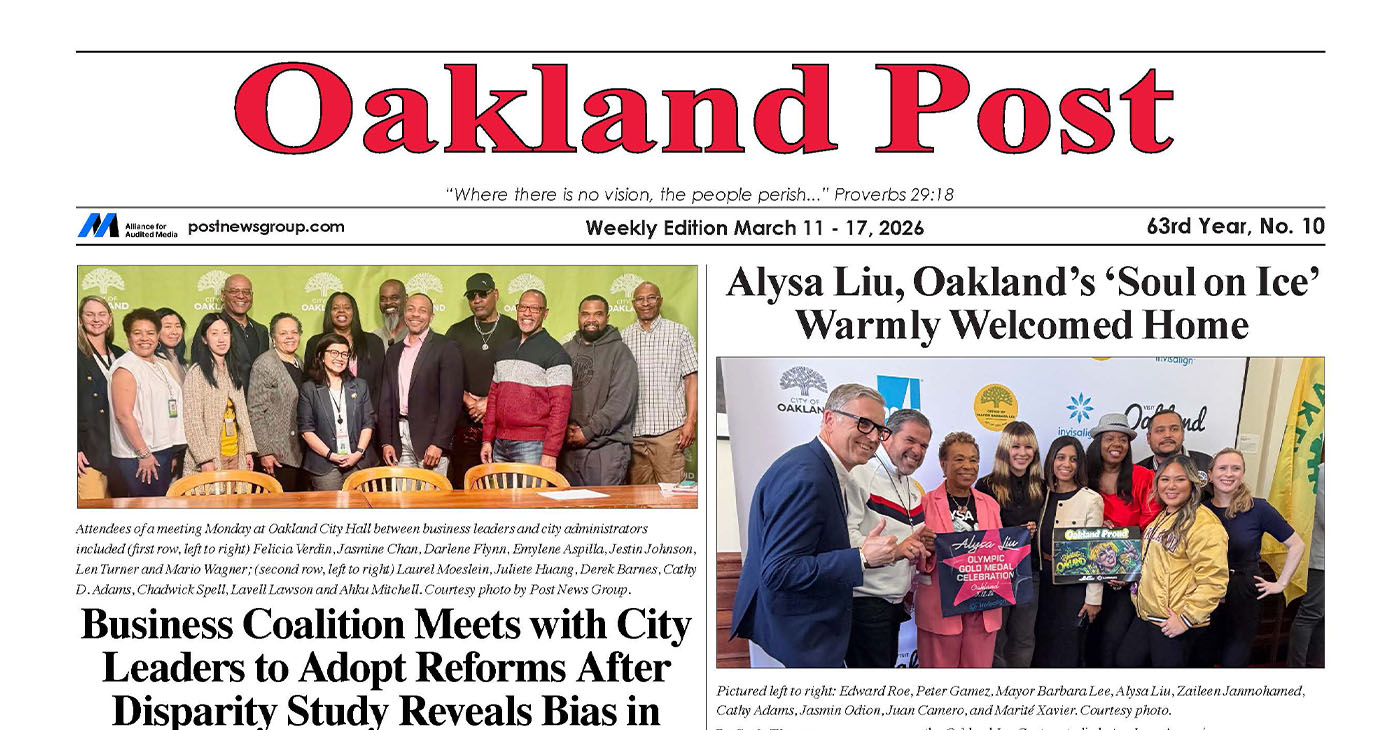
To enlarge your view of this issue, use the slider, magnifying glass icon or full page icon in the lower right corner of the browser window.
Activism
Oakland Post: Week of March 4 – 10, 2026
The printed Weekly Edition of the Oakland Post: Week of March 4 – 10, 2026

To enlarge your view of this issue, use the slider, magnifying glass icon or full page icon in the lower right corner of the browser window.
Activism
Oakland Post: Week of February 25 – March 3, 2026
The printed Weekly Edition of the Oakland Post: Week of – February 25 – March 3, 2026
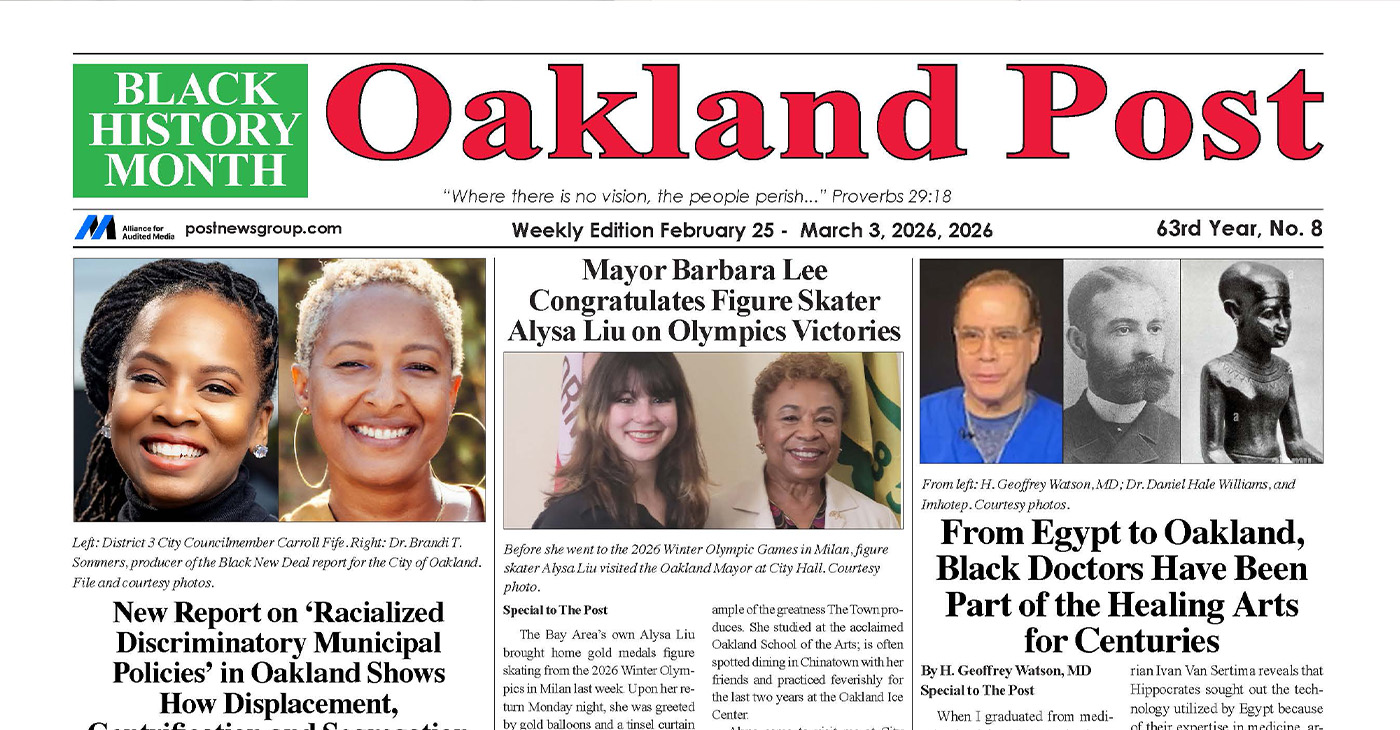
To enlarge your view of this issue, use the slider, magnifying glass icon or full page icon in the lower right corner of the browser window.

WORK FROM HOME
Home-based business with potential monthly income of $10K+ per month. A proven training system and website provided to maximize business effectiveness. Perfect job to earn side and primary income. Contact Lynne for more details: Lynne4npusa@gmail.com 800-334-0540


Financial Wellness and Mental Health: Managing Money Stress in College

Oakland Post: Week of March 11 -17, 2026

Women & Wealth: Tips for Navigating Your Lifelong Financial Journey

COMMENTARY: Women of Color Shape Our Past and Future

Woman’s Search for Family’s Roots Leads to Ancestor John T. Ward – A Successful Entrepreneur and Conductor on the Underground Railroad

Advocates Raise Alarm Over ICE Operation, MOU and Detention Risks in Baltimore County

Pete Buttigieg to Join Mayor Randall Woodfin for Community Town Hall in Birmingham

WATCH: Week One – NNPA’s “Leadership Matters” Video Series

Oakland Post: Week of March 4 – 10, 2026

OP-ED: NNPA Launches 2026 “Leadership Matters” Video Series

PRESS ROOM: PMG and Cranbrook Horizons-Upward Bound Launch Journey Fellowship Cohort 2

Los Angeles Summit Brings Together Leaders to Tackle Poverty and Affordability

Civil Rights TV Launches 24/7 Network Focused on Black History, Education and Equity

REVIEW: The Ultimate Hot Girl Summer Getaway: Sunseeker Resort Florida

COMMENTARY: How You Stop a Prescription Medicine is as Important as How You Start

Book Review: Books on Black History and Black Life for Kids

Community Celebrates Turner Group Construction Company as Collins Drive Becomes Turner Group Drive

Discrimination in City Contracts

California Launches Study on Mileage Tax to Potentially Replace Gas Tax as Republicans Push Back

COMMENTARY: The Biases We Don’t See — Preventing AI-Driven Inequality in Health Care

Black History Events in the East Bay

Post Newspaper Invites NNPA to Join Nationwide Probate Reform Initiative

Art of the African Diaspora Celebrates Legacy and Community at Richmond Art Center

New Bill, the RIDER Safety Act, Would Support Transit Ambassadors and Safety on Public Transit

COMMENTARY: The National Protest Must Be Accompanied with Our Votes

Oakland Post: Week of February 4 – 10, 2026

Oakland Post: Week of February 11 – 17, 2026

Dorothy Lee Bolden: Uniting Domestic Workers

After Don Lemon’s Arrest, Black Officials Raise Concerns About Independent Black Media

Reflecting on Black History Milestones in Birmingham AL

Hyundai Ioniq 5 Parking, Safety, and 360 View #shorts

2025 Ioniq 5 New Wiper & Powerful Performance! #shorts

Electric SUV Range: Is 259 Miles Enough? #shorts

EV Charging: How Fast Can You Charge an Electric Vehicle? #shorts

Biometric Cooling… Messaging Seats…Come on! 2025 Infiniti QX80 Autograph 4WD

Charged Up: Witness the Magic of a Fully Electric Car! #shorts

Range Rover Sport PHEV Included…: See What’s Inside This Luxury SUV! #shorts

Invisible Hood View: Perfect Parking with X-Ray Vision! #shorts

AI Is Reshaping Black Healthcare: Promise, Peril, and the Push for Improved Results in California

ESSAY: Technology and Medicine, a Primary Care Point of View

Sanctuary Cities

The RESISTANCE – FREEDOM NOW

STATE OF THE PEOPLE: Freddie

ECONOMIC BOYCOTT DAY!!!!!

I told You So
-
 #NNPA BlackPress3 weeks ago
Reflecting on Black History Milestones in Birmingham AL
-
 #NNPA BlackPress3 weeks ago
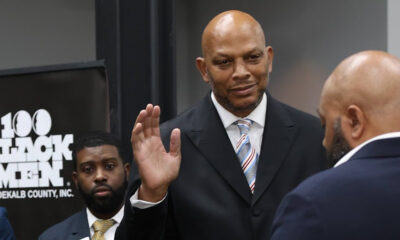
PRESS ROOM: NBA Hall of Fame Nominee Terry Cummings Joins 100 Black Men of DeKalb County to Launch Victory & Values Initiative
-

 #NNPA BlackPress4 weeks ago
U.S. manufacturing rebounds – how foundry services are adapting to rising demand
-

 #NNPA BlackPress4 weeks ago
OP-ED: One Hundred Years of Black Workers Telling the Truth
-

 Activism3 weeks ago
Oakland Post: Week of February 25 – March 3, 2026
-

 #NNPA BlackPress4 weeks ago
Advancements in solar technology that are changing the way we power the world
-

 #NNPA BlackPress3 weeks ago
Trump’s MAGA Allies are Creating Executive Order Plan to Steal the 2026 Midterms
-

 #NNPA BlackPress4 weeks ago
PRESS ROOM: Civil Rights TV Launches in Selma as the World’s First 24/7 Civil Rights Television Network
