
Bay Area
BRIDGE Housing and The Unity Council Celebrate Grand Opening of Casa Sueños, a 181-Unit Affordable Housing Community in Oakland’s Fruitvale Village
OAKLAND, Calif. (June 26, 2024) – BRIDGE Housing, the leading nonprofit affordable housing developer and manager on the West Coast, and The Unity Council, an acclaimed social equity development corporation, today welcomed dignitaries, partners and community members to celebrate the grand opening of Casa Sueños, a 181-unit affordable housing community in Oakland’s Fruitvale Village.

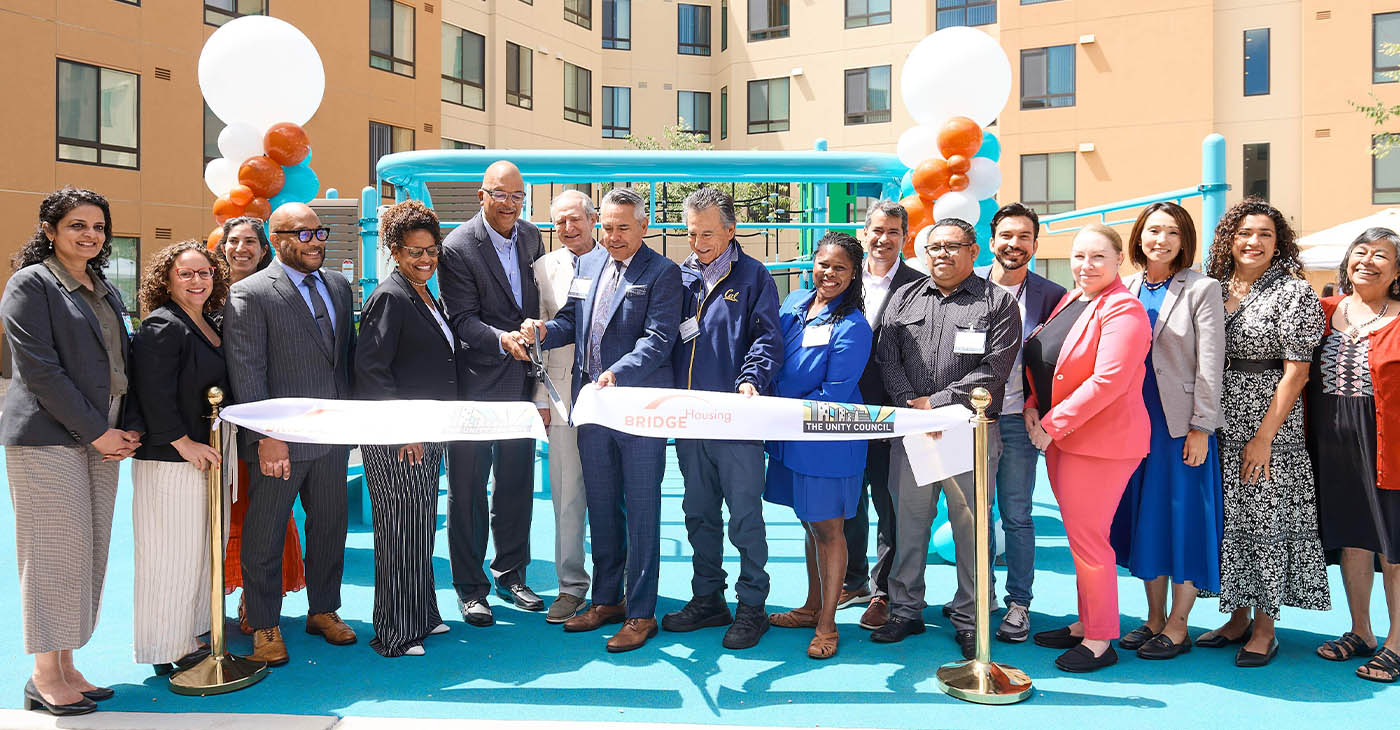
As part of the award-winning, transit-oriented Fruitvale Village, Casa Sueños provides essential affordable housing for individuals, families, and those who have experienced homelessness
OAKLAND, Calif. (June 26, 2024) – BRIDGE Housing, the leading nonprofit affordable housing developer and manager on the West Coast, and The Unity Council, an acclaimed social equity development corporation, today welcomed dignitaries, partners and community members to celebrate the grand opening of Casa Sueños, a 181-unit affordable housing community in Oakland’s Fruitvale Village.
Casa Sueños, located at the intersection of East 12th Street and 35th Avenue, will help address Oakland’s critical housing shortage by providing studio, one-, two-, and three-bedroom apartments that will be affordable for families earning 20-80% of Area Median Income. Forty-six units are reserved for residents who have previously experienced homelessness, with permanent supportive services provided by Lifelong Medical Care and funded by Alameda County. Another 29 apartments are available through vouchers from the Oakland Housing Authority. Youth and family services are provided by The Unity Council.
Casa Sueños also includes 7,500 square feet of affordable ground-floor commercial space that will be utilized by Communities United for Restorative Youth Justice (CURYJ), an Oakland-based nonprofit focused on ending youth criminalization and mass incarceration.
Today’s ribbon-cutting was attended by dozens of government leaders, housing officials, financing partners, new Casa Sueños residents, and community members.
“Casa Sueños demonstrates the transformational power of high-quality affordable housing, along with resident services, that will make a lasting positive difference in the lives of 181 individuals and families,” said BRIDGE Housing President and CEO Ken Lombard. “Working shoulder to shoulder with The Unity Council and our other partners, we have made the innovative Fruitvale Village even more vibrant – setting a new standard for livable communities that help residents realize their fullest potential.”
“Place-based affordable housing is the cornerstone of stability. This incredible structure was a BART parking lot just a few years ago. Now it will offer affordable, dignified housing to families and essential workers in the heart of Oakland,” said The Unity Council CEO Chris Iglesias. “The return on investment will benefit the entire region. All parties need to find ways to remove barriers, work collaboratively, and speed up the process for the greater good.”
Casa Sueños responds to the growing need for affordable homes for working families and essential workers in Oakland and the Bay Area. It was developed in partnership with City, County and transit partners, is steps away from Fruitvale BART station, a major AC Transit hub, and the planned Bus Rapid Transit. Initially planned as a market-rate housing development, Casa Sueños is the final residential component of the award-winning Fruitvale Transit Village, which first opened in 2004.
Importantly, Casa Sueños was the model development instrumental in the passage of AB 434, a state law that streamlines four funding programs for rental housing into a single application and award process – accelerating the production of affordable housing for Californians.
Amenities at Casa Sueños include a multi-purpose room with chairs and tables for resident educational use; a community room with desks, sofas, and a kitchen; communal laundry rooms on the first four floors; Amazon lockers in the mailroom; a large courtyard with children’s play equipment, grills, and numerous seating areas; and an underground garage with EV chargers and a bike storage room.
Founded in 1983, BRIDGE Housing has a 40-year history of providing safe, affordable homes for families in the Bay Area and throughout the West Coast. With a focus on community development and comprehensive support services, BRIDGE has nearly 1,200 units of affordable housing in 10 locations throughout Oakland, including the historic St. Joseph’s campus in Fruitvale. Its total portfolio exceeds 13,000 units in California, Washington and Oregon, providing affordable homes for 30,000 residents.
For 60 years, The Unity Council has been focused on supporting Oakland residents through improved social equity and quality of life while addressing the area’s most pressing challenges – unemployment, poverty, access to education, and erasure of cultural identity. Its programs include workforce development, early childhood education, food security, youth leadership and senior services, and development without displacement.
“As we celebrate the grand opening of Casa Sueños, a beacon of opportunity in our beloved Fruitvale of Oakland’s District 5, we affirm our commitment to equity and dignity for all,” said Oakland City Councilmember Noel Gallo (D-5). “This remarkable transit-oriented community not only provides affordable housing but also embodies our shared vision of inclusive development. Thanks to the leadership of The Unity Council and BRIDGE Housing, Casa Sueños stands as a testament to what is possible when we come together with purpose and passion. Let us continue to build unity and bridges as we create homes where every resident can thrive and contribute to the vibrant tapestry of our city.”
Financing for Casa Sueños was provided by the City of Oakland; Oakland Housing Authority; Alameda County; Alameda County Health Care Services Agency; California Department of Housing and Community Development TOD Housing Program; California Climate Investments (funded through the Greenhouse Gas Reduction Fund); Affordable Housing and Sustainable Communities Program through the Strategic Growth Council and the California Department of Housing and Community Development; National Affordable Housing Trust; Lument; JPMorgan Chase; California Tax Credit Allocation Committee; and California Debt Limit Allocation Committee. The architect is SVA Architects, and the general contractor is J.H. Fitzmaurice.
About BRIDGE Housing
BRIDGE Housing is a leading nonprofit developer, owner and manager of high-quality affordable housing on the West Coast, with a mission to strengthen communities and improve lives. Founded in 1983, BRIDGE has participated in the creation of more than 21,000 affordable homes in California, Oregon and Washington, with a total development cost of $5.2 billion. Its current portfolio totals more than 13,000 apartments that are home to 30,000 residents, with another 8,000 units in the development pipeline. For more information, visit www.bridgehousing.com.
About The Unity Council
The Unity Council is a non-profit community development organization committed to promoting social equity and improving the quality of life for diverse communities in Oakland and the Greater East Bay. Since its inception in 1964, The Unity Council has provided vital services, including affordable housing, workforce development, and health and wellness programs, to empower residents and strengthen neighborhoods.






Activism
Oakland Post: Week of March 18 – 24, 2026
The printed Weekly Edition of the Oakland Post: Week of March 18 – 24, 2026

To enlarge your view of this issue, use the slider, magnifying glass icon or full page icon in the lower right corner of the browser window.
Activism
Oakland Post: Week of March 11 -17, 2026
The printed Weekly Edition of the Oakland Post: Week of March 11 – 17, 2026
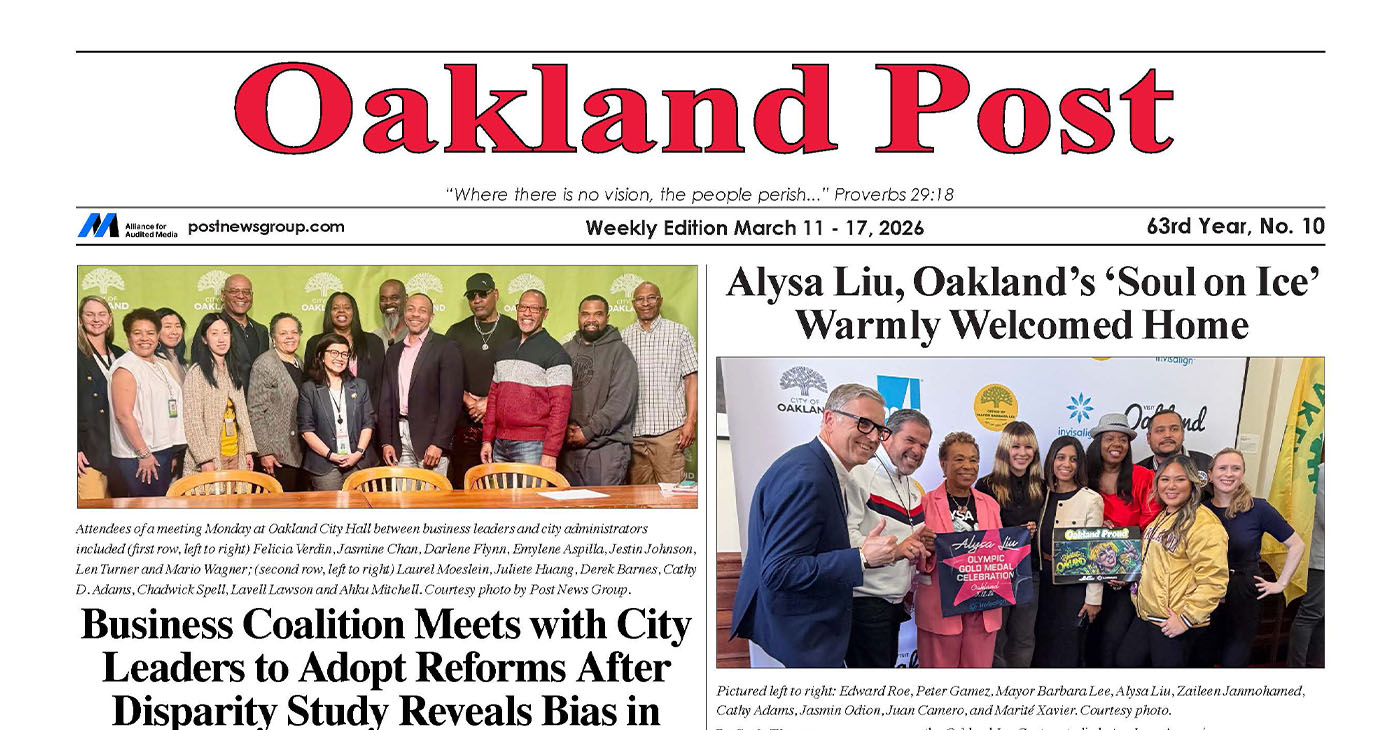
To enlarge your view of this issue, use the slider, magnifying glass icon or full page icon in the lower right corner of the browser window.
Activism
Oakland Post: Week of March 4 – 10, 2026
The printed Weekly Edition of the Oakland Post: Week of March 4 – 10, 2026

To enlarge your view of this issue, use the slider, magnifying glass icon or full page icon in the lower right corner of the browser window.

WORK FROM HOME
Home-based business with potential monthly income of $10K+ per month. A proven training system and website provided to maximize business effectiveness. Perfect job to earn side and primary income. Contact Lynne for more details: Lynne4npusa@gmail.com 800-334-0540


Black Artists in America, Installation Three Wraps at the Dixon Gallery and Gardens

Grief, Advocacy, and Education: A Counselor Reflects on Black Maternal Health

Future of Florida’s Black History Museum in Limbo

New Research Shows the Many Benefits of Early Learning

South Hampton K-8 Students Among Top 10 Finalists for Samsung’s ‘Solve for Tomorrow’ Competition

Cuba: No Negotiation with US on the President or Political System

Brooklyn Academy of Music Names Jamaican-Born Tamara McCaw as President

Trinidad & Tobego – U.S. Launches WhatsApp Channel for American Citizens in the Country

Oakland Post: Week of March 18 – 24, 2026

AI Innovation vs. Ethics and Environmental Impact

AI, Web3, and Digital Reparations

What If You Owned Your AI Agent?

Season 7, Episode 3 – January Reporter’s Roundtable 📱

Season 7, Episode 3 – January Reporter’s Roundtable

AI, Media, and Power | Part 2, Real-World Impacts and Tradeoffs

Reflecting on Black History Milestones in Birmingham AL

CITY OF SAN LEANDRO STATE OF CALIFORNIA PUBLIC WORKS DEPARTMENT ENGINEERING DIVISION NOTICE TO BIDDERS FOR ANNUAL STREET OVERLAY/REHABILITATION 2019-21 – PHASE III

Oakland Post: Week of February 18 – 24, 2026

Oakland Post: Week of February 25 – March 3, 2026

PRESS ROOM: NBA Hall of Fame Nominee Terry Cummings Joins 100 Black Men of DeKalb County to Launch Victory & Values Initiative

Trump’s MAGA Allies are Creating Executive Order Plan to Steal the 2026 Midterms

Oakland Post: Week of March 4 – 10, 2026

Chase Oakland Community Center Hosts Alley-Oop Accelerator Building Community and Opportunity for Bay Area Entrepreneurs

U.S. manufacturing rebounds – how foundry services are adapting to rising demand

Poll Shows Support for Policies That Help Families Afford Child Care

OP-ED: One Hundred Years of Black Workers Telling the Truth

Advancements in solar technology that are changing the way we power the world

Woman’s Search for Family’s Roots Leads to Ancestor John T. Ward – A Successful Entrepreneur and Conductor on the Underground Railroad

Oakland Post: Week of March 11 -17, 2026

COMMENTARY: Women of Color Shape Our Past and Future

Hyundai Ioniq 5 Parking, Safety, and 360 View #shorts

2025 Ioniq 5 New Wiper & Powerful Performance! #shorts

Electric SUV Range: Is 259 Miles Enough? #shorts

EV Charging: How Fast Can You Charge an Electric Vehicle? #shorts

Biometric Cooling… Messaging Seats…Come on! 2025 Infiniti QX80 Autograph 4WD

Charged Up: Witness the Magic of a Fully Electric Car! #shorts

Range Rover Sport PHEV Included…: See What’s Inside This Luxury SUV! #shorts

Invisible Hood View: Perfect Parking with X-Ray Vision! #shorts

AI Is Reshaping Black Healthcare: Promise, Peril, and the Push for Improved Results in California

ESSAY: Technology and Medicine, a Primary Care Point of View

Sanctuary Cities

The RESISTANCE – FREEDOM NOW

STATE OF THE PEOPLE: Freddie

ECONOMIC BOYCOTT DAY!!!!!

I told You So

-
 Activism4 weeks ago
Oakland Post: Week of March 4 – 10, 2026
-
 #NNPA BlackPress4 weeks ago
Woman’s Search for Family’s Roots Leads to Ancestor John T. Ward – A Successful Entrepreneur and Conductor on the Underground Railroad
-
 Activism3 weeks ago
Oakland Post: Week of March 11 -17, 2026
-
 #NNPA BlackPress4 weeks ago
COMMENTARY: Women of Color Shape Our Past and Future
-

 #NNPA BlackPress4 weeks ago
Advocates Raise Alarm Over ICE Operation, MOU and Detention Risks in Baltimore County
-

 Advice3 weeks ago
Financial Wellness and Mental Health: Managing Money Stress in College
-

 #NNPA BlackPress4 weeks ago
Pete Buttigieg to Join Mayor Randall Woodfin for Community Town Hall in Birmingham
-
 Activism2 weeks ago
Oakland Post: Week of March 18 – 24, 2026
