
Politics
Black Motorist’s Fatal Shooting: Outcry Over Police Tactics


In this April 4, 2015, frame from dashboard video provided by the North Charleston Police Department, Patrolman Michael Thomas Slager stands by Walter Lamer Scott’s car during a traffic stop in North Charleston, S.C. The video captures the moments leading up to a fatal shooting that has sparked outrage as the latest example of a white police officer killing an unarmed black man. Slager has been fired and charged with murder. (AP Photo/North Charleston Police Department)
JEFFREY COLLINS, Associated Press
MITCH WEISS, Associated Press
NORTH CHARLESTON, South Carolina (AP) — As its population surged in the last decade, South Carolina’s third-largest city fought rising crime through aggressive policing. But North Charleston’s police department lost the respect of many black residents in neighborhoods they blitzed, and now many are upset after the fatal shooting of an unarmed black motorist by a white officer.
Police in North Charleston used computers to track the neighborhoods where crime was on the rise, then sent waves of officers to patrol and conduct traffic stops, looking for offenders and letting drivers know they were cracking down. By the numbers, the tactics worked: every major category of crime, from murder to burglary to robbery to rape all fell significantly from 2007 to 2012, the last year for which statistics are available.
But anger is surfacing as civil rights leaders are demanding a full U.S. Justice Department investigation of the North Charleston force. The fatal shooting of Walter Scott as he fled after a traffic stop Saturday stirred outrage around the U.S., but people in North Charleston said they weren’t surprised.
“If the image of the city is more important than the lives of their citizens, there is going to be a problem,” said Dot Scott, president of the Charleston branch of the NAACP civil rights group. She’s unrelated to the slain motorist.
The U.S. Justice Department is conducting a parallel investigation with a local prosecutor into whether there were civil rights violations in the killing of Walter Scott. The NAACP would like that expanded to a full probe of whether racism and lack of respect for civil rights is pervasive through the entire department — similar to the federal agency’s probe after the fatal shooting of an 18-year-old unarmed black man by a white officer in Ferguson, Missouri.
With just over 100,000 people, North Charleston grew by nearly 16,500 people or about 20 percent from 2000 to 2010. More than half of its residents are minorities, mostly African-Americans. About 28 percent of its families make less than $25,000 a year.
For years, it battled an economic slump caused by the mid-1990s closing of the Charleston Naval Base on the city’s waterfront. For decades, city fortunes were tied to the base, where 38,000 people worked in the late 1980s.
But the city had plenty of land and proximity to next door Charleston, an affluent city popular with tourists. North Charleston has since bounced back, largely because of a huge investment by Boeing, which has a 787 aircraft manufacturing plant in the city.
Now North Charleston reaches from upscale subdivisions of $700,000 homes near the banks of the Ashley River to the older, impoverished black neighborhoods near the old naval base.
And those poor and black residents have learned to band together and be cautious around a police force that is nearly 80 percent white. Several residents around the city this week told the same story about what they do when an officer turns on the lights to pull them over. They said they immediately call a friend to see if they are nearby and can walk over to be a witness to a traffic stop. If no one is close, the phone is kept on so the person on the other end can listen, just in case.
Blacks were routinely putting their hands in the air when police confronted them for years before “Hands up, Don’t shoot” became a slogan in the wake of the death of Michael Brown in Ferguson, said 25-year-old Robert Blanton.
He said he has been stopped plenty of times for simply walking around his neighborhood after dark.
“I wonder — do they do that to whites walking in their neighborhood?” Blanton said.
The police department has refused to talk about its crime-fighting strategies since Scott was killed and officer Michael Slager was charged with murder, saying they want to wait until after Scott’s funeral on Saturday out of respect for his family.
But in a 2012 article in The Post and Courier of Charleston, then-Police Chief Jon Zumalt justified his more aggressive approach by saying it ensured people were obeying the law. And even if traffic stops didn’t lead to arrests, it got the word out that North Charleston was serious about fighting crime, he told the newspaper, which reported traffic stops in the city increased by about 3,000 to nearly 64,000 in 2011.
Numbers gathered by the state back that up. North Charleston had 26 murders in 2007 and 13 murders in 2012. The number of robberies in that five-year span fell 66 percent, while the number of burglaries dropped 29 percent.
Copyright 2015 The Associated Press. All rights reserved. This material may not be published, broadcast, rewritten or redistributed.








Activism
Oakland Post: Week of April 1 – 7, 2026
The printed Weekly Edition of the Oakland Post: Week of April 1 – 7, 2026
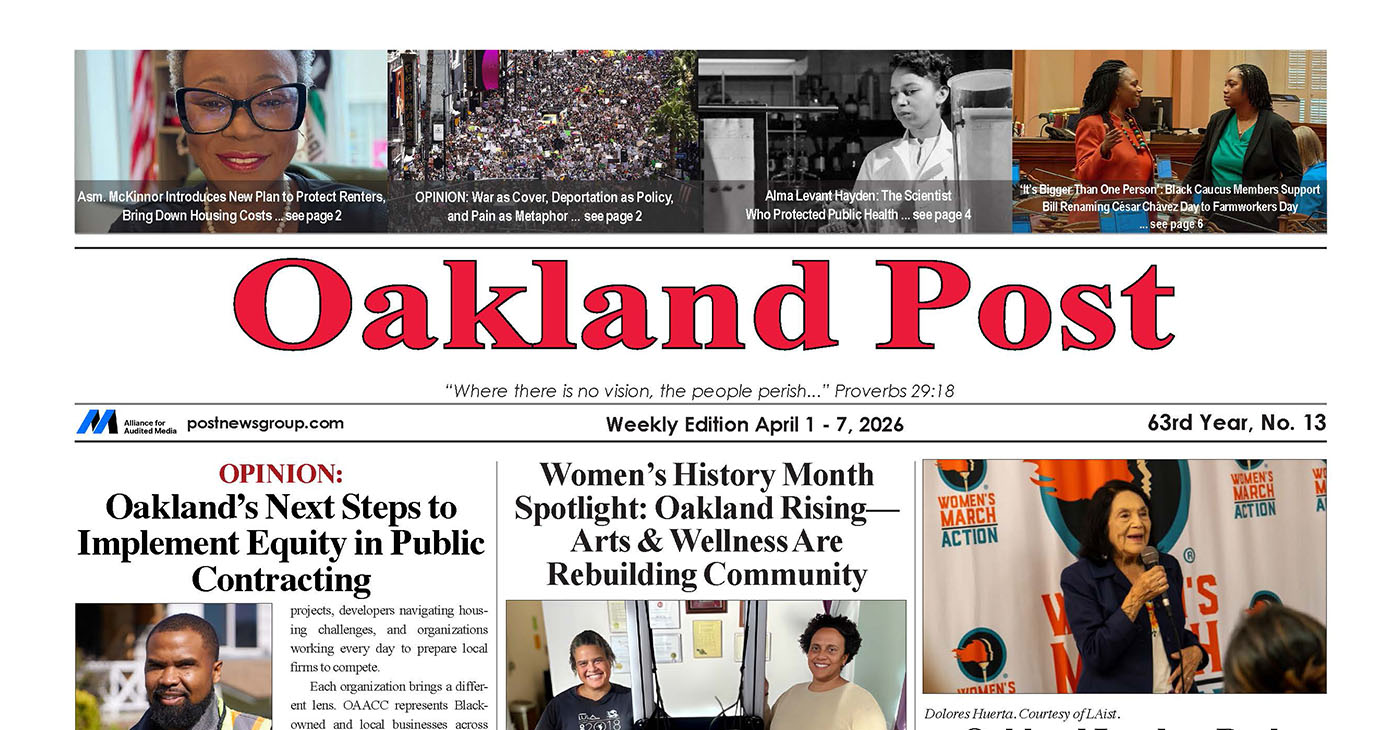
To enlarge your view of this issue, use the slider, magnifying glass icon or full page icon in the lower right corner of the browser window.
Activism
Oakland Post: Week of March 18 – 24, 2026
The printed Weekly Edition of the Oakland Post: Week of March 18 – 24, 2026

To enlarge your view of this issue, use the slider, magnifying glass icon or full page icon in the lower right corner of the browser window.
Activism
Oakland Post: Week of March 11 -17, 2026
The printed Weekly Edition of the Oakland Post: Week of March 11 – 17, 2026
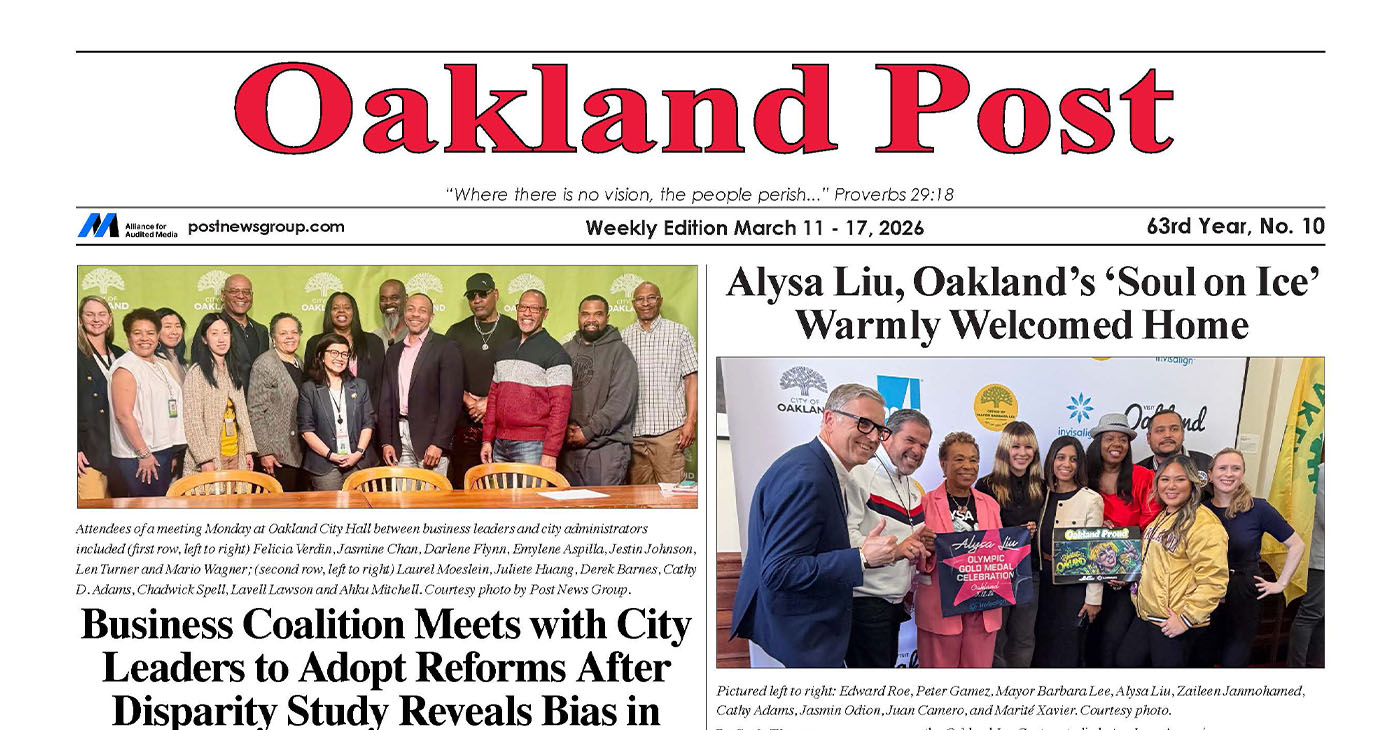
To enlarge your view of this issue, use the slider, magnifying glass icon or full page icon in the lower right corner of the browser window.


WORK FROM HOME
Home-based business with potential monthly income of $10K+ per month. A proven training system and website provided to maximize business effectiveness. Perfect job to earn side and primary income. Contact Lynne for more details: Lynne4npusa@gmail.com 800-334-0540


Oakland Post: Week of April 1 – 7, 2026

Black Artists in America, Installation Three Wraps at the Dixon Gallery and Gardens

Grief, Advocacy, and Education: A Counselor Reflects on Black Maternal Health

Future of Florida’s Black History Museum in Limbo

New Research Shows the Many Benefits of Early Learning

South Hampton K-8 Students Among Top 10 Finalists for Samsung’s ‘Solve for Tomorrow’ Competition

Cuba: No Negotiation with US on the President or Political System

Brooklyn Academy of Music Names Jamaican-Born Tamara McCaw as President

Trinidad & Tobego – U.S. Launches WhatsApp Channel for American Citizens in the Country

Oakland Post: Week of March 18 – 24, 2026

AI Innovation vs. Ethics and Environmental Impact

AI, Web3, and Digital Reparations

What If You Owned Your AI Agent?

Season 7, Episode 3 – January Reporter’s Roundtable 📱

Season 7, Episode 3 – January Reporter’s Roundtable

Reflecting on Black History Milestones in Birmingham AL

Oakland Post: Week of February 25 – March 3, 2026

PRESS ROOM: NBA Hall of Fame Nominee Terry Cummings Joins 100 Black Men of DeKalb County to Launch Victory & Values Initiative

Trump’s MAGA Allies are Creating Executive Order Plan to Steal the 2026 Midterms

Oakland Post: Week of March 4 – 10, 2026

U.S. manufacturing rebounds – how foundry services are adapting to rising demand

Poll Shows Support for Policies That Help Families Afford Child Care

OP-ED: One Hundred Years of Black Workers Telling the Truth

Advancements in solar technology that are changing the way we power the world

Oakland Post: Week of March 11 -17, 2026

Woman’s Search for Family’s Roots Leads to Ancestor John T. Ward – A Successful Entrepreneur and Conductor on the Underground Railroad
Oakland Post: Week of March 18 – 24, 2026

COMMENTARY: Women of Color Shape Our Past and Future

PRESS ROOM: Civil Rights TV Launches in Selma as the World’s First 24/7 Civil Rights Television Network

OP-ED: NNPA Launches 2026 “Leadership Matters” Video Series

Hyundai Ioniq 5 Parking, Safety, and 360 View #shorts

2025 Ioniq 5 New Wiper & Powerful Performance! #shorts

Electric SUV Range: Is 259 Miles Enough? #shorts

EV Charging: How Fast Can You Charge an Electric Vehicle? #shorts

Biometric Cooling… Messaging Seats…Come on! 2025 Infiniti QX80 Autograph 4WD

Charged Up: Witness the Magic of a Fully Electric Car! #shorts

Range Rover Sport PHEV Included…: See What’s Inside This Luxury SUV! #shorts

Invisible Hood View: Perfect Parking with X-Ray Vision! #shorts

AI Is Reshaping Black Healthcare: Promise, Peril, and the Push for Improved Results in California

ESSAY: Technology and Medicine, a Primary Care Point of View

Sanctuary Cities

The RESISTANCE – FREEDOM NOW

STATE OF THE PEOPLE: Freddie

ECONOMIC BOYCOTT DAY!!!!!

I told You So
-
 Activism3 weeks ago
Oakland Post: Week of March 11 -17, 2026
-
 #NNPA BlackPress4 weeks ago
Woman’s Search for Family’s Roots Leads to Ancestor John T. Ward – A Successful Entrepreneur and Conductor on the Underground Railroad
-
 Activism2 weeks ago
Oakland Post: Week of March 18 – 24, 2026
-
 #NNPA BlackPress4 weeks ago
COMMENTARY: Women of Color Shape Our Past and Future
-

 Advice3 weeks ago
Financial Wellness and Mental Health: Managing Money Stress in College
-

 #NNPA BlackPress4 weeks ago
Advocates Raise Alarm Over ICE Operation, MOU and Detention Risks in Baltimore County
-

 #NNPA BlackPress4 weeks ago
Pete Buttigieg to Join Mayor Randall Woodfin for Community Town Hall in Birmingham
-
 #NNPA BlackPress2 weeks ago
Brooklyn Academy of Music Names Jamaican-Born Tamara McCaw as President
