
Activism
Black LGBTQ+ Leaders and Allies Applaud 3 California Bills
Some of the proposed laws aim to address challenges that impact various segments of the African American LGBTQ+ community — either directly or circumstantially.

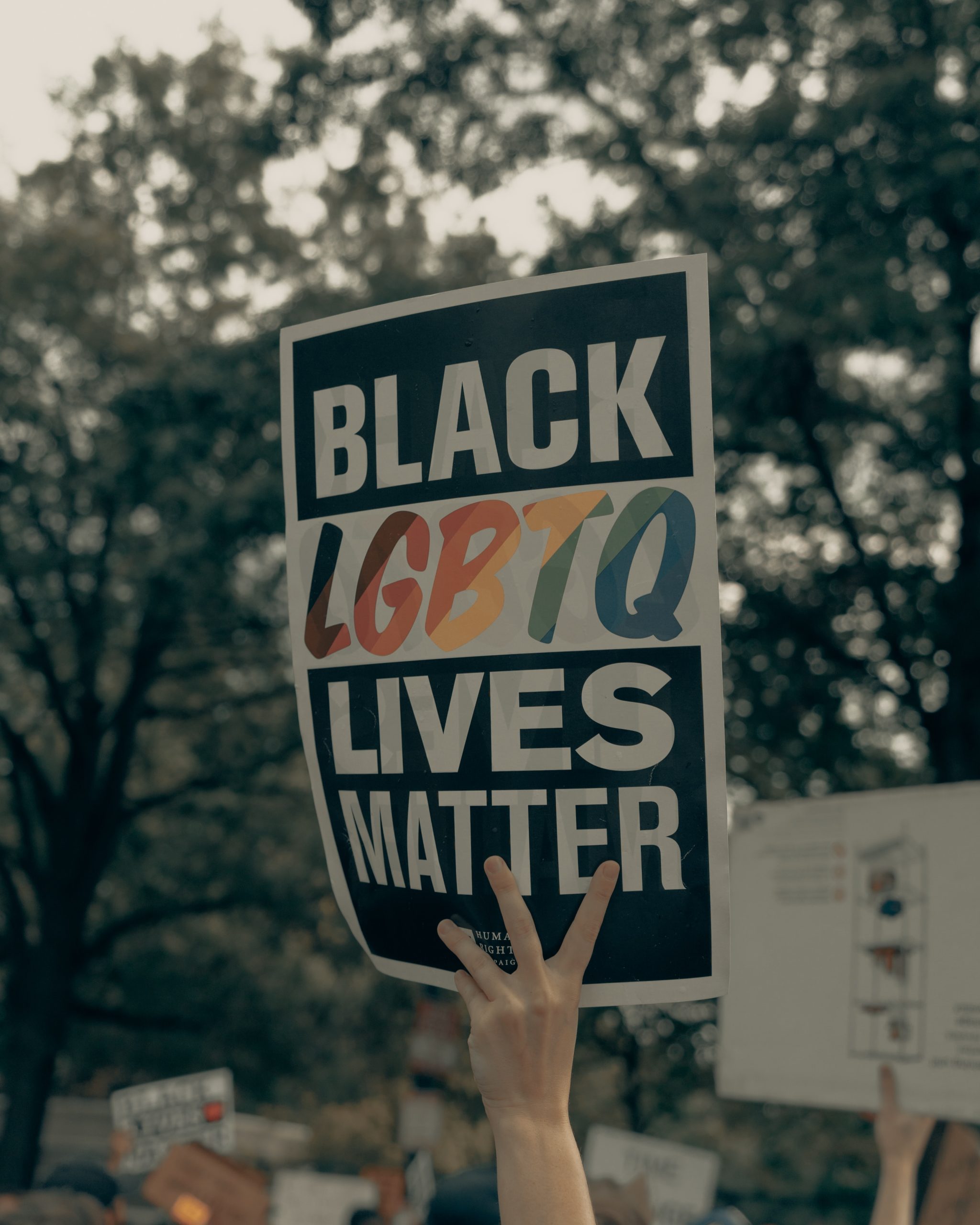
June is Pride Month and lawmakers in California are advancing a number of bills to make life safer and less difficult for people who are LGBTQ+.

Some of the proposed laws aim to address challenges that impact various segments of the African American LGBTQ+ community — either directly or circumstantially.
The first is Senate Bill (SB) 357. If the Legislature approves it, the law will repeal California Penal Code Section 653.22, which penalizes loitering with the intent to engage in sex work. This particular bill, if approved, supporters say will significantly reduce the risks and dangers many LGBTQ+ people at the lowest ends of the socioeconomic ladder face.
Many of them are young people who turn to sex work because of a number of reasons, including being unsupported by their families or the social structure because of their sexuality; trauma brought about by sexual or physical abuse; drug addiction; unemployment, among other factors.
Based on English Elizabethan “poor laws,” loitering laws in America were developed as a part of the Black Codes in the late 1800s as a means to arrest Black people in order to sell their labor in a practice called convict leasing.
“These laws were created to eradicate us,” said Dr. Jon Paul Higgins, a California-based social justice advocate and writer who is African American.
“So, when you talk about the importance of repealing these laws, it’s not even just about the law, it’s about getting to the root of what’s creating these laws,” Higgins explained.
According to the Centers for Disease Control, “many persons who exchange sex may have a history of homelessness, unemployment, incarceration, mental health issues, violence, emotional/physical/sexual abuse, and drug use.”
In California – and across the United States — a disproportionate number of African Americans are impacted by those challenges — all of them considered social determinants of good health by Public Health professionals.
Because of the vagueness of these loitering laws, many critics have noted that they gave police a wide range of arresting powers to target “undesirables” like Black people and people in the LGBTQ+ community, Higgins explained.
California State Senator Scott Wiener (D-San Francisco), author of this bill, says it would help make the streets safer for sex workers who are a part of a marginalized community.
“Sex workers are workers, and they deserve respect and safety,” Wiener said. “We must work toward a future where people — especially the most marginalized — aren’t criminalized because of who they are and what they look like. Anti-sex workers loitering laws are deeply pernicious, and they need to be repealed.”
SB 357 also allows those convicted of California Penal Code Section 653.22 to seal their records.
SB 357 was passed by the Senate Public Safety Committee 4-1 and has now been referred to the Assembly Appropriations Committee.
Another bill concerned with safety is Assembly Bill (AB) 1094, which would require the State Department of Public Health to establish a three-year pilot program in up to six participating counties to collect gender identity and sexual orientation data in violent death cases to get more accurate counts about hate crimes.
According to the Los Angeles County Commission on Human Relations 2019 Hate Crime Report, Black people accounted for 9% of the county’s population but 47% of the total racial hate crimes.
The report also stated that 2019 saw a 64% increase in hate crimes targeting trans people, many of whom were Black or Brown, according to the Human Rights Campaign.
“Yet another year with alarming levels of bias-motivated crimes underscores just how urgent it is to address this hate crimes epidemic,” said Alphonso David, Human Rights Campaign president. David is the first African American to lead the organization, the largest advocacy body for LGBTQ+ people and issues in the United States.
“This year, we saw a tragic new record of fatal violence against transgender and gender non-conforming people in this country, particularly against Black and Brown transgender women,” he said.
Following the Stonewall riots in New York, Black trans women like Marsha P. Johnson and Miss Major Griffin-Gracy became influential figures in the fight for LGBTQ+ rights at the time when discrimination and hate crimes against people like them were much more commonplace.
Assemblymember Joaquin Arambula (D-Fresno), author of AB 1094, explained why he feels the bill is crucial.
“I deeply appreciate the overwhelming support that my Assembly colleagues gave today to AB 1094,” Arambula said in a statement. “This legislation may be centered on data, but its purpose encompasses compassion and empathy to better understand what is happening in our LGTBQ+ community — particularly among the youth — when it comes to violent deaths, including homicide and suicide. AB 1094 is an important and humane step in ultimately preventing these deaths.”
AB 1094 has passed in the Assembly and is now on its way to the State Senate for consideration.
Senate Bill (SB) 379, which has now been referred to the Senate Appropriations Committee, would ensure the University of California Health System [UC Health] only contracts with healthcare facilities that provide LGBTQ-inclusive healthcare services, such as gender-affirming and reproductive care.
According to Blue Cross Blue Shield, Black mothers’ maternal mortality rate is 63% higher than white mothers while Black men are 70% more likely to die from a stroke as compared to non-Hispanic White men.
People in the LGBTQ+ community are less likely to have access to competent healthcare, largely due to issues with discrimination, according to Cigna.
Higgins spoke from personal experience about the intersectional nature of being both Black and in the LGBTQ+ community.
“For me, being a Black nonbinary person and meeting a provider who has all of these bias ideologies or stereotypes about Black people… there are all of these preconceived notions about who I am as a Black person and then you add on the nonbinary-slash-trans part of it, there’s just a lot of underlying stereotypes and bias,” Higgins said.
Jasmyne Cannick, founder and CEO of Empowerment Justice Strategies, praised this bill for moving with the tides of progress.
“In 2021, it makes absolute sense for UC Health to contract with healthcare facilities that provide LGBTQ-inclusive healthcare services given the population that it serves,” Cannick said.
“We are moving towards a more inclusive society, and these are the types of bills that will ensure that members of the LGBTQ+ community can receive healthcare they need,” she continued.
Higgins, Cannick and other advocates say it means a great deal that California lawmakers are making an effort to ensure that these “warriors” can continue to do so safely, and that those who just wish to live their lives without fear for being who they are may do so more boldly.










Activism
Oakland Post: Week of September 30 – October 6, 2026
The printed Weekly Edition of the Oakland Post: Week of September 30 – October 6, 2026

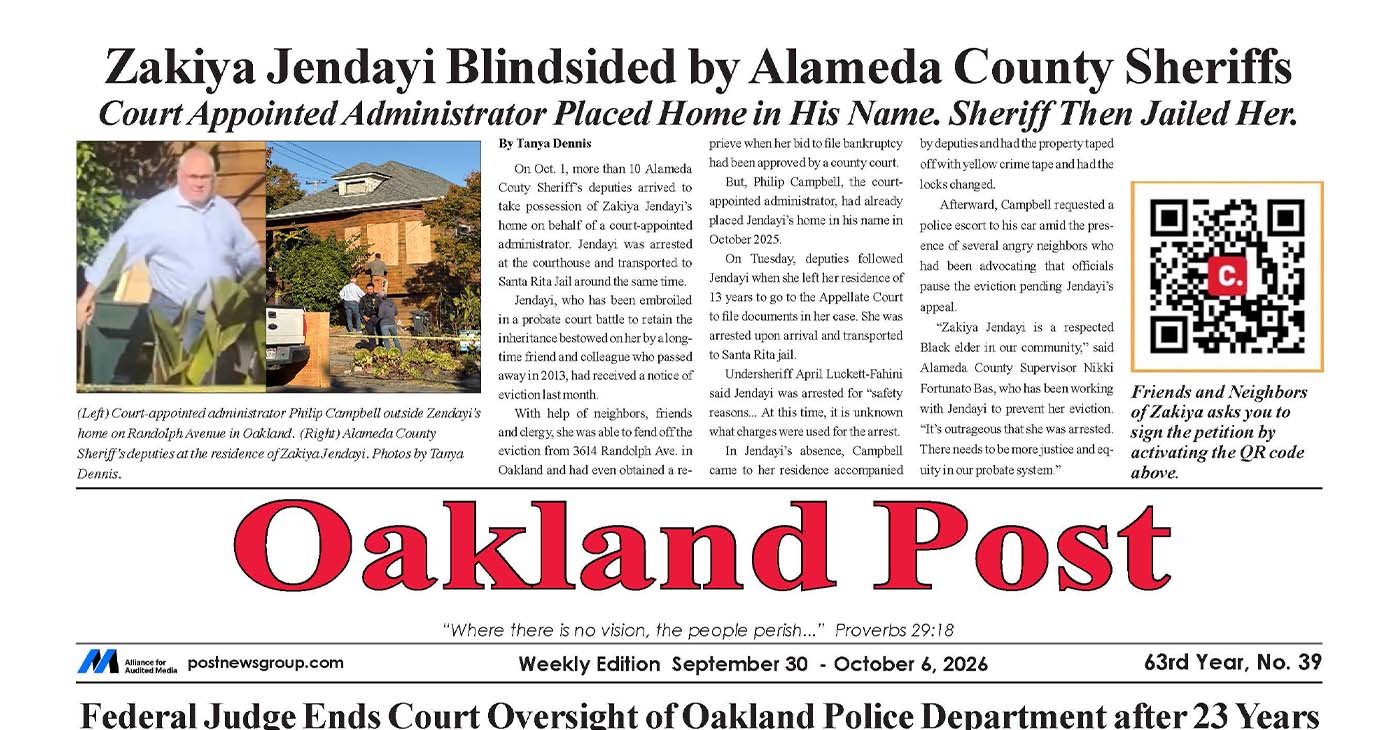
To enlarge your view of this issue, use the slider, magnifying glass icon or full page icon in the lower right corner of the browser window.

Activism
Oakland Post: Week of September 23 – 29, 2026
The printed Weekly Edition of the Oakland Post: Week of September 23 – 29, 2026

To enlarge your view of this issue, use the slider, magnifying glass icon or full page icon in the lower right corner of the browser window.
Activism
Oakland Post: Week of September 16 – 22, 2026
The printed Weekly Edition of the Oakland Post: Week of September 16 – 22, 2026

To enlarge your view of this issue, use the slider, magnifying glass icon or full page icon in the lower right corner of the browser window.


OP-ED: Proposition 44 Would Put a Price on Trust

OP-ED: Proposition 40: It’s Time to Play Chess, Not Checkers

Listening as a Lifeline: A Doula’s Witness to Black Maternal Health

New Protections for Ticket Buyers: Gov. Newsom Signs Assemblymember Isaac Bryan’s Bill

‘We Don’t Talk Trash — We Pick Up Trash!’

Zakiya Jendayi Arrested, Locked Out of Home by Sheriff’s Deputies

Oakland Post: Week of September 30 – October 6, 2026

Asm. Corey Jackson Announces Launch of 24-Hour Childcare in His District

IN MEMORIAM: The Rev. Leon “Sonny” Clark, Longtime Orange County Pastor and Community Leader, Dies at 72

Poll: Becerra Widens His Lead Over Hilton; Californians Split on Wealth Tax

From Historic Memories to New Possibilities: Oakland Celebrates Coliseum 60

County Office of Education Says OUSD Finances Are Getting Healthier, Materially Stronger

LIVE FREE Sunday Dinner Brings Faith, Fellowship and Civic Conversation to Oakland

Remembering Chauncey Bailey as Student Journalists Face Threats to Truth-Telling

BLACspace Cooperative Invites Bay Area to Experience Oakland’s Black Cultural Ecosystem Through a BLAC Map Tour + Party

Standoff for Justice: Our Homes Are Worth Fighting For

Oakland Post: Week of August 26 – September 1, 2026

Frontier Airlines’ Return to Oakland Airport Brings Flights, Jobs and Opportunity

Gubernatorial Candidate Steve Hilton Blasts California New Tire Rules; Newsom Hits Back

Chef Sharon Lee Blends Culinary Excellence, Education and Empowerment

Jackie Wright Champions Bay Area Stories, Filmmakers and Cultural Institutions

Misnamed ‘Parent’ PAC Seeks to Influence Oakland School Board Elections

Oakland Coliseum Project Opens Door for Small Businesses to Build Bigger

Gov. Newsom’s Latest Appointees Include Sacramento Advocate for Formerly Incarcerated Students; State’s New Tech Chief

Big City Mayors Ask for “Yes” Vote on Housing Bond Measure; Conservatives Say “No”

Longtime BWOPA Member Brendalyn Goodall Appointed to California Workforce Development Board

Oakland Post: Week of September 2 – 8, 2026

Gov. Newsom Signs Law Shielding Immigration Aid Workers From Doxing Threats

Secretary of State Shirley N. Weber Urges Californians to Vote Early as Voter ID Battle Intensifies

IN MEMORIAM: Dolly Parton Dead at 80 — How She Built a Legacy of Love and Earned Her Place in Black Culture

The Conversation With Al McFarlane 6/23/26

Media Monday 6/22/26

LIVE! ASK ALMA! — TUES. 6.23.26 7PM EST

Car Buying Secrets: 4 Hidden Checks Before You Sign!

Is This 550 HP Charger Worth YOUR Money? AutoNetwork Review

Celebrating Juneteenth – Frederick Douglass on education and resistance

LIVE! — ASK ALMA! — TUES. 6.19.26 7PM EST

Hyundai Ioniq 5 Parking, Safety, and 360 View #shorts

2025 Ioniq 5 New Wiper & Powerful Performance! #shorts

Electric SUV Range: Is 259 Miles Enough? #shorts

EV Charging: How Fast Can You Charge an Electric Vehicle? #shorts

Biometric Cooling… Messaging Seats…Come on! 2025 Infiniti QX80 Autograph 4WD

Charged Up: Witness the Magic of a Fully Electric Car! #shorts

Range Rover Sport PHEV Included…: See What’s Inside This Luxury SUV! #shorts

Invisible Hood View: Perfect Parking with X-Ray Vision! #shorts
-
 Community4 weeks ago
Misnamed ‘Parent’ PAC Seeks to Influence Oakland School Board Elections
-

 Activism4 weeks ago
Oakland Post: Week of September 9 – 15, 2026
-

 Community4 weeks ago
Richmond Tiny House Village Farm & Garden Set to Open Gates on Sept. 26
-

 Black History4 weeks ago
Latest Massacre in Haiti Reveals Cruelty U.S. Deportations
-

 Black History4 weeks ago
OPINION: Nolan Wells’ Death One of Several Signifying Racial Terror Lives on in U.S. South
-

 Business2 weeks ago
Mayor Lee Announces $1 Million Kaiser Permanente Grant for Pilot Program to Address Homelessness, Clean Up Public Spaces throughout Oakland
-

 Community3 weeks ago
Democratic Clubs Interview Candidates for Oakland School Board
-

 Uncategorized4 weeks ago
NBA All-Star Damian Lillard Returns Home for 15th Annual Backpack Giveaway
