
Bay Area
Black Caucus Black History Month Event Celebrates Business Owners
The California Black Chamber of Commerce (CBCC) and the California Legislative Black Caucus (CLBC) recognized the success of 16 thriving Black-owned businesses at its annual Legislative Business Brunch at the Citizen Hotel in Sacramento. The brunch, organized to celebrate Black History Month, honored the achievements of the businesses and celebrated their commitment to professional service and making an impact on the economy of communities around California.

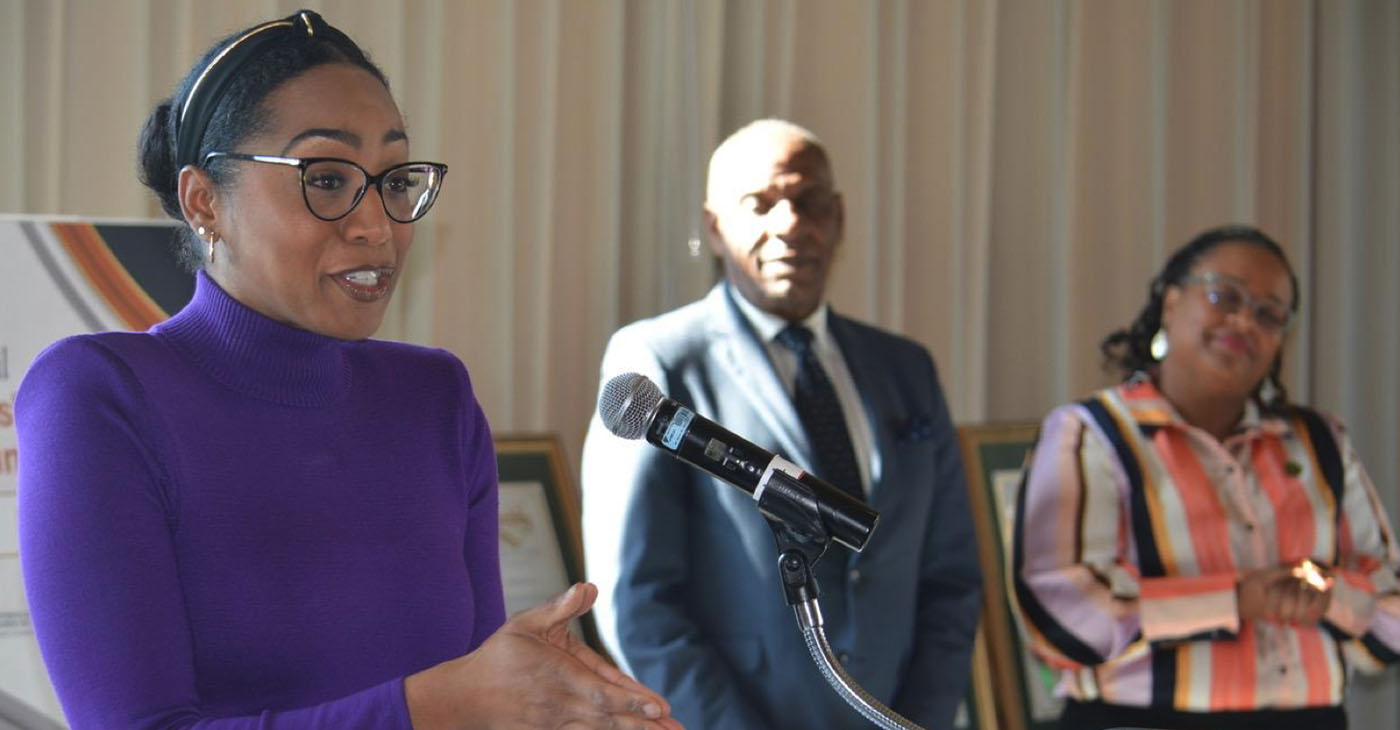
By Antonio Ray Harvey
California Black Media

The California Black Chamber of Commerce (CBCC) and the California Legislative Black Caucus (CLBC) recognized the success of 16 thriving Black-owned businesses at its annual Legislative Business Brunch at the Citizen Hotel in Sacramento.
The brunch, organized to celebrate Black History Month, honored the achievements of the businesses and celebrated their commitment to professional service and making an impact on the economy of communities around California.
“I am thankful that today, as it being the month of February and celebrating Black History Month, we get the opportunity to celebrate Black businesses. We get the opportunity to celebrate each one of you who are pouring into your communities in a meaningful and economic way,” said Assemblymember Lori D. Wilson (D-Suisun City), chair of the CLBC. “You are making an economic impact, not only for your families but for those that you employ and those that you provide good service to.”
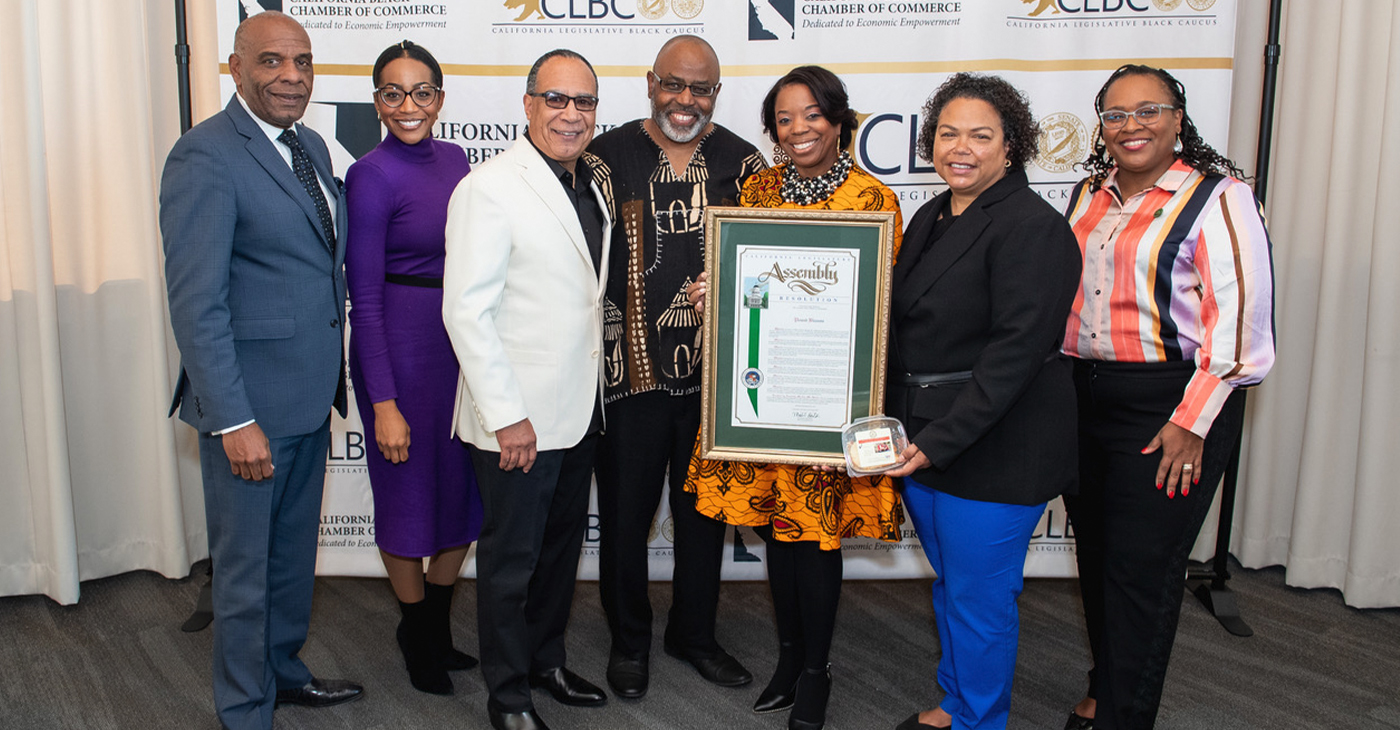
Sponsored by Amazon and Instacart, the business program attracted Black business leaders, non-profit operators, and all 12 members of the CLBC.
Sponsored by Amazon and Instacart, the business program attracted Black business leaders, nonprofit operators, and all 12 members of the CLBC. Three Black constitutional officers — Secretary of State Dr. Shirley Weber, State Controller Malia Cohen and Superintendent of Public Instruction Tony Thurmond — were recognized at the event held at Citizen Hotel.
Cohen and Thurmond were present to accept their awards, and Reginald “Reggie” Fair, Deputy Secretary of State for Operations, accepted the award on behalf of Weber.
Radio personality Keisha Mathews was the program emcee. Dr. Roy Larry and his wife, Penelope, of the Potter’s House COGIC church in Sacramento, provided the invocation. Sacramento area youth advocate Patrice Hill shared inspirational words in the form of a poem.
The event’s program was presented by Wilson, CBCC’s President and CEO Jay King, and CLBC Vice Chairman Sen. Steven Bradford (D-Inglewood). Anthony Williams, the California public policy director for Amazon, was the guest speaker.
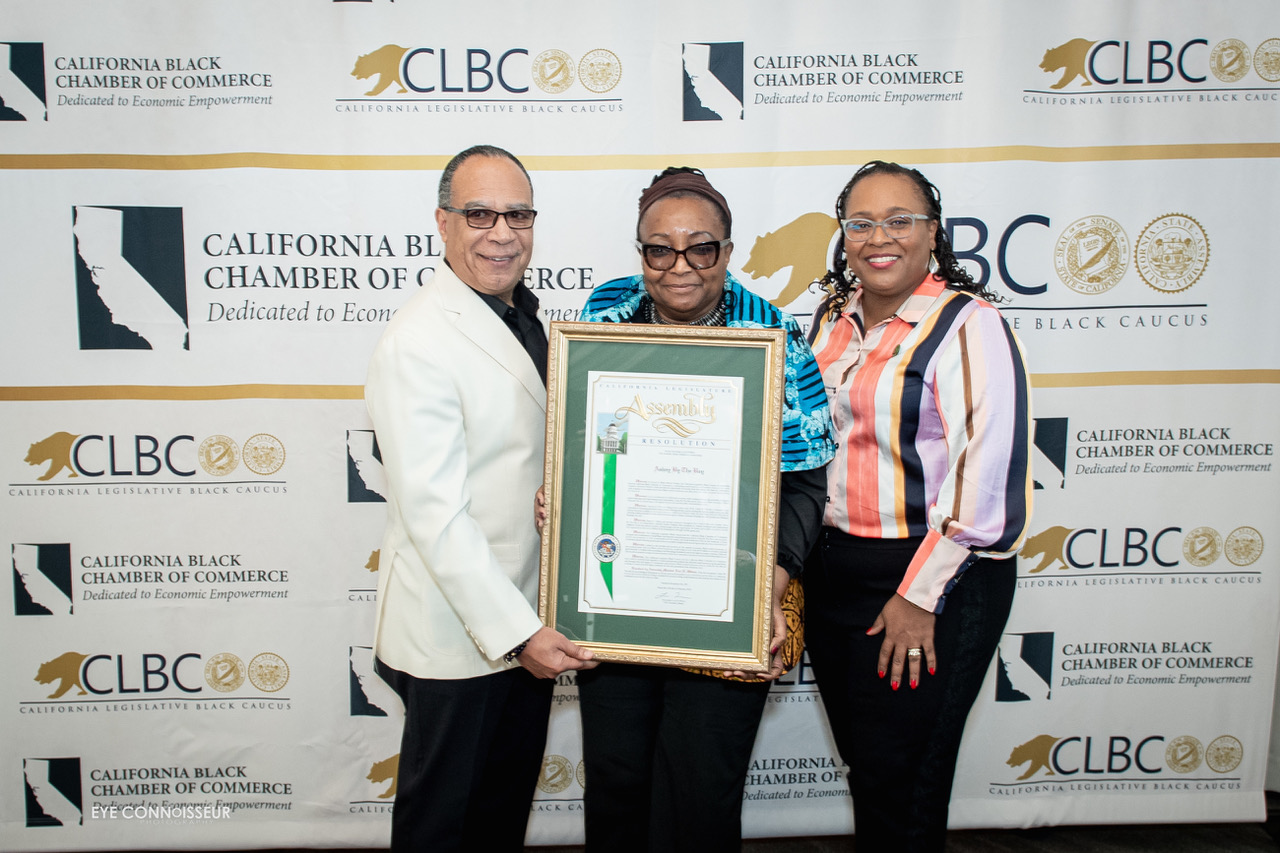
Each honoree was selected from the state lawmakers’ districts, including four special recognitions selected separately by King.
King reminded the attendees that the event was made possible by Aubry Stone, who started the advocacy for Black businesses in the state in 1995 until his passing in November 2018.
Stone facilitated networking among different business organizations across the state and fostered relationships with local governments. In the process, he opened doors of access to all races, King said.
“We are the California Black Chamber of Commerce, and we believe in diversity, equity, and inclusion. I believe that means everybody. We shouldn’t leave anybody out,” King said. “We help small businesses. Today, it just so happens to be African American small businesses because of the many obstacles they face every day.”
Each honoree was selected from the state lawmakers’ districts, including four special recognitions selected separately by King. The following proprietors received business awards from the CLBC and CBCC:
Demetrius Porter, Center Cork Wines (Fresno); Chandra Brooks, Chandra Brooks International (San Jose); Juana Williams and Blair Paysinger, Downtown Disney (Anaheim); Earl Johnson, Home and Work Mobile Oil Changers (Fremont); Deborah A. Day, Ashay By The Bay (Vallejo); and Clayrone Clark, Coop and Fire (Gardena); and Dr. Leonard Thompson III, M.A.N.D.A.T.E. Records, (San Diego);
Rounding out the business honorees are Keith Corbin, Alta Adams (Los Angeles); Reggie and Nicole Borders, Pound Bizness (San Francisco Bay Area); Lee Williams, Lee Williams Real Estate Group (San Pedro); Ann Hamilton, Robsag Real Estate, LLC (Pasadena); Twina Brown, Mama T’s Food For the Soul (Moreno Valley); Austin Clements, Slauson & Co (Los Angeles); Zion F.A. Taddese, Queen Sheba Ethiopian Restaurant (Sacramento); Tyrei Lacy, Restaurant Seven Nineteen by G/S (Los Angeles); and Bo and Kay Anuluoha, Kutula by Africana (Los Angeles).
The CBCC is an African American non-profit business organization that represents hundreds of small and emerging businesses, affiliates and chambers of commerce throughout the state. It provides advocacy assistance for supplier’s diversity needs, and business development and training for small businesses.
The CLBC, formed in 1967, was created to address the concerns of African Americans and other citizens of color. According to the organization’s website, the members believed that a caucus would provide political influence and visibility far beyond their numbers. Today, there are 12 members of the CLBC serving in the California Assembly and Senate.









Activism
Oakland Post: Week of September 30 – October 6, 2026
The printed Weekly Edition of the Oakland Post: Week of September 30 – October 6, 2026
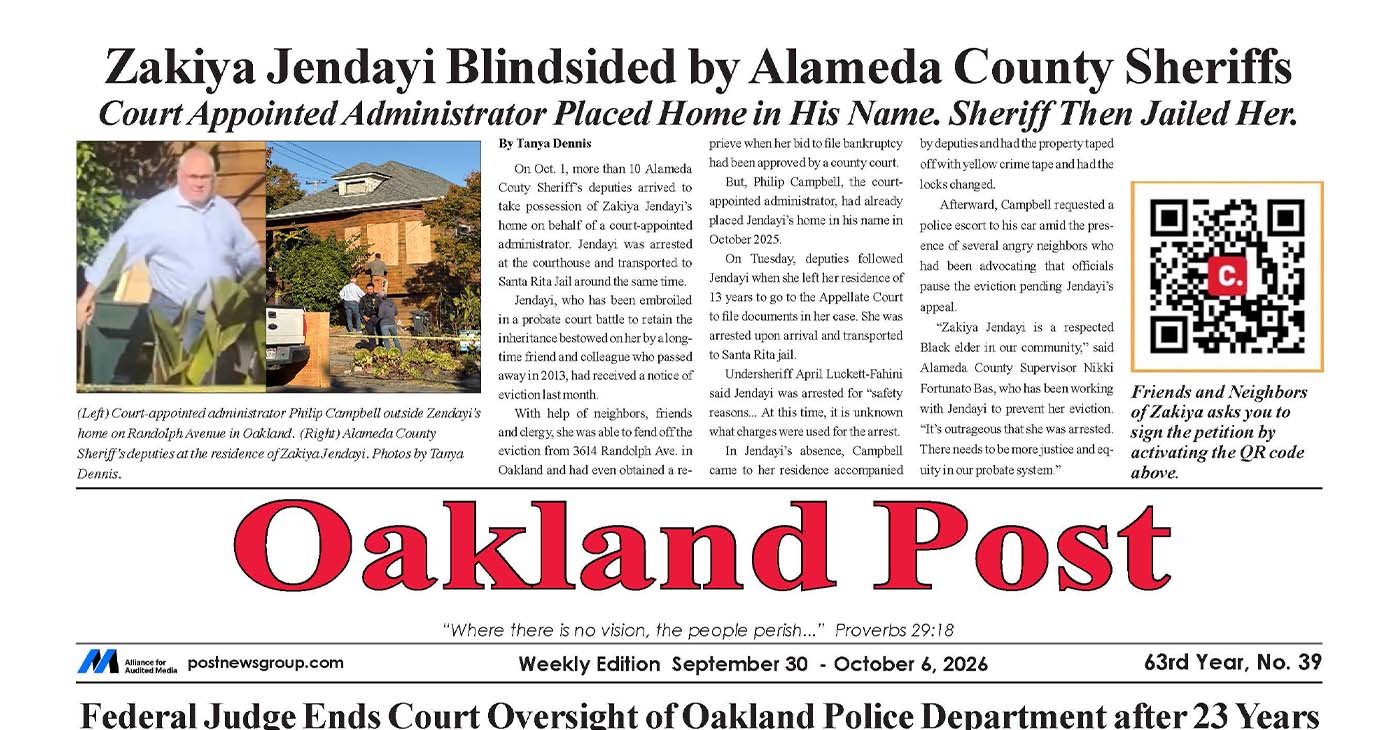
To enlarge your view of this issue, use the slider, magnifying glass icon or full page icon in the lower right corner of the browser window.
Activism
Oakland Post: Week of September 23 – 29, 2026
The printed Weekly Edition of the Oakland Post: Week of September 23 – 29, 2026

To enlarge your view of this issue, use the slider, magnifying glass icon or full page icon in the lower right corner of the browser window.
Activism
Oakland Post: Week of September 16 – 22, 2026
The printed Weekly Edition of the Oakland Post: Week of September 16 – 22, 2026

To enlarge your view of this issue, use the slider, magnifying glass icon or full page icon in the lower right corner of the browser window.


Listening as a Lifeline: A Doula’s Witness to Black Maternal Health

New Protections for Ticket Buyers: Gov. Newsom Signs Assemblymember Isaac Bryan’s Bill

‘We Don’t Talk Trash — We Pick Up Trash!’

Zakiya Jendayi Arrested, Locked Out of Home by Sheriff’s Deputies

Oakland Post: Week of September 30 – October 6, 2026

Asm. Corey Jackson Announces Launch of 24-Hour Childcare in His District

IN MEMORIAM: The Rev. Leon “Sonny” Clark, Longtime Orange County Pastor and Community Leader, Dies at 72

Poll: Becerra Widens His Lead Over Hilton; Californians Split on Wealth Tax

From Historic Memories to New Possibilities: Oakland Celebrates Coliseum 60

County Office of Education Says OUSD Finances Are Getting Healthier, Materially Stronger

LIVE FREE Sunday Dinner Brings Faith, Fellowship and Civic Conversation to Oakland

Remembering Chauncey Bailey as Student Journalists Face Threats to Truth-Telling

BLACspace Cooperative Invites Bay Area to Experience Oakland’s Black Cultural Ecosystem Through a BLAC Map Tour + Party

In Wake of Death on Doorstep, Williams Chapel Baptist Church Calls for Better Care, Funding for Unhoused

Oakland Centenarian Nuna McKee Honored!

Standoff for Justice: Our Homes Are Worth Fighting For

Oakland Post: Week of August 26 – September 1, 2026

Frontier Airlines’ Return to Oakland Airport Brings Flights, Jobs and Opportunity

Gubernatorial Candidate Steve Hilton Blasts California New Tire Rules; Newsom Hits Back

Chef Sharon Lee Blends Culinary Excellence, Education and Empowerment

Jackie Wright Champions Bay Area Stories, Filmmakers and Cultural Institutions

Oakland Coliseum Project Opens Door for Small Businesses to Build Bigger

Big City Mayors Ask for “Yes” Vote on Housing Bond Measure; Conservatives Say “No”

Misnamed ‘Parent’ PAC Seeks to Influence Oakland School Board Elections

Gov. Newsom’s Latest Appointees Include Sacramento Advocate for Formerly Incarcerated Students; State’s New Tech Chief

Longtime BWOPA Member Brendalyn Goodall Appointed to California Workforce Development Board

Gov. Newsom Signs Law Shielding Immigration Aid Workers From Doxing Threats

Secretary of State Shirley N. Weber Urges Californians to Vote Early as Voter ID Battle Intensifies

Oakland Post: Week of September 2 – 8, 2026

IN MEMORIAM: Dolly Parton Dead at 80 — How She Built a Legacy of Love and Earned Her Place in Black Culture

The Conversation With Al McFarlane 6/23/26

Media Monday 6/22/26

LIVE! ASK ALMA! — TUES. 6.23.26 7PM EST

Car Buying Secrets: 4 Hidden Checks Before You Sign!

Is This 550 HP Charger Worth YOUR Money? AutoNetwork Review

Celebrating Juneteenth – Frederick Douglass on education and resistance

LIVE! — ASK ALMA! — TUES. 6.19.26 7PM EST

Hyundai Ioniq 5 Parking, Safety, and 360 View #shorts

2025 Ioniq 5 New Wiper & Powerful Performance! #shorts

Electric SUV Range: Is 259 Miles Enough? #shorts

EV Charging: How Fast Can You Charge an Electric Vehicle? #shorts

Biometric Cooling… Messaging Seats…Come on! 2025 Infiniti QX80 Autograph 4WD

Charged Up: Witness the Magic of a Fully Electric Car! #shorts

Range Rover Sport PHEV Included…: See What’s Inside This Luxury SUV! #shorts

Invisible Hood View: Perfect Parking with X-Ray Vision! #shorts
-
 Community3 weeks ago
Misnamed ‘Parent’ PAC Seeks to Influence Oakland School Board Elections
-
 Activism4 weeks ago
Oakland Post: Week of September 2 – 8, 2026
-

 Community3 weeks ago
Richmond Tiny House Village Farm & Garden Set to Open Gates on Sept. 26
-

 Activism3 weeks ago
Oakland Post: Week of September 9 – 15, 2026
-

 Black History3 weeks ago
Latest Massacre in Haiti Reveals Cruelty U.S. Deportations
-

 Black History3 weeks ago
OPINION: Nolan Wells’ Death One of Several Signifying Racial Terror Lives on in U.S. South
-

 Community3 weeks ago
Democratic Clubs Interview Candidates for Oakland School Board
-

 Business2 weeks ago
Mayor Lee Announces $1 Million Kaiser Permanente Grant for Pilot Program to Address Homelessness, Clean Up Public Spaces throughout Oakland
