
Politics
Black Backer of Confederate Flag Was Anomaly in Mississippi


In this May 8, 2000, file photograph, Anthony Hervey holds a Confederate flag while standing underneath the Confederate monument in Oxford, Miss. The Highway Patrol says 49-year-old Hervey was killed Sunday, July 19, 2015, when his 2005 Ford Explorer left the roadway and overturned on Mississippi Highway 6 in Lafayette County. (Bruce Newman/The Oxford Eagle via AP, File)
EMILY WAGSTER PETTUS, Associated Press
OXFORD, Miss. (AP) — In a town where Confederate soldier statues stand sentinel on the courthouse square and a university campus, Anthony Hervey remained an anomaly — a black man who draped himself in the Confederate battle flag and publicly declared his loyalty to the secessionist Lost Cause and his belief that the Civil War was not fought over slavery.
Hervey, 49, died Sunday when the sport utility vehicle he was driving flipped into a ditch beside Mississippi Highway 6 near Oxford. He and another black Confederate supporter were returning home after speaking at an event to support a Confederate monument in Birmingham, Alabama.
The passenger, Arlene Barnum of Stuart, Oklahoma, survived and told The Associated Press that Hervey lost control of her vehicle after they were chased by a silver or gray sedan carrying four or five black men.
The Mississippi Highway Patrol is interviewing witnesses and reconstructing the crash, said patrol spokesman Johnny Poulos. The local coroner, Rocky Kennedy, said Tuesday that he was waiting for autopsy results.
Hervey was well known in Oxford and at the University of Mississippi, where students waved Confederate flags for decades to cheer the Rebels.
In Hervey’s 2006 book, “Why I Wave the Confederate Flag, Written by a Black Man,” he said the Civil War was not fought over slavery and that he was supporting black soldiers who fought for the South in the Civil War.
Even people who had known Hervey for years say they didn’t always understand him.
Randal McJunkins, 47, said he and Hervey had known each other since they were Oxford High School students in the 1980s and they had played basketball together in recent years. McJunkins called Hervey by his nickname Tony, and described him as smart and opinionated.
“He was different, I can say that,” McJunkins said. “If you knew him, you knew what to say to him, what not to say to him.”
McJunkins, who is black, recalled seeing Hervey around Oxford wearing a Confederate uniform and waving a flag. Several years ago, Hervey walked about 25 miles from Oxford to Batesville carrying a large rebel flag.
“I always wanted to ask him, what was the deal with that,” McJunkins said Monday.
In 2000 and 2001, Hervey made several appearances around Mississippi, speaking against a proposal to remove the Confederate battle emblem that has been on the state flag since Reconstruction. State voters decided in 2001 to keep the flag design, but now some people are saying the issue should be reconsidered.
Barnum said organizers of Saturday’s Alabama event had asked her to give Hervey a ride there. She said she didn’t know him previously.
Barnum and Hervey both spoke at the rally, and Barnum said she burned an NAACP membership card during her speech. A video shows the crowd cheered when Hervey said he doesn’t like black people or white people, “but I love me some Southerners.”
The public display of Confederate symbols has come under fresh scrutiny since the June 17 massacre of nine black worshippers at a church in Charleston, South Carolina. The white man charged in the killings had posed with a Confederate battle flag in photos posted online before the attack.
At the Alabama rally, Hervey called attempts to remove Confederate symbols and monuments “an assault on working-class people.”
Hervey also said: “You know what white guilt is? If I can accuse you of something you ain’t have nothing to do with, and I do it long enough and I put on ‘Twelve Years a Slave’ and ‘Mississippi Burning,’ I program your children. This is where the racism comes in, that white guilt.”
Barnum said that as she and Hervey were traveling home Sunday, she let Hervey drive. She said he stopped at a convenience store, and she remained in the vehicle as he went in. She said Hervey was wearing a Confederate kepi, or military hat. Barnum said soon after they left the store, a car with four or five young black men pulled up near them.
“They were angry with Mr. Hervey,” Barnum said. “Mr. Hervey sped up and said, ‘Hell, no.’ … He really had to gun it on the gas pedal.”
Barnum said Hervey didn’t have time to explain what was happening. “I could have sworn that they knew him because of his reaction to them,” she said.
She said the car ran Hervey off the highway, and the SUV rolled over. Barnum said she unbuckled herself and told Hervey he should take a pocket knife off her key chain and cut his seatbelt. She said he was breathing but didn’t respond.
Hervey died at the scene. Funeral arrangements had not been made by Tuesday.
___
Follow Emily Wagster Pettus on Twitter: http://twitter.com/EWagsterPettus.
Copyright 2015 The Associated Press. All rights reserved. This material may not be published, broadcast, rewritten or redistributed.








Activism
Oakland Post: Week of March 18 – 24, 2026
The printed Weekly Edition of the Oakland Post: Week of March 18 – 24, 2026
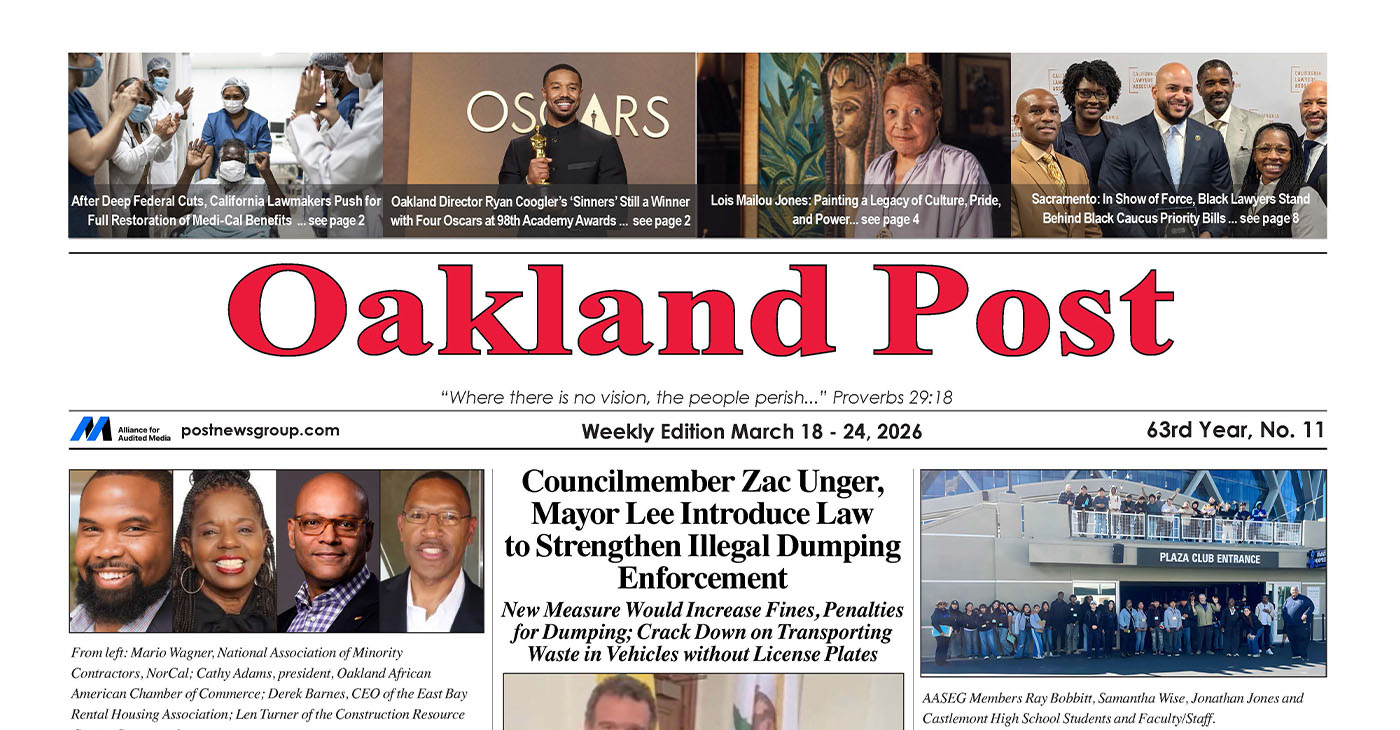
To enlarge your view of this issue, use the slider, magnifying glass icon or full page icon in the lower right corner of the browser window.
Activism
Oakland Post: Week of March 11 -17, 2026
The printed Weekly Edition of the Oakland Post: Week of March 11 – 17, 2026
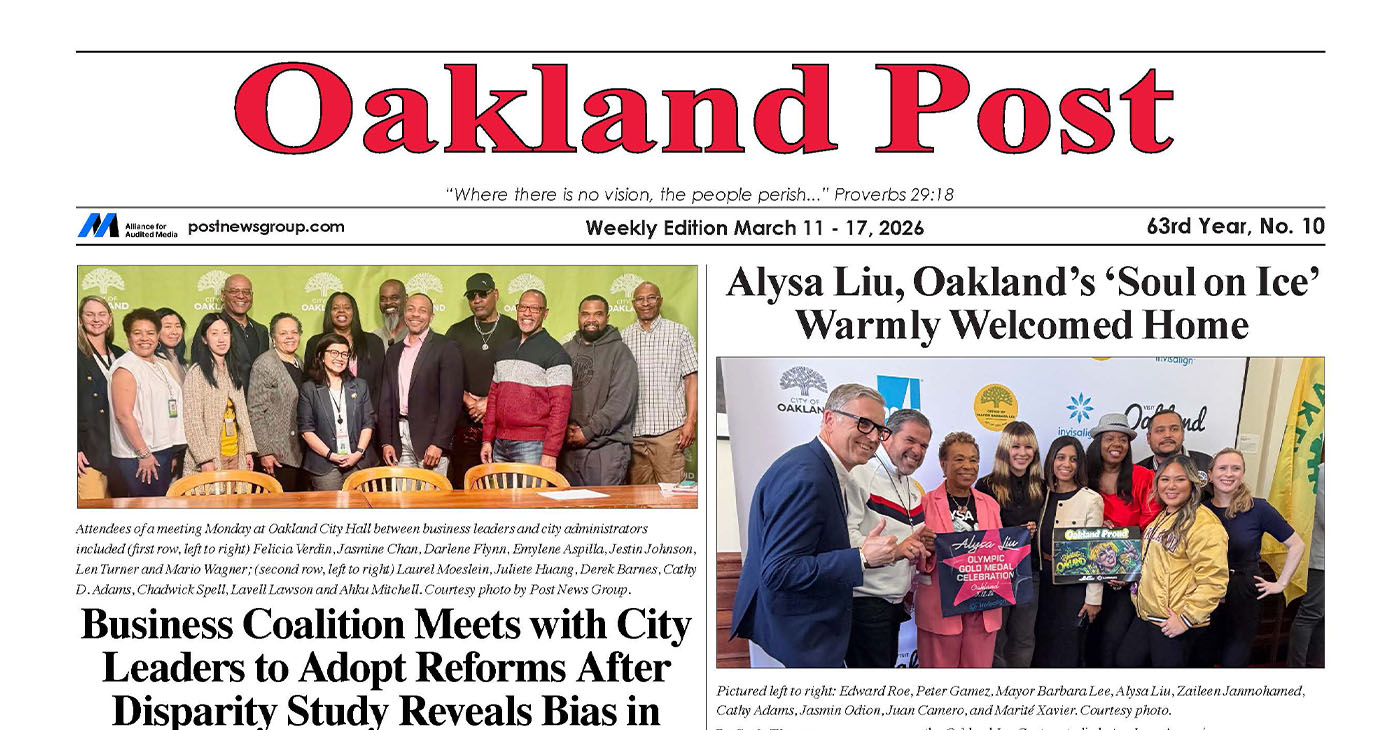
To enlarge your view of this issue, use the slider, magnifying glass icon or full page icon in the lower right corner of the browser window.
Activism
Oakland Post: Week of March 4 – 10, 2026
The printed Weekly Edition of the Oakland Post: Week of March 4 – 10, 2026
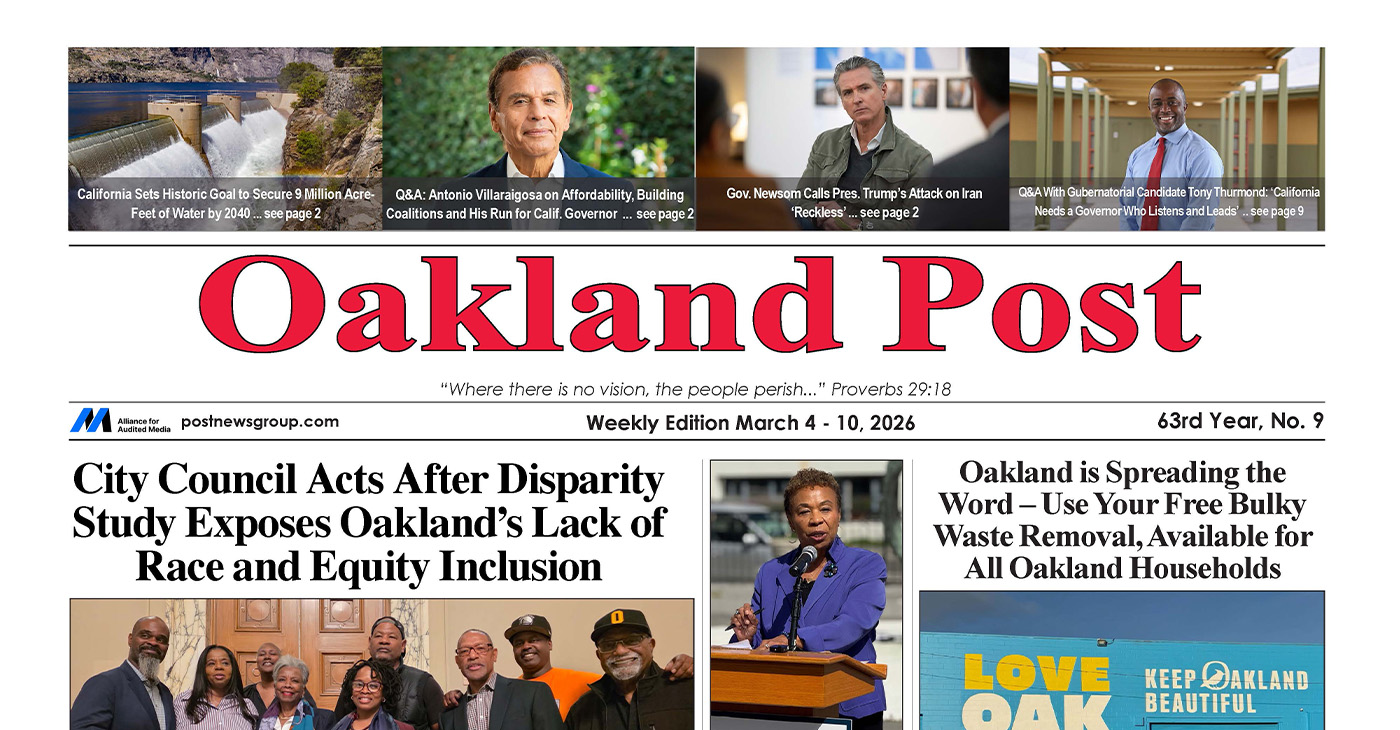
To enlarge your view of this issue, use the slider, magnifying glass icon or full page icon in the lower right corner of the browser window.

WORK FROM HOME
Home-based business with potential monthly income of $10K+ per month. A proven training system and website provided to maximize business effectiveness. Perfect job to earn side and primary income. Contact Lynne for more details: Lynne4npusa@gmail.com 800-334-0540


Black Artists in America, Installation Three Wraps at the Dixon Gallery and Gardens

Grief, Advocacy, and Education: A Counselor Reflects on Black Maternal Health

Future of Florida’s Black History Museum in Limbo

New Research Shows the Many Benefits of Early Learning

South Hampton K-8 Students Among Top 10 Finalists for Samsung’s ‘Solve for Tomorrow’ Competition

Cuba: No Negotiation with US on the President or Political System

Brooklyn Academy of Music Names Jamaican-Born Tamara McCaw as President

Trinidad & Tobego – U.S. Launches WhatsApp Channel for American Citizens in the Country

Oakland Post: Week of March 18 – 24, 2026

AI Innovation vs. Ethics and Environmental Impact

AI, Web3, and Digital Reparations

What If You Owned Your AI Agent?

Season 7, Episode 3 – January Reporter’s Roundtable 📱

Season 7, Episode 3 – January Reporter’s Roundtable

AI, Media, and Power | Part 2, Real-World Impacts and Tradeoffs

Oakland Post: Week of February 11 – 17, 2026

Reflecting on Black History Milestones in Birmingham AL

Rising Optimism Among Small And Middle Market Business Leaders Suggests Growth for California

CITY OF SAN LEANDRO STATE OF CALIFORNIA PUBLIC WORKS DEPARTMENT ENGINEERING DIVISION NOTICE TO BIDDERS FOR ANNUAL STREET OVERLAY/REHABILITATION 2019-21 – PHASE III

Oakland Post: Week of February 18 – 24, 2026

PRESS ROOM: NBA Hall of Fame Nominee Terry Cummings Joins 100 Black Men of DeKalb County to Launch Victory & Values Initiative

Oakland Post: Week of February 25 – March 3, 2026

Trump’s MAGA Allies are Creating Executive Order Plan to Steal the 2026 Midterms

U.S. manufacturing rebounds – how foundry services are adapting to rising demand

OP-ED: One Hundred Years of Black Workers Telling the Truth

Advancements in solar technology that are changing the way we power the world

Chase Oakland Community Center Hosts Alley-Oop Accelerator Building Community and Opportunity for Bay Area Entrepreneurs

Poll Shows Support for Policies That Help Families Afford Child Care

Oakland Post: Week of March 4 – 10, 2026

PRESS ROOM: Civil Rights TV Launches in Selma as the World’s First 24/7 Civil Rights Television Network

Hyundai Ioniq 5 Parking, Safety, and 360 View #shorts

2025 Ioniq 5 New Wiper & Powerful Performance! #shorts

Electric SUV Range: Is 259 Miles Enough? #shorts

EV Charging: How Fast Can You Charge an Electric Vehicle? #shorts

Biometric Cooling… Messaging Seats…Come on! 2025 Infiniti QX80 Autograph 4WD

Charged Up: Witness the Magic of a Fully Electric Car! #shorts

Range Rover Sport PHEV Included…: See What’s Inside This Luxury SUV! #shorts

Invisible Hood View: Perfect Parking with X-Ray Vision! #shorts

AI Is Reshaping Black Healthcare: Promise, Peril, and the Push for Improved Results in California

ESSAY: Technology and Medicine, a Primary Care Point of View

Sanctuary Cities

The RESISTANCE – FREEDOM NOW

STATE OF THE PEOPLE: Freddie

ECONOMIC BOYCOTT DAY!!!!!

I told You So
-
 Activism4 weeks ago
Oakland Post: Week of February 25 – March 3, 2026
-
 #NNPA BlackPress4 weeks ago
Poll Shows Support for Policies That Help Families Afford Child Care
-
 Activism3 weeks ago
Oakland Post: Week of March 4 – 10, 2026
-

 #NNPA BlackPress3 weeks ago
Woman’s Search for Family’s Roots Leads to Ancestor John T. Ward – A Successful Entrepreneur and Conductor on the Underground Railroad
-

 #NNPA BlackPress4 weeks ago
OP-ED: NNPA Launches 2026 “Leadership Matters” Video Series
-

 #NNPA BlackPress3 weeks ago
Advocates Raise Alarm Over ICE Operation, MOU and Detention Risks in Baltimore County
-

 #NNPA BlackPress3 weeks ago
COMMENTARY: Women of Color Shape Our Past and Future
-

 #NNPA BlackPress3 weeks ago
Pete Buttigieg to Join Mayor Randall Woodfin for Community Town Hall in Birmingham
