
Entertainment
Best Picture Nod for ‘Selma’ Caps Big Year for Black Women


Ava DuVernay, director of the film “Selma.” (Chris Pizzello/Invision/AP)
Sandy Cohen, ASSOCIATED PRESS
LOS ANGELES (AP) — Three black women released movies in 2014, more than ever before in a single year. And one of them is a contender for the motion picture academy’s top prize.
But that’s just three films in one year — out of the 373 that came out in theaters.
Black female filmmakers are one of Hollywood’s greatest rarities. In the past seven years, only three were connected to the top 700 movies, according to recent research by the University of Southern California’s Media, Diversity & Social Change Initiative.
“The ecosystem of filmmaking is problematic for women and people of color,” said initiative director Stacy L. Smith. More than 95 percent of the directors of top-grossing films during the past decade have been men, she said. Looking at the top 700 films over a recent seven-year period, almost 90 percent of them were white.
So while there’s been a lot of talk about the lack of diversity among this year’s Oscar acting nominees, the larger issue may be the overwhelming lack of diversity among those telling the stories on the big screen.

“Selma” director Ava DuVernay, as a black woman, defied incredible odds with her film’s best-picture bid at next Sunday’s Academy Awards. But was it merely an exception?
“The push for me is that it doesn’t stay an anomaly,” said Gina Prince-Bythewood, writer and director of “Beyond the Lights,” which earned an Oscar nod this year for its original song, “Grateful.”
“The Oscars are not the problem,” said Prince-Bythewood, whose credits include 2008’s “The Secret Life of Bees” and her 2000 breakthrough, “Love & Basketball.” ”It’s more so Hollywood and the films that are being greenlit.”
She finds the dearth of stories about women equally disheartening. “Belle” director Amma Asante agreed, noting that all of this year’s eight best-picture contenders are about men. And DuVernay is the only female director behind any best-picture nominee.
Asante, DuVernay and Prince-Bythewood credit coincidental timing and continued hard work for their accomplishments in 2014.
Asante suggests the success of “12 Years A Slave,” ”The Butler” and “Mandela” in 2013 may have contributed to their films being financed the same year.
“We were lucky that they all got greenlit at a time when the films that came before us were showing that these films were important and they were attracting audiences,” she said.
But there’s no momentum if the number of women and people of color behind the camera don’t continue to increase, DuVernay said.
“Three is not enough. While we celebrate the three, we’re talking three in the hundreds of films that came out last year between the U.K. and the United States,” she said. “Unless (our success) equals more women being able to do the same thing next year — which legacy says is probably not going to happen — then we’re still at the same place.”
So how can non-white, non-male voices speak more loudly in Hollywood?
Financing is often the first obstacle. Smith’s research finds a general perception in Hollywood that stories by or about women are more niche than mainstream, and therefore less profitable. Asante laughs at that.
“We’re half the population!” she said. Recent blockbusters like “Gone Girl” and “The Hunger Games” franchise show large audiences will come see female-led films.
The frustrating truth, DuVernay and the other directors said, is that the number of female filmmakers of any ethnicity working in Hollywood has remained essentially unchanged for the past two decades, hovering around five percent.
But they insist women have to keep making movies, despite the odds.
“Stop waiting for someone to say it’s OK to move forward,” DuVernay said. “You just have to find a way to make the work. … You have to make it with what you have and by any means necessary.”
Be sure to make them good movies, added Prince-Bythewood, since quality, heartfelt stories speak to everyone.
“People do not go to the theater out of guilt,” she said. “A film should not be medicine. … I want people to go to my films because they’re good.”
Even films with wide appeal across ethnicity and gender can be impeded by marginalized marketing based on the women-as-niche perspective, she said. “Beyond the Lights,” her contemporary story about a pop star who finds love outside the spotlight, was marketed almost exclusively to women, she lamented, even though early screenings were well received by both genders.
“Let’s not assume that an audience is not going to respond to a film,” she said. “Put it out there and make it enticing for men and women.”
It just makes good business sense, Asante and DuVernay said. Today’s broadening TV landscape — which has been quicker to embrace women and people of color — gives viewers hundreds of good reasons to skip the theater and stay home.
“When you allow a variety of people to look through their lens and tell a story through their lens,” Asante said, “what you get is a more interesting variety of films at your local cinema.”
Audiences want to see movies that reflect the world around them, DuVernay said.
“If you are a person … that has a human spirit looking to be enlarged, you cannot do that staying in the same room with the same people,” she said. “It’s not about diversity. It’s not about even inclusion or representation. It’s about reality.”
___
Follow AP Entertainment Writer Sandy Cohen at http://www.twitter.com/APSandy.
Copyright 2015 The Associated Press. All rights reserved. This material may not be published, broadcast, rewritten or redistributed.
###











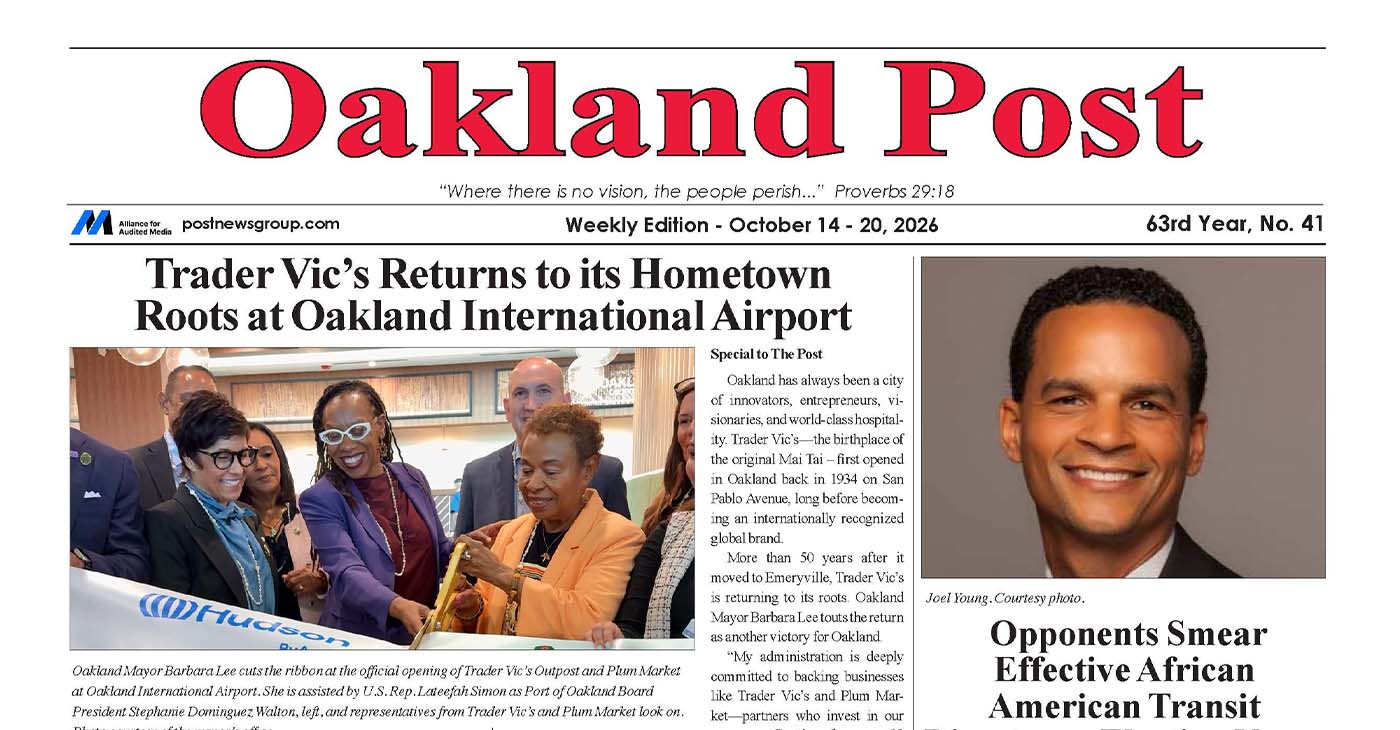
To enlarge your view of this issue, use the slider, magnifying glass icon or full page icon in the lower right corner of the browser window.


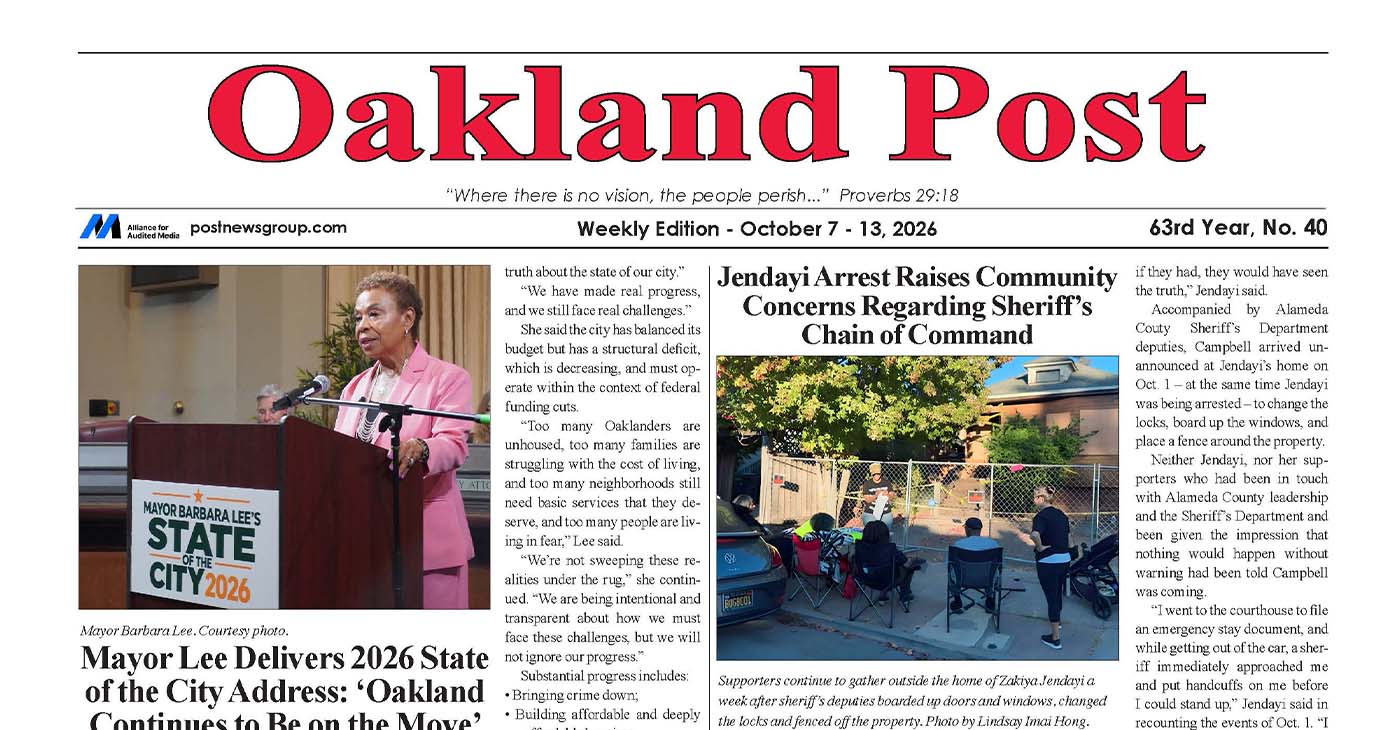
To enlarge your view of this issue, use the slider, magnifying glass icon or full page icon in the lower right corner of the browser window.
Activism
Oakland Post: Week of September 30 – October 6, 2026
The printed Weekly Edition of the Oakland Post: Week of September 30 – October 6, 2026


To enlarge your view of this issue, use the slider, magnifying glass icon or full page icon in the lower right corner of the browser window.



Mayor Barbara Lee Holds Special State of the City Address in Deep East Oakland

Practitioners of African Traditional Spirituality Offer Ancestral Reverence Ritual Oct. 31

It’s Time to Lose Weight Before the Holidays

Trader Vic’s Returns to Its Oakland Roots

Oakland Coal Terminal Backed by Trump Would Be Bigger, Dirtier Than Promised, Says Report

Opponents Smear Effective African American Transit Director as Election Nears

Oakland Post: Week of October 14 – 20, 2026

OP-ED: The Black Church Writes AI’s Next Chapter

OP-ED: The Black Church Writes AI’s Next Chapter

WCCUSD Joins Statewide Organic School Food Purchasing Cooperative

Democrats, Community Groups Back Measure EE to Change How Oakland Is Governed

Four Tips to Help You Plan a Holiday “Staycation”

Veterans Housing Project Proposed for South Richmond
PRESS ROOM: Transformative Justice Coalition 2026 Voting Rights Champion Awards Reception ‘Yesterday Is Today: The Battle For Voting Rights

Mayor Lee Delivers 2026 State of the City Address: ‘Oakland Continues to Be on the Move’

Misnamed ‘Parent’ PAC Seeks to Influence Oakland School Board Elections

Listening as a Lifeline: A Doula’s Witness to Black Maternal Health

Poll: Becerra Widens His Lead Over Hilton; Californians Split on Wealth Tax

Oakland Post: Week of September 9 – 15, 2026

County Office of Education Says OUSD Finances Are Getting Healthier, Materially Stronger

Richmond Tiny House Village Farm & Garden Set to Open Gates on Sept. 26

Mayor Lee Announces $1 Million Kaiser Permanente Grant for Pilot Program to Address Homelessness, Clean Up Public Spaces throughout Oakland

Doulas Are Helping Black California Moms Navigate Pregnancy–Even as High Mortality Rates Persist

Latest Massacre in Haiti Reveals Cruelty U.S. Deportations

OPINION: Nolan Wells’ Death One of Several Signifying Racial Terror Lives on in U.S. South

Zakiya Jendayi Arrested, Locked Out of Home by Sheriff’s Deputies

BLACspace Cooperative Invites Bay Area to Experience Oakland’s Black Cultural Ecosystem Through a BLAC Map Tour + Party

Oakland Post: Week of September 16 – 22, 2026

Democratic Clubs Interview Candidates for Oakland School Board

Oakland People’s Arms Embargo Coalition Demands End to Military Shipments Thru Oakland

The Conversation With Al McFarlane 6/23/26

Media Monday 6/22/26

LIVE! ASK ALMA! — TUES. 6.23.26 7PM EST

Car Buying Secrets: 4 Hidden Checks Before You Sign!

Is This 550 HP Charger Worth YOUR Money? AutoNetwork Review

Celebrating Juneteenth – Frederick Douglass on education and resistance

LIVE! — ASK ALMA! — TUES. 6.19.26 7PM EST

Hyundai Ioniq 5 Parking, Safety, and 360 View #shorts

2025 Ioniq 5 New Wiper & Powerful Performance! #shorts

Electric SUV Range: Is 259 Miles Enough? #shorts

EV Charging: How Fast Can You Charge an Electric Vehicle? #shorts

Biometric Cooling… Messaging Seats…Come on! 2025 Infiniti QX80 Autograph 4WD

Charged Up: Witness the Magic of a Fully Electric Car! #shorts

Range Rover Sport PHEV Included…: See What’s Inside This Luxury SUV! #shorts

Invisible Hood View: Perfect Parking with X-Ray Vision! #shorts
-
 Black History3 weeks ago
Listening as a Lifeline: A Doula’s Witness to Black Maternal Health
-
 Economy4 weeks ago
Poll: Becerra Widens His Lead Over Hilton; Californians Split on Wealth Tax
-
 Business4 weeks ago
County Office of Education Says OUSD Finances Are Getting Healthier, Materially Stronger
-
 Lead Story3 weeks ago
Zakiya Jendayi Arrested, Locked Out of Home by Sheriff’s Deputies
-
 Art4 weeks ago
BLACspace Cooperative Invites Bay Area to Experience Oakland’s Black Cultural Ecosystem Through a BLAC Map Tour + Party
-

 Business4 weeks ago
From Historic Memories to New Possibilities: Oakland Celebrates Coliseum 60
-

 Community4 weeks ago
Asm. Corey Jackson Announces Launch of 24-Hour Childcare in His District
-

 Black History4 weeks ago
IN MEMORIAM: The Rev. Leon “Sonny” Clark, Longtime Orange County Pastor and Community Leader, Dies at 72
