
Activism
Art of the African Diaspora Celebrates Legacy and Community at Richmond Art Center
Now in its 29th year, Art of the African Diaspora is the Bay Area’s longest-running exhibition of its kind. Its roots stretch back to 1989, when artist and educator Marie Johnson Calloway founded Colors of Black, a salon for African American artists. That gathering inspired artists Jan Hart-Schuyers and Rae Louise Hayward to establish The Art of Living Black at the Richmond Art Center in 1996.


By Carla Thomas
The 2026 Art of the African Diaspora exhibition is on display at the Richmond Art Center (RAC) through March 14. The one-room gallery bursts with more than 100 works – paintings, photographs, sculptures, and mixed-media pieces – each affirming the power, beauty, and vitality of cultural expression across the African diaspora.
Now in its 29th year, Art of the African Diaspora is the Bay Area’s longest-running exhibition of its kind. Its roots stretch back to 1989, when artist and educator Marie Johnson Calloway founded Colors of Black, a salon for African American artists. That gathering inspired artists Jan Hart-Schuyers and Rae Louise Hayward to establish The Art of Living Black at the Richmond Art Center in 1996. Their vision was to showcase the creativity of emerging and established Black artists, bridging communities and widening access to audiences historically excluded from mainstream art spaces.
Over the decades, that founding vision has expanded and evolved, carried forward by artists, family members, and the Richmond Art Center after the loss of Hart-Schuyers and Hayward. In 2018, a new generation of artists formed a steering committee to organize the event; a year later, the exhibition was renamed Art of the African Diaspora to embrace the broader global connections of people of African descent.
The new name reflects not only a broader cultural lens but also an empowered community network that supports artists across the Bay Area. As part of this year’s programming, RAC will host ‘Art of the African Diaspora: Public Art in Our Communities,’ a free panel on Sat., Feb. 21, from 12 to 1:30 p.m. Artists Kristine Mays, James Moore, and Malik Seneferu will join arts administrator Denise Pate for a conversation on the impact and process of public art. The discussion will be moderated by longtime arts advocate and producer Flo Wiley.
Each panelist brings a distinctive voice to the conversation. Mays, known for her ethereal wire sculptures that capture movement and spirit, has exhibited internationally and is represented in collections ranging from the Smithsonian to the Crocker Art Museum.
Sculptor and painter James Moore creates abstract metal works and colorful field paintings that explore movement, balance, and emotion. His recent public art installations include large-scale pieces in Richmond’s Shields-Reid Park. Malik Seneferu, a self-taught San Francisco native, has built a large body of work celebrating African American life through vibrant murals and expressive figurative art.
Representing the institutional side, Denise Pate oversees public arts investments as director of Community Investments at the San Francisco Arts Commission, advancing racial and cultural equity through funding and advocacy. Together, these artists and administrators will trace how public art emerges, from concept to community collaboration, and why it matters.
The Art of the African Diaspora exhibition runs through March 14 at the Richmond Art Center, 2540 Barrett Ave., Richmond. The center is open Wednesday through Saturday from 10 a.m. to 4 p.m. Admission and programs are free and open to the public.












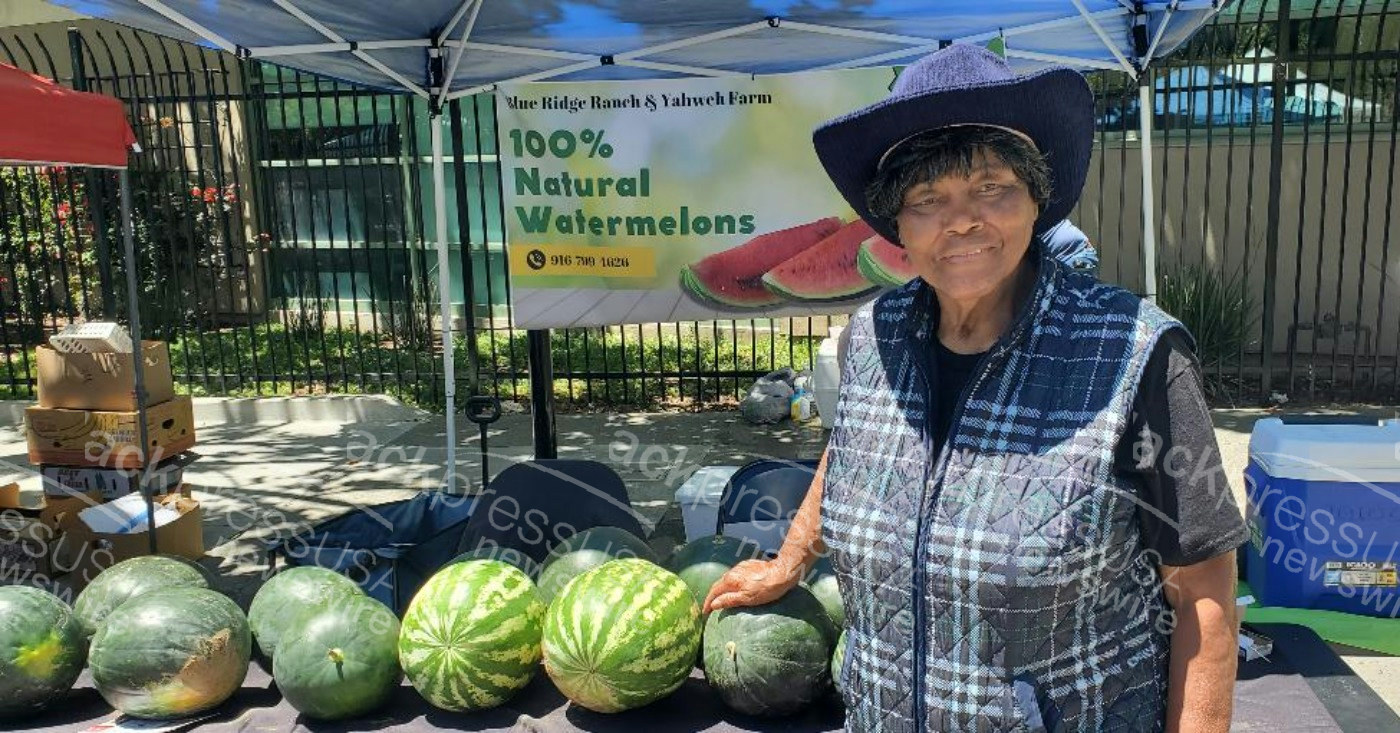
In her 80s and still actively working as an agricultural engineer, Effie Gant continues to break barriers in urban farming and community leadership.
The certified USDA grower and respected urban farmer, based in South Sacramento, was recently spotted vending at the Freedom Farmers’ Market by the Temescal Street Fair on Saturday, July 11, where she proudly displayed dozens of sweet, juicy watermelons.
Festivalgoers gathered not only to purchase her produce but also to enjoy activities like the popular watermelon-eating contest. Yet beyond the festive atmosphere, Gant has a larger vision.
Gant is now setting her sights on the Bay Area, where she plans to launch a farmers’ market to increase access to fresh, locally grown food.
Known for her leadership in sustainable agriculture and food justice, she brings decades of hands-on experience and community advocacy to regions where food access remains inconsistent.
She has built a strong reputation through her work with Meadowview Urban Farm and the Yisrael Family Urban Farm, cultivating crops such as watermelons, honeydew melons, and collard greens. Her approach emphasizes sustainability, education, and empowering residents to grow their own food, even in small urban spaces.
As a USDA-certified grower, Gant blends technical expertise with grassroots engagement to combat food insecurity.
Beyond farming, Gant serves as CEO and President of Highways to Hedges, a nonprofit focused on environmental justice and community development. She is also president of the Hampton Station Neighborhood Association and board chairman for HHCORE, where she advocates for safety, equity, and economic opportunity.
Her proposed farmers market will connect small-scale farmers with urban communities while elevating Black farmers and other underrepresented growers.
“I want to teach the next generation about farming and how lucrative it can be,” Gant said. “You don’t need hundreds of acres. You can start with one acre or even your backyard.”Gant also noted her involvement in a collective of farmers who supply produce through government-supported programs.
“We operate as a team, and we all benefit,” she said.
Through workshops, speaking engagements, and hands-on training, Gant and her organization continue to educate communities about agriculture and food justice. Her market initiative will emphasize affordability, cultural relevance, and nutrition education.
Her broader work includes creating edible forests in partnership with Soil Born Farms, planting fruit trees directly in neighborhoods to expand food access. As a mentor with the Center of Expertise on Food Justice and Health Equity, Gant remains a leading voice in building sustainable and resilient food systems.
Gant says she welcomes the community to join her in creating a new farmer’s market.
“Farming is essential to life,” she said. “I want to train as many people as I can to use food and farming as a tool for empowerment, health, and long-term change.”

Activism
Oakland Post: Week of July 15 – 21, 2026
The printed Weekly Edition of the Oakland Post: Week of July 15 – 21, 2026
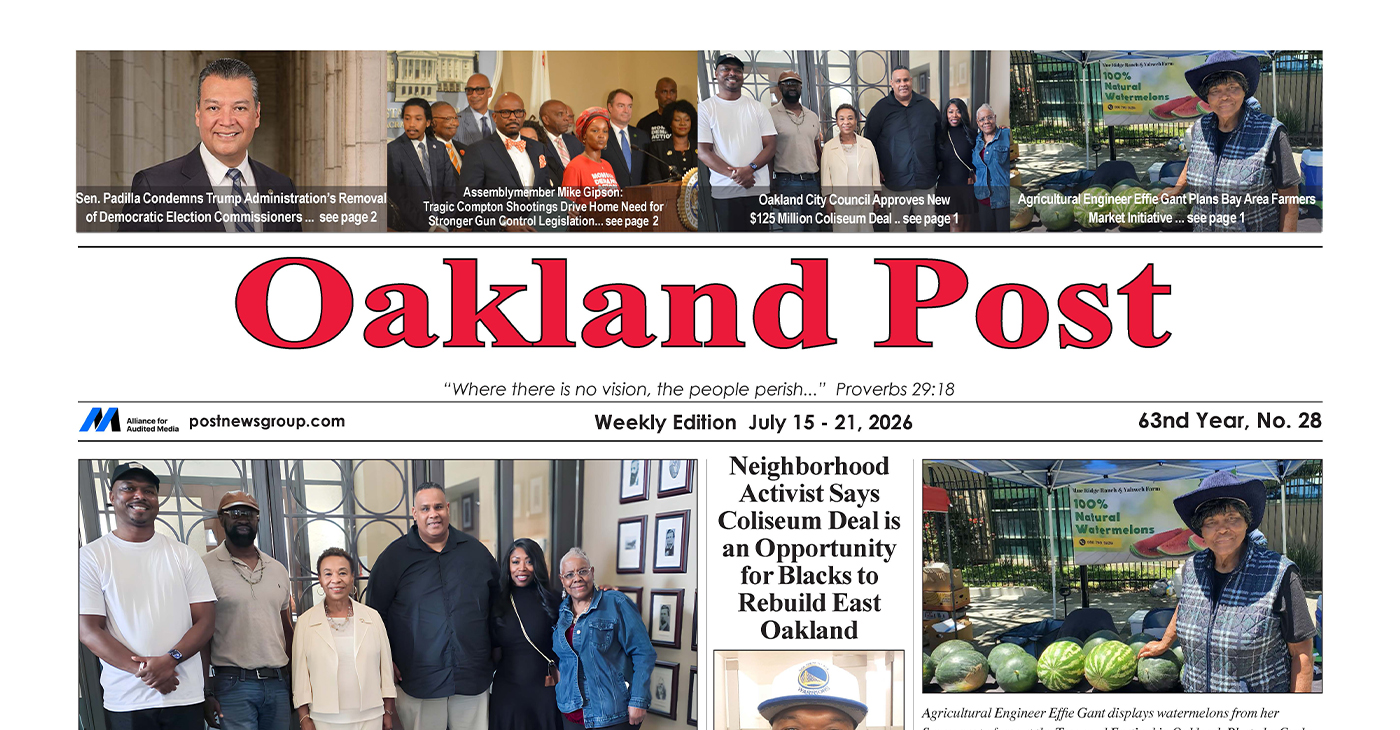
To enlarge your view of this issue, use the slider, magnifying glass icon or full page icon in the lower right corner of the browser window.
Activism
From Disparity Study to Solutions: Oakland Coalition and Mayor Barbara Lee Renew Commitment to Reform City Contracting
She committed to ensuring the coalition has direct access to City leadership by designating Assistant Deputy City Administrator Chuck Baker the primary liaison. Working alongside Deputy City Administrator Sofia Navarro, DWES Director Emylene Aspilla, Race and Equity Director Darlene Flynn, and other City departments, the coalition will continue advancing these priorities while maintaining regular communication with City leadership.

Special to The Post
On June 30, a coalition of minority business leaders, contractors and others met with Oakland Mayor Barbara Lee to discuss the City’s commitment to implement recommendations outlined in Oakland’s Disparity Study and eliminate barriers that have historically prevented Black and minority-owned businesses from fully participating in public contracting opportunities.
Representatives of the Oakland African American Chamber of Commerce (OAACC), National Association of Minority Contractors Northern California (NAMC NorCal), Construction Resource Center (CRC), and the East Bay Rental Housing Association (EBRHA) said the meeting represented an important milestone in a process that has been underway for several months.
On April 21, the Oakland City Council’s Life Enrichment Committee received a progress report from the Department of Workplace and Employment Standards (DWES), where Director Emylene Aspilla presented the coalition’s working document and outlined a collaborative implementation plan between the coalition and the City. That report established 30-, 60-, and 90-day objectives focused on five key priorities:
- Reforming Local and Small Local Business Enterprise (L/SLBE) waiver practices
- Strengthening prompt payment compliance
- Improving procurement forecasting and transparency
- Expanding contractor capacity building and business development
- Increasing oversight, accountability, and public reporting
A series of working sessions was scheduled between coalition representatives, DWES, and the City Administrator’s Office to begin implementing those priorities but were temporarily delayed by the resignation of former City Administrator Jestin Johnson.
Rather than allowing that momentum to stall, OAACC President and CEO Cathy Adams requested a meeting with Lee to gain clarity on the City’s direction and reaffirm its commitment to implementing the recommendations contained within the Disparity Study.
Coalition leaders described the meeting as productive, candid, collaborative, and encouraging.
During the meeting, Lee spoke not only from her role as mayor but also from her experience as an 8(a) contractor and business owner, sharing that she understands firsthand what it takes to build and grow a successful company, employ a substantial workforce, compete for public work, and navigate the complexities of municipal contracting.
She committed to ensuring the coalition has direct access to City leadership by designating Assistant Deputy City Administrator Chuck Baker the primary liaison. Working alongside Deputy City Administrator Sofia Navarro, DWES Director Emylene Aspilla, Race and Equity Director Darlene Flynn, and other City departments, the coalition will continue advancing these priorities while maintaining regular communication with City leadership.
Mayor Lee also expressed her commitment to personally participate in future working meetings with the coalition.
“This meeting represents a renewed commitment to partnership,” said Adams. “Mayor Lee listened, engaged, and demonstrated that she wants to move beyond conversation and into implementation.”
CRC’s Len Turner said the roadmap is already in place. ““The City already has the evidence. What’s been missing is execution. …Now it’s time to deliver results.”
Mario Wagner, president of NAMC NorCal agreed that the next phase must focus on implementation, funding, and accountability.
“The coalition is ready to get to work. …The next step is ensuring these initiatives receive meaningful funding in the upcoming fiscal budget cycle. Just as important, the City must establish transparent reporting mechanisms that keep the public informed through regular progress reports, measurable benchmarks, and accountability.”
Coalition leaders also acknowledged that while City leadership has indicated it is reviewing Local and Small Local Business Enterprise waiver practices, the community continues to seek a formal response regarding existing long-term waivers, including waivers extending 10 and 25 years. The coalition believes those waivers should be comprehensively reviewed and, where appropriate, rolled back as part of the City’s broader contracting reforms.
The coalition is also calling on the City to include meaningful funding in the upcoming fiscal budget cycle to support implementation of the Disparity Study recommendations and establish better methods and mechanisms to keep the public informed through regular progress reports, measurable benchmarks, and transparent accountability.
The coalition’s immediate next step is to schedule a working meeting with Baker, Aspilla, Lee, and the appropriate City staff to review what has already been accomplished under the implementation framework.

WORK FROM HOME
Home-based business with potential monthly income of $10K+ per month. A proven training system and website provided to maximize business effectiveness. Perfect job to earn side and primary income. Contact Lynne for more details: Lynne4npusa@gmail.com 800-334-0540

Fed Court to Decide Landmark First Amendment Case

Jordan Walker Leads Call for More Black Youth in Baseball

How Black WNBA Players Became Collateral Damage in the Caitlin Clark Culture War

NAACP Announces $20m Voter Registration Drive at National Convention in Chicago

Starting This Summer, California Car Buyers Can Get an Instant $3500 Off the Cost of Electric Vehicles

Surveillance Pricing Fight: State Senate Debates Bill Banning Retailers from Using AI to Set Prices Based on a Buyer’s Profile

Oakland Children’s Hospital Workers and Patients Rally for Pediatric Medical Care

Opinion: When Politicians Start Sanitizing One Chapter of History, They’re Coming After The Whole Book

Beyond Politics: California Legislators Across Party Lines Celebrate Lori Wilson at 50

NPRC to Meet with California Attorney General’s Office on to Urge Guardianship Reform

Mount Zion MBC, Church of Jesus Christ of Latter-day Saints Partner to Bring 29,000 Meals to Alameda County

Councilmember Houston Helps Deter Trend to Award Contracts to Suburban Companies

Rep. Garamendi, House Democrats Demand Trump Administration Abandon Illegal Plans to Dismantle Civil Rights, Special Ed Offices

Council Gives Approval for $125 Million Oakland Coliseum Sale to AASEG

Job Readiness, Housing Resources Among Services Provided at Coliseum Job Fair
Mount Zion MBC, Church of Jesus Christ of Latter-day Saints Partner to Bring 29,000 Meals to Alameda County
Oakland Children’s Hospital Workers and Patients Rally for Pediatric Medical Care
Surveillance Pricing Fight: State Senate Debates Bill Banning Retailers from Using AI to Set Prices Based on a Buyer’s Profile

Saving Black Mothers Starts Outside the Hospital

IN MEMORIAM: Oakland Dance Legend Reginald Ray-Savage, 67

Gov. Gavin Newsom Signs Law Streamlining Affordable Housing Rules

Oakland Celebrates $125 Million Coliseum Sale


NPRC Heads to Washington to Elevate Adult Guardianship Reform at National Whistleblower Summit

The Part of Buying a Home That No Real Estate Show Ever Prepares You For

Oakland Post: Week of June 17 – 23, 2026

Agricultural Engineer Effie Gant Plans Bay Area Farmers Market Initiative

Oakland Post: Week of July 1 – 7, 2026

NCBW-OBAC Champions Black Women Entrepreneurs at Business en Blaque Expo

Ferry Fares to Increase July 1 as Ridership Hits Record Highs

The Conversation With Al McFarlane 6/23/26

Media Monday 6/22/26

LIVE! ASK ALMA! — TUES. 6.23.26 7PM EST

Car Buying Secrets: 4 Hidden Checks Before You Sign!

Is This 550 HP Charger Worth YOUR Money? AutoNetwork Review

Celebrating Juneteenth – Frederick Douglass on education and resistance

LIVE! — ASK ALMA! — TUES. 6.19.26 7PM EST

Hyundai Ioniq 5 Parking, Safety, and 360 View #shorts

2025 Ioniq 5 New Wiper & Powerful Performance! #shorts

Electric SUV Range: Is 259 Miles Enough? #shorts

EV Charging: How Fast Can You Charge an Electric Vehicle? #shorts

Biometric Cooling… Messaging Seats…Come on! 2025 Infiniti QX80 Autograph 4WD

Charged Up: Witness the Magic of a Fully Electric Car! #shorts

Range Rover Sport PHEV Included…: See What’s Inside This Luxury SUV! #shorts

Invisible Hood View: Perfect Parking with X-Ray Vision! #shorts
-
 Business20 hours ago
Mount Zion MBC, Church of Jesus Christ of Latter-day Saints Partner to Bring 29,000 Meals to Alameda County
-
 Business19 hours ago
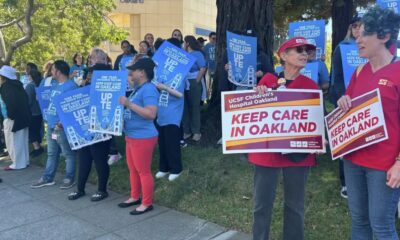
Oakland Children’s Hospital Workers and Patients Rally for Pediatric Medical Care
-
 Business16 hours ago
Surveillance Pricing Fight: State Senate Debates Bill Banning Retailers from Using AI to Set Prices Based on a Buyer’s Profile
-
 Black History5 days ago
Saving Black Mothers Starts Outside the Hospital
-
 Business3 days ago
Gov. Gavin Newsom Signs Law Streamlining Affordable Housing Rules
-
 Black History1 week ago
Oakland Celebrates $125 Million Coliseum Sale
-
 Community1 week ago
NPRC Heads to Washington to Elevate Adult Guardianship Reform at National Whistleblower Summit
-
 Business4 days ago
The Part of Buying a Home That No Real Estate Show Ever Prepares You For
