
Bay Area
Apply for Seasonal Jobs for Youth Recreation Programs
Create fun experiences and gain valuable work experience when you apply for seasonal summer positions at overnight and day camps, pools, and waterfront. We’re looking for overnight camp staff, recreation activity leaders, lifeguards, and others to join our recreation staff and work outdoors while providing fun, active, and creative programs for Berkeley youth.


Create fun experiences and gain valuable work experience when you apply for seasonal summer positions at overnight and day camps, pools, and waterfront.

We’re looking for overnight camp staff, recreation activity leaders, lifeguards, and others to join our recreation staff and work outdoors while providing fun, active, and creative programs for Berkeley youth.
You might be someone who can teach kids to help navigate the outdoors at one of our sleepaway camps in the Sierras, show them how to use tools at our innovative Adventure Playground, or lead programs for tots.
These jobs build skills for life and future careers. You’ll join a dedicated team that’s proud of the service we provide to our diverse community. We promote an accessible, safe, culturally rich, environmentally sound, and healthy city.
Please check our Seasonal Recreation jobs page every couple of weeks as new opportunities arise.
APPLY FOR SEASONAL RECREATION JOBS
To qualify for a seasonal position, you must be 16 years or older, be able to work 20-40 hours per week, and available to start in early June. You must also pass a tuberculosis test, complete a Live Scan background check, and have a signed Social Security card.
To apply for seasonal employment:
- Fill out the application form
- Send it to recreationjobs@cityofberkeley.info
OPEN SEASONAL POSITIONS WITH THE RECREATION DEPARTMENT
Echo Lake Youth Camp & Tuolumne Family Camp
- Camp Staff Member: Daily rate of $80.28 – $96.34
- Camp Staff Leader: Daily rate of $101.16 – $115.61
- Camp Staff Supervisor: Daily rate of $125.72 – $156.07
Day camps, tots, sports, adventure playground, teens, skate park, special events
- Recreation Activity Leader: $22.62 per hour (starting pay)
- Playground Leader Trainee: $20.90 per hour
Aquatics
- Aquatics Specialist I: $20.90 per hour
- Aquatics Specialist II: $21.29 per hour
- Senior Aquatic Specialist: $27.42 per hour
Waterfront
- Waterfront Monitors: $20.91 per hour
- Recreation Activity Leader: $22.62 per hour (starting pay)
If you don’t have access to a computer, call or come into our office. We can assist you in completing your application online. Contact our office during business hours:
Recreation Division
Parks, Recreation & Waterfront
1720 8th Street Berkeley, CA 94710
(510) 981-5140
Monday-Friday, 8:00 am – 5:00 pm
These jobs serve the City of Berkeley’s Recreation Division, which offers dozens of camps, classes, and other activities for participants of all ages. Families and individuals can learn more about programs and sign up via our registration portal and see more opportunities on our events calendar.
For youth and others looking for seasonal work over the summer, come join our recreation team and help provide fun, active, and creative programs for Berkeley youth.
LINKS
Keep up with City of Berkeley news via our news page, email, or on Twitter @cityofberkeley














Activism
Oakland Post: Week of September 30 – October 6, 2026
The printed Weekly Edition of the Oakland Post: Week of September 30 – October 6, 2026

To enlarge your view of this issue, use the slider, magnifying glass icon or full page icon in the lower right corner of the browser window.
Activism
Oakland Post: Week of September 23 – 29, 2026
The printed Weekly Edition of the Oakland Post: Week of September 23 – 29, 2026

To enlarge your view of this issue, use the slider, magnifying glass icon or full page icon in the lower right corner of the browser window.
Activism
Oakland Post: Week of September 16 – 22, 2026
The printed Weekly Edition of the Oakland Post: Week of September 16 – 22, 2026
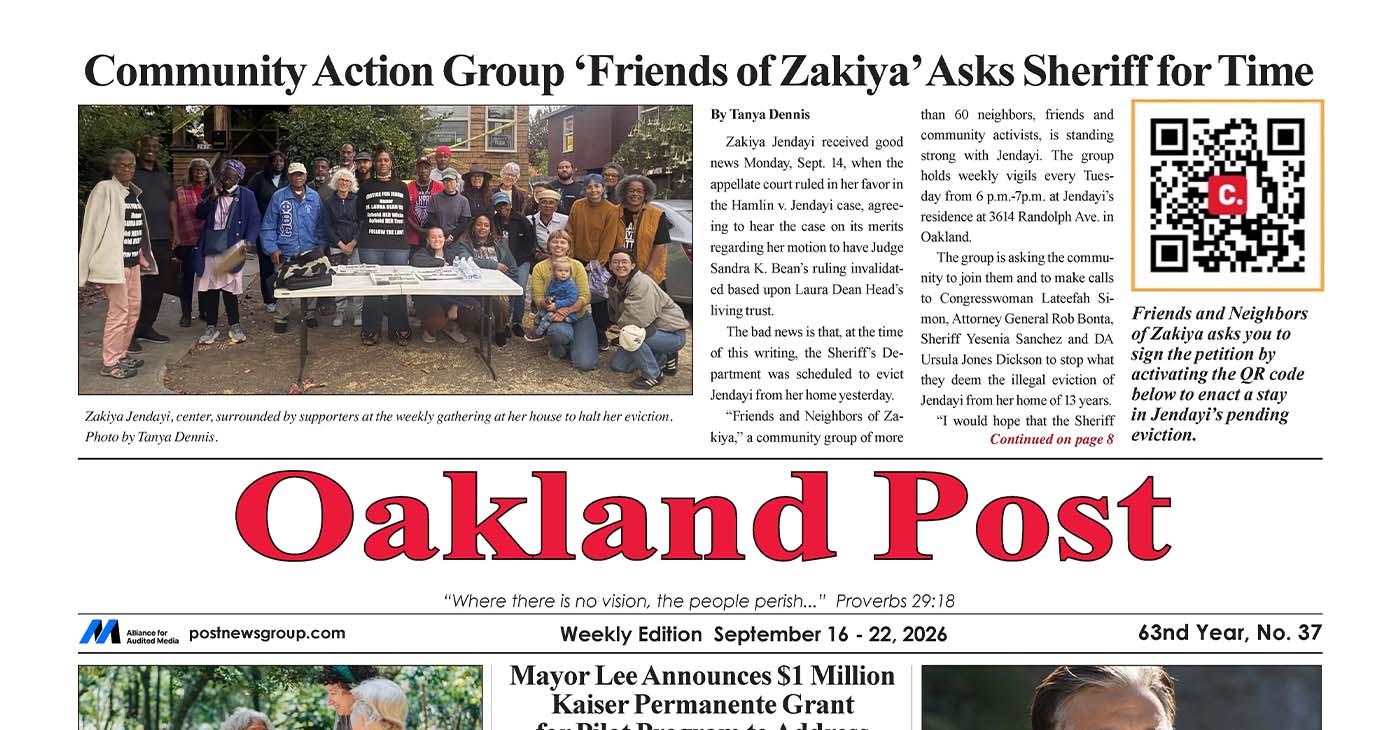
To enlarge your view of this issue, use the slider, magnifying glass icon or full page icon in the lower right corner of the browser window.



OP-ED: Proposition 44 Would Put a Price on Trust

OP-ED: Proposition 40: It’s Time to Play Chess, Not Checkers

Listening as a Lifeline: A Doula’s Witness to Black Maternal Health

New Protections for Ticket Buyers: Gov. Newsom Signs Assemblymember Isaac Bryan’s Bill

‘We Don’t Talk Trash — We Pick Up Trash!’

Zakiya Jendayi Arrested, Locked Out of Home by Sheriff’s Deputies

Oakland Post: Week of September 30 – October 6, 2026

Asm. Corey Jackson Announces Launch of 24-Hour Childcare in His District

IN MEMORIAM: The Rev. Leon “Sonny” Clark, Longtime Orange County Pastor and Community Leader, Dies at 72

Poll: Becerra Widens His Lead Over Hilton; Californians Split on Wealth Tax

From Historic Memories to New Possibilities: Oakland Celebrates Coliseum 60

County Office of Education Says OUSD Finances Are Getting Healthier, Materially Stronger

LIVE FREE Sunday Dinner Brings Faith, Fellowship and Civic Conversation to Oakland

Remembering Chauncey Bailey as Student Journalists Face Threats to Truth-Telling

BLACspace Cooperative Invites Bay Area to Experience Oakland’s Black Cultural Ecosystem Through a BLAC Map Tour + Party

Standoff for Justice: Our Homes Are Worth Fighting For

Oakland Post: Week of August 26 – September 1, 2026

Frontier Airlines’ Return to Oakland Airport Brings Flights, Jobs and Opportunity

Gubernatorial Candidate Steve Hilton Blasts California New Tire Rules; Newsom Hits Back

Jackie Wright Champions Bay Area Stories, Filmmakers and Cultural Institutions

Chef Sharon Lee Blends Culinary Excellence, Education and Empowerment

Misnamed ‘Parent’ PAC Seeks to Influence Oakland School Board Elections

Oakland Coliseum Project Opens Door for Small Businesses to Build Bigger

Gov. Newsom’s Latest Appointees Include Sacramento Advocate for Formerly Incarcerated Students; State’s New Tech Chief

Big City Mayors Ask for “Yes” Vote on Housing Bond Measure; Conservatives Say “No”

Longtime BWOPA Member Brendalyn Goodall Appointed to California Workforce Development Board

Oakland Post: Week of September 2 – 8, 2026

Gov. Newsom Signs Law Shielding Immigration Aid Workers From Doxing Threats

Secretary of State Shirley N. Weber Urges Californians to Vote Early as Voter ID Battle Intensifies

IN MEMORIAM: Dolly Parton Dead at 80 — How She Built a Legacy of Love and Earned Her Place in Black Culture

The Conversation With Al McFarlane 6/23/26

Media Monday 6/22/26

LIVE! ASK ALMA! — TUES. 6.23.26 7PM EST

Car Buying Secrets: 4 Hidden Checks Before You Sign!

Is This 550 HP Charger Worth YOUR Money? AutoNetwork Review

Celebrating Juneteenth – Frederick Douglass on education and resistance

LIVE! — ASK ALMA! — TUES. 6.19.26 7PM EST

Hyundai Ioniq 5 Parking, Safety, and 360 View #shorts

2025 Ioniq 5 New Wiper & Powerful Performance! #shorts

Electric SUV Range: Is 259 Miles Enough? #shorts

EV Charging: How Fast Can You Charge an Electric Vehicle? #shorts

Biometric Cooling… Messaging Seats…Come on! 2025 Infiniti QX80 Autograph 4WD

Charged Up: Witness the Magic of a Fully Electric Car! #shorts

Range Rover Sport PHEV Included…: See What’s Inside This Luxury SUV! #shorts

Invisible Hood View: Perfect Parking with X-Ray Vision! #shorts
-
 Community4 weeks ago
Misnamed ‘Parent’ PAC Seeks to Influence Oakland School Board Elections
-

 Activism4 weeks ago
Oakland Post: Week of September 9 – 15, 2026
-

 Community4 weeks ago
Richmond Tiny House Village Farm & Garden Set to Open Gates on Sept. 26
-

 Black History4 weeks ago
Latest Massacre in Haiti Reveals Cruelty U.S. Deportations
-

 Black History4 weeks ago
OPINION: Nolan Wells’ Death One of Several Signifying Racial Terror Lives on in U.S. South
-

 Business3 weeks ago
Mayor Lee Announces $1 Million Kaiser Permanente Grant for Pilot Program to Address Homelessness, Clean Up Public Spaces throughout Oakland
-

 Community4 weeks ago
Democratic Clubs Interview Candidates for Oakland School Board
-
 Uncategorized3 weeks ago
Oakland People’s Arms Embargo Coalition Demands End to Military Shipments Thru Oakland
