
Politics
Analysis: Republican Budget Claims Don’t Add Up


In this Jan. 14, 2014 file photo, Senate Budget Committee Chairman Sen. Mike Enzi, R-Wyo., leaves a closed-door GOP caucus luncheon on Capitol Hill in Washington. On paper and in speeches, Republicans boast that Congress first budget since they won control of the Senate and House last fall will eliminate red ink within a decade. Actually, it will do nothing of the sort.Thats because the budget itself is non-binding, and on its own, has no effect on spending. (AP Photo/J. Scott Applewhite, File )
DAVID ESPO, AP Special Correspondent
An AP News Analysis
WASHINGTON (AP) — On paper and in speeches, Republicans boast that Congress’ first budget since they won control of the Senate and House last fall will eliminate red ink within a decade.
Actually, it will do nothing of the sort.
That’s because the budget itself is nonbinding and, on its own, has no effect on spending.
And also because Republicans have decided against using unique budget rules for follow-up legislation to save the trillions of dollars from food stamps, Medicaid and other benefit programs that would be needed to erase red ink. To do that would spark a pitched political battle with Democrats, a veto from President Barack Obama — and a possible backlash from the voters in 2016.
Republican veterans and newcomers alike made no mention of this political truth in praising their own handiwork in recent days as the blueprint was ratified on party-line votes in both houses.
“This balanced budget achieves real results and allows the federal government to support Americans when it must and get out of the way when it should,” said Wyoming Sen. Mike Enzi, who chairs the Senate Budget Committee.
“Today I was pleased to vote for a budget that will curb out-of-control spending, ensure a strong national defense, protect Social Security, strengthen Medicare, all without raising taxes on hardworking Alaskans,” said Sen. Dan Sullivan, a first-term lawmaker from Alaska.
House Speaker John Boehner’s office listed 10 ways the budget will help taxpayers, including “balancing the budget without raising taxes to help create 1.2 million new jobs, save taxpayers more than $5 trillion and protect future generations from crushing debt.”
In a brief burst of candor, Republican negotiators who put together the final House-Senate compromise were more restrained. They called their work a “statement of good faith to the American people that Congress can govern responsibly and effectively.”
Overall the Republican spending plan charts a far different course that the one pursued by Democrats, who treated budget-drafting as optional when they held the Senate majority in recent years and show less interest in deficit control.
It will curtail spending on programs that are funded on a yearly basis, by about one-tenth of the $5 trillion needed to balance the budget over the next 10 years. Democrats and the White House are sure to contest those bills.
But it generally will leave alone the large benefit programs where far greater savings are needed if deficits are to end.
The shortfall is projected to total $468 billion for the current budget year, the lowest since Obama took office.
Instead of pursuing elimination of red ink, Republicans intend to use special budget rules to pass legislation repealing the health care law known as Obamacare, or whatever part of it might remain standing after a widely anticipated Supreme Court ruling later this summer.
That is the “sole purpose” of any reconciliation legislation that will be passed as a follow-up, the agreement says, using the budget-speak label for a bill debated under rules that bar a Senate minority from preventing a final vote.
That, too, would stand as something of an accomplishment for Republicans, since it would mark the first time they have succeeded in sending Obama legislation to repeal the law.
In previous years, Senate Democrats blocked dozens of House GOP attempts to wipe out or neutralize the law, but they are in the minority now.
The repeal measure that Republicans intend to pass will produce a pitched battle with Democrats and a veto from the president. With savings of roughly $2 trillion over a decade, it won’t come close to balancing the budget. In purely political terms, though, it will please conservatives who helped put the GOP in power last fall without risking voter anger at the polls.
Repeal of the health care law is estimated to save about $2 trillion, less than half of the amount needed to erase deficits over a decade.
In addition, the original House budget blueprint recommended cuts in Medicaid and other health programs of about $1 trillion over a decade, and savings from benefit programs like food stamps of another $1 trillion. It also envisioned an intensely controversial overhaul of Medicare for the future.
Senate Republicans, whose majority could be sternly tested at the polls in 2016, have been particularly unwilling to disclose any long-term blueprint for cutting spending.
___
EDITOR’S NOTE: David Espo is AP’s chief congressional correspondent.
Copyright 2015 The Associated Press. All rights reserved. This material may not be published, broadcast, rewritten or redistributed.








Activism
Stop the Hate Symposium Brings Oakland Together Through Dialogue, Partnership, and Community Healing
More than a meeting and panel discussion, the annual symposium serves as a powerful example of what can happen when neighbors, community leaders, and organizations choose conversation over division, and unity over silence.

By Dr. Maritony Jones, Special to The Post
With the purpose of creating safer, stronger, and more inclusive communities, and in partnership with the Oakland Private Industry Council and other community organizations, the Oakland Chinatown Improvement Council (OCIC) hosted the ‘Stop the Hate Symposium’ on June 13 at the Oakland Asian Cultural Center.
More than a meeting and panel discussion, the annual symposium serves as a powerful example of what can happen when neighbors, community leaders, and organizations choose conversation over division, and unity over silence.
The free event featured keynote speakers, breakout sessions, cultural programming, creating a space where people from many backgrounds sat together with a shared purpose.
The turnout itself reflected the urgency and importance of the topic. The room was packed with community members eager not only to listen, but also to participate. Throughout the event, speakers shared data, personal experiences, research, and practical solutions designed to address hate, violence, social inequity, and community safety.
The keynote panel featured respected leaders and advocates, including Ray Bobbitt, founder of the African American Sports & Entertainment Group (AASEG); Ryan Takemiya from RAMA; Caheri Gutierrez from the Unity Council; honorary guest speaker Oakland City Councilmember at-Large Rowena Brown and City Councilmember Charlene Wang; representatives for Oakland Mayor Barbara Lee and U.S. Rep. Lateefah Simon, with Gia Vang of NBC serving as moderator.
The symposium also offered multiple breakout sessions that addressed issues affecting communities across Oakland and Alameda County:
- Session 1, 2, 3: Building Safer and More Inclusive Communities, led by Pastor Raymond Lankfort, CEO of Oakland Private Industry Council (OPIC), Jessica Kang, research manager for Stop AAPI Hate, Kara Guerra of The Unity Council, and Gabriela delaRiva of the Spanish Speaking Citizens Foundation
- Session 4: Talk Story: Collective Healing and Relationship Repair, presented by Ryan Takemiya, executive director of RAMA
- Session 5: Sexual Violence Prevention, presented by Tunisia Owens, interim deputy director of Realized Potential
- Session 6: Violent Attacks on Teens, presented by MaryAnn Alvarado, program manager of Youth Alive
Every session contributed to an important truth: meaningful change begins within communities, through honest dialogue and a willingness to work together.
One of the strongest themes to emerge from the day was the need to create more conversations and stronger partnerships—not just during times of crisis, but consistently and intentionally. Relationships among organizations, neighborhoods, and community leaders often operate behind the scenes but are not always highlighted or celebrated.
Bobbitt spoke powerfully about this issue, noting that partnerships and relationships often go unrecognized despite being essential to community progress. He pointed to examples such as the partnership between OPIC and OCHIC, emphasizing that these collaborations deserve more visibility, investment, and expansion.
Perhaps his most memorable message resonated deeply throughout the room. Bobbitt explained that when a grandparent is attacked or harmed, the impact extends beyond race or ethnicity because today’s families and communities are increasingly multicultural and interconnected.
“We are not going to see our grandparents as just Latino, Asian, Caucasian, or African American,” he shared in essence. “We are going to see them simply as our grandparents.”
Those words reflected the heart of the symposium. Hate may target one group, but pain and loss are felt by everyone. Likewise, healing and progress are shared responsibilities.
For more information about the Stop The Hate Program visit the website: https://www.oaklandchinatownchamber.org/stop-the-hate (or) https://oaklandpic.or
Activism
Six Months in, Probate Reform Coalition Marks Progress in Protecting Elders From Financial Abuse
Despite the cited obstacles, NPRC has made some promising inroads towards their mission. NPRC has identified that nationwide the Attorneys General must be engaged and encouraged to implement oversight, protection and enforcement of the law; members find support from each other as they advocate for redress via “letters of compassion” sent to judges, nursing facilities and law enforcement agencies and members are instructed on their rights, how to take constructive action to protect those rights through access to resources that allow them to intelligently represent themselves in court.
By Tanya Dennis
The National Probate Reform Coalition, a loose-knit national coalition of advocates, victims, and families dedicated to protecting elder rights, especially within the probate court system, was formed by the Post Newspaper Group (PNG) after more than a decade of reporting on the mistreatment of elders and the plunder of their estates.
In response, PNG Publisher Paul Cobb set in motion a series of monthly town halls to address the problem and propose workable solutions, designating it a “year of action.”
At six months, the coalition has attracted families, advocates, and experts across the nation whose strategies have proven effective in their respective states, and who are moving forward collectively with the mission of engaging judicial, legislative, and enforcement agencies to ensure elders are not exploited or abused.
“The issue of elder abuse is multi-layered”, says NPRC planning committee member Venus Gist. “Elders are our most vulnerable population, next to children, and they are easily exploited by strangers, their own family members, and the judicial system designed to protect them.”
Since January, NPRC has, via monthly virtual meetings held on the first Thursday of each month, clearly defined the issues and formulated workable solutions that can be implemented nationwide.
“There are amazing laws on the books that protect elders and their assets,” said NPRC member Zakiya Jendayi. “The problem is they are ignored, and that lack of oversight has led to systemic abuse in the Probate Court system, not just in Alameda County, but nationwide.
“The scary part is the collusion and wall of silence NPRC has encountered when reaching out to the Judicial Council, legislators, and the State Bar for assistance. It’s so obvious that one hand is washing the other, that they’re protecting each other, that it’s difficult to initiate any type of meaningful reform much less dialogue.”
Despite the cited obstacles, NPRC has made some promising inroads towards their mission. NPRC has identified that nationwide the Attorneys General must be engaged and encouraged to implement oversight, protection and enforcement of the law; members find support from each other as they advocate for redress via “letters of compassion” sent to judges, nursing facilities and law enforcement agencies and members are instructed on their rights, how to take constructive action to protect those rights through access to resources that allow them to intelligently represent themselves in court.
Stacy Drake, a Texas member, says, “I’ve been looking for help for over 10 years with my situation, and I finally found it within the NPRC coalition. God answered my prayers.”
Broadening its reach within Alameda County, NPRC has invited Oakland Mayor Barbara Lee to assist with outreach, education, and resolution.
“We hope to host an elder abuse/elder protection symposium annually, if not twice a year, to let our elders know that Alameda County and the City of Oakland are a safe place, a place where in their golden years they have no worries regarding exploitation and abuse,” said Cobb. “Society is defined by how the care for its children and elders.”
Bay Area
A Long Time Coming: School District Kicks Off Massive $97 Million Renovation of West Oakland’s McClymonds High School
The extensive project will involve the full modernization of the campus, including essential upgrades to building systems such as plumbing replacement (with lead abatement), seismic improvements, and modernization of heating, electrical, ventilation, and air conditioning systems. Indoor spaces will be updated with new flooring, wall treatments, and upgrades to classrooms, labs, shops, and sports locker rooms.
‘We gather on sacred ground,’ said OUSD Supt. Denise Saddler
By Post Staff
After being stalled for many years, the massive $97 million renovation of McClymonds High School is finally breaking ground under the leadership of the district’s new superintendent, Dr. Denise Saddler, and backed by the unrelenting efforts of the school’s parents, students, school board members, community, and alumni.
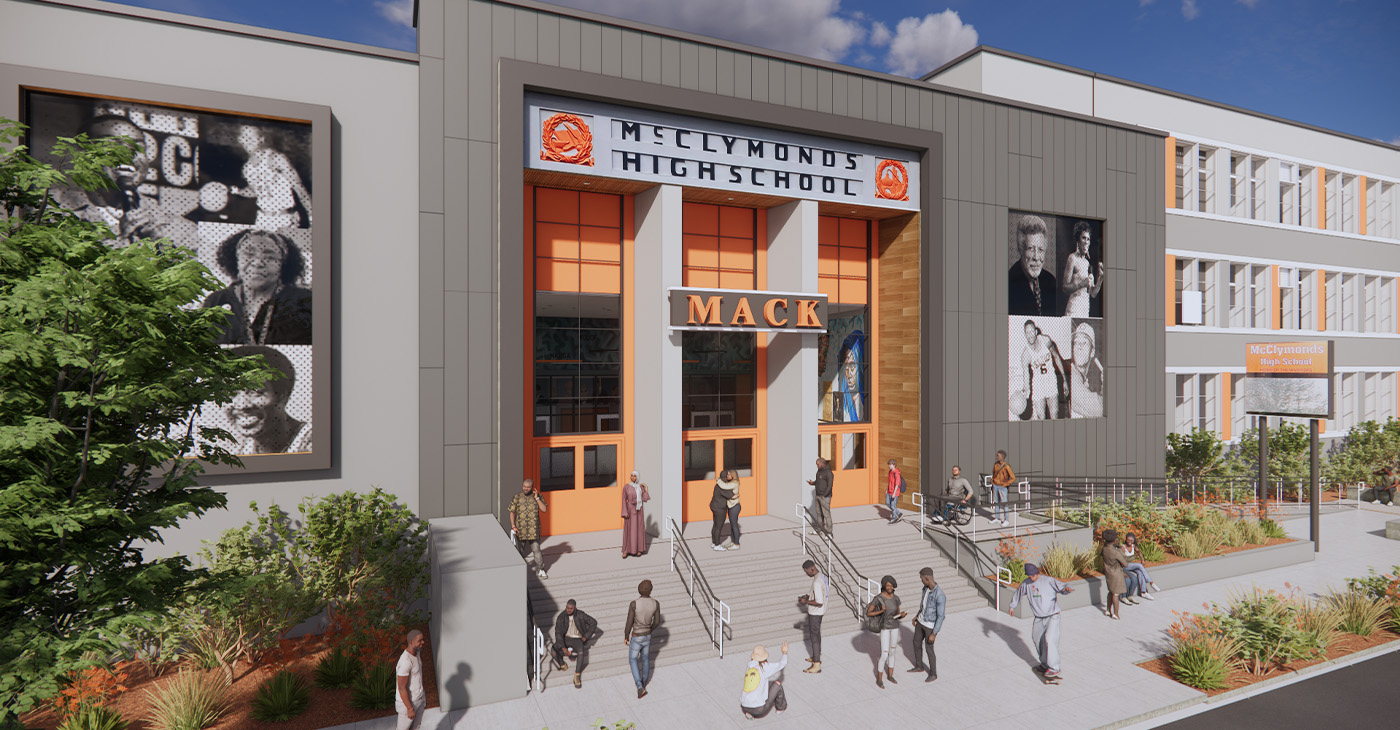
The Oakland Unified School District (OUSD) held the groundbreaking ceremony on June 12 to kick off the three-year modernization project for McClymonds, a historic center of African American culture and educational opportunity in Oakland, located at 2607 Myrtle St. in West Oakland.
The overhaul will include seismic and environmental upgrades, a new turf field, and modernized campus facilities. The comprehensive transformation is financed by Measure Y, a $735 million general obligation bond approved by Oakland voters to renovate and upgrade aging school sites.
This renovation is considered a milestone for the West Oakland campus, which has operated in the same building since 1938 and has been in dire need of structural and plumbing safety remediation for years.
Speaking at the event, Supt. Denise Saddler said,
“We gather on sacred ground… that has shaped generations of Oakland leaders, scholars, artists, activists, entrepreneurs, educators like Mr. Herman Brown – one of our top math teachers. I also want to say it’s the historic home of the mighty Warriors (athletic teams). It’s a historic home of so many people.”
“This was, for Black people, our high school,” she continued “For more than a century, McClymonds has stood as a beacon of excellence in West Oakland and beyond. It’s not simply a school building; it’s a symbol of resilience, pride, community, and possibility.”
The superintendent said the legacy of McClymonds includes legendary alumni such as NBA player-coach Bill Russell, whose excellence transformed the game of basketball and whose courage helped transform the nation.
The school’s legacy also includes MLB players Frank ‘Judge’ Robinson and Curt Flood, basketball player Paul Silas and civic leaders including Lionel Wilson, a Superior Court judge and Oakland’s first African American mayor.
She emphasized that the groundbreaking was not only about honoring the past, but also about investing in the future.
“(It) represents Oakland’s commitment to the young people of West Oakland. It sends a powerful message that our students deserve facilities that match their brilliance, their talent and their dreams. “
The extensive project will involve the full modernization of the campus, including essential upgrades to building systems such as plumbing replacement (with lead abatement), seismic improvements, and modernization of heating, electrical, ventilation, and air conditioning systems. Indoor spaces will be updated with new flooring, wall treatments, and upgrades to classrooms, labs, shops, and sports locker rooms.
The cafeteria also will be reconfigured, and outdoor areas will feature a new grandstand, track and field upgrades, accessible field bathrooms and concessions, and updates to the plaza, garden, and outdoor gathering areas.
Mayor Barbara Lee, who attended the event, thanked Oakland voters for passing the Measure Y bond that is paying for the school’s renovation.

Renderings of McClymond High School renovation. Courtesy image.
“It’s a good day – It’s a good news day,” she said. “The voters who (approved) Measure Y care about our young people. Today, we have the opportunity on this historic day to say, well done. Thank you to the voters for the facilities our community, our students, our teachers deserve.”
School Board member VanCedric Williams, whose district includes McClymonds, said that OUSD passed repeated school bond measures for decades, promising to renovate the school, but it did not happen.
“I just want to thank all the community (who) put pressure on the district to do right, to hold school board members accountable, and to really say, ‘We’re not going to take anything less than a renovation.’”
“When I first met Dr. Saddler, she said, ‘I have a commitment to McClymonds – I’m going to make it happen.’ And she has done something in one year that has not been done in 20 years. So, I have the belief that we’re going to get it done.”
Rising senior LaTanya Nolen, praised the school for the opportunities she has received and for the dedication of its staff.
“Every student here is treated like they matter and given opportunities to grow and build onto themselves,” she said. “We’ve gotten to do things like sports, field trips, college and career excursions, networking, and more. Our futures are taken seriously, and the people around us are always pushing us so that we are prepared for it.”
Parent Brejea Colthirst said, “Thank you to everyone who had a part in this, who helped make this possible. Together, we are building something special.”
Brian McGhee, popular McClymonds staff member and alumni, pledged to build on the strength of McClymonds’ traditions. “Mack is back. We’re going to up the enrollment with this new school. We’re going to continue to know every student’s name who comes through this school. My job as a community manager is going to continue to provide resources for our families and our students, and continue to communicate with our parents, which is huge.”

WORK FROM HOME
Home-based business with potential monthly income of $10K+ per month. A proven training system and website provided to maximize business effectiveness. Perfect job to earn side and primary income. Contact Lynne for more details: Lynne4npusa@gmail.com 800-334-0540



Oakland Museum Presents Landmark Retrospective Celebrating Beloved Bay Area Artist Mildred Howard

Ferry Fares to Increase July 1 as Ridership Hits Record Highs

Stop the Hate Symposium Brings Oakland Together Through Dialogue, Partnership, and Community Healing

Six Months in, Probate Reform Coalition Marks Progress in Protecting Elders From Financial Abuse

A Long Time Coming: School District Kicks Off Massive $97 Million Renovation of West Oakland’s McClymonds High School

IN MEMORIAM: Oakland Dance Legend Reginald Ray-Savage, 67

UC Berkeley Named Top Public University in the U.S. and No. 7 in the World by ‘U.S. News’

NCBW-OBAC Champions Black Women Entrepreneurs at Business en Blaque Expo

Lock In Car Price: Avoid Dealer Payment Traps!

Sell Your Car: Get Offers BEFORE Visiting Dealerships!

The Conversation With Al McFarlane 6/23/26

Media Monday 6/22/26

LIVE! ASK ALMA! — TUES. 6.23.26 7PM EST

Car Buying Secrets: 4 Hidden Checks Before You Sign!

After 10-Year Wait, Fillmore Heritage Center Reopens in San Francisco

Oakland Post: Week of June 3 – 9, 2026

Oakland Post: Week of May 20 – 26, 2026

Oakland Post: Week of May 27 – June 2, 2026

5 Cleveland Police Officers Injured, Gunfire Erupts During East Side Pursuit

COMMENTARY: Black Music is the Sound of Black Freedom: Let Us Reclaim Both This Juneteenth

2026 World Cup is Here and Atlanta is Ready For It

Oakland Director Boots Dazzles Once Again in ‘I Love Boosters’

Venus Williams Calls a Sabalenka Exit a Tragedy

COMMENTARY: Using Art, Healing, And Community to Transform Mental Health Dialogue

Oakland Post: Week of June 10 – 16, 2026

Sale of Coliseum to African American Developers Moves Toward Completion

Study: Waiting Lists for Child Care Assistance Nearly Doubled

Uptown Music Theatre Summer Camp Returns to Inspire the Next Generation of Performers
The Conversation With Al McFarlane 6/23/26
Media Monday 6/22/26
LIVE! ASK ALMA! — TUES. 6.23.26 7PM EST
Car Buying Secrets: 4 Hidden Checks Before You Sign!

Is This 550 HP Charger Worth YOUR Money? AutoNetwork Review

Celebrating Juneteenth – Frederick Douglass on education and resistance

LIVE! — ASK ALMA! — TUES. 6.19.26 7PM EST

Hyundai Ioniq 5 Parking, Safety, and 360 View #shorts

2025 Ioniq 5 New Wiper & Powerful Performance! #shorts

Electric SUV Range: Is 259 Miles Enough? #shorts

EV Charging: How Fast Can You Charge an Electric Vehicle? #shorts

Biometric Cooling… Messaging Seats…Come on! 2025 Infiniti QX80 Autograph 4WD

Charged Up: Witness the Magic of a Fully Electric Car! #shorts

Range Rover Sport PHEV Included…: See What’s Inside This Luxury SUV! #shorts

Invisible Hood View: Perfect Parking with X-Ray Vision! #shorts
-
 Art3 weeks ago
After 10-Year Wait, Fillmore Heritage Center Reopens in San Francisco
-
 Activism3 weeks ago
Oakland Post: Week of June 3 – 9, 2026
-
 #NNPA BlackPress4 weeks ago
5 Cleveland Police Officers Injured, Gunfire Erupts During East Side Pursuit
-
 Arts and Culture3 weeks ago
COMMENTARY: Black Music is the Sound of Black Freedom: Let Us Reclaim Both This Juneteenth
-
 #NNPA BlackPress4 weeks ago
2026 World Cup is Here and Atlanta is Ready For It
-
 Art3 weeks ago
Oakland Director Boots Dazzles Once Again in ‘I Love Boosters’
-
 #NNPA BlackPress4 weeks ago
Venus Williams Calls a Sabalenka Exit a Tragedy
-
 #NNPA BlackPress4 weeks ago
COMMENTARY: Using Art, Healing, And Community to Transform Mental Health Dialogue
