
Politics
Despite Low Gas Prices, Gas Tax Hike Appears Unlikely


A person gets fuel after gas prices dropped below $2 a gallon at the Quick Mart in High Point, N.C., Wednesday, Jan. 14, 2015. (AP Photo/Daily Free Press, Laura Greene)
JOAN LOWY, Associated Press
WASHINGTON (AP) — The new Republican-controlled Congress is facing an old problem: where to find the money for highway and transit programs.
With gasoline prices at their lowest in years when the new Congress convened, there had been talk that it might be time to raise federal gas and diesel taxes, which haven’t budged in more than 20 years.
But already, GOP leaders are tamping down expectations, leaving no clear solution to the funding problem.
“I don’t know of any support for a gas tax increase in Congress,” Sen. John Cornyn, R-Texas, the No. 2 Senate GOP leader, said flatly. Explained Sen. John McCain, R-Ariz.: “They don’t want to vote for a tax increase.”
House Speaker John Boehner, R-Ohio, while not closing the door entirely, said there aren’t enough votes in the House for a gas tax increase. Rep. Bill Shuster, R-Pa., the House Transportation and Infrastructure Committee chairman, was equally doubtful.
“The president has ruled out a gas tax. I don’t think there’s a will in Congress, and the American people don’t want it,” Shuster recently told The Associated Press.
The gas tax, now 18.4 cents a gallon, and the diesel fuel tax, now 24.4 cents a gallon, were last increased in 1993. In the meantime, Americans are driving less per capita, cars are more fuel efficient and construction costs have gone up. Fuel taxes bring in about $34 billion a year to the federal Highway Trust Fund, but the government spends about $50 billion a year. The trust fund has been the main source of federal transportation aid to states for more than 60 years.
In that environment, two key GOP senators — Finance Committee Chairman Orrin Hatch of Utah and Environment and Public Works Committee Chairman James Inhofe of Oklahoma — had raised the hopes of transportation advocates by saying raising fuel taxes should be considered along with other funding options, using the more politically palatable term “user fees.” But the idea appears to be a long shot at best.
Congress has kept transportation programs teetering on the edge of insolvency since 2008 by repeatedly transferring just enough funds from the general treasury — and making corresponding spending cuts elsewhere in the federal budget — to meet obligations for a few more months or, in one case, as long as two years. Finding acceptable spending cuts to offset the transfers gets more difficult each time.
The latest funding patch cleared Congress last August only about three hours before the Transportation Department said it would begin cutting back aid payments to states. That fix is only expected to last through May, when Congress will be back where it started unless lawmakers act sooner.
“The political support for increasing taxes to pay for transportation appears to be very limited,” said Joshua Schank, president of the Eno Center for Transportation, a think tank.
A majority of Americans think the economic benefits of good transportation outweigh the cost, but they can’t agree on how to pay for new highways or repairs of old ones. An Associated Press-GfK poll last summer, before the plunge in gas prices, showed 58 percent opposed raising federal gasoline taxes to pay for repair, replacement or expansion of roads and bridges. Only 14 percent supported an increase.
The lack of voter enthusiasm for raising gas taxes hasn’t deterred die-hard gas tax supporters who say it is preferable to a one-time fix because it would ensure continued funding. Rep. Earl Blumenauer, D-Ore., issued a statement Thursday saying he intends to reintroduce a bill to raise fuel taxes 15 cents a gallon. He introduced a similar bill last year, but it wasn’t considered by the GOP-controlled House. Blumenauer estimated the increase would raise an additional $210 billion over the next decade.
President Barack Obama has previously rejected a gas tax increase, instead proposing to close corporate tax loopholes and use the revenue to pay for infrastructure. His plan would boost highway spending 22 percent and transit spending 70 percent over four years.
Transportation Secretary Anthony Foxx told a transportation conference this week that’s still the administration’s preferred option, but he also expressed “openness to ideas that emerge from Congress.”
Sen. John Thune, R-S.D., the No. 3 Senate GOP leader, who helped raise speculation that a fuel tax increase might be possible when he said all possible funding options should be considered, including a gas tax increase, this week described such a possibility as “unlikely.”
“I can’t see a scenario for some sort of user fee increase that you’d have to offset with tax relief in some other area,” he told reporters. “Nobody is going to vote for a gas tax increase.”
Instead, Thune said, closing tax loopholes, especially those that encourage corporations to move overseas, and using the money to pay for infrastructure is his “preferred option.” But he also observed that “tax increases are always hard, and there’s a perception that we ought to be able to find savings in other areas to fund infrastructure.”
___
Follow Joan Lowy on Twitter at http://www.twitter.com/AP_Joan_Lowy
Copyright 2015 The Associated Press. All rights reserved. This material may not be published, broadcast, rewritten or redistributed.





Business
OP-ED: Proposition 44 Would Put a Price on Trust
The danger in Proposition 44 is not only its 90 percent figure. It is that the meaning of “qualifying” spending will be worked out later. A clinic preparing a budget today may not know whether a navigator, health educator, transportation program, outreach worker, technology upgrade, or other patient-support service will be counted the way it expects. Yet the financial consequence of getting it wrong could be immediate.



Business
OP-ED: Proposition 40: It’s Time to Play Chess, Not Checkers
Proposition 40 would impose a one-time 5 percent tax on the wealth of Californians with more than $1 billion in assets. Most of that money would go toward health care, with the remainder supporting food assistance and education-related programs.

Activism
Oakland Post: Week of September 30 – October 6, 2026
The printed Weekly Edition of the Oakland Post: Week of September 30 – October 6, 2026
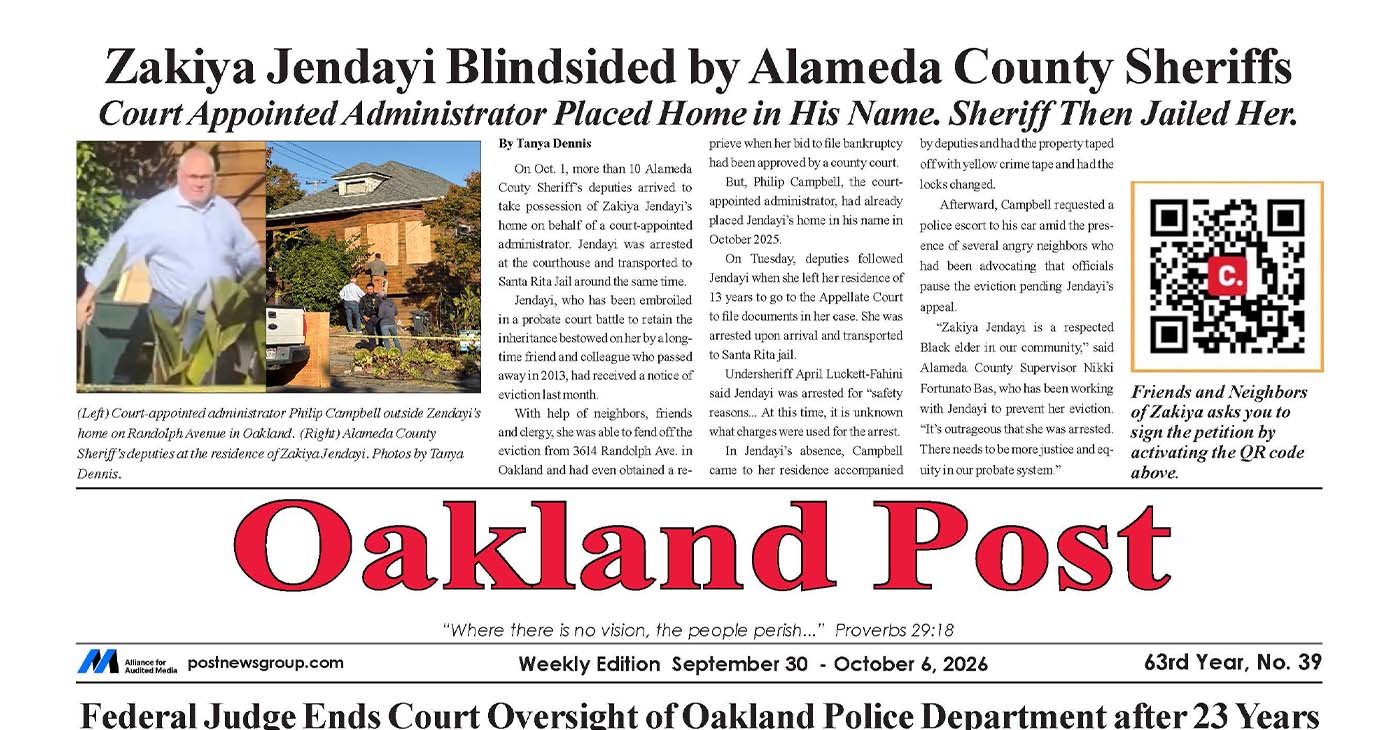
To enlarge your view of this issue, use the slider, magnifying glass icon or full page icon in the lower right corner of the browser window.



OP-ED: Proposition 44 Would Put a Price on Trust

OP-ED: Proposition 40: It’s Time to Play Chess, Not Checkers

Listening as a Lifeline: A Doula’s Witness to Black Maternal Health

New Protections for Ticket Buyers: Gov. Newsom Signs Assemblymember Isaac Bryan’s Bill

‘We Don’t Talk Trash — We Pick Up Trash!’

Zakiya Jendayi Arrested, Locked Out of Home by Sheriff’s Deputies

Oakland Post: Week of September 30 – October 6, 2026

Asm. Corey Jackson Announces Launch of 24-Hour Childcare in His District

IN MEMORIAM: The Rev. Leon “Sonny” Clark, Longtime Orange County Pastor and Community Leader, Dies at 72

Poll: Becerra Widens His Lead Over Hilton; Californians Split on Wealth Tax

From Historic Memories to New Possibilities: Oakland Celebrates Coliseum 60

County Office of Education Says OUSD Finances Are Getting Healthier, Materially Stronger

LIVE FREE Sunday Dinner Brings Faith, Fellowship and Civic Conversation to Oakland

Remembering Chauncey Bailey as Student Journalists Face Threats to Truth-Telling

BLACspace Cooperative Invites Bay Area to Experience Oakland’s Black Cultural Ecosystem Through a BLAC Map Tour + Party

Standoff for Justice: Our Homes Are Worth Fighting For

Oakland Post: Week of August 26 – September 1, 2026

Frontier Airlines’ Return to Oakland Airport Brings Flights, Jobs and Opportunity

Gubernatorial Candidate Steve Hilton Blasts California New Tire Rules; Newsom Hits Back

Chef Sharon Lee Blends Culinary Excellence, Education and Empowerment

Jackie Wright Champions Bay Area Stories, Filmmakers and Cultural Institutions

Misnamed ‘Parent’ PAC Seeks to Influence Oakland School Board Elections

Oakland Coliseum Project Opens Door for Small Businesses to Build Bigger

Big City Mayors Ask for “Yes” Vote on Housing Bond Measure; Conservatives Say “No”

Gov. Newsom’s Latest Appointees Include Sacramento Advocate for Formerly Incarcerated Students; State’s New Tech Chief

Longtime BWOPA Member Brendalyn Goodall Appointed to California Workforce Development Board

Gov. Newsom Signs Law Shielding Immigration Aid Workers From Doxing Threats

Secretary of State Shirley N. Weber Urges Californians to Vote Early as Voter ID Battle Intensifies

Oakland Post: Week of September 2 – 8, 2026

IN MEMORIAM: Dolly Parton Dead at 80 — How She Built a Legacy of Love and Earned Her Place in Black Culture

The Conversation With Al McFarlane 6/23/26

Media Monday 6/22/26

LIVE! ASK ALMA! — TUES. 6.23.26 7PM EST

Car Buying Secrets: 4 Hidden Checks Before You Sign!

Is This 550 HP Charger Worth YOUR Money? AutoNetwork Review

Celebrating Juneteenth – Frederick Douglass on education and resistance

LIVE! — ASK ALMA! — TUES. 6.19.26 7PM EST

Hyundai Ioniq 5 Parking, Safety, and 360 View #shorts

2025 Ioniq 5 New Wiper & Powerful Performance! #shorts

Electric SUV Range: Is 259 Miles Enough? #shorts

EV Charging: How Fast Can You Charge an Electric Vehicle? #shorts

Biometric Cooling… Messaging Seats…Come on! 2025 Infiniti QX80 Autograph 4WD

Charged Up: Witness the Magic of a Fully Electric Car! #shorts

Range Rover Sport PHEV Included…: See What’s Inside This Luxury SUV! #shorts

Invisible Hood View: Perfect Parking with X-Ray Vision! #shorts
-
 Community3 weeks ago
Misnamed ‘Parent’ PAC Seeks to Influence Oakland School Board Elections
-
 Activism4 weeks ago
Oakland Post: Week of September 2 – 8, 2026
-

 Activism3 weeks ago
Oakland Post: Week of September 9 – 15, 2026
-

 Community3 weeks ago
Richmond Tiny House Village Farm & Garden Set to Open Gates on Sept. 26
-

 Black History3 weeks ago
Latest Massacre in Haiti Reveals Cruelty U.S. Deportations
-

 Black History3 weeks ago
OPINION: Nolan Wells’ Death One of Several Signifying Racial Terror Lives on in U.S. South
-

 Business2 weeks ago
Mayor Lee Announces $1 Million Kaiser Permanente Grant for Pilot Program to Address Homelessness, Clean Up Public Spaces throughout Oakland
-

 Community3 weeks ago
Democratic Clubs Interview Candidates for Oakland School Board
