
Bay Area
Alcatraz Ferry Workers Want to Unionize
If the workers do secure a union, it won’t be the first time Alcatraz ferry workers have been unionized. The companies that had operated the ferry from its opening in 1973 until 2006, had always hired union workers. But when Hornblower Group took over the ferry in 2006, they set up Alcatraz Cruises, an operation that representation for ferry workers, and the Alcatraz ferry workers have been nonunion since then.

By Zack Haber | Post News Group
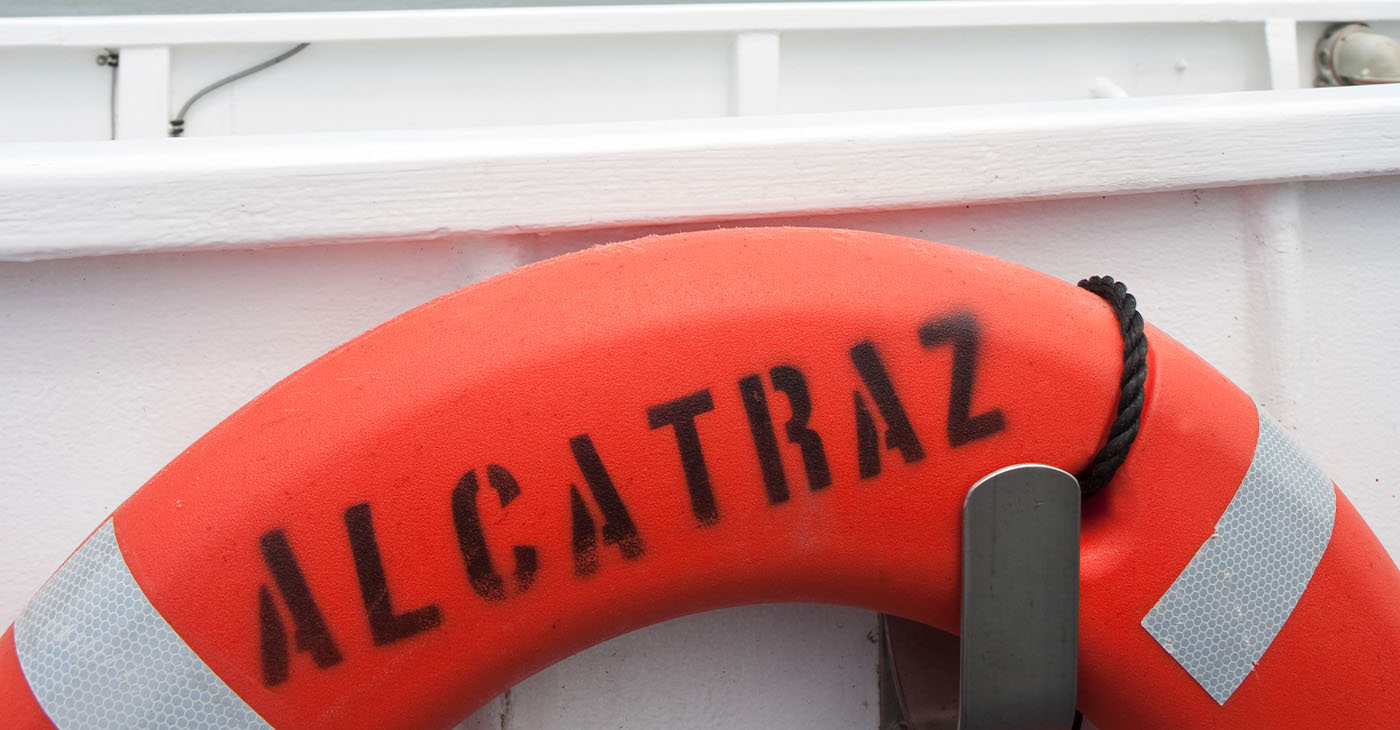
Workers who operate and provide services to customers riding the ferry that runs from San Francisco’s Pier 33 to Alcatraz Island are attempting to form a union.
“I think if we formed a union this would be a happy place,” said Erik Anfinson, who works as a captain with Alcatraz Cruises, which operates the ferry. “We used to have that, but now it’s gone.”
Anfinson feels that working conditions and morale have deteriorated since the ferry reopened post-COVID. He’s one of 68 workers who signed a letter in mid-July asking Hornblower Group, the company that runs Alcatraz Cruises, to recognize their union. About 85 employees, according to Anfinson, work at the ferry. These employees include other captains, as well as deckhands, maintenance, ticket booth, and food and beverage workers.
Hornblower Group has chosen not to honor the workers’ request for them to voluntarily recognize their union.
“We enjoy and value being able to directly communicate with our employees, and believe that the company, our employees and our guests are better served when such communications occur directly between the company and its employees rather than through any third party, including a labor organization,” reads a statement that Hornblower Group Vice President of Communications Melissa Gunderson emailed to this reporter.

Ultimately, the workers are attempting to unionize by joining the Inlandboatmen’s Union of the Pacific, which is also known as the IBU, and is a part of the International Longshore and Warehouse Union (ILWU). A recent post on an Instagram account representing the proposed Alcatraz ferry union says, “We are organizing because we deserve fair scheduling, predictable raises, job security, adequate training, respect and a seat at the table.”
For the union drive to be successful, workers will have to go through a formal vote organized by the National Labor Review Board. They currently are working through that process and hope to unionize in coming weeks.
If the workers do secure a union, it won’t be the first time Alcatraz ferry workers have been unionized. The companies that had operated the ferry from its opening in 1973 until 2006, had always hired union workers. But when Hornblower Group took over the ferry in 2006, they set up Alcatraz Cruises, an operation that opposes representation for ferry workers, and the Alcatraz ferry workers have been nonunion since then.
Anfinson hopes that a union contract will help him secure some stability with his work schedule. He says his work hours change from week to week in an unpredictable manner.
“I want to know when I can make doctor and dentist appointments,” he said. “Not having a set schedule makes it tough, you can’t plan anything.”
In her email, Gunderson, of Hornblower, attributed the unpredictability to problems related to COVID, but said that the situation is now becoming better.
“Like most employers across a host of industries, the pandemic caused staffing challenges at Alcatraz City Cruises, and this issue was compounded by unpredictable government restrictions and related tourist demand that rapidly changed with COVID variants,” said Gunderson’s email.
Gunderson did not respond when asked to provide current and pre-COVID staff numbers. According to Anfinson, Alcatraz Cruises has less than half the employees it had before COVID, which forces him and other workers to take on more tasks and work longer hours than they used to.
“They don’t want to hire more employees, and I don’t know why,” said Anfinson. “I think they’re just trying to cut back on everything.”
An Alcatraz ferry worker, who asked not to be named due to fears of retaliation, told this reporter they feel a union could help workers secure safer working conditions and a smoother, safer operation for customers. Workers expressed frustration at unnecessary ferry delays that occur multiple times a week and described sewage lines backing up and overflowing at least three times this year.
“I’m concerned for the safety and well-being of my co-workers and the guests,” said the worker. “I really feel the union would have our back and give us an added protection.”
A worker criticized the company for hiring two business consultants they say have been talking with staff to dissuade them from unionizing. The consultants work for The Redd Group, a company that lists “union prevention” as a service it offers on its website. The worker wishes the money Hornblower spends on consultants could go elsewhere.
“That money would be better spent doing permanent repair work on our boats,” the worker said.
In her emailed statement, Gunderson compared their two consultants to Northern California ILWU Organizer Evan McLaughlin, since all three people are paid to talk with workers about union-related issues.
“It would be unfair to let the union tell our employees only one side of the story,” Gunderson wrote. “We have engaged these consultants to ensure that our employees are informed, hearing both the pros and cons of unionizing from credible sources with knowledge of union governance and dues.”
“We’ve been talking about unionizing for years,” said Anfinson. “But they let people go during the offseason and we have to start all over; it’s like a revolving door.”
Anfinson feels an urgency to get to the vote soon, and that momentum is building for a unionization. On Sunday, at noon, the workers are hosting an event, which is open to the public, at Pier 33 in San Francisco, to celebrate their union’s formation, and show the worker’s optimism.
“I think the work atmosphere will be better,” said Anfinson. “I feel confident like there’s going to be some change.”










Activism
Oakland Post: Week of September 16 – 22, 2026
The printed Weekly Edition of the Oakland Post: Week of September 16 – 22, 2026

To enlarge your view of this issue, use the slider, magnifying glass icon or full page icon in the lower right corner of the browser window.
Activism
Oakland Post: Week of September 9 – 15, 2026
The printed Weekly Edition of the Oakland Post: Week of September 9 – 15, 2026

To enlarge your view of this issue, use the slider, magnifying glass icon or full page icon in the lower right corner of the browser window.
Activism
Oakland Post: Week of September 2 – 8, 2026
The printed Weekly Edition of the Oakland Post: Week of September 2 – 8, 2026
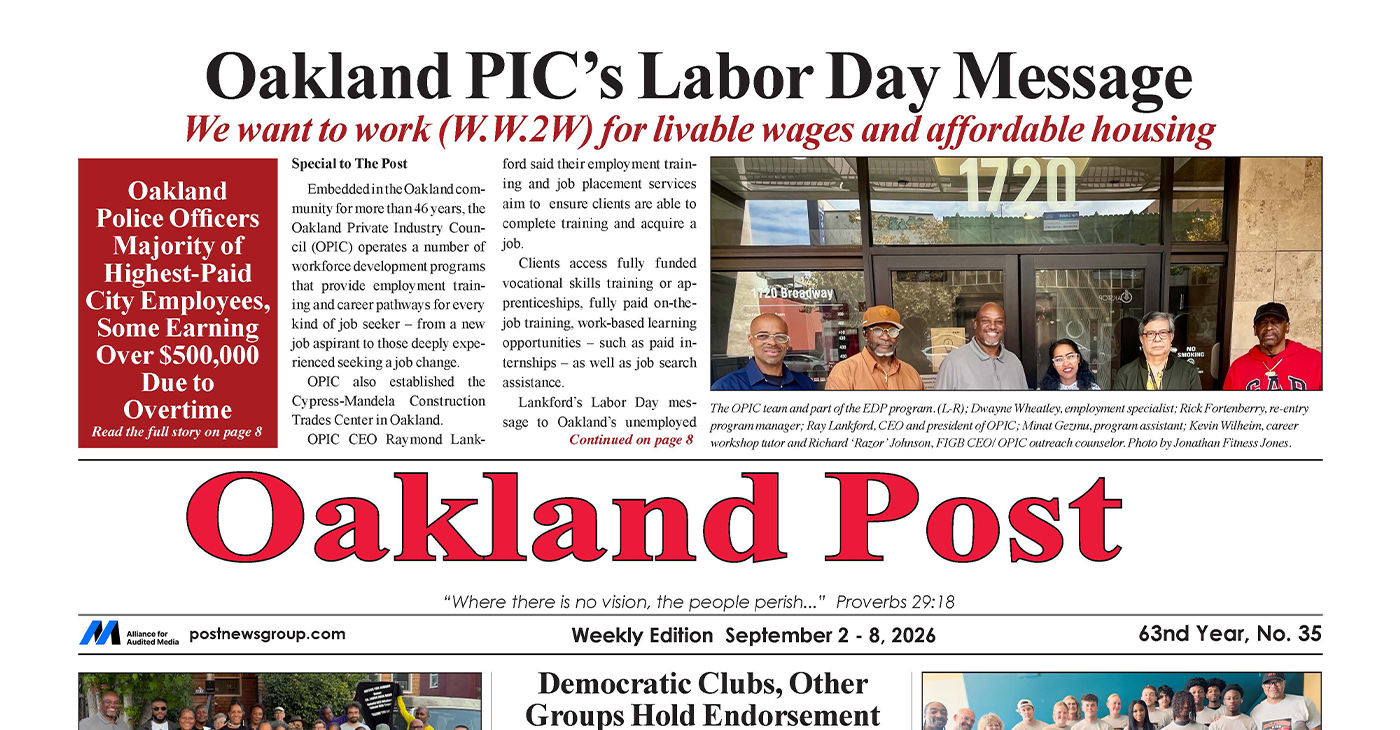
To enlarge your view of this issue, use the slider, magnifying glass icon or full page icon in the lower right corner of the browser window.



Doulas Are Helping Black California Moms Navigate Pregnancy–Even as High Mortality Rates Persist

Newsom Signs Addictive Social Media Law to Protect Kids

On Your November Ballot: Prop 38 Would Allocate $8.4 Billion to Immunology and Immunotherapy Funding

Ask California: Golden State Releases New AI Chatbot

Asm. Isaac Bryan’s Bill Banning California Police From ICE Side Jobs Reaches Newsom’s Desk

Assemblymember LaShae Sharp-Collins’s Bill Would Pause Law Enforcement’s Use of Shock Gloves Pending Study

BOOK REVIEW: ‘Laws of Solomon’ Reveals Tender Heart of Former Child Soldier

OPINION: The New American Fear – From 9-11 to AI

Passing for White, Fighting for Black America: The Courage of Walter White

Oakland People’s Arms Embargo Coalition Demands End to Military Shipments Thru Oakland

Barbara Lee Mourns Gloria Steinem, Remembers a Friendship Rooted in Equality

Event Preview: ‘Fashion v. Fascism’ – A Runway Revolution Is Coming to the Bay Area

Two Looming Threats Every Alameda County Elder Should Know About

Oakland Mayor Reads to Children at Bookout Block Party at Marcus Books Store

Tradition Comes to the Streets in 11th Annual Black-Eyed Pea Festival at the Freedom Farmers Market

Less Affluent School Districts, Including Sacramento City, Face Threat of State Takeover

ESSAY: California Can Close Its Colorectal Cancer Gap

California Hispanic Chambers of Commerce Unveils: ‘Powering the Future’ Theme for 47th Annual Statewide Convention

Four Candidates, Including Incumbent Barbara Lee, Qualify for Oakland Mayor’s Race

Oakland Post: Week of August 12 – 18, 2026

From Blueprint to Breakthrough: Tackling Affordable Housing in Oakland

Oakland Observes Black August with Block Parties, Film Showings, Workshops

COMMENTARY: Why Local School Tax Measure G1 Will Not Be on the November Ballot

Standoff for Justice: Our Homes Are Worth Fighting For

Returning to Its Roots, the Oakland Black-Eyed Pea Festival Partners with the Freedom Farmers Market Sept. 12

NPRC Scores First Advocacy Victory: David Shaw Finally Gets His Wish to ‘Go Home’

Oakland Post: Week of August 26 – September 1, 2026

Frontier Airlines’ Return to Oakland Airport Brings Flights, Jobs and Opportunity

Gubernatorial Candidate Steve Hilton Blasts California New Tire Rules; Newsom Hits Back

Chef Sharon Lee Blends Culinary Excellence, Education and Empowerment

The Conversation With Al McFarlane 6/23/26

Media Monday 6/22/26

LIVE! ASK ALMA! — TUES. 6.23.26 7PM EST

Car Buying Secrets: 4 Hidden Checks Before You Sign!

Is This 550 HP Charger Worth YOUR Money? AutoNetwork Review

Celebrating Juneteenth – Frederick Douglass on education and resistance

LIVE! — ASK ALMA! — TUES. 6.19.26 7PM EST

Hyundai Ioniq 5 Parking, Safety, and 360 View #shorts

2025 Ioniq 5 New Wiper & Powerful Performance! #shorts

Electric SUV Range: Is 259 Miles Enough? #shorts

EV Charging: How Fast Can You Charge an Electric Vehicle? #shorts

Biometric Cooling… Messaging Seats…Come on! 2025 Infiniti QX80 Autograph 4WD

Charged Up: Witness the Magic of a Fully Electric Car! #shorts

Range Rover Sport PHEV Included…: See What’s Inside This Luxury SUV! #shorts

Invisible Hood View: Perfect Parking with X-Ray Vision! #shorts
-
 Commentary4 weeks ago
Standoff for Justice: Our Homes Are Worth Fighting For
-
 Activism4 weeks ago
Oakland Post: Week of August 26 – September 1, 2026
-
 Business4 weeks ago
Frontier Airlines’ Return to Oakland Airport Brings Flights, Jobs and Opportunity
-
 Business4 weeks ago
Gubernatorial Candidate Steve Hilton Blasts California New Tire Rules; Newsom Hits Back
-
 Business4 weeks ago
Chef Sharon Lee Blends Culinary Excellence, Education and Empowerment
-

 Education4 weeks ago
Gov. Newsom’s Latest Appointees Include Sacramento Advocate for Formerly Incarcerated Students; State’s New Tech Chief
-

 Community4 weeks ago
Big City Mayors Ask for “Yes” Vote on Housing Bond Measure; Conservatives Say “No”
-

 Business4 weeks ago
Oakland Coliseum Project Opens Door for Small Businesses to Build Bigger
