
Bay Area
Alameda County DA’s Office Offers Help to Human Trafficking Victims with New Billboards at Oakland International Airport
The Alameda County D.A.’s office reports that the county is identified as the third-largest trafficking hub in the country with 4,700 youth victims of sex trafficking. Sixty-one percent (61%) are African American, followed by 15% Latinx, 12% Caucasian, and 12% from other ethnicities.

By Magaly Muñoz
Post Staff
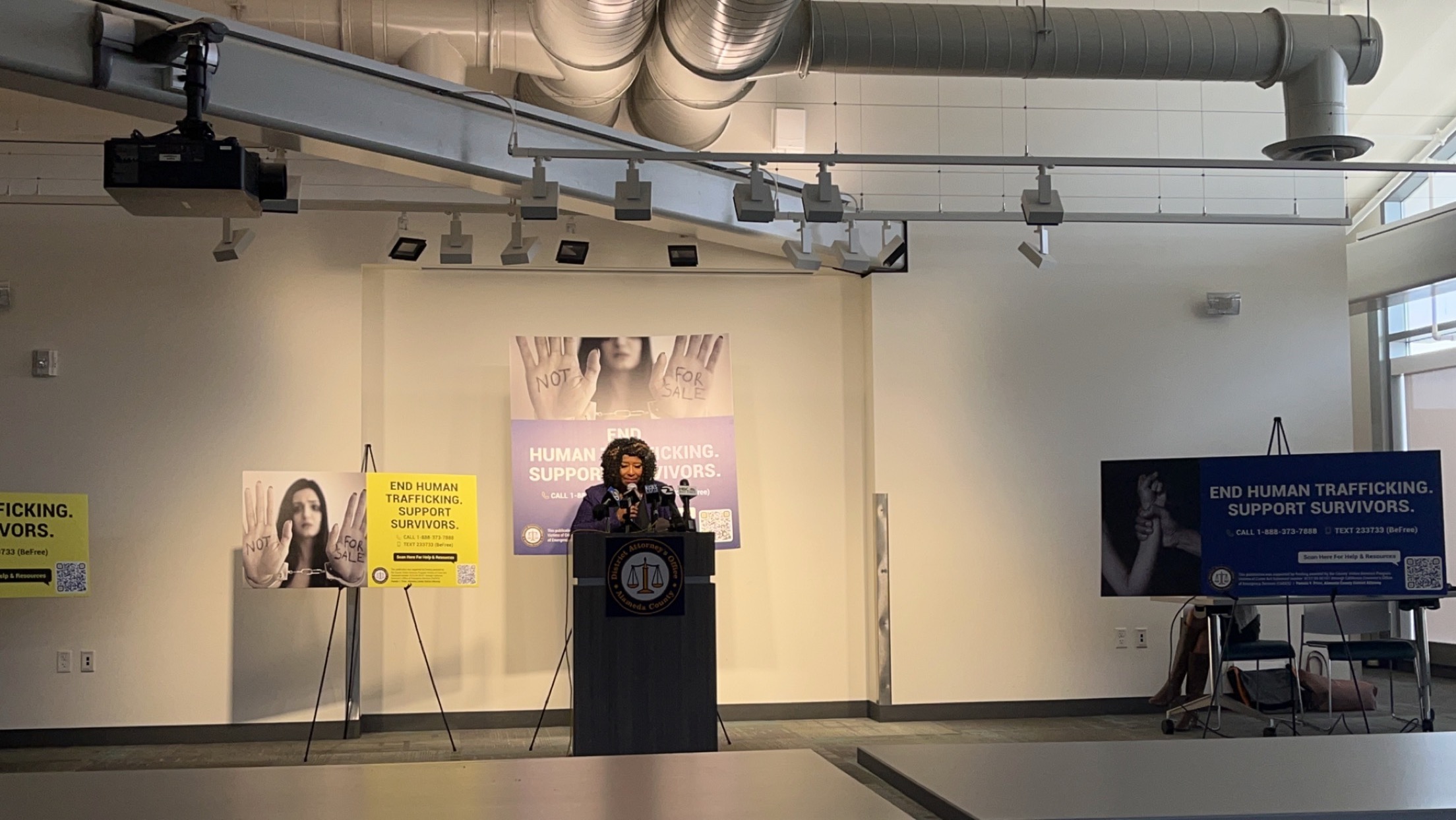
During a Tuesday press conference held at the Oakland International Airport, Alameda County District Attorney Pamela Price unveiled six new billboards that are part of an initiative to fight human trafficking in the Bay Area.
The billboards, funded by a grant from Gov. Gavin Newsom’s office, will be strategically placed around the airport. They will display QR codes and phone numbers, providing access to helplines and resources for victims and survivors. The information on these billboards will be available in three languages.
“As the home of the Oakland International Airport, we need to have a presence. We need to let people know as they travel through our borders that there are people who are being enslaved, who are being traded for sex and labor, and that that is an unacceptable situation,” Price said.
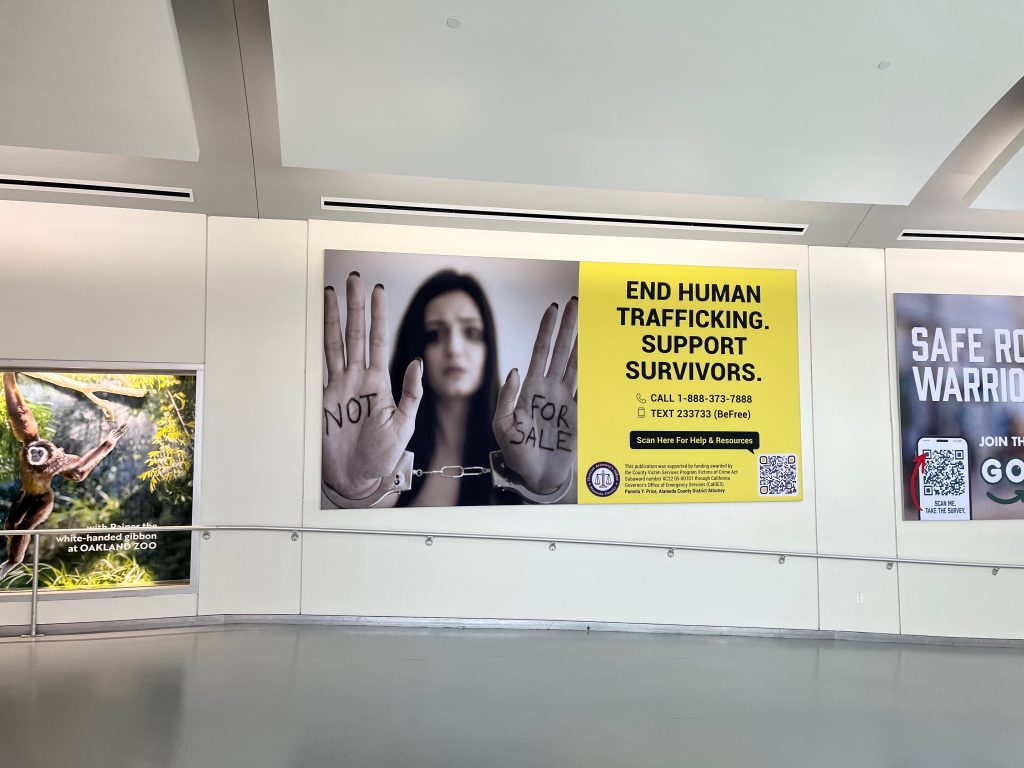
A billboard hung along a wall that can be easily seen by trafficking victims at Oakland International Airport. Photo by Magaly Muñoz.
The Alameda County D.A.’s office reports that the county is identified as the third-largest trafficking hub in the country with 4,700 youth victims of sex trafficking. Sixty-one percent (61%) are African American, followed by 15% Latinx, 12% Caucasian, and 12% from other ethnicities.
When asked why the county is one of the largest hubs, Price said, “because we’re not doing enough.” She added that Alameda County is in the epicenter of most of the nine Bay Area counties and is home to the airport, making it easier for the transportation of victims.
“It [human trafficking] is a billion-dollar industry, and our efforts have to step up to that,” Price said.
California is recognized as one of the major hotspots of human trafficking in the U.S., according to data from the Human Trafficking Hotline.
In 2018, 1,656 cases of human trafficking were reported in California. Of those cases, 1,226 were sex-trafficking cases, 151 were labor-trafficking cases, 110 involved both labor and sex trafficking, and in 169 cases the type of trafficking was not specified.
In September, Gov. Newsom signed Senate Bill (SB) 14, a law that classifies the trafficking of a minor for commercial sex acts as a serious felony, which is also considered under the state’s “Three Strikes” law. The bill, authored by Sen. Shannon Grove (R-Bakersfield), imposes harsher penalties and sentencing enhancements for individuals convicted of the crime.
“Human trafficking is a sick crime. With this new law, California is going further to protect kids,” Newsom said in a press release. “I’m grateful for the leadership of Senator Grove, Speaker Rivas, and Pro Tem Atkins in spearheading this bipartisan effort to make our communities and children safer.”
Price said her office “most definitely” is looking into serious prison sentences for those arrested and convicted of exploiting women and children in these crimes and will also look at crimes like domestic violence, the effects of which can lead to something like human trafficking.
Nikki Fortunato Bas, Oakland City Council president and District 2 councilmember, also addressed the press conference. She stated that her office has been working with community-based organizations to help provide victims of these crimes with resources and support.
“Trafficking of people for their labor has gone on for generations — from slavery to workers in our fields and garment factories to sexual exploitation, and we need to call it what it is: Human exploitation,” Bas said.
Bas stated that she’s been working with the Oakland Department of Transportation (OakDOT) on environmental improvements in the city. These improvements include better street lighting, speed bumps, and traffic diverters to inhibit sex trade in residential areas.
Bas also announced that Oakland Mayor Sheng Thao would launch an advisory council on human trafficking on Wednesday, Oct. 18, to act against this human rights issue.
“Addressing human tracking is important for Mayor Sheng Thao, and her administration is working with various stakeholders on this issue. We expect the City of Oakland to provide additional information on our plan of action in the coming weeks,” said Francis Zamora, chief of Communications for the mayor’s office.
Price explained that the purpose of the billboards, along with the efforts of her office and various community organizations, is to ensure victims are aware that they have the help they need when they’re ready to escape the life they’ve been forced into.
“‘What does a new life look like?’ That’s so important for us as a community. [We need to] begin to extend that vision of a new life to those who have lost hope and don’t know that there is a way out,” Price said.









Activism
Oakland Post: Week of September 30 – October 6, 2026
The printed Weekly Edition of the Oakland Post: Week of September 30 – October 6, 2026

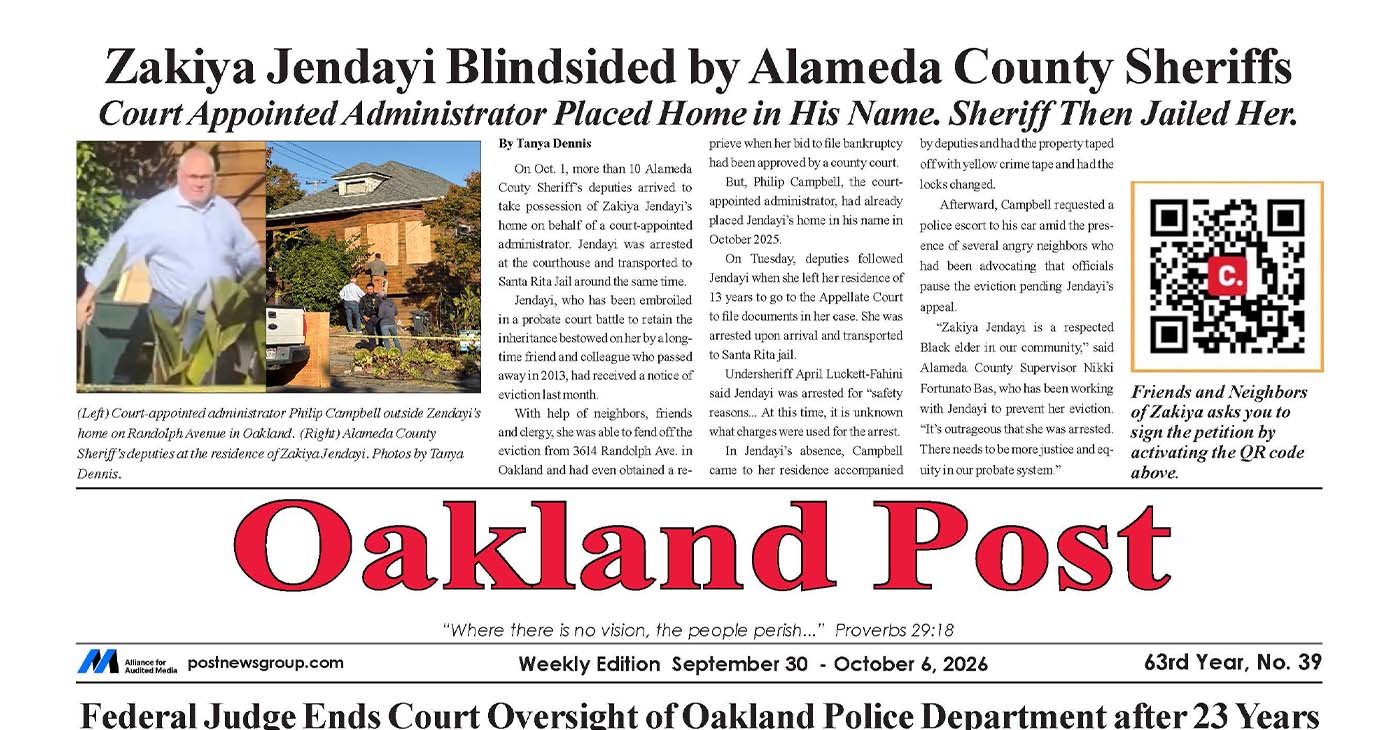
To enlarge your view of this issue, use the slider, magnifying glass icon or full page icon in the lower right corner of the browser window.

Activism
Oakland Post: Week of September 23 – 29, 2026
The printed Weekly Edition of the Oakland Post: Week of September 23 – 29, 2026
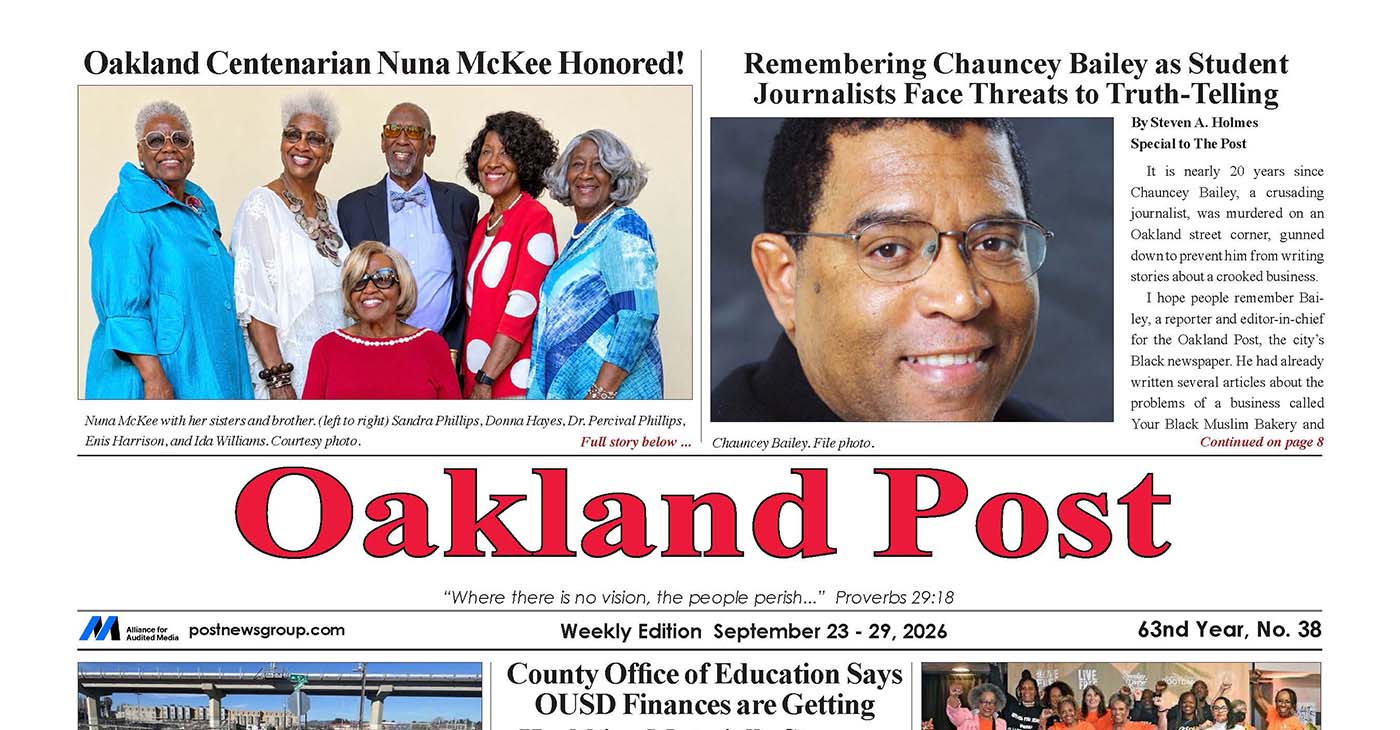
To enlarge your view of this issue, use the slider, magnifying glass icon or full page icon in the lower right corner of the browser window.

Activism
Oakland Post: Week of September 16 – 22, 2026
The printed Weekly Edition of the Oakland Post: Week of September 16 – 22, 2026
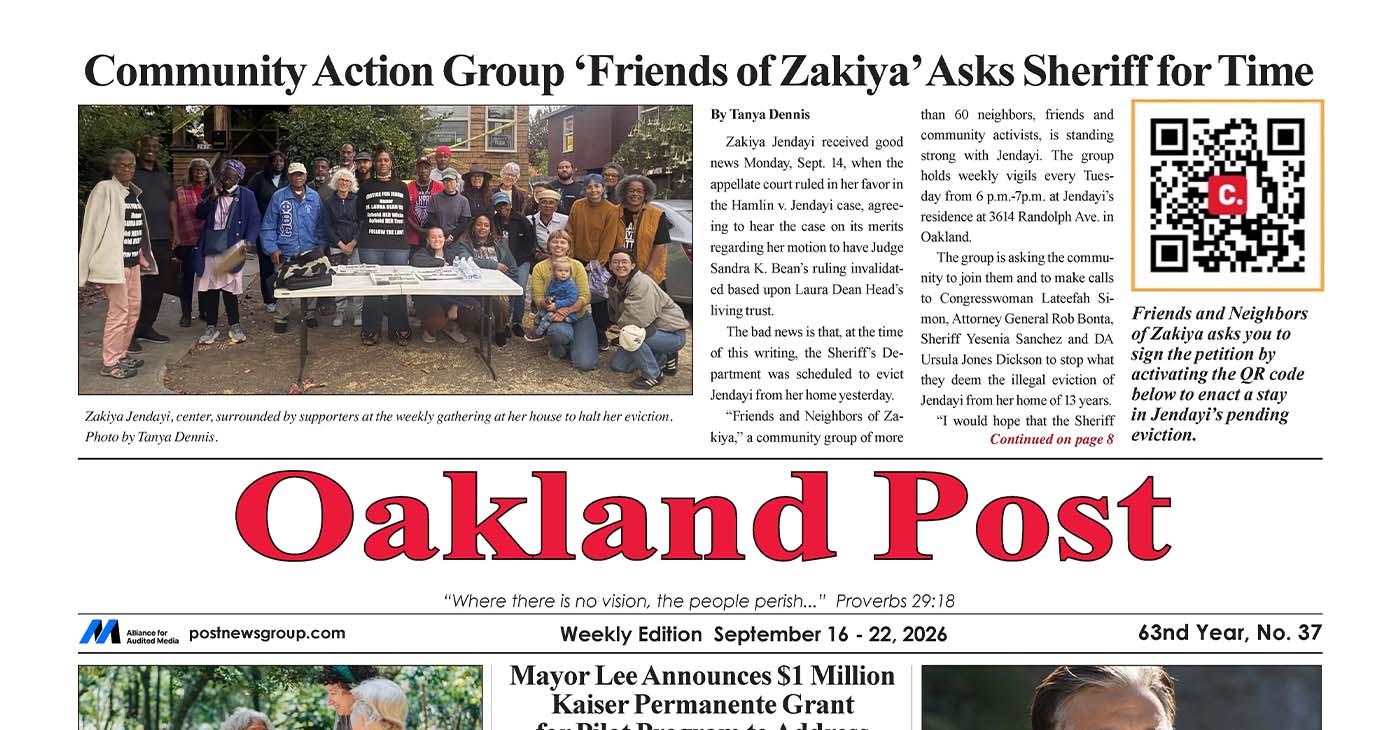
To enlarge your view of this issue, use the slider, magnifying glass icon or full page icon in the lower right corner of the browser window.


Listening as a Lifeline: A Doula’s Witness to Black Maternal Health

New Protections for Ticket Buyers: Gov. Newsom Signs Assemblymember Isaac Bryan’s Bill

‘We Don’t Talk Trash — We Pick Up Trash!’

Zakiya Jendayi Arrested, Locked Out of Home by Sheriff’s Deputies

Oakland Post: Week of September 30 – October 6, 2026

Asm. Corey Jackson Announces Launch of 24-Hour Childcare in His District

IN MEMORIAM: The Rev. Leon “Sonny” Clark, Longtime Orange County Pastor and Community Leader, Dies at 72

Poll: Becerra Widens His Lead Over Hilton; Californians Split on Wealth Tax

From Historic Memories to New Possibilities: Oakland Celebrates Coliseum 60

County Office of Education Says OUSD Finances Are Getting Healthier, Materially Stronger

LIVE FREE Sunday Dinner Brings Faith, Fellowship and Civic Conversation to Oakland

Remembering Chauncey Bailey as Student Journalists Face Threats to Truth-Telling

BLACspace Cooperative Invites Bay Area to Experience Oakland’s Black Cultural Ecosystem Through a BLAC Map Tour + Party

In Wake of Death on Doorstep, Williams Chapel Baptist Church Calls for Better Care, Funding for Unhoused

Oakland Centenarian Nuna McKee Honored!

Standoff for Justice: Our Homes Are Worth Fighting For

Oakland Post: Week of August 26 – September 1, 2026

Frontier Airlines’ Return to Oakland Airport Brings Flights, Jobs and Opportunity

Gubernatorial Candidate Steve Hilton Blasts California New Tire Rules; Newsom Hits Back

Chef Sharon Lee Blends Culinary Excellence, Education and Empowerment

Jackie Wright Champions Bay Area Stories, Filmmakers and Cultural Institutions

Big City Mayors Ask for “Yes” Vote on Housing Bond Measure; Conservatives Say “No”

Oakland Coliseum Project Opens Door for Small Businesses to Build Bigger

Gov. Newsom’s Latest Appointees Include Sacramento Advocate for Formerly Incarcerated Students; State’s New Tech Chief

Misnamed ‘Parent’ PAC Seeks to Influence Oakland School Board Elections

Longtime BWOPA Member Brendalyn Goodall Appointed to California Workforce Development Board

Gov. Newsom Signs Law Shielding Immigration Aid Workers From Doxing Threats

Secretary of State Shirley N. Weber Urges Californians to Vote Early as Voter ID Battle Intensifies

Oakland Post: Week of September 2 – 8, 2026

IN MEMORIAM: Dolly Parton Dead at 80 — How She Built a Legacy of Love and Earned Her Place in Black Culture

The Conversation With Al McFarlane 6/23/26

Media Monday 6/22/26

LIVE! ASK ALMA! — TUES. 6.23.26 7PM EST

Car Buying Secrets: 4 Hidden Checks Before You Sign!

Is This 550 HP Charger Worth YOUR Money? AutoNetwork Review

Celebrating Juneteenth – Frederick Douglass on education and resistance

LIVE! — ASK ALMA! — TUES. 6.19.26 7PM EST

Hyundai Ioniq 5 Parking, Safety, and 360 View #shorts

2025 Ioniq 5 New Wiper & Powerful Performance! #shorts

Electric SUV Range: Is 259 Miles Enough? #shorts

EV Charging: How Fast Can You Charge an Electric Vehicle? #shorts

Biometric Cooling… Messaging Seats…Come on! 2025 Infiniti QX80 Autograph 4WD

Charged Up: Witness the Magic of a Fully Electric Car! #shorts

Range Rover Sport PHEV Included…: See What’s Inside This Luxury SUV! #shorts

Invisible Hood View: Perfect Parking with X-Ray Vision! #shorts
-
 Community3 weeks ago
Misnamed ‘Parent’ PAC Seeks to Influence Oakland School Board Elections
-
 Activism4 weeks ago
Oakland Post: Week of September 2 – 8, 2026
-

 Community3 weeks ago
Richmond Tiny House Village Farm & Garden Set to Open Gates on Sept. 26
-

 Activism3 weeks ago
Oakland Post: Week of September 9 – 15, 2026
-

 Black History3 weeks ago
Latest Massacre in Haiti Reveals Cruelty U.S. Deportations
-

 Black History3 weeks ago
OPINION: Nolan Wells’ Death One of Several Signifying Racial Terror Lives on in U.S. South
-

 Community3 weeks ago
Democratic Clubs Interview Candidates for Oakland School Board
-

 Business2 weeks ago
Mayor Lee Announces $1 Million Kaiser Permanente Grant for Pilot Program to Address Homelessness, Clean Up Public Spaces throughout Oakland
