
Activism
After Two Decades, Oakland Unified Will Finally Regain Local Control
The decades of direct intervention by state officials, Alameda County education officials and a powerful, state-funded regulatory agency, the Fiscal Crisis Management and Assistance Team (FCMAT), will finally come to an end in July, according to the office of State Superintendent of Schools Tony Thurmond.


By Ken Epstein
After 20 years under state control, the Oakland Unified School District (OUSD) will regain local authority over its budget and day-to-day decision-making, emerging from an era of austerity when the district was forced by state-appointed overseers to close more than 40 mostly flatland schools, eliminate educational programs, and cut millions of dollars in services for students and classrooms.
After making its final payment on a $100 million state loan at the end of June, the district in July will again be under the authority of the local school board, like other districts statewide.
The decades of direct intervention by state officials, Alameda County education officials and a powerful, state-funded regulatory agency, the Fiscal Crisis Management and Assistance Team (FCMAT), will finally come to an end in July, according to the office of State Superintendent of Schools Tony Thurmond.
The official narrative of the state takeover is a simple one: the district overspent its budget, and the state altruistically stepped in to rescue it.
But the truth behind the takeover is far different. It’s a story of raw power, greed, and racism.
When the state declared the district insolvent in 2003, OUSD had a $39 million deficit, and funds in a reserve account sufficient to loan itself funds to cover the deficit, a practice that was common in other districts. However, the state would not allow Oakland to use its own money to cover the shortfall.
The state stepped in, fired Supt. Dennis Chaconas, eliminated the authority of the Board of Education, forced the district to take a $100 million loan that it neither needed nor requested, and appointed a receiver, Randolph Ward, who reported to the state schools’ superintendent, making all the decisions related to the operation of OUSD, including how to spend the $100 million loan.
Not only did the district have to repay the loan, it had to pay the salaries of the various overseers it was required to hire.
Involved in the drive to take control of the district and sell school properties was Oakland’s then powerful State Senator Don Perata, who had been pushing for several years to take control of the district, unsuccessfully attempting to sell the district’s Second Avenue headquarters to real estate developers.
Other local business and political leaders, including State Supt. of Schools Bill Honig, were determined to eliminate the power of the Black majority school board, which was seen as an impediment to the agenda for business as usual.
Among recent interventions by Oakland’s outside overseers was in 2021, when the district, with broad community support, was about to adopt a resolution for “Reparations for Black Students.” The outside trustee spoke at a school board meeting to block the passage of the measure until the board removed wording that would have protected predominantly Black schools from being closed.
In 2024, during district negotiations with administrators, the trustee did not allow the board to approve more money unless it agreed to guidelines to close and merge schools.
In a letter to the district, Alameda County Superintendent of Schools Alysse Castro agreed that the district has done what is necessary to regain local control but that challenges remain.
“These improvements co-exist with ongoing concerns that OUSD must still confront its structural deficit and address the long-standing overinvestment in small schools,” she wrote.
“However, these are challenges of local policy and the domain of a locally elected board of education, not of mismanagement or financial misconduct,” Castro wrote.
“Continuing to require a trustee to backstop them risks continued delay in local ownership and accountability and reinforces a counterproductive narrative that feeds resistance and undermines the board’s willingness to engage their community in making necessary tradeoffs.”
Going forward, the district still faces financial difficulties. According to reports, the board must make $73 million in cuts to the 2025-2026 budget and an additional $17 million from the 2026-2027 budget.











Activism
Oakland Post: Week of March 11 -17, 2026
The printed Weekly Edition of the Oakland Post: Week of March 11 – 17, 2026

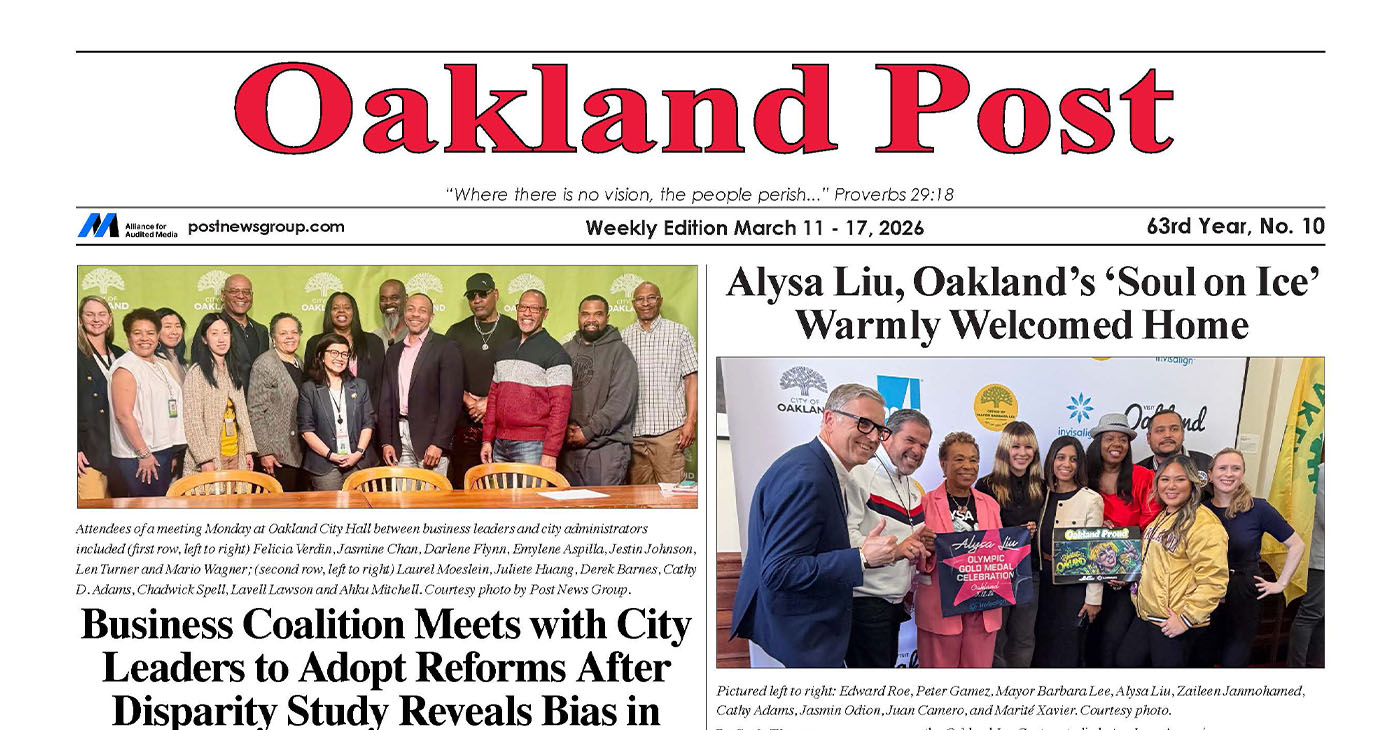
To enlarge your view of this issue, use the slider, magnifying glass icon or full page icon in the lower right corner of the browser window.

Activism
Oakland Post: Week of March 4 – 10, 2026
The printed Weekly Edition of the Oakland Post: Week of March 4 – 10, 2026

To enlarge your view of this issue, use the slider, magnifying glass icon or full page icon in the lower right corner of the browser window.
Activism
Oakland Post: Week of February 25 – March 3, 2026
The printed Weekly Edition of the Oakland Post: Week of – February 25 – March 3, 2026

To enlarge your view of this issue, use the slider, magnifying glass icon or full page icon in the lower right corner of the browser window.

WORK FROM HOME
Home-based business with potential monthly income of $10K+ per month. A proven training system and website provided to maximize business effectiveness. Perfect job to earn side and primary income. Contact Lynne for more details: Lynne4npusa@gmail.com 800-334-0540


Financial Wellness and Mental Health: Managing Money Stress in College

Oakland Post: Week of March 11 -17, 2026

Women & Wealth: Tips for Navigating Your Lifelong Financial Journey

COMMENTARY: Women of Color Shape Our Past and Future

Woman’s Search for Family’s Roots Leads to Ancestor John T. Ward – A Successful Entrepreneur and Conductor on the Underground Railroad

Advocates Raise Alarm Over ICE Operation, MOU and Detention Risks in Baltimore County

Pete Buttigieg to Join Mayor Randall Woodfin for Community Town Hall in Birmingham

WATCH: Week One – NNPA’s “Leadership Matters” Video Series

Oakland Post: Week of March 4 – 10, 2026

OP-ED: NNPA Launches 2026 “Leadership Matters” Video Series

PRESS ROOM: PMG and Cranbrook Horizons-Upward Bound Launch Journey Fellowship Cohort 2

Los Angeles Summit Brings Together Leaders to Tackle Poverty and Affordability

Civil Rights TV Launches 24/7 Network Focused on Black History, Education and Equity

REVIEW: The Ultimate Hot Girl Summer Getaway: Sunseeker Resort Florida

COMMENTARY: How You Stop a Prescription Medicine is as Important as How You Start

Book Review: Books on Black History and Black Life for Kids

Community Celebrates Turner Group Construction Company as Collins Drive Becomes Turner Group Drive

Discrimination in City Contracts

California Launches Study on Mileage Tax to Potentially Replace Gas Tax as Republicans Push Back

COMMENTARY: The Biases We Don’t See — Preventing AI-Driven Inequality in Health Care

Black History Events in the East Bay

Post Newspaper Invites NNPA to Join Nationwide Probate Reform Initiative

Art of the African Diaspora Celebrates Legacy and Community at Richmond Art Center

New Bill, the RIDER Safety Act, Would Support Transit Ambassadors and Safety on Public Transit

COMMENTARY: The National Protest Must Be Accompanied with Our Votes

Oakland Post: Week of February 4 – 10, 2026

Oakland Post: Week of February 11 – 17, 2026

Dorothy Lee Bolden: Uniting Domestic Workers

After Don Lemon’s Arrest, Black Officials Raise Concerns About Independent Black Media

Reflecting on Black History Milestones in Birmingham AL

Hyundai Ioniq 5 Parking, Safety, and 360 View #shorts

2025 Ioniq 5 New Wiper & Powerful Performance! #shorts

Electric SUV Range: Is 259 Miles Enough? #shorts

EV Charging: How Fast Can You Charge an Electric Vehicle? #shorts

Biometric Cooling… Messaging Seats…Come on! 2025 Infiniti QX80 Autograph 4WD

Charged Up: Witness the Magic of a Fully Electric Car! #shorts

Range Rover Sport PHEV Included…: See What’s Inside This Luxury SUV! #shorts

Invisible Hood View: Perfect Parking with X-Ray Vision! #shorts

AI Is Reshaping Black Healthcare: Promise, Peril, and the Push for Improved Results in California

ESSAY: Technology and Medicine, a Primary Care Point of View

Sanctuary Cities

The RESISTANCE – FREEDOM NOW

STATE OF THE PEOPLE: Freddie

ECONOMIC BOYCOTT DAY!!!!!

I told You So

-
 #NNPA BlackPress3 weeks ago
Reflecting on Black History Milestones in Birmingham AL
-
 #NNPA BlackPress3 weeks ago
PRESS ROOM: NBA Hall of Fame Nominee Terry Cummings Joins 100 Black Men of DeKalb County to Launch Victory & Values Initiative
-

 #NNPA BlackPress4 weeks ago
U.S. manufacturing rebounds – how foundry services are adapting to rising demand
-

 #NNPA BlackPress4 weeks ago
OP-ED: One Hundred Years of Black Workers Telling the Truth
-

 Activism3 weeks ago
Oakland Post: Week of February 25 – March 3, 2026
-

 #NNPA BlackPress4 weeks ago
Advancements in solar technology that are changing the way we power the world
-

 #NNPA BlackPress3 weeks ago
Trump’s MAGA Allies are Creating Executive Order Plan to Steal the 2026 Midterms
-

 #NNPA BlackPress4 weeks ago
PRESS ROOM: Civil Rights TV Launches in Selma as the World’s First 24/7 Civil Rights Television Network
