
#NNPA BlackPress
COMMENTARY: Women of Color Shape Our Past and Future
MINNESOTA SPOKESMAN RECORDER — Every March, Women’s History Month invites us to pause and honor the women whose courage, intellect, and leadership have shaped our world. This year, that invitation feels especially urgent. We are living in a time when history is being rewritten, when DEI is being recast as a threat, and when the stories we choose to uplift matter more than ever. The stories of women of color must be centered, celebrated, and carried forward with intention.


Women of Color Leadership Shapes the Legacy of Women’s History Month
By Dr. Sharon M. Holder | Minnesota Spokesman Recorder
Women’s History Month offers an opportunity to recognize the enduring impact of women of color leadership across history and in the present day. From Harriet Tubman and Shirley Chisholm to today’s leaders in science, politics and culture, women of color continue to shape movements, institutions and communities through courage, collaboration and vision.
Every March, Women’s History Month invites us to pause and honor the women whose courage, intellect, and leadership have shaped our world. This year, that invitation feels especially urgent. We are living in a time when history is being rewritten, when DEI is being recast as a threat, and when the stories we choose to uplift matter more than ever. The stories of women of color must be centered, celebrated, and carried forward with intention.
For centuries, women of color have been architects of progress, even when history tried to confine them to the margins. They have led movements, built institutions, transformed culture, and expanded the boundaries of justice, leadership, and community. Their contributions are not postscripts; they are landmarks. Yet too often, their brilliance has been acknowledged only in hindsight. Women’s History Month offers a chance to correct that imbalance, not only by remembering the past, but by recognizing their leadership unfolding before us.

This legacy lives in Harriet Tubman, whose courage and strategic brilliance transformed the Underground Railroad into one of the boldest freedom operations in American history. In Barbara Jordan, whose moral clarity reshaped the nation’s understanding of justice and constitutional responsibility. In Madam C. J. Walker, expanding both the beauty industry and the economic horizons of Black women. It dances in Josephine Baker, who challenged racism and resisted fascism. In Ida B. Wells and Dolores Huerta, who wielded truth and determination in pursuit of justice. In Chien-Shiung Wu, whose experiments altered science, and Shirley Chisholm, whose political courage expanded the very definition of leadership. These women did more than break barriers; they built new worlds.
A powerful throughline in the leadership of women of color is how they lead: collaboratively, creatively, relationally, and with deep responsibility to community. Their leadership is grounded not in hierarchy but in connection, in the belief that progress is something we build together.
We see this in Kamala Harris, whose presence expands the boundaries of possibility; in Ketanji Brown Jackson; in Oprah Winfrey; and in Toni Morrison, who insisted that the interior lives of Black women are essential to the human story. It resonates in Simone Biles and Serena Williams, redefining strength through excellence and self-belief.
Today, women of color continue to drive breakthroughs in medicine, technology, the arts, politics, and environmental justice. Their leadership appears not only in boardrooms or public office, but in mentorship, advocacy, and the daily navigation of systems never designed for them. The spirit shines in Mae Jemison and Ellen Ochoa; in Michelle Obama; and in the brilliance of Katherine Johnson, Dorothy Vaughan, Mary Jackson, and Christine Darden, whose work helped launch a nation into space.
Celebration is important, but it is not enough. Honoring women of color requires intentional action rooted in equity. It means creating environments where their voices are valued, challenging the biases that shape who is recognized, and ensuring progress is shared.
As we celebrate Women’s History Month, let us honor women of color not as symbols, but as leaders whose work continues to guide us. When we uplift women of color, we honor history and shape the future.
Dr. Sharon M. Holder lives in South Carolina. She holds a PhD/MPhil in Gerontology from the Center for Research on Aging at the University of Southampton, UK; a Master of Science in Gerontology from the Institute of Gerontology at King’s College London, UK; and a Master of Social Work from the Graduate College of Social Work at the University of Houston, Texas.
Dr. Holder discovered her love of poetry at the University of Houston–Downtown, where she published in The Bayou Review and the Anthology of Poetry. Today, she writes poetry as a practice of gratitude alongside her academic research.













#NNPA BlackPress
Youth-Led Black August Event Brings Past to Present at East Oakland Boxing Association
The mission of Youth Alive! Is to “break the cycle of violence, heal trauma, and uplift a thriving community of leaders, to save lives in Oakland and beyond” by serving “as mentors, youth leaders, counselors, case managers, intervention specialists and violence interrupters,” working “to help violently wounded people heal themselves and their community.”
The post The mission of Youth Alive! Is to “break the cycle of violence, heal trauma, and uplift a thriving community of leaders, to save lives in Oakland and beyond” by serving “as mentors, youth leaders, counselors, case managers, intervention specialists and violence interrupters,” working “to help violently wounded people heal themselves and their community.” appeared first on BlackPressUSA.

Youth-Led Black August Event Brings Past to Present at East Oakland Boxing Association
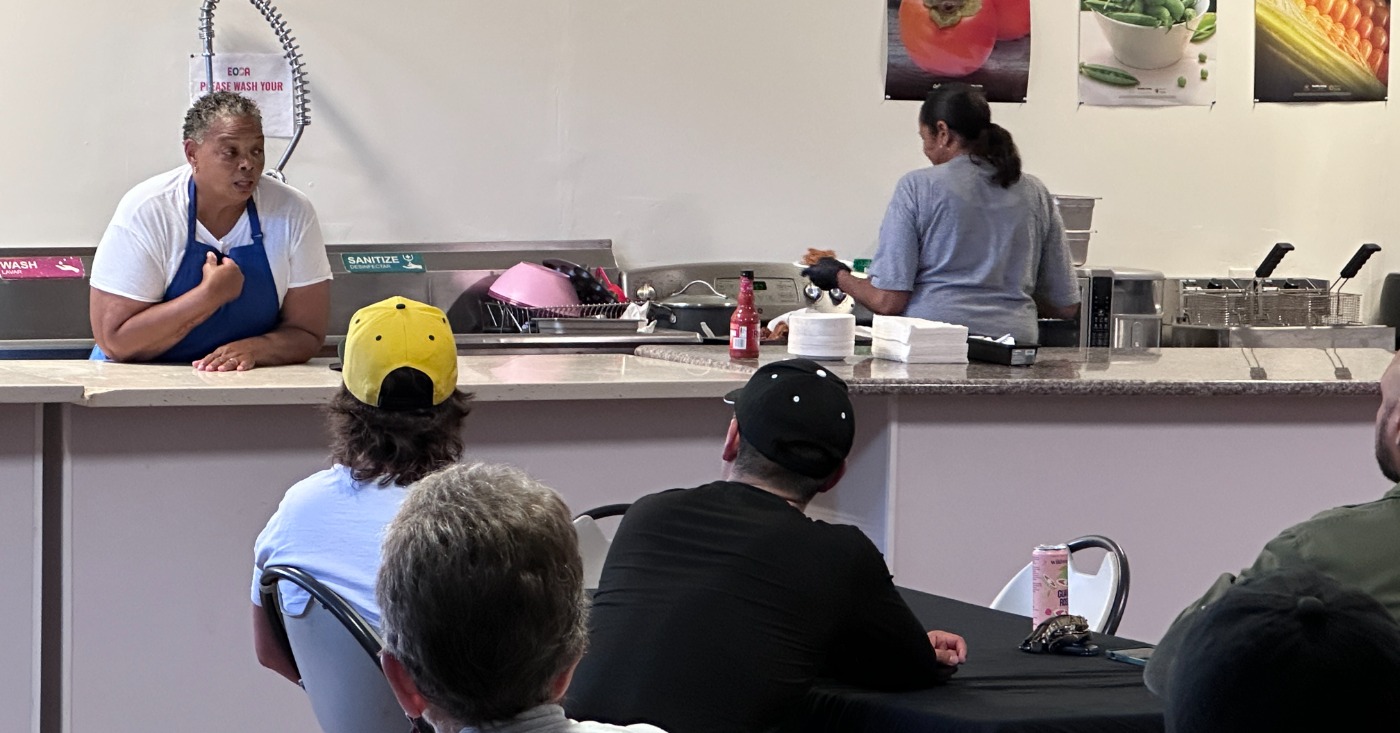
The East Oakland Boxing Association (EOBA) and Youth Alive! came together on Aug. 21 to share with their community all that Black August means to them.
Held on EOBA’s patio at 816 98th Ave. in Deep East Oakland, the two organizations hosted their second annual Black August Experience, featuring a food tasting, financial literacy and mindfulness workshops, and voter registration with the League of Women Voters Oakland (LWV).
Black August is known as a time to uphold the legacy of prisoners who protested their conditions by fasting, fighting, and educating themselves on the economic and political circumstances that contributed to their incarceration.
According to its website, “EOBA is a multi-service youth and community development hub that goes far beyond the ring. While rooted in the discipline of boxing, for nearly 40 years EOBA has also integrated robust programs in workforce development, food justice, afterschool enrichment, financial literacy, mentorship, and wellness.”.

The mission of Youth Alive! Is to “break the cycle of violence, heal trauma, and uplift a thriving community of leaders, to save lives in Oakland and beyond” by serving “as mentors, youth leaders, counselors, case managers, intervention specialists and violence interrupters,” working “to help violently wounded people heal themselves and their community.”
Through Coro California, another leadership organization serving young people across the state for 80 years, they gained a broader understanding of Black August.
EOBA Executive Director Dawna Williams spoke about how much she learned about Black August from the youth who created it. “I let them educate me,” she said. Instead of talking about prison reform and mass incarceration, Williams and youth interns found that Black August meant so much more. “We would have done a disservice if we had just focused on who the people were and what their situation was…We tried to take their message from back in the day and make it relevant to the young people today. What do they need to know?”
Youth interns created and placed posters around the patio to help participants understand how traditional Black foodways, civic engagement, financial literacy, and the power of education are relevant to Black resistance today.
An EOBA member described Black August with Youth ALIVE! as “a whole vibe. “This year we added the Fun Zone for the kids, because you really cannot go wrong with a Fun Zone. I also loved seeing everyone chillin’ in the outdoor lounge, catching some Vitamin D and just enjoying a Friday evening together.”
The food tasting, a popular event from last year, featured traditional Black foods such as black-eyed peas, johnny cakes, and fried chicken. Led by Williams, the tasting included a talk about how these traditional foods were made and why they are forms of Black resilience.
The “‘Plate of History’ was a favorite of the online writers. “Fun, educational, and did I mention delicious? Our Taste of History cook, Angela Southall, served up some good eats while connecting food to history and culture.”
The writer also commended the “League of Women Voters Oakland for their civic leadership and for getting our young people informed, ready, and registered to vote.”
Overall, it was a “good Friday event in East Oakland,” the writer said.
Upcoming Black August events: Building Opportunities for Self-Sufficiency (BOSS), will host “Black August: The Arc of Liberation” at Oakland City Hall on Sat. Aug. 29, from 11 a.m. to 3 p.m.
The websites for East Oakland Boxing Association, Youth Alive! and CORO are sources for this report.
Jana Lang is an Oakland resident, teacher, gardener and poet participating in the Propel News Initiative.
The post The mission of Youth Alive! Is to “break the cycle of violence, heal trauma, and uplift a thriving community of leaders, to save lives in Oakland and beyond” by serving “as mentors, youth leaders, counselors, case managers, intervention specialists and violence interrupters,” working “to help violently wounded people heal themselves and their community.” appeared first on BlackPressUSA.

#NNPA BlackPress
EV Home Charging Warning: What Dealerships Won’t Tell You! #shorts
Is your home EV charging setup ready? Dealerships may not warn you about critical outlet and circuit needs. Find out before you plug in!
The post EV Home Charging Warning: What Dealerships Won’t Tell You! #shorts appeared first on BlackPressUSA.

Dealerships won’t tell you: charging this big battery at home isn’t always simple. Verify your outlet capacity, circuit, and setup before assuming level one or basic outdoor outlets will suffice.
 Watch the full video: https://youtu.be/A9Cd2SspoaQ
#AutoNetwork
The post EV Home Charging Warning: What Dealerships Won’t Tell You! #shorts appeared first on BlackPressUSA.
#NNPA BlackPress
Car Buying Secrets: Dealership Traps & How to Avoid Them #shorts
Don’t get tricked at the dealership! Learn essential car buying secrets to secure the best deal and avoid hidden traps.
The post Car Buying Secrets: Dealership Traps & How to Avoid Them #shorts appeared first on BlackPressUSA.

Before stepping into a dealership, secure bank pre-approval for your financing rate. Then, get the out-the-door price in writing. Never discuss monthly payments until that number is fixed. Test road noise and rear visibility yourself. Decline add-ons with a simple ‘Not today’. Check backseat space with your tallest household member.
Watch the full video: https://youtu.be/maAOBjO1puY
#AutoNetwork
The post Car Buying Secrets: Dealership Traps & How to Avoid Them #shorts appeared first on BlackPressUSA.


Prostate Cancer is Twice as Likely to Kill Black Men. Talking to Your Doctor Could Help Save Your Life

Oakland Post: Week of September 2 – 8, 2026

Longtime BWOPA Member Brendalyn Goodall Appointed to California Workforce Development Board

Jackie Wright Champions Bay Area Stories, Filmmakers and Cultural Institutions

Chef Sharon Lee Blends Culinary Excellence, Education and Empowerment

‘Passing a Law Isn’t The Finish Line’: California Assembly Evaluates Implementation, Results

OPINION: Angie Nixon Will Turn You Into a Democratic Socialist If Donald Trump Hasn’t Already

Gov. Newsom Signs Law Shielding Immigration Aid Workers From Doxing Threats

BOOK REVIEW: Every Inch of a Lady

Big City Mayors Ask for “Yes” Vote on Housing Bond Measure; Conservatives Say “No”

Madeline M. Turner: The Inventor Who Made Juicing Easier

Gubernatorial Candidate Steve Hilton Blasts California New Tire Rules; Newsom Hits Back

Frontier Airlines’ Return to Oakland Airport Brings Flights, Jobs and Opportunity

Secretary of State Shirley N. Weber Urges Californians to Vote Early as Voter ID Battle Intensifies

Gov. Newsom’s Latest Appointees Include Sacramento Advocate for Formerly Incarcerated Students; State’s New Tech Chief

Department of Homeland Security Demands California Secretary of State Shirley N. Weber Scrub Voter Rolls

New Judge Could Decide if Karmelo Anthony Gets a New Trial

“The Power to See Threats Sooner”: Gov. Newsom, Safety Officials Showcase California’s Investments in Hi-Tech Wildfire Prevention

Alpha Kappa Alpha Sorority, Inc. Celebrates New North Atlantic Regional Director

California Sen. Padilla Joins Colleagues to Introduce Bill Imposing Term Limits on Supreme Court Justices

Less Affluent School Districts, Including Sacramento City, Face Threat of State Takeover

Car Wash Workers Cope with Lingering Impacts of ICE Raids

COMMENTARY: You Are Already Paying for the AI Boom

California Bill Would Let Abuse Victims Use Trauma as Legal Defense for Violent Crime

Oakland Post: Week of July 29 – August 4, 2026

OP-ED: ‘The Trusted Messenger’ and the Black Vote

How Oakland’s Courtsmith is Scaling its Business and Local Impact

ESSAY: California Can Close Its Colorectal Cancer Gap

As Part of Your Back-to- School Checklist, Vaccinate

Oakland Post: Week of August 5 – 11, 2026

The Conversation With Al McFarlane 6/23/26

Media Monday 6/22/26

LIVE! ASK ALMA! — TUES. 6.23.26 7PM EST

Car Buying Secrets: 4 Hidden Checks Before You Sign!

Is This 550 HP Charger Worth YOUR Money? AutoNetwork Review

Celebrating Juneteenth – Frederick Douglass on education and resistance

LIVE! — ASK ALMA! — TUES. 6.19.26 7PM EST

Hyundai Ioniq 5 Parking, Safety, and 360 View #shorts

2025 Ioniq 5 New Wiper & Powerful Performance! #shorts

Electric SUV Range: Is 259 Miles Enough? #shorts

EV Charging: How Fast Can You Charge an Electric Vehicle? #shorts

Biometric Cooling… Messaging Seats…Come on! 2025 Infiniti QX80 Autograph 4WD

Charged Up: Witness the Magic of a Fully Electric Car! #shorts

Range Rover Sport PHEV Included…: See What’s Inside This Luxury SUV! #shorts

Invisible Hood View: Perfect Parking with X-Ray Vision! #shorts
-
 Community4 weeks ago
Less Affluent School Districts, Including Sacramento City, Face Threat of State Takeover
-
 Commentary4 weeks ago
ESSAY: California Can Close Its Colorectal Cancer Gap
-
 Business4 weeks ago
California Hispanic Chambers of Commerce Unveils: ‘Powering the Future’ Theme for 47th Annual Statewide Convention
-

 Community4 weeks ago
Four Candidates, Including Incumbent Barbara Lee, Qualify for Oakland Mayor’s Race
-

 Business4 weeks ago
From Blueprint to Breakthrough: Tackling Affordable Housing in Oakland
-
 Black History4 weeks ago
Oakland Observes Black August with Block Parties, Film Showings, Workshops
-
 Activism4 weeks ago
Oakland Post: Week of August 12 – 18, 2026
-

 Commentary4 weeks ago
COMMENTARY: Why Local School Tax Measure G1 Will Not Be on the November Ballot
