
Advice
COMMENTARY: If You Don’t Want Your ‘Black Card’ Revoked, Watch What You Bring to Holiday Dinners
From Thanksgiving to Christmas to New Year’s Day, whether it’s the dining room table or the bid whist (Spades? Uno, anyone?) table, your card may be in danger.


By Wanda Ravernell
Post Staff
From the fourth week of November to the first week in January, if you are of African descent, but particularly African American, certain violations of cultural etiquette will get your ‘Black card’ revoked.
From Thanksgiving to Christmas to New Year’s Day, whether it’s the dining room table or the bid whist (Spades? Uno, anyone?) table, your card may be in danger.
It could take until Super Bowl Sunday for reinstatement.
I don’t know much about the card table, but for years I was on probation by the ‘Aunties,’ the givers and takers of Black cards.
How I Got into Trouble
It was 1970-something and I was influenced by the health food movement that emerged from the hippie era. A vegetarian (which was then considered sacrilegious by most Black people I knew) prepared me a simple meal: grated cheese over steamed broccoli, lentils, and brown rice.
I introduced the broccoli dish at the Friday night supper with my aunt and grandfather. She pronounced the bright green broccoli undone, but she ate it. (I did not, of course, try brown rice on them.)
I knew that I would be allowed back in the kitchen when she attempted the dish, but the broccoli had been cooked to death. (Y’all remember when ALL vegetables, not just greens, were cooked to mush?)
My Black card, which had been revoked was then reattained because they ate what I prepared and imitated it.
Over the decades, various transgressions have become normalized. I remember when having a smoked turkey neck instead of a ham hock in collard greens was greeted with mumblings and murmurings at both the dining room and card tables. Then came vegan versions with just olive oil (What? No Crisco? No bacon, at least?) and garlic. And now my husband stir fries his collards in a wok.
But No Matter How Things Have Changed…
At holiday meals, there are assigned tasks. Uncle Jack chopped raw onions when needed. Uncle Buddy made the fruit salad for Easter. My mother brought the greens in winter, macaroni salad in summer. Aunt Deanie did the macaroni and cheese, and the great aunts, my deceased grandmother’s sisters, oversaw the preparation of the roast beef, turkey, and ham. My father, if he were present, did the carving.
These designations/assignments were binding agreements that could stand up in a court of law. Do not violate the law of assignments by bringing some other version of a tried-and-true dish, even if you call it a new ‘cheese and noodle item’ to ‘try out.’ The auntie lawgivers know what you are trying to do. It’s called a menu coup d’état, and they are not having it.
The time for experiments is in your own home: your spouse and kids are the Guinea pigs.
My mother’s variation of a classic that I detested from that Sunday to the present was adding crushed pineapple to mashed sweet potatoes. A relative stops by, tries it, and then it can be introduced as an add-on to the standard holiday menu.
My Aunt Vivian’s concoctions from Good Housekeeping or Ladies’ Home Journal magazine also made it to the Black people’s tables all over the country in the form of a green bean casserole.
What Not to Do and How Did It Cross Your Mind?
People are, of all things holy, preparing mac ‘n’ cheese with so much sugar it tastes like custard with noodles in it.
Also showing up in the wrong places: raisins. Raisins have been reported in the stuffing (makes no sense unless it’s in a ‘sweet meats’ dish), in a pan of corn bread, and – heresy in the Black kitchen – the MAC ‘n’ CHEESE.
These are not mere allegations: There is photographic evidence of these Black card violations, but I don’t want to defame witnesses who remained present at the scene of the crimes.
The cook – bless his/her heart – was probably well-meaning, if ignorant. Maybe they got the idea from a social media influencer, much like Aunt Viv got recipes from magazines.
Thankfully, a long-winded blessing of the food at the table can give the wary attendee time to locate the oddity’s place on the table and plan accordingly.
But who knows? Innovation always prevails, for, as the old folks say, ‘waste makes want.’ What if the leftovers were cut up, dipped in breadcrumbs and deep fried? The next day, that dish might make it to the TV tray by the card table.
An older cousin – on her way to being an Auntie – in her bonnet, leggings, T-shirt, and bunny slippers and too tired to object, might try it and like it….
And if she ‘rubs your head’ after eating it, the new dish might be a winner and (Whew!) everybody, thanks God, keeps their Black cards.
Until the next time.


Activism
Six Months in, Probate Reform Coalition Marks Progress in Protecting Elders From Financial Abuse
Despite the cited obstacles, NPRC has made some promising inroads towards their mission. NPRC has identified that nationwide the Attorneys General must be engaged and encouraged to implement oversight, protection and enforcement of the law; members find support from each other as they advocate for redress via “letters of compassion” sent to judges, nursing facilities and law enforcement agencies and members are instructed on their rights, how to take constructive action to protect those rights through access to resources that allow them to intelligently represent themselves in court.

By Tanya Dennis
The National Probate Reform Coalition, a loose-knit national coalition of advocates, victims, and families dedicated to protecting elder rights, especially within the probate court system, was formed by the Post Newspaper Group (PNG) after more than a decade of reporting on the mistreatment of elders and the plunder of their estates.
In response, PNG Publisher Paul Cobb set in motion a series of monthly town halls to address the problem and propose workable solutions, designating it a “year of action.”
At six months, the coalition has attracted families, advocates, and experts across the nation whose strategies have proven effective in their respective states, and who are moving forward collectively with the mission of engaging judicial, legislative, and enforcement agencies to ensure elders are not exploited or abused.
“The issue of elder abuse is multi-layered”, says NPRC planning committee member Venus Gist. “Elders are our most vulnerable population, next to children, and they are easily exploited by strangers, their own family members, and the judicial system designed to protect them.”
Since January, NPRC has, via monthly virtual meetings held on the first Thursday of each month, clearly defined the issues and formulated workable solutions that can be implemented nationwide.
“There are amazing laws on the books that protect elders and their assets,” said NPRC member Zakiya Jendayi. “The problem is they are ignored, and that lack of oversight has led to systemic abuse in the Probate Court system, not just in Alameda County, but nationwide.
“The scary part is the collusion and wall of silence NPRC has encountered when reaching out to the Judicial Council, legislators, and the State Bar for assistance. It’s so obvious that one hand is washing the other, that they’re protecting each other, that it’s difficult to initiate any type of meaningful reform much less dialogue.”
Despite the cited obstacles, NPRC has made some promising inroads towards their mission. NPRC has identified that nationwide the Attorneys General must be engaged and encouraged to implement oversight, protection and enforcement of the law; members find support from each other as they advocate for redress via “letters of compassion” sent to judges, nursing facilities and law enforcement agencies and members are instructed on their rights, how to take constructive action to protect those rights through access to resources that allow them to intelligently represent themselves in court.
Stacy Drake, a Texas member, says, “I’ve been looking for help for over 10 years with my situation, and I finally found it within the NPRC coalition. God answered my prayers.”
Broadening its reach within Alameda County, NPRC has invited Oakland Mayor Barbara Lee to assist with outreach, education, and resolution.
“We hope to host an elder abuse/elder protection symposium annually, if not twice a year, to let our elders know that Alameda County and the City of Oakland are a safe place, a place where in their golden years they have no worries regarding exploitation and abuse,” said Cobb. “Society is defined by how the care for its children and elders.”
Advice
Book Review: Books for College-Bound Students
The kind of workday your Grandpa had is probably over, and you can’t count on toiling at the same place for 40 years for a pension and a gold watch. You already know that, and these books will help you decide your next step. You’ll learn what kind of worker you are, what’s stopping you from finding a job or occupation you’ll love, how to determine the purpose you envision for your future, and how to get where you need to be.

By Terri Schlichenmeyer
Authors: Various, Copyright: c.2026, Publishers: Various, SRP: $21.00 – $29.00, Page Counts: Various
The videos and news reports were inspiring.
In them, a hesitant prospective college student became a happy, new college-bound student with the click of a key. They were accepted into the college of their dreams – so how can you get the same feeling next spring, when you’re the one with the highest of hopes?
You can start by reading these great books and sharing them with your family…
You probably already know that getting into the college of your choice is not something you do last-minute. In “The People’s Guide to College Applications: A Week-by-Week Approach to Writing, Connecting, and Getting in” (Prometheus Books, $ 21.95), Jill Constantino takes you through each step, but not in a frantic way. There’s no pressure here, just easy-to-grasp, makes-sense methods to apply for the college you want. There are reminders here, things you can’t forget and things you can, hints on asking for referrals and writing essays, and plenty of reminders to take a deep breath. Bonus: it’s also a book for parents, who may feel just as much pressure as their child does.
Okay, but let’s say that you’re an adult, a parent who’s sweating those college applications, classes, and the FAFSA for yourself, ugh! Then you’ll want to read “Student Parent: The Fight for Families, the Cost of Poverty, and the Power of College” by Nicole Lynn Lewis (Beacon Press, $26.97). an urgent call meant for nontraditional students who are also Black, Latinx, gay, Moms, or Dads.
Inside this book, you’ll find stats and stories that may already sound familiar, tales of not enough money, not enough support, not enough arms or sleep or resources. If you’re looking for a book of advice, this isn’t it, though. It’s more of a resource that you’ll want to take to your guidance counselor or any local politician.
Alright, but what if you’ve decided that college can wait? Is that okay? Look for “The Mission Generation: Reclaim Your Purpose, Rewrite Success, Rebuild Our Future” by Arun Gupta and Thomas J. Fewer (Wiley, $29.00) because – guess what? – you have many options for your future.
The kind of workday your Grandpa had is probably over, and you can’t count on toiling at the same place for 40 years for a pension and a gold watch. You already know that, and this book will help you decide your next step. You’ll learn what kind of worker you are, what’s stopping you from finding a job or occupation you’ll love, how to determine the purpose you envision for your future, and how to get where you need to be. This book isn’t just for high schoolers, but for anyone ages 16 and beyond who’s feeling restless, ready for change, or who’s thinking about some kind of purposeful retirement.
And if these aren’t the college-based or not-college-bound books you need, then be sure to ask your favorite bookseller or librarian for help on ideas, how-to’s, test prep books, or study guides. They’ll have books for you, and maybe a little inspiration, too.
Activism
‘Hire Oakland’ Job Fair Draws 2,000, Connecting Residents to Immediate Job Opportunities
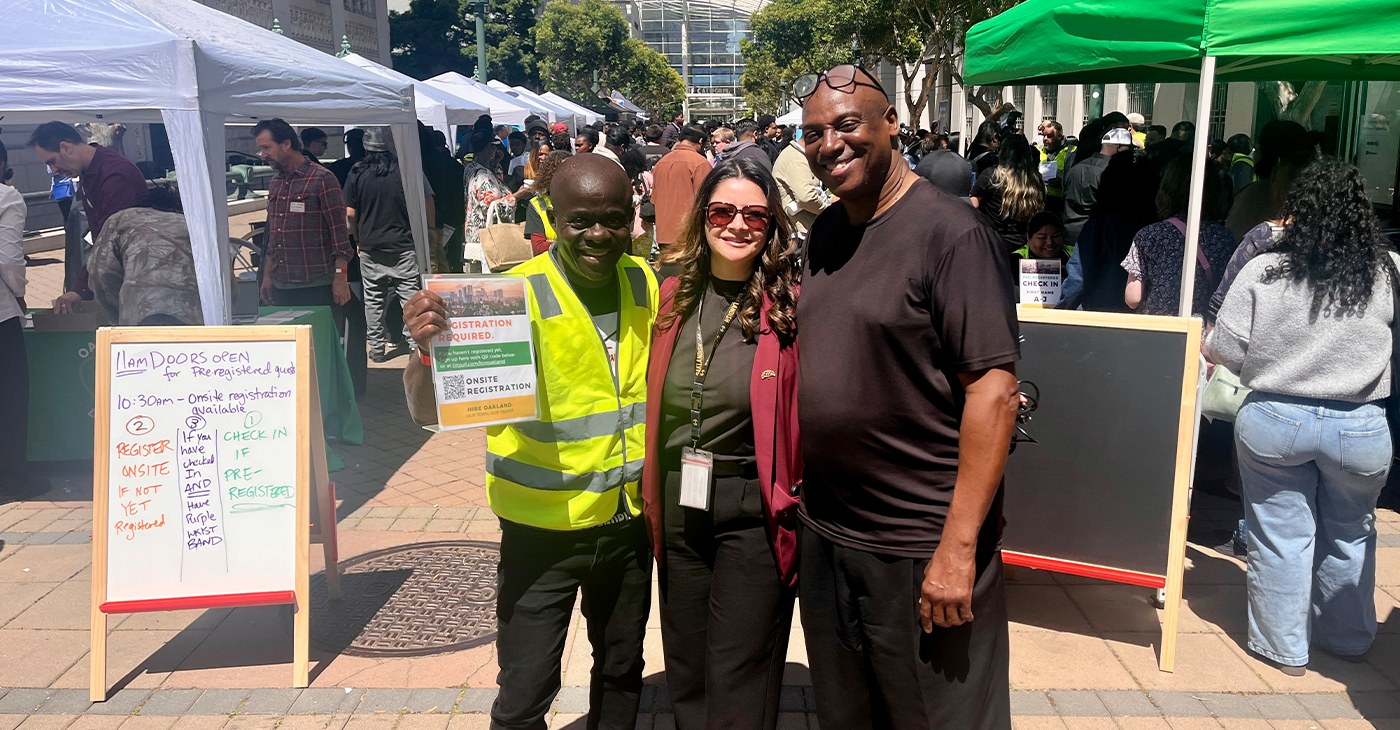
Oakland’s Hire Oakland job fair, hosted by Mayor Barbara Lee’s office, connected over 2,000 job seekers with employers, highlighting a strong demand for quality jobs and career pathways in the city.
By Post Staff
The Office of Mayor Barbara Lee, in partnership with the City of Oakland and regional employers, hosted a successful Hire Oakland job fair this week at Frank H. Ogawa Plaza, bringing together job seekers and employers for a day focused on opportunity, connection, and economic mobility.
With more than 2,000 RSVPs, the event on Wednesday reflected strong demand across Oakland for access to quality jobs and career pathways. Attendees participated in on-site recruitment, application support, and hands-on workshops designed to help job seekers navigate hiring processes and prepare for interviews.
Over the course of the day, employers and community partners engaged directly with residents in a welcoming, high-energy environment centered on opportunity and hope. Participating employers included EBMUD, Samuel Merritt University, the City of Oakland, BART, PG&E, AC Transit, East Bay Regional Parks District, Southwest Airlines, FedEx, and many others offering immediate openings and career pathways across sectors.
Workforce development partners Oakland Private Industry Council (OPIC) and Lao Family Community Development provided connections to résumé support, interview coaching, and individualized job search assistance throughout the event.
The strong turnout underscores a clear reality: Oakland residents are eager for pathways into meaningful work, and sustained investment in youth and workforce programs is essential.
That is why Mayor Lee has prioritized relaunching the Oakland Police Cadet Program and the Mayor’s Youth Employment and Education Program (MYEEP)—ensuring young people have early access to paid work experience, mentorship, and long-term career pathways, according to a City press statement.
“The turnout shows what we already know—Oaklanders are ready to work, ready to grow, and ready to build their futures here at home,” said Lee. “When we connect people directly to employers and invest in young people early, we are not just filling jobs—we are changing lives and strengthening our city’s future.”
The Hire Oakland job fair is part of the City’s broader effort to strengthen workforce pipelines, expand access to good-paying jobs, and ensure Oakland residents are first in line for local opportunity.
About Hire OaklandHire Oakland is a citywide workforce initiative led by the Office of Mayor Barbara Lee in partnership with City departments, workforce development organizations, and regional employers. The program connects Oakland job seekers to real-time hiring opportunities, training resources, and career pathways.



REPORT: Community Level Policy Is Impacting Homelessness and Drug Abuse in California
OPINION: AI Needs to Know Who Is the Boss
Goldi-Locs and Two (or Three) Bears in the Forest in California Hills

Election Watch 2026: 85% of Eligible Voters in California Are Registered

Don’t Let scammers Crash Your School Year

BOOK REVIEW — Curved Air: A Biography of Sickle Cell Anemia and the Quest to Cure the First Molecular Disease

California’s Legal Cannabis Market Hits $8 Billion as State Touts Progress on Fighting Drugs, Crime

Blacks and Latinos Clash Over LA’s Barrio Run; Mayor Karen Bass Calls for Dialogue Across Racial, Neighborhood Lines

Asm. Smallwood-Cuevas’s Bill Repealing ‘Racist’ CalWORKs ‘Man-in-the-House’ Rule Clears Legislature

Asm. Smallwood-Cuevas’s Bill Repealing ‘Racist’ CalWORKs ‘Man-in-the-House’ Rule Clears Legislature

‘Ready to See These Bills Become Law’: Sen. Weber’s Package of 15 Bills Advance to Gov. Newsom’s Desk

‘Ready to See These Bills Become Law’: Sen. Weber’s Package of 15 Bills Advance to Gov. Newsom’s Desk

Tarsha Jordan’s Bonita the Bumble Bee Brings STEAM Learning to Life

On Your November Ballot: Prop 45 Would Speed Up Environmental and Public Project Reviews

Henry O. Flipper: A Trailblazer at West Point and Beyond

Department of Homeland Security Demands California Secretary of State Shirley N. Weber Scrub Voter Rolls

New Judge Could Decide if Karmelo Anthony Gets a New Trial

“The Power to See Threats Sooner”: Gov. Newsom, Safety Officials Showcase California’s Investments in Hi-Tech Wildfire Prevention

Alpha Kappa Alpha Sorority, Inc. Celebrates New North Atlantic Regional Director

California Sen. Padilla Joins Colleagues to Introduce Bill Imposing Term Limits on Supreme Court Justices

Less Affluent School Districts, Including Sacramento City, Face Threat of State Takeover

Car Wash Workers Cope with Lingering Impacts of ICE Raids

Oakland Post: Week of July 29 – August 4, 2026

How Oakland’s Courtsmith is Scaling its Business and Local Impact

ESSAY: California Can Close Its Colorectal Cancer Gap

Oakland Post: Week of August 5 – 11, 2026

As Part of Your Back-to- School Checklist, Vaccinate

Oakland ‘Port Serves as a Powerful Engine for Good Jobs and Economic Development

Gov. Newsom Signs New Affordable Housing Legislation

Gov. Newsom Announces $109.6 Million in Funding for 278 Supportive Homes in Bakersfield, Contra Costa, Sacramento and Fresno

The Conversation With Al McFarlane 6/23/26

Media Monday 6/22/26

LIVE! ASK ALMA! — TUES. 6.23.26 7PM EST

Car Buying Secrets: 4 Hidden Checks Before You Sign!

Is This 550 HP Charger Worth YOUR Money? AutoNetwork Review

Celebrating Juneteenth – Frederick Douglass on education and resistance

LIVE! — ASK ALMA! — TUES. 6.19.26 7PM EST

Hyundai Ioniq 5 Parking, Safety, and 360 View #shorts

2025 Ioniq 5 New Wiper & Powerful Performance! #shorts

Electric SUV Range: Is 259 Miles Enough? #shorts

EV Charging: How Fast Can You Charge an Electric Vehicle? #shorts

Biometric Cooling… Messaging Seats…Come on! 2025 Infiniti QX80 Autograph 4WD

Charged Up: Witness the Magic of a Fully Electric Car! #shorts

Range Rover Sport PHEV Included…: See What’s Inside This Luxury SUV! #shorts

Invisible Hood View: Perfect Parking with X-Ray Vision! #shorts
-
 Community4 weeks ago
Less Affluent School Districts, Including Sacramento City, Face Threat of State Takeover
-
 Commentary4 weeks ago
ESSAY: California Can Close Its Colorectal Cancer Gap
-
 Business4 weeks ago
California Hispanic Chambers of Commerce Unveils: ‘Powering the Future’ Theme for 47th Annual Statewide Convention
-

 Community4 weeks ago
Four Candidates, Including Incumbent Barbara Lee, Qualify for Oakland Mayor’s Race
-

 Activism4 weeks ago
Oakland Post: Week of August 12 – 18, 2026
-

 Business4 weeks ago
From Blueprint to Breakthrough: Tackling Affordable Housing in Oakland
-

 Black History4 weeks ago
Oakland Observes Black August with Block Parties, Film Showings, Workshops
-

 Commentary4 weeks ago
COMMENTARY: Why Local School Tax Measure G1 Will Not Be on the November Ballot
