Connect with us

Activism

Grocery Inflation Causes Food Banks to be the Default for Families in Oakland

Steve Morris, Director of Natural Resources and Environment at GAO, explained that while the pandemic certainly had an effect on food increases, there is not one single factor for a rise in food prices. He said events like the Ukraine-Russian war, the avian influenza epidemic that raised the price of eggs, and climate change are also key factors.

Published

on

Photo: iStock image.

By Magaly Muñoz

During the past three years, the US has seen the largest increase in food prices since the 1980s. In response to this crisis, community food banks have emerged to provide much-needed assistance to families in need.

The U.S. Government Accountability Office (GAO) reports that national food prices have increased 11% from 2021 to 2022, when the average yearly increase was previously 2%. The San Francisco Bay Area saw a 12% increase from 2021 to 2022.

Steve Morris, Director of Natural Resources and Environment at GAO, explained that while the pandemic certainly had an effect on food increases, there is not one single factor for a rise in food prices. He said events like the Ukraine-Russian war, the avian influenza epidemic that raised the price of eggs, and climate change are also key factors.

While still maintaining that elevated prices will persist for the foreseeable future, Morris anticipates a decrease of 8% in food price increases.

He also stated that while the average person may spend 10% of their income on groceries, a low-income family may spend 30%, making the inflation in food prices that much harsher.

“Higher food prices can put people in a position where they have to make some tough choices between ‘can they go to the grocery store and buy food’ or ‘do they have to spend it on other necessities like home or health care or other things,’” Morris said.

Michael Altfest is the Director of Community Engagement and Marketing for Alameda County (AC) Food Bank, the primary food distributor in the county with over 400 community partners that receive frequent donations.

Altfest shared that from 2019 to 2023, the number of pounds of food distributed to their community partners has doubled. In 2019, the food bank distributed 32.5 million pounds of food, while in 2021 during the height of the pandemic, they distributed 58.1 million pounds. This year they are on pace to distribute almost 60 million pounds of food.

“If we’re on pace this year to provide more than we did in the pandemic, I think that says a lot about what the state of hunger is right now,” Altfest said.

During the height of the pandemic, state and federal government relief programs helped families offset significant expenses like groceries. These programs included the child tax credit increase that put anywhere from $2,000 up to $3,600 back into qualifying families pockets when filing their yearly taxes.

Another program that directly targeted food insecurity, was the increase in funds for SNAP or CalFresh. These government programs provide food-purchasing assistance for low- and no-income people to help them maintain adequate nutrition and health. But earlier this spring, funding was cut from the state program CalFresh and families saw at least a $95 decrease in their assistance.

“Every single person talks about the cost of living in Alameda County, every single person. The cost of rent, the cost of food, those are things that come up every single time without fail,” Altfest shared.

One of AC Food Bank’s community partners is Homies Empowerment, a non-profit in Oakland that was established as a means to support youth and the community through a positive lens.

Selena Duarte, the FREEdom Store Coordinator, said the organization’s initiative to help families with food provision began in May of 2020 when their original store was filled only with books and students told them that while it was nice to have things to read, “they can’t eat books,” showing the team at Homies Empowerment that there were bigger needs in the community that they had to address.

Since then, the organization has expanded its services. They now provide groceries every Tuesday, have established the FREEdom Farm where they grow produce that gets distributed in their make-shift store, offer hot breakfast to 40 students and their families five days a week, and much more.

Duarte said that they serve almost 400 families a week and they are continuing to expand their food services due to the increasing number of people coming to them seeking help to reduce their spending on groceries. She recognized that although people say that the “pandemic is over”, she knows that the stress that families are experiencing is still very real.

“The next phase is really becoming a sustainable community food hub, where literally we can grow, share, cook, and store our food here in the community and for the community,” Duarte said.

Magaly Muñoz

Magaly Muñoz

A graduate of Sacramento State University, Magaly Muñoz’s journalism experience includes working for the State Hornet, the university’s student-run newspaper and conducting research and producing projects for “All Things Considered” at National Public Radio. She also was a community reporter for El Timpano, serving Latino and Mayan communities, and contributed to the Sacramento Observer, the area’s African American newspaper.

Muñoz is one of 40 early career journalists who are part of the California Local News Fellowship program, a state-funded initiative designed to strengthen local news reporting in California, with a focus on underserved communities.

The fellowship program places journalism fellows throughout the state in two-year, full-time reporting positions.

A graduate of Sacramento State University, Magaly Muñoz’s journalism experience includes working for the State Hornet, the university’s student-run newspaper and conducting research and producing projects for “All Things Considered” at National Public Radio. She also was a community reporter for El Timpano, serving Latino and Mayan communities, and contributed to the Sacramento Observer, the area’s African American newspaper. Muñoz is one of 40 early career journalists who are part of the California Local News Fellowship program, a state-funded initiative designed to strengthen local news reporting in California, with a focus on underserved communities. The fellowship program places journalism fellows throughout the state in two-year, full-time reporting positions.

Activism

EBMUD Enshrines the Legacy of  its First Black Board Member William ‘Bill’ Patterson 

Patterson, who died in 2025 at the age of 94, was remembered as a tireless advocate, mentor, and public servant whose influence shaped generations across the East Bay.

Published

on

William “Bill” Patterson, Jr. Courtesy Peralta College District

By Carla Thomas

On Tuesday, May 12, Oakland honored a towering community figure, William “Bill” Patterson, with the unveiling of a bronze plaque and the renaming of the East Bay Municipal Utility District (EBMUD) boardroom in downtown Oakland.

Board members, family, colleagues, and mentees gathered to reflect on Patterson’s enduring legacy at the meeting.

Patterson, who died in 2025 at the age of 94, was remembered as a tireless advocate, mentor, and public servant whose influence shaped generations across the East Bay.

“This is well deserved,” said Patterson’s cousin, Maria Simon. “He was such a big part of the Oakland community. It’s heartwarming to know he was known by so many people.

“So many credit him with helping them get their first job. It was especially meaningful when he held the Bible for Mayor Barbara Lee’s swearing-in. He truly believed in the goodness of people, in possibilities, and in the power to bring things to fruition.”

Oakland NAACP President Cynthia Adams described Patterson as a father figure. “He took me under his wing,” she said. “This recognition is a very special moment.”

Fellow NAACP member Robert “Bob” Harris echoed that sentiment, recalling Patterson as “a great member of the NAACP and a proud Kappa Alpha Psi man.”

Patterson’s son, William Patterson Jr., reflected on his father’s professional life.

“My father loved his community, and he loved working with EBMUD and spoke highly of his colleagues,” he said, standing alongside cousin Rise Jones Pichon, a former Santa Clara County Superior Court judge.

EBMUD Board President Luz Gómez praised Patterson’s resilience and dedication.

“As his health declined, he would spend half the day in the hospital and still come to our meetings,” she said. “There will never be another like him.”

Activist Cheryl Sudduth highlighted Patterson’s commitment to workforce development and youth empowerment. “He had the vision to bring water careers to students and the next generation,” she said, noting that participants in one of his initiatives received $2,000 stipends.

Sudduth also summed up one of Patterson’s guiding philosophies: “He told me it’s not enough to have a seat at the table. You need to have access to quality resources, the tools to build the table, and the skills to ensure everyone there can contribute. We should be more than a representation; we should reflect determination.”

EBMUD Board Member Andy Katz emphasized the importance of remembrance.

“When you die, you die twice, physically, and then when people stop saying your name,” he said. “By honoring him this way, his name will continue to be spoken for years to come.”

Others in attendance reflected on Patterson’s broad impact.

“It was a joy to watch him accomplish so much,” said EBMUD Board Member Marguerite Young.

Business leader, Delane Sims added that Patterson became a trusted advisor to multiple Oakland mayors.

“We need young people to learn about him so they can become leaders capable of creating meaningful change,” Sims said.

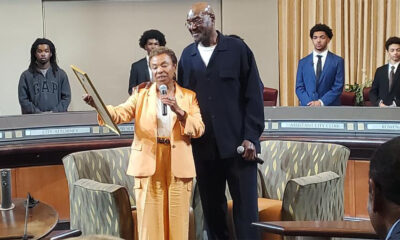
Following public comments, attendees witnessed the unveiling of the bronze plaque in the boardroom foyer, along with signage officially renaming the space in Patterson’s honor.

Born in 1931, Patterson devoted more than seven decades to public service in Oakland and the broader East Bay. Appointed to the EBMUD Board in 1997, he served for 27 years and became its first African American board president. His leadership extended beyond water governance into civil rights, education, and community development.

A three-term president of the Oakland NAACP, Patterson also advised Oakland’s first Black mayor, Lionel Wilson, and played a key role in advancing equity, public health, and environmental justice. He served on the Urban Strategies Council and the Oakland Public Ethics Commission, further shaping public policy.

In 1971, Patterson was a founding director of the Peralta Colleges Foundation, which provides financial assistance and support to students across Berkeley City College, College of Alameda, Laney College, and Merritt College.

In addition, Patterson mentored countless young people through Oakland’s recreation programs, helping guide future leaders and even professional athletes. Though slight in stature, Patterson will always be remembered as a giant of a man.

Continue Reading

Activism

Supreme Court Voting Rights Ruling Reverberates From the South to California

The Supreme Court’s recent ruling weakening the Voting Rights Act is reshaping political battles, particularly in the South. While California’s protections may offer a buffer, the decision raises national concerns about Black political representation and redistricting.

Published

on

Researchers pointed out that the number amounts to 1 in every 50 adults, with 3 out of 4 disenfranchised living in their communities, having completed their sentences or remaining supervised while on probation or parole. (Photo: iStockphoto)
iStock.

By Brandon Patterson

A recent U.S. Supreme Court ruling weakening a key section of the federal Voting Rights Act is already reshaping political battles in parts of the South while raising broader questions about the future of Black political representation nationwide.

In Louisiana v. Callais, the Court’s conservative majority limited the use of Section 2 of the Voting Rights Act, the provision historically used to challenge electoral maps that dilute minority voting strength. Writing in dissent, Justice Elena Kagan warned that the ruling marked the “now-complete demolition of the Voting Rights Act.”

The immediate effects of the ruling are expected to be felt most sharply in Southern states, where litigation over majority-Black districts has shaped congressional maps for decades. Republican-led states including Louisiana, Alabama, and Texas have already moved to defend or revisit maps following the decision, according to reporting by Reuters and Politico.

California’s political landscape is different. The state uses an independent citizen’s commission to draw district lines and also has its own California Voting Rights Act, which in some cases provides broader protections than federal law. Because of those safeguards, the Supreme Court’s decision is not expected to immediately alter Black political representation in California.

Still, legal scholars and voting rights advocates say the ruling could shape future national debates over how race is considered in redistricting and voting rights enforcement.

“It changes the legal atmosphere around voting rights nationally,” UCLA law professor Rick Hasen told Axios. “Even states with stronger protections are paying attention to where the Court is headed.”

The decision also arrives amid renewed political fights over redistricting. In California, voters approved Proposition 50 in November 2025, a measure backed by Gov. Gavin Newsom that expanded the state’s ability to redraw congressional maps in response to mid-decade redistricting efforts in other states.

Supporters argued the measure was necessary to counter increasingly aggressive Republican-led redistricting nationally, while critics warned it could weaken California’s independent redistricting tradition.

For Black Californians, the ruling lands at a time when political representation remains significant even as demographic shifts have changed historically Black neighborhoods in cities like Oakland, Los Angeles and San Francisco.

Oakland Mayor Barbara Lee criticized the Court’s decision in comments to The Oaklandside, calling the Voting Rights Act one of the nation’s foundational civil rights protections.

“This decision weakens one of the most important civil rights tools our communities have had,” Lee said. “We know voting rights were never given freely. People fought and died for them.”

Rep. Lateefah Simon warned against complacency.

“This is part of a larger effort to erase the gains of the civil rights movement,” Simon told Oaklandside. “Black political power matters, and representation matters.”

The Voting Rights Act, passed in 1965 during the height of the Civil Rights Movement, helped expand Black political representation nationwide, including in California, where coalition politics among Black, Latino and Asian American voters helped elect candidates of color at the local, state and federal levels.

For many observers, the latest ruling serves less as an immediate threat to California districts and more as a reminder that voting rights protections long viewed as settled remain politically and legally contested.

Continue Reading

Activism

The People’s Coalition to Stop Deed Theft Speaks at National Probate Reform Coalition Meeting

Evangeline Byars and Carmella Carrington lead the STOPDEEDTHEFT.org movement, fighting rising deed and title fraud, which disproportionately affects Black and Brown communities nationwide.

Published

on

Left to right:  Evangeline Byars  and Carmella Carrington are gaining nationwide attention with their STOPDEEDTHEFT.org movement.

By Tanya Dennis

The National Probate Reform Coalition (NPRC) has learned that aside from rampant theft of properties occurring through probate court, deed theft extends even further with the support of banks, police, judges, attorneys and “the system” to steal Black and Brown properties.

Deed and title fraud are rising, with FBI data showing over 9,300 complaints and $173.6 million in losses in 2024 alone.

To that end, NPRC invited Evangeline Byars of The People’s Coalition to Stop Deed Theft as their keynote speaker on May 7.

Deed theft victims reach out to Byars because she has a reputation of getting things done.  Introduced to community organizing at Medgar Evers College in 2011, Byars was mentored by Harry Belafonte and gained further movement training in 2012-13 through his “Gathering for Justice.” Byars also trained with the Youth Brigade 32BJ, Union in 2012 where she learned to map, target, and execute actions.

With that knowledge as an advocacy worker, Byars ran for president of TWU Local 100 for transit workers.  During challenges of the union and political changes in New York when unions no longer had friends in government, they organized.

In 2025, deed theft victims approached Byars and told their stories.  Byars investigated, and discovered rampant, unrelenting theft of properties, primarily from Black and brown families, got involved and helped them with their fight, teaching them how to sustain their fight at the grassroots level while remaining politically independent.  This independence gave them the ability to move without co promise.

Deed theft is the taking of someone’s deed through fraudulent mortgages or a stranger that accesses property records, prepares paperwork and files for an owner’s property. New York is a’ first notice’ state, which means whoever appears first on record is the designated deed holder.

Deed theft escalated between 2013-23, the outcome of the subprime market, when people faced mass foreclosure and short sales. By 2014 people, primary Black and Brown, were fighting for their property.

In California, title theft (deed fraud) is a fast-growing threat often targeting high-equity homes, vacant land, and rentals. As of 2024, California leads the nation in real estate fraud with over 1,583 cases costing roughly $24.8 million in losses in a single year, reflecting the state’s prime position for scammers due to high property values, the FBI reports.

Byars says, “Deed theft affects Black and Brown people: it is by design, leading to the erasure of people of color homeownership that is happening nationwide. In every big city across the United States, towns and municipalities, we are witnessing a mass exodus of Black and brown people.  This theft cannot occur without judges, notaries and law enforcement, it is a syndicate of players working together for the removal of people by illegal ejectment or eviction.

The People’s Coalition to Stop Deed Theft does court watch and constantly highlight the inequities in the court system.

Byars says, “This is a human rights crisis.  Because of Wall Street and what New York signifies to the nation, know that no state is safe.  Any person can come and create paper terrorism, slap forgery notes on homes; engage in illegal guardian procedures; initiate foreclosures; apply for fraudulent loan modifications; then there’s outright theft and forgery, just taking people’s homes.  Believe me, it’s happening nationally and on the daily, These predators also target seniors over the age of 60 and women.”

The People’s Coalition to Stop Deed Theft take direct actions against perpetrators and are working with the New York District Attorney to create an office dedicated to gighting deed theft.

“Two ways to protect your deed is to keep a note, never satisfy your mortgage, because the bank is the biggest gangster, but if you’re making a payment, it keeps them in check.  Or put your home in a living trust, once you have a trust, it hides the owner’s name and protects the person from predators.”

Continue Reading

Subscribe to receive news and updates from the Oakland Post

* indicates required

CHECK OUT THE LATEST ISSUE OF THE OAKLAND POST

ADVERTISEMENT

WORK FROM HOME

Home-based business with potential monthly income of $10K+ per month. A proven training system and website provided to maximize business effectiveness. Perfect job to earn side and primary income. Contact Lynne for more details: Lynne4npusa@gmail.com 800-334-0540

Facebook

Trending

Copyright ©2021 Post News Group, Inc. All Rights Reserved.