
Bay Area
Community Celebrates Life of Sylvester Hodges, Education Leader, Parent Activist
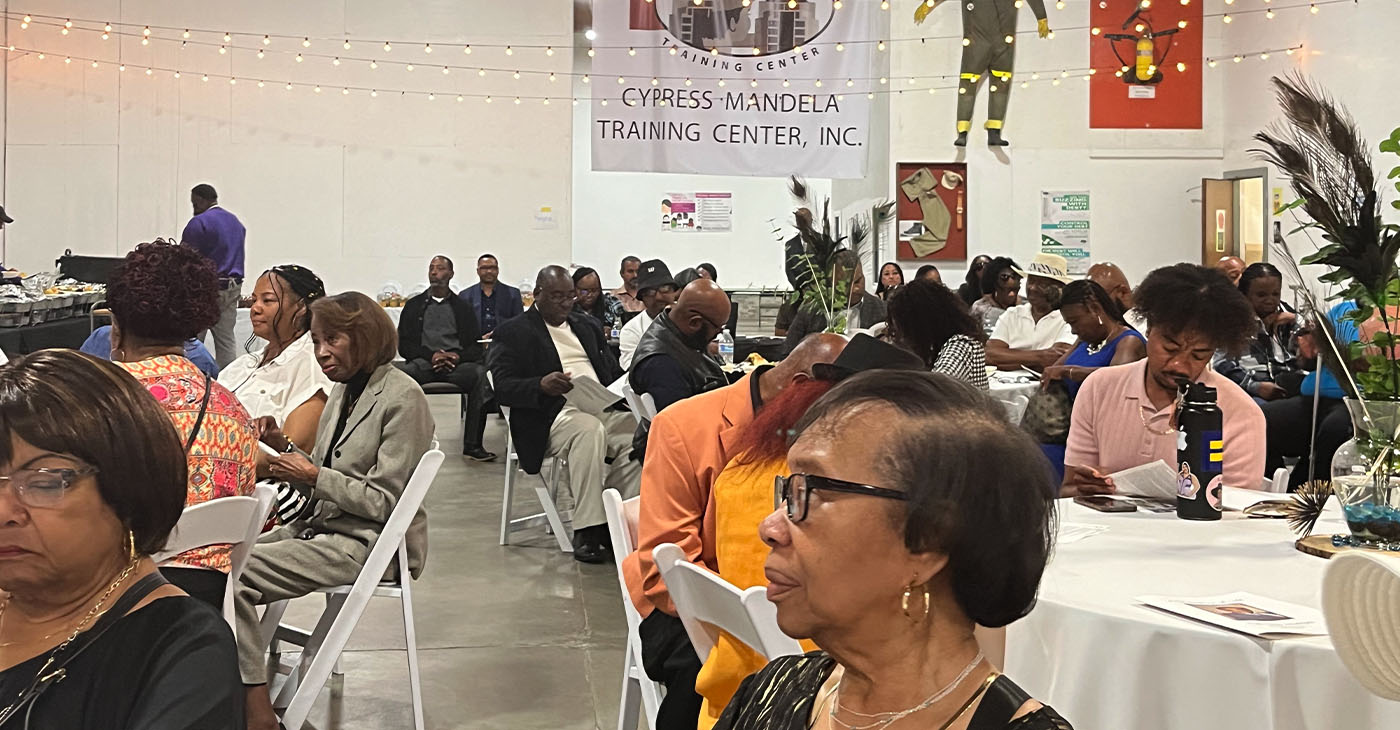
A community celebration was held Saturday, July 8, commemorating the life of former Oakland Board of Education member, civil rights leader, and parent activist Sylvester Hodges. Many lifelong friends and loved ones came out to join the celebration of his life at the Cypress Mandela Training Center in East Oakland. Hodges, 78, died on May 21, 2020, but the event was postponed until this month due to the pandemic.

By Ken Epstein
A community celebration was held Saturday, July 8, commemorating the life of former Oakland Board of Education member, civil rights leader, and parent activist Sylvester Hodges.
Many lifelong friends and loved ones came out to join the celebration of his life at the Cypress Mandela Training Center in East Oakland. Hodges, 78, died on May 21, 2020, but the event was postponed until this month due to the pandemic.
Hodges’ son, LaRone Hodges, organized the event.
Alvin Moore Sr., who hosted the celebration, remembered Hodges as a man of courage who was unafraid to stand alone when he was fighting for what he knew was right.
One of Hodges’ lifelong friends, Ashlee Sherman, told stories of their experiences as young athletes at McClymonds High School and how, with encouragement from Hodges, he went on to San Francisco State, earned a bachelor’s degree and later a master’s degree.
Kitty Kelly Epstein, an education leader and community activist, said, “Sylvester did probably what was the most important action ever taken by an elected official in Oakland — he saved the school district from being taken over by the racist, elitist State of California for 15 years,” adding that Oakland was the only school district in the country that was able to halt an attempted state takeover.

Underscoring the strength and clarity of Hodges’ leadership, Epstein said, “People should live their lives like Sylvester did, with the amount of courage and principle that I have not seen often before in my life, and I learned so much from him.”
Despite repeated attempts, the state was never able to seize control of the Oakland Unified School District until Hodges retired from the board.
During those years of African American leadership on the school board, the district made some major changes to benefit Black and Brown students, including ending some of the worst forms of tracking, which prevented them from taking algebra and assigned them perpetually to remedial math classes.
The board also rejected a racist textbook that was pushed on schools by the state, and the first programs were created to bring more Black and Brown teachers into the schools.
At the time, many people did not understand the importance of maintaining local control and had hopes that state intervention would lead to improvements in the district’s financial condition and reduce unresponsive bureaucracy.
When eventually the state did take over, the results turned out to be the opposite of what people had hoped for: continual budget cuts and school closures, lack of transparency, more consultants and highly paid bureaucrats, and unending budget deficits.
Hodges was born on April 30, 1942, in Montrose, Arkansas, moving with his parents, Chester and Maggie Hodges, to Oakland in 1946. He attended Prescott Elementary, Lowell Middle School, and graduated from McClymonds High in 1960. He entered the U.S. Air Force, where he was on the wrestling team. In 1964, he met Lola Ingram, who he married in 1965.
Besides serving on school board for 12 years, Hodges served as chair of the Paul Robeson Centennial Committee, working successfully to rename the school district administration building in Robeson’s memory.
After he retired from the recreation department in San Mateo County, he went to work as an administrator for the Cypress Mandela Training Center, training countless Black and Latino young people to overcome barriers to enter positions in the construction trades.
He also served on the board of the Oakland Emiliano Zapata Street Academy, a school he loved because of its unique approach to young people’s education. He also remained a dedicated supporter of McClymonds High School.












Activism
Oakland Post: Week of August 12 – 18, 2026
The printed Weekly Edition of the Oakland Post: Week of August 12 – 18, 2026

To enlarge your view of this issue, use the slider, magnifying glass icon or full page icon in the lower right corner of the browser window.
Activism
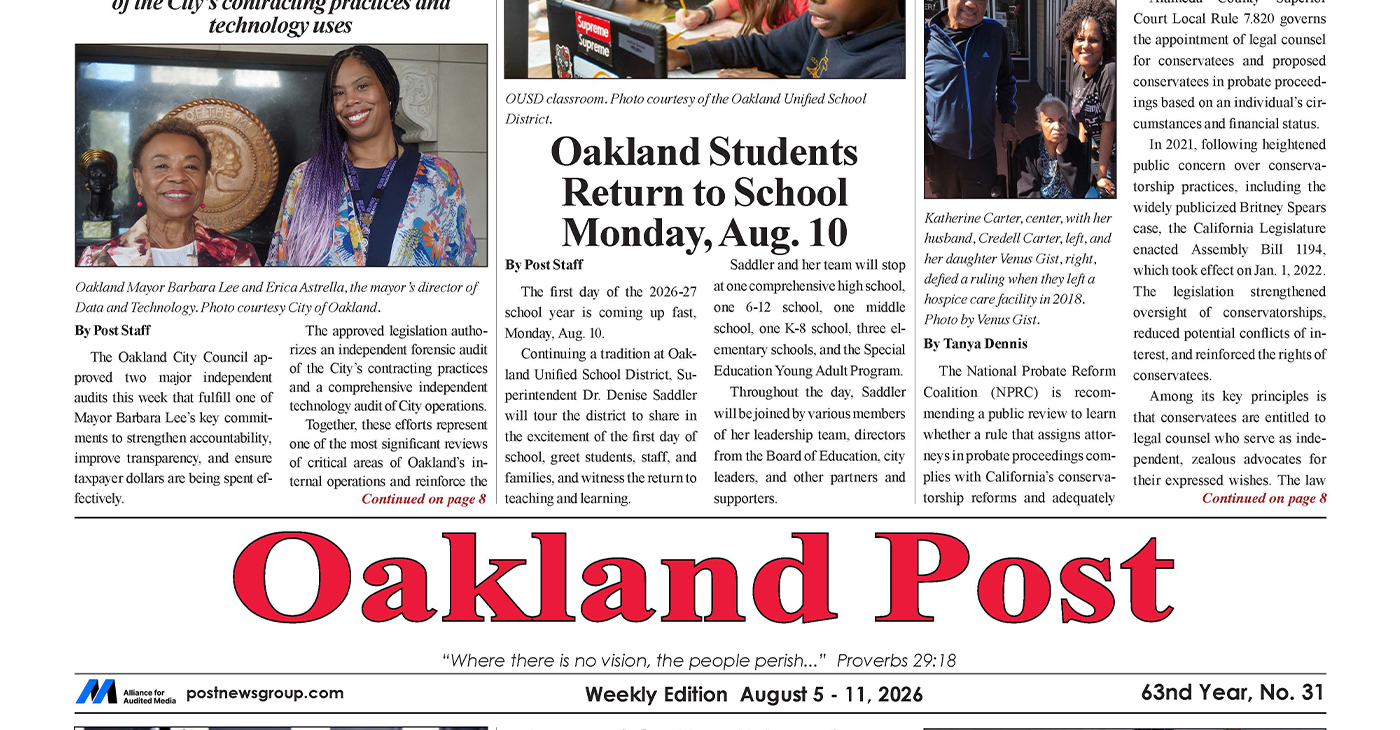
Oakland Post: Week of August 5 – 11, 2026
The printed Weekly Edition of the Oakland Post: Week of August 5 – 11, 2026
To enlarge your view of this issue, use the slider, magnifying glass icon or full page icon in the lower right corner of the browser window.
Activism
Oakland Post: Week of July 29 – August 4, 2026
The printed Weekly Edition of the Oakland Post: Week of July 29 – August 4, 2026

To enlarge your view of this issue, use the slider, magnifying glass icon or full page icon in the lower right corner of the browser window.

WORK FROM HOME
Home-based business with potential monthly income of $10K+ per month. A proven training system and website provided to maximize business effectiveness. Perfect job to earn side and primary income. Contact Lynne for more details: Lynne4npusa@gmail.com 800-334-0540


Four Candidates, Including Incumbent Barbara Lee, Qualify for Oakland Mayor’s Race

Oakland Observes Black August with Block Parties, Film Showings, Workshops

Oakland Post: Week of August 12 – 18, 2026

COMMENTARY: Why Local School Tax Measure G1 Will Not Be on the November Ballot

California Hispanic Chambers of Commerce Unveils: ‘Powering the Future’ Theme for 47th Annual Statewide Convention

Returning to Its Roots, the Oakland Black-Eyed Pea Festival Partners with the Freedom Farmers Market Sept. 12

Less Affluent School Districts, Including Sacramento City, Face Threat of State Takeover

From Blueprint to Breakthrough: Tackling Affordable Housing in Oakland

NPRC Scores First Advocacy Victory: David Shaw Finally Gets His Wish to ‘Go Home’

ESSAY: California Can Close Its Colorectal Cancer Gap

Car Wash Workers Cope with Lingering Impacts of ICE Raids

Misty Copeland Shapes Ballet’s Tomorrow

As Part of Your Back-to- School Checklist, Vaccinate

As Part of Your Back-to- School Checklist, Vaccinate

Congresswoman Simon Demands Investigation into Trump’s Abuse of Emergency Powers for Coal Export Terminal in West Oakland

Department of Homeland Security Demands California Secretary of State Shirley N. Weber Scrub Voter Rolls

Oakland Children’s Hospital Workers and Patients Rally for Pediatric Medical Care

New Judge Could Decide if Karmelo Anthony Gets a New Trial

“The Power to See Threats Sooner”: Gov. Newsom, Safety Officials Showcase California’s Investments in Hi-Tech Wildfire Prevention

Alpha Kappa Alpha Sorority, Inc. Celebrates New North Atlantic Regional Director

Surveillance Pricing Fight: State Senate Debates Bill Banning Retailers from Using AI to Set Prices Based on a Buyer’s Profile

Mount Zion MBC, Church of Jesus Christ of Latter-day Saints Partner to Bring 29,000 Meals to Alameda County

California Sen. Padilla Joins Colleagues to Introduce Bill Imposing Term Limits on Supreme Court Justices

Starting This Summer, California Car Buyers Can Get an Instant $3500 Off the Cost of Electric Vehicles

COMMENTARY: You Are Already Paying for the AI Boom
Less Affluent School Districts, Including Sacramento City, Face Threat of State Takeover

California Bill Would Let Abuse Victims Use Trauma as Legal Defense for Violent Crime
Car Wash Workers Cope with Lingering Impacts of ICE Raids

Fed Court to Decide Landmark First Amendment Case

Gov. Gavin Newsom Signs Law Streamlining Affordable Housing Rules

The Conversation With Al McFarlane 6/23/26

Media Monday 6/22/26

LIVE! ASK ALMA! — TUES. 6.23.26 7PM EST

Car Buying Secrets: 4 Hidden Checks Before You Sign!

Is This 550 HP Charger Worth YOUR Money? AutoNetwork Review

Celebrating Juneteenth – Frederick Douglass on education and resistance

LIVE! — ASK ALMA! — TUES. 6.19.26 7PM EST

Hyundai Ioniq 5 Parking, Safety, and 360 View #shorts

2025 Ioniq 5 New Wiper & Powerful Performance! #shorts

Electric SUV Range: Is 259 Miles Enough? #shorts

EV Charging: How Fast Can You Charge an Electric Vehicle? #shorts

Biometric Cooling… Messaging Seats…Come on! 2025 Infiniti QX80 Autograph 4WD

Charged Up: Witness the Magic of a Fully Electric Car! #shorts

Range Rover Sport PHEV Included…: See What’s Inside This Luxury SUV! #shorts

Invisible Hood View: Perfect Parking with X-Ray Vision! #shorts
-
 Featured1 week ago
Department of Homeland Security Demands California Secretary of State Shirley N. Weber Scrub Voter Rolls
-
 Business3 weeks ago
Oakland Children’s Hospital Workers and Patients Rally for Pediatric Medical Care
-
 #NNPA BlackPress2 weeks ago
New Judge Could Decide if Karmelo Anthony Gets a New Trial
-
 Environment1 week ago
“The Power to See Threats Sooner”: Gov. Newsom, Safety Officials Showcase California’s Investments in Hi-Tech Wildfire Prevention
-
 Black History2 weeks ago
Alpha Kappa Alpha Sorority, Inc. Celebrates New North Atlantic Regional Director
-
 Business3 weeks ago
Surveillance Pricing Fight: State Senate Debates Bill Banning Retailers from Using AI to Set Prices Based on a Buyer’s Profile
-
 Business3 weeks ago
Mount Zion MBC, Church of Jesus Christ of Latter-day Saints Partner to Bring 29,000 Meals to Alameda County
-
 Featured1 week ago
California Sen. Padilla Joins Colleagues to Introduce Bill Imposing Term Limits on Supreme Court Justices
