
Bay Area
San Francisco Public Safety Initiative to Disrupt Open-Air Drug Markets Seizing Fentanyl at Record Levels
On June 21, Mayor London Breed announced progress from the City’s multiagency initiative to address open-air drug markets made up of local, state, and federal public safety partners focused on a more coordinated enforcement and disruption of illegal activities.


SFPD has seized over 60 kilos of fentanyl this year so far – an increase of 160% over the same period last year and more than 640% since 2021
S.F. Mayor’s Office of Communication
On June 21, Mayor London Breed announced progress from the City’s multiagency initiative to address open-air drug markets made up of local, state, and federal public safety partners focused on a more coordinated enforcement and disruption of illegal activities.
As part of this work, SFPD has focused enforcement in the Tenderloin and South of Market area, where officers have seized over 60 kilos of fentanyl so far this year, amounting to over 30 million lethal doses of the deadly drug.
This is an increase of 160% over the same time period last year, and more than 640% seized year over year since 2021.
Additionally, 28% of those cited for public drug use under new enforcement efforts have had existing warrants for other crimes and are now being charged under those warrants. Only 8% cited for public drug use identified as San Francisco residents.
This effort is part of Mayor Breed’s commitment to enforcing laws to make our streets safer for residents, small businesses, and workers, to offering help to people in crisis, and holding people accountable for the harm that they do to everyone when they refuse help and continue to deal or use in public.

This initiative is focused on addressing drug markets in three key areas: open drug sales, public drug use, and fencing of stolen goods in drug market areas.
“Shutting down open-air drug markets is critical to the safety of our neighborhoods and the overall health of our City,” said Breed. “The work that our city agencies and state and federal partners are doing to confront this crisis has to be sustained and expanded and we can’t continue to accept the existence of these drug markets on our streets. We will continue to offer help to people in crisis, but we must hold people accountable who are hurting our communities.”
Coordinated Response to Fentanyl
A coordinated City initiative to address open-air drug markets led by the Department of Emergency Management (DEM) began ramping up in April. Starting June 12, this effort expanded to include more city agencies as well as regional and state partners, and is focused on enforcing existing laws, as well as continuing street outreach and offers of services to those in need of care.
DEM is coordinating local and state agencies involved in this effort, including enforcement agencies such as the San Francisco Police Department (SFPD), the San Francisco Sheriff’s Office (SFSO), the San Francisco District Attorney’s Office, the Adult Probation Department, the California Highway Patrol (CHP), and the California National Guard.
It also involves agencies providing outreach and services, including the Department of Public Health (DPH), Human Services Agency (HSA), and the Department of Homelessness and Supportive Housing (HSH).
Open Drug Sales
In the first six months of 2023, SFPD has focused enforcement efforts in the Tenderloin and South of Market areas. This work has yielded in these areas alone:
- 390 arrests for sale
- 61 kilograms of fentanyl seized
- 95 kilograms of narcotics seized
This data does not include arrests and seizures in other parts of San Francisco. Through ongoing City public safety coordination, the agencies will work more closely with state and federal law enforcement partners to identify and arrest drug dealers and traffickers, disrupt the supply chain, and reduce the profitability of this criminal operation.
Last week, the CHP announced the seizure of 4 kilograms of fentanyl since May 1 when the state of California announced its plans to direct resources to San Francisco to support efforts targeting open-air drug markets. The California National Guard has been deployed to provide investigative support for dismantling drug rings.
U.S. House of Representatives Speaker Emerita Nancy Pelosi has also announced that San Francisco will be included in Operation Overdrive, a federal initiative under the Department of Justice that deploys federal law enforcement resources to help local and state authorities identify and dismantle criminal drug networks.
Public Drug Use
SFPD and SFSO have launched a new coordinated effort to arrest and detain those who pose a danger to themselves and to others through their public drug use. Between May 30 and June 18, this team of officers trained to identify narcotics use completed 58 total encounters, resulting in five medical transports to local hospitals, 11 misdemeanor citations, and 42 misdemeanor bookings into county jail for temporary detention due to narcotics intoxication.
Of the 53 cited or booked for public drug use:
- 28% had outstanding warrants. These individuals were then held on these warrants. Only one of these 15 individuals identified as San Francisco residents.
- 8% overall identified as San Francisco residents. 51% came from another California county, and 34% came from out of state. The remaining came from out of country or didn’t identify their residency.
None of those detained under public intoxication laws accepted services for treatment offered to them upon release. Anyone detained in San Francisco’s jails are supported by Jail Health Services and offered access to voluntary services upon release.
Additionally, City health and homelessness outreach teams will continue routine daily outreach to offer services and treatment linkages in targeted neighborhoods.
Next Steps
As part of the City’s efforts to streamline and coordinate efforts, regular data updates on key metrics around these efforts will be shared publicly as they become available.
The Mayor’s Budget, which is currently before the Board of Supervisors, provides key funding to continue this work, as well as broader support for law enforcement and public health needs.












Activism
Oakland Post: Week of September 16 – 22, 2026
The printed Weekly Edition of the Oakland Post: Week of September 16 – 22, 2026

To enlarge your view of this issue, use the slider, magnifying glass icon or full page icon in the lower right corner of the browser window.
Activism
Oakland Post: Week of September 9 – 15, 2026
The printed Weekly Edition of the Oakland Post: Week of September 9 – 15, 2026

To enlarge your view of this issue, use the slider, magnifying glass icon or full page icon in the lower right corner of the browser window.
Activism
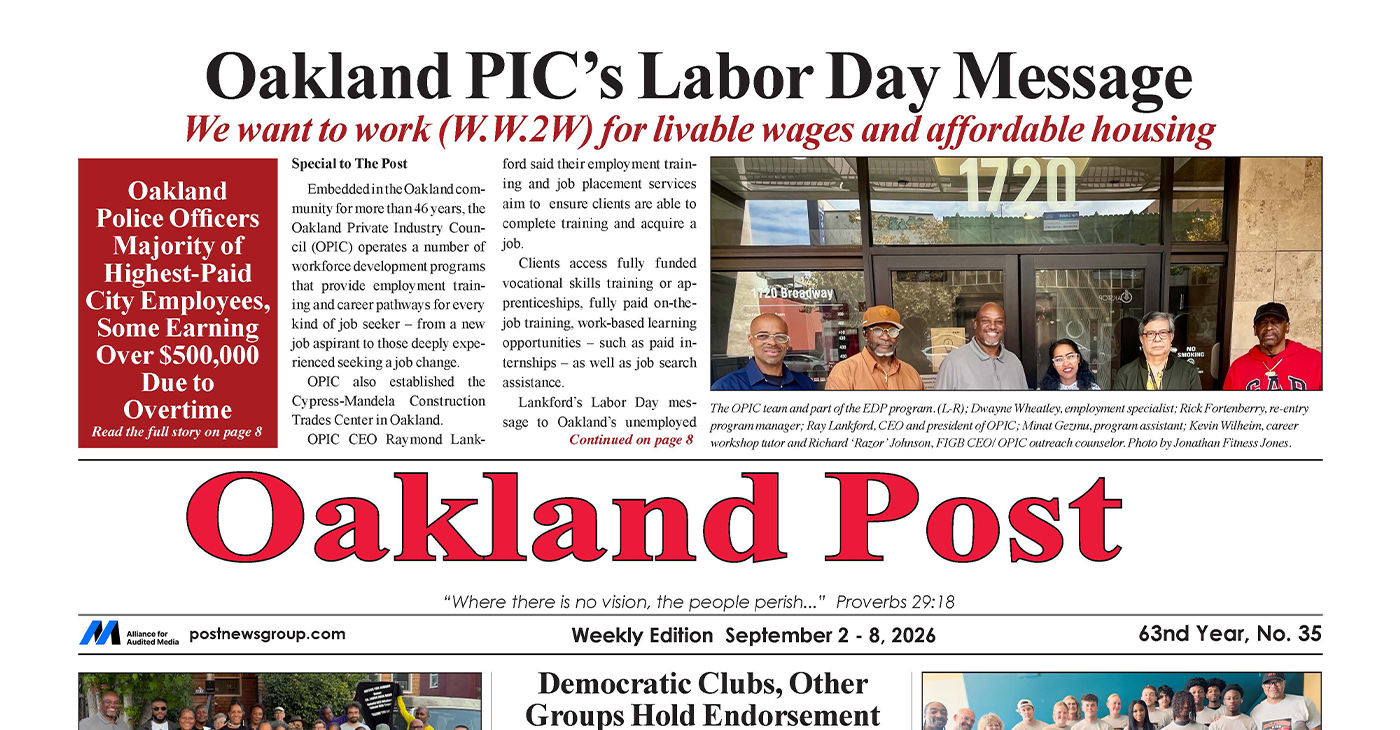
Oakland Post: Week of September 2 – 8, 2026
The printed Weekly Edition of the Oakland Post: Week of September 2 – 8, 2026
To enlarge your view of this issue, use the slider, magnifying glass icon or full page icon in the lower right corner of the browser window.



Doulas Are Helping Black California Moms Navigate Pregnancy–Even as High Mortality Rates Persist

Newsom Signs Addictive Social Media Law to Protect Kids

On Your November Ballot: Prop 38 Would Allocate $8.4 Billion to Immunology and Immunotherapy Funding

Ask California: Golden State Releases New AI Chatbot

Asm. Isaac Bryan’s Bill Banning California Police From ICE Side Jobs Reaches Newsom’s Desk

Assemblymember LaShae Sharp-Collins’s Bill Would Pause Law Enforcement’s Use of Shock Gloves Pending Study

BOOK REVIEW: ‘Laws of Solomon’ Reveals Tender Heart of Former Child Soldier

OPINION: The New American Fear – From 9-11 to AI

Passing for White, Fighting for Black America: The Courage of Walter White

Oakland People’s Arms Embargo Coalition Demands End to Military Shipments Thru Oakland

Barbara Lee Mourns Gloria Steinem, Remembers a Friendship Rooted in Equality

Event Preview: ‘Fashion v. Fascism’ – A Runway Revolution Is Coming to the Bay Area

Two Looming Threats Every Alameda County Elder Should Know About

Oakland Mayor Reads to Children at Bookout Block Party at Marcus Books Store

Tradition Comes to the Streets in 11th Annual Black-Eyed Pea Festival at the Freedom Farmers Market

Less Affluent School Districts, Including Sacramento City, Face Threat of State Takeover

ESSAY: California Can Close Its Colorectal Cancer Gap

California Hispanic Chambers of Commerce Unveils: ‘Powering the Future’ Theme for 47th Annual Statewide Convention

Four Candidates, Including Incumbent Barbara Lee, Qualify for Oakland Mayor’s Race

Oakland Post: Week of August 12 – 18, 2026

From Blueprint to Breakthrough: Tackling Affordable Housing in Oakland

Oakland Observes Black August with Block Parties, Film Showings, Workshops

COMMENTARY: Why Local School Tax Measure G1 Will Not Be on the November Ballot

Standoff for Justice: Our Homes Are Worth Fighting For

Returning to Its Roots, the Oakland Black-Eyed Pea Festival Partners with the Freedom Farmers Market Sept. 12

NPRC Scores First Advocacy Victory: David Shaw Finally Gets His Wish to ‘Go Home’

Oakland Post: Week of August 26 – September 1, 2026

Frontier Airlines’ Return to Oakland Airport Brings Flights, Jobs and Opportunity

Gubernatorial Candidate Steve Hilton Blasts California New Tire Rules; Newsom Hits Back

Chef Sharon Lee Blends Culinary Excellence, Education and Empowerment

The Conversation With Al McFarlane 6/23/26

Media Monday 6/22/26

LIVE! ASK ALMA! — TUES. 6.23.26 7PM EST

Car Buying Secrets: 4 Hidden Checks Before You Sign!

Is This 550 HP Charger Worth YOUR Money? AutoNetwork Review

Celebrating Juneteenth – Frederick Douglass on education and resistance

LIVE! — ASK ALMA! — TUES. 6.19.26 7PM EST

Hyundai Ioniq 5 Parking, Safety, and 360 View #shorts

2025 Ioniq 5 New Wiper & Powerful Performance! #shorts

Electric SUV Range: Is 259 Miles Enough? #shorts

EV Charging: How Fast Can You Charge an Electric Vehicle? #shorts

Biometric Cooling… Messaging Seats…Come on! 2025 Infiniti QX80 Autograph 4WD

Charged Up: Witness the Magic of a Fully Electric Car! #shorts

Range Rover Sport PHEV Included…: See What’s Inside This Luxury SUV! #shorts

Invisible Hood View: Perfect Parking with X-Ray Vision! #shorts
-
 Commentary4 weeks ago
Standoff for Justice: Our Homes Are Worth Fighting For
-
 Activism4 weeks ago
Oakland Post: Week of August 26 – September 1, 2026
-
 Business4 weeks ago
Frontier Airlines’ Return to Oakland Airport Brings Flights, Jobs and Opportunity
-
 Business4 weeks ago
Gubernatorial Candidate Steve Hilton Blasts California New Tire Rules; Newsom Hits Back
-
 Business4 weeks ago
Chef Sharon Lee Blends Culinary Excellence, Education and Empowerment
-

 Education4 weeks ago
Gov. Newsom’s Latest Appointees Include Sacramento Advocate for Formerly Incarcerated Students; State’s New Tech Chief
-

 Community4 weeks ago
Big City Mayors Ask for “Yes” Vote on Housing Bond Measure; Conservatives Say “No”
-

 Business4 weeks ago
Oakland Coliseum Project Opens Door for Small Businesses to Build Bigger
