
Bay Area
The Case Against SB357: Black, Vulnerable and Trafficked
Facts and reality establish that passing SB 357 and similar legislation harms Black communities which are some of the most vulnerable and traumatized people in America. When the ACLU co-authored SB357 and claimed that full decriminalization of sex work would improve public health and safety, whose health and safety were they referring to?


PART 7 – Not all Sexual Exploitation is Equal and Black Girls Get the Worst of It
By Tanya Dennis and Vanessa Russell
Facts and reality establish that passing SB 357 and similar legislation harms Black communities which are some of the most vulnerable and traumatized people in America.
When the ACLU co-authored SB357 and claimed that full decriminalization of sex work would improve public health and safety, whose health and safety were they referring to?
Authors of this article are proponents of the equity model which would decriminalize exploitation for the exploited and provide exit services, while continuing to hold sex buyers and exploiters accountable.
The exploited, whether they identify as survivors of human trafficking or independent sex workers, should not be criminalized. The problem is that the ACLU and social service agencies align with proponents of decriminalizing sex buying knowing that Black girls are the most impacted by an increase in demand.
There range of opinions about this topic is vast. Some advocates are looking to cure human trafficking with criminal convictions and longer sentences, without simultaneously prioritizing investment in prevention and intervention care for BIPOC communities.
Others, such as those who support SB357, are advocating for full decriminalization despite the knowledge that demand for sex from marginalized and disempowered communities will increase.
Groups like Open Society Foundations, which is funded by George Soros, pushes for full decriminalization and states in their “Ten Reasons to Decriminalize Sex Work” white paper that decriminalizing the act of sex-buying will improve human trafficking response rates.
In their report, they note that New Zealand, which fully decriminalized sex work, was “doing great work on human trafficking.”
Melissa Farley of Prostitution Research had a completely different perspective on sex work decriminalization in New Zealand. In her white paper, she noted that after New Zealand’s decriminalization of prostitution, “the violence and sexual abuse continued as before” and “sex workers felt that the law could do little about violence; that it was an inevitable element of the sex trade.”
The other unanswered question raised decriminalizing sex work is what happens to those who remain in the industry even though they want to get out. Reports in New Zealand say that sex workers no longer receive job training or housing advocacy.
Some of the loudest voices in support of SB 357 are those of privileged people who do not understand the implications of these policies that disproportionately harm Black women and girls. They fail to understand that not all forms of sexual exploitation are equal.
Elizabeth Quiroz, a survivor who was sold at the age of 16 and trafficked throughout the Bay Area, has a strong reaction to full decriminalization.
“Fully decriminalizing the sex trade will promote human trafficking in our communities and expose our most vulnerable populations, such as people of color, to additional violence and trauma,” Quiroz said. “Without accountability for the buyers and exploiters, even those who enter the industry on their own free will can eventually become victims of human trafficking.”
The logic outlined in the ACLU decriminalization white paper and legislative position reveals the authors have not considered the health and safety of Black women and girls.
SB 357 has not provided alternatives to police intervention. Those interventions could include
- paid ubiquitous outreach
- survivor advocacy across the state
- exit services such as housing
- workforce development
- mental health services
The mental health service providers should be required to be familiar with the systemic oppression in Black communities and understand the dangers of the street trade, which is where Blacks women and girls are the most vulnerable and the most exploited.
Tanya Dennis serves on the Board of Oakland Frontline Healers (OFH) and series co-author Vanessa Russell of “Love Never Fails Us” and member of OFH












Activism
Oakland Post: Week of September 23 – 29, 2026
The printed Weekly Edition of the Oakland Post: Week of September 23 – 29, 2026
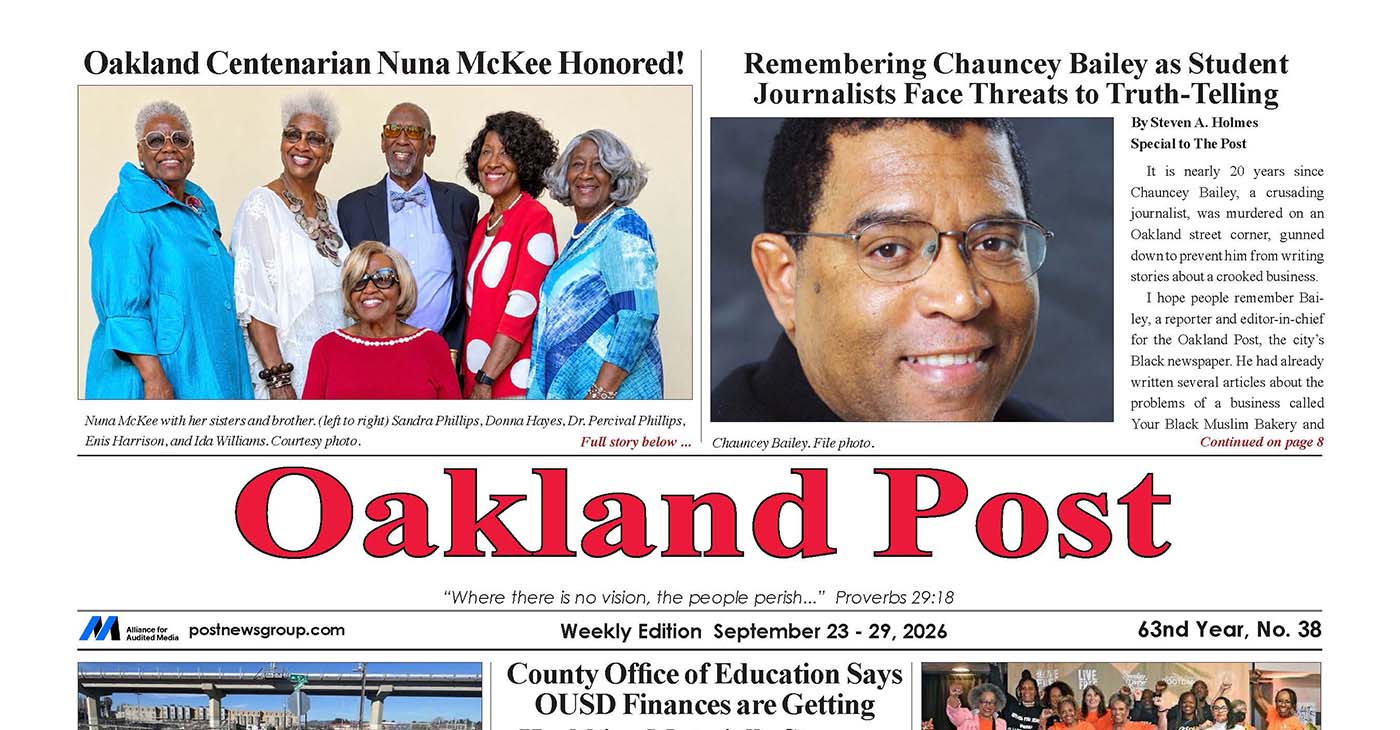
To enlarge your view of this issue, use the slider, magnifying glass icon or full page icon in the lower right corner of the browser window.
Activism
Oakland Post: Week of September 16 – 22, 2026
The printed Weekly Edition of the Oakland Post: Week of September 16 – 22, 2026
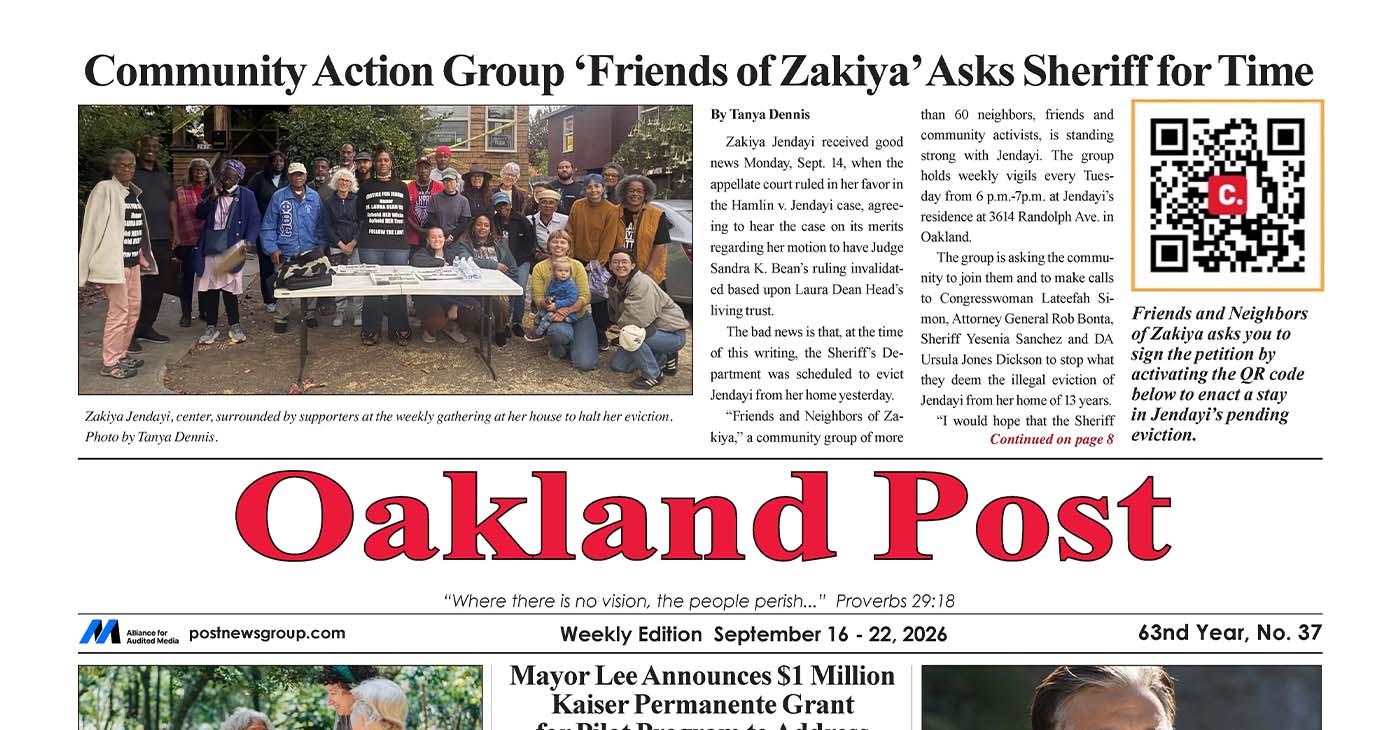
To enlarge your view of this issue, use the slider, magnifying glass icon or full page icon in the lower right corner of the browser window.
Activism
Oakland Post: Week of September 9 – 15, 2026
The printed Weekly Edition of the Oakland Post: Week of September 9 – 15, 2026
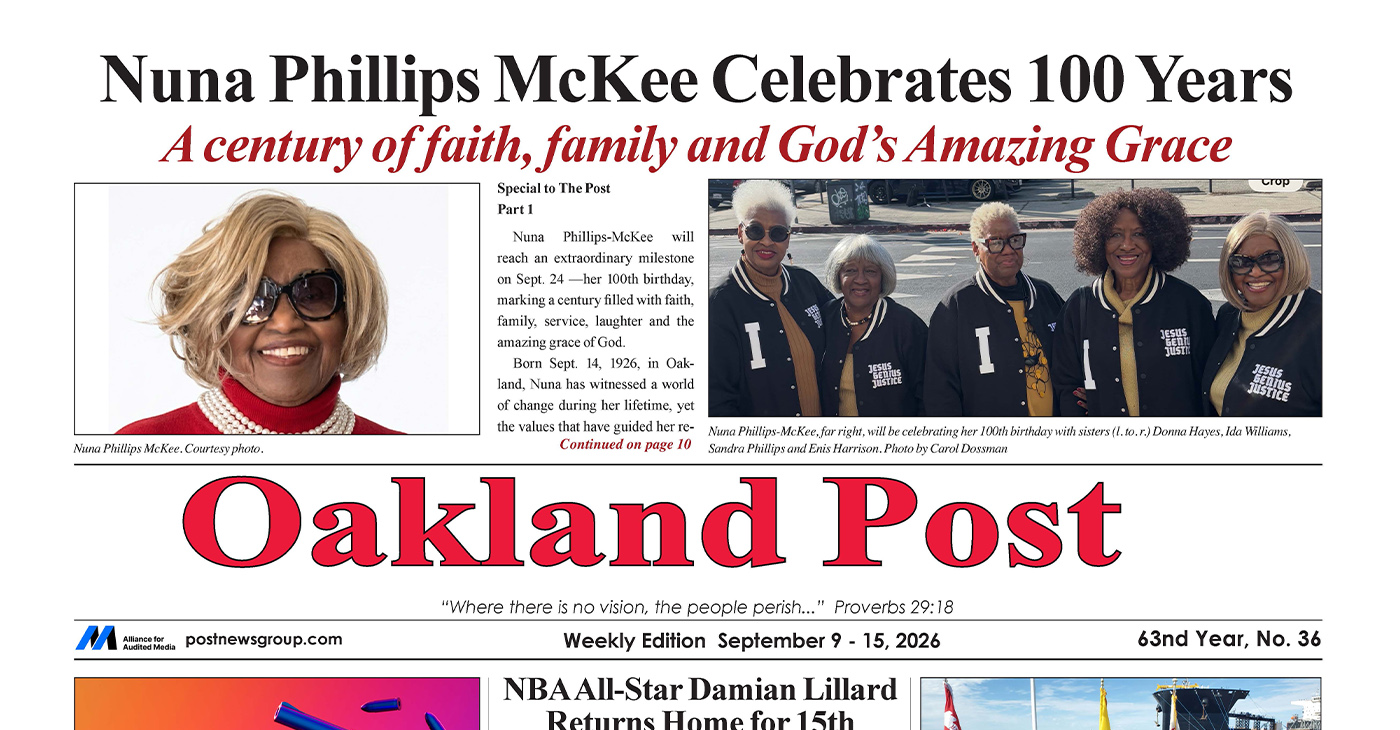
To enlarge your view of this issue, use the slider, magnifying glass icon or full page icon in the lower right corner of the browser window.



Asm. Corey Jackson Announces Launch of 24-Hour Childcare in His District

IN MEMORIAM: The Rev. Leon “Sonny” Clark, Longtime Orange County Pastor and Community Leader, Dies at 72

Poll: Becerra Widens His Lead Over Hilton; Californians Split on Wealth Tax

From Historic Memories to New Possibilities: Oakland Celebrates Coliseum 60

County Office of Education Says OUSD Finances Are Getting Healthier, Materially Stronger

LIVE FREE Sunday Dinner Brings Faith, Fellowship and Civic Conversation to Oakland

Remembering Chauncey Bailey as Student Journalists Face Threats to Truth-Telling

BLACspace Cooperative Invites Bay Area to Experience Oakland’s Black Cultural Ecosystem Through a BLAC Map Tour + Party

In Wake of Death on Doorstep, Williams Chapel Baptist Church Calls for Better Care, Funding for Unhoused

Oakland Centenarian Nuna McKee Honored!

Caribbean Nations Produce Action Plan Calling for UK Reparations Over Slavery

Oakland Post: Week of September 23 – 29, 2026

Doulas Are Helping Black California Moms Navigate Pregnancy–Even as High Mortality Rates Persist

Newsom Signs Addictive Social Media Law to Protect Kids

On Your November Ballot: Prop 38 Would Allocate $8.4 Billion to Immunology and Immunotherapy Funding

Less Affluent School Districts, Including Sacramento City, Face Threat of State Takeover

ESSAY: California Can Close Its Colorectal Cancer Gap

California Hispanic Chambers of Commerce Unveils: ‘Powering the Future’ Theme for 47th Annual Statewide Convention

Four Candidates, Including Incumbent Barbara Lee, Qualify for Oakland Mayor’s Race

Oakland Post: Week of August 12 – 18, 2026

From Blueprint to Breakthrough: Tackling Affordable Housing in Oakland

Oakland Observes Black August with Block Parties, Film Showings, Workshops

COMMENTARY: Why Local School Tax Measure G1 Will Not Be on the November Ballot

Standoff for Justice: Our Homes Are Worth Fighting For

Returning to Its Roots, the Oakland Black-Eyed Pea Festival Partners with the Freedom Farmers Market Sept. 12

Oakland Post: Week of August 26 – September 1, 2026

NPRC Scores First Advocacy Victory: David Shaw Finally Gets His Wish to ‘Go Home’

Frontier Airlines’ Return to Oakland Airport Brings Flights, Jobs and Opportunity

Gubernatorial Candidate Steve Hilton Blasts California New Tire Rules; Newsom Hits Back

Chef Sharon Lee Blends Culinary Excellence, Education and Empowerment

The Conversation With Al McFarlane 6/23/26

Media Monday 6/22/26

LIVE! ASK ALMA! — TUES. 6.23.26 7PM EST

Car Buying Secrets: 4 Hidden Checks Before You Sign!

Is This 550 HP Charger Worth YOUR Money? AutoNetwork Review

Celebrating Juneteenth – Frederick Douglass on education and resistance

LIVE! — ASK ALMA! — TUES. 6.19.26 7PM EST

Hyundai Ioniq 5 Parking, Safety, and 360 View #shorts

2025 Ioniq 5 New Wiper & Powerful Performance! #shorts

Electric SUV Range: Is 259 Miles Enough? #shorts

EV Charging: How Fast Can You Charge an Electric Vehicle? #shorts

Biometric Cooling… Messaging Seats…Come on! 2025 Infiniti QX80 Autograph 4WD

Charged Up: Witness the Magic of a Fully Electric Car! #shorts

Range Rover Sport PHEV Included…: See What’s Inside This Luxury SUV! #shorts

Invisible Hood View: Perfect Parking with X-Ray Vision! #shorts
-
 Commentary4 weeks ago
Standoff for Justice: Our Homes Are Worth Fighting For
-
 Activism4 weeks ago
Oakland Post: Week of August 26 – September 1, 2026
-
 Business4 weeks ago
Frontier Airlines’ Return to Oakland Airport Brings Flights, Jobs and Opportunity
-
 Business4 weeks ago
Gubernatorial Candidate Steve Hilton Blasts California New Tire Rules; Newsom Hits Back
-
 Business4 weeks ago
Chef Sharon Lee Blends Culinary Excellence, Education and Empowerment
-

 Community4 weeks ago
Big City Mayors Ask for “Yes” Vote on Housing Bond Measure; Conservatives Say “No”
-
 Black History4 weeks ago
Jackie Wright Champions Bay Area Stories, Filmmakers and Cultural Institutions
-

 Education4 weeks ago
Gov. Newsom’s Latest Appointees Include Sacramento Advocate for Formerly Incarcerated Students; State’s New Tech Chief
