
Bay Area
Proposed Office Tower Is ‘Direct Threat’ to Geoffrey’s Inner Circle, Community Leaders Say
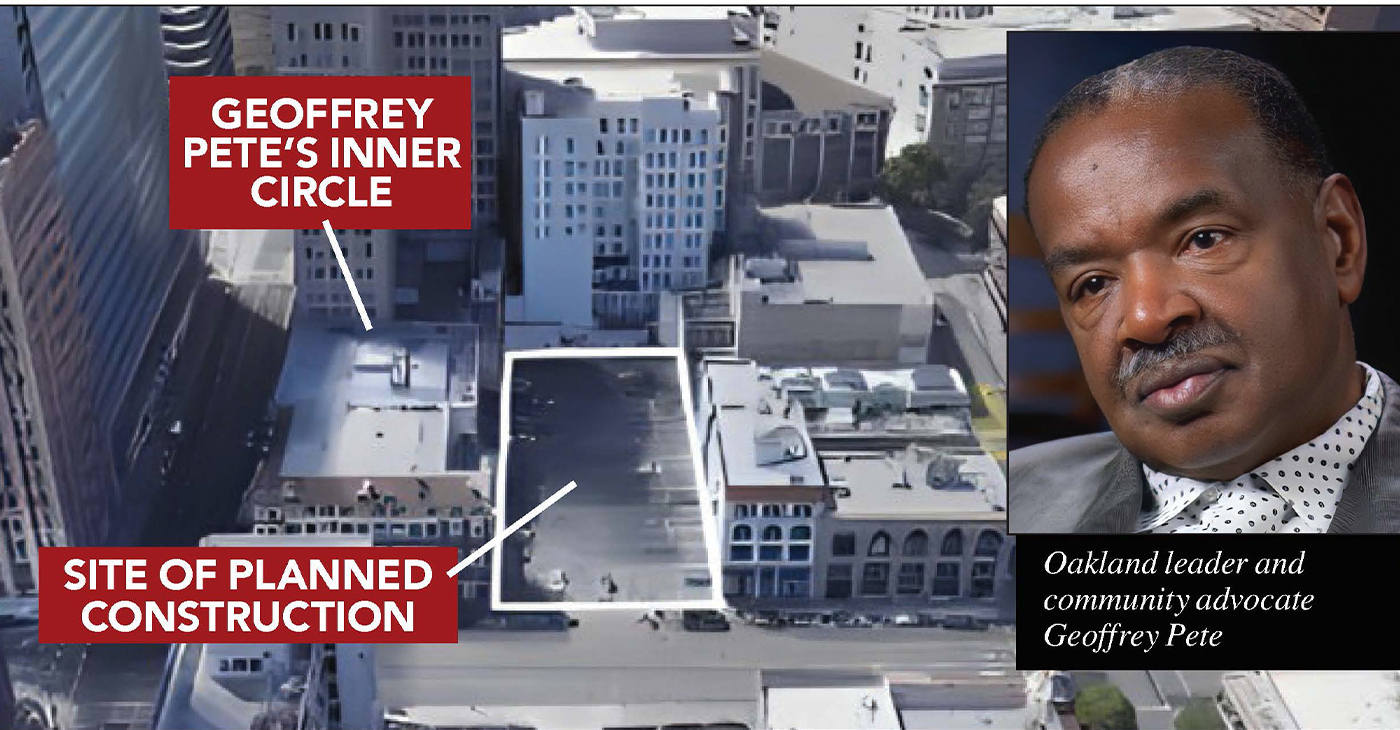
Supporters of Geoffrey’s Inner Circle, a revered downtown entertainment venue, and its owner, highly respected Oakland leader and community advocate Geoffrey Pete, want to block city approval for a 27-story office tower adjacent to Geoffrey’s and in the midst of Oakland’s Black Arts Movement and Business District (BAM). Protesters came out in force at a recent Planning Commission meeting, taking the members to task for considering the proposal by out-of-town developer Tidewater Capital.

By Ken Epstein
Supporters of Geoffrey’s Inner Circle, a revered downtown entertainment venue, and its owner, highly respected Oakland leader and community advocate Geoffrey Pete, want to block city approval for a 27-story office tower adjacent to Geoffrey’s and in the midst of Oakland’s Black Arts Movement and Business District (BAM).
Protesters came out in force at a recent Planning Commission meeting, taking the members to task for considering the proposal by out-of-town developer Tidewater Capital.
Some of the issues at stake were laid out at the meeting by Alameda County Supervisor Nate Miley, one of 26 speakers at the April 5 public hearing.
“The development (Tidewater) is proposing a direct threat to Geoffrey’s Inner Circle. The Black Arts Movement and Business District needs parking, galleries, a coffee shop, signage to commemorate Black Oaklanders – it needs all those things,” Miley said.
“Geoffrey’s used to be the Athenian Niles Club, where the Republican white male establishment would meet. African Americans were excluded, there was racial bias,” Miley continued. “Eventually Geoffrey purchased that place. Geoffrey’s means a lot to us who live in Oakland and have been here for a long, long time. It’s symbolic.”
Tidewater Capital has submitted two alternate development proposals – one for an office tower and another for a residential tower– to the Planning Commission to build on the parking lot at 1431 Franklin St., directly behind Geoffrey’s at 410 14th St.
The proposed 39-story residential building was approved by the Planning Commission in February and but was held up awaiting an appeal hearing at City Council. The other proposal for the 27-story office tower was heard by commissioners on April 5, but the final decision was postponed until May 17.
During discussion, planning commissioners acknowledged they went through the entire design review process for the building without knowing that the BAM district existed. The district was created in 2016 by City Council resolution but never implemented by city staff.
Oakland filmmaker Cheryl Fabio told commissioners she made a documentary on local blues music venues. “(Geoffrey’s) is the only surviving establishment. You’re killing off the last piece of it,” she said.
“There is a conversation here about the good of Oakland, and there’s a conversation that you’re putting a man out of business.”
Kitty Epstein, professor of urban studies and education and a 30-year Oakland resident, said, “This entire proposal and discussion by the Planning Commission is so full of racism that it’s embarrassing to me as a white person to watch this happen in this city.”
Citing racial bias in this case, Epstein pointed to the composition of the Planning Commission, which is not diverse; adding that only 9% of construction work in Oakland goes to African Americans; and that the “entire process has completely ignored that there’s a Black Arts district in that area. So unimportant was it to you and the Planning Department that you didn’t even bother to notice it until a month ago. And you have not put it into your plans yet.”
Mr. Pete asked the commission to postpone its decision. “We request a continuance of this meeting due to the pending appeal on the previous residential (development) approval for this site. (I) should not be penalized by having to file a second appeal on the very same grounds, while the first appeal is pending.”
Further, he said, “The Planning Commission erroneously approved a residential project despite admittedly conducting an improper review process. They ignored their own procedures with respect to review of projects within the BAM cultural district.”
He added, “The commission should not approve any other projects within the (BAM) district until they officially map BAM’s boundaries.”
Pete said the proposed skyscraper would throw his building into shadow, threaten the fire escape behind his building, and remove the parking lot his business needs for customers. In addition, he said, the vibrations from the construction of the project could jeopardize physical stability of his building.
In his remarks, construction director of Tidewater Capital, emphasized that his 10-year-old Bay Area company, which also owns and manages Eastmont Town Center in East Oakland, has conducted extensive community engagement.
“(We) try to take a “hands-on, collaborative approach to create spaces that preserve the character of the neighborhood while boosting economic activity and generating benefits for all stakeholders,” he said.
In their discussion, planning commissioners voted to postpone the decision on the project to give Mr. Pete time to reach an agreement with Tidewater. However, they expressed little interest in considering speakers’ suggestions to reject the project or postpone a decision until the city’s BAM district in downtown Oakland was implemented and funded.














Activism
Oakland Post: Week of September 23 – 29, 2026
The printed Weekly Edition of the Oakland Post: Week of September 23 – 29, 2026

To enlarge your view of this issue, use the slider, magnifying glass icon or full page icon in the lower right corner of the browser window.
Activism
Oakland Post: Week of September 16 – 22, 2026
The printed Weekly Edition of the Oakland Post: Week of September 16 – 22, 2026

To enlarge your view of this issue, use the slider, magnifying glass icon or full page icon in the lower right corner of the browser window.
Activism
Oakland Post: Week of September 9 – 15, 2026
The printed Weekly Edition of the Oakland Post: Week of September 9 – 15, 2026

To enlarge your view of this issue, use the slider, magnifying glass icon or full page icon in the lower right corner of the browser window.



Asm. Corey Jackson Announces Launch of 24-Hour Childcare in His District

IN MEMORIAM: The Rev. Leon “Sonny” Clark, Longtime Orange County Pastor and Community Leader, Dies at 72

Poll: Becerra Widens His Lead Over Hilton; Californians Split on Wealth Tax

From Historic Memories to New Possibilities: Oakland Celebrates Coliseum 60

County Office of Education Says OUSD Finances Are Getting Healthier, Materially Stronger

LIVE FREE Sunday Dinner Brings Faith, Fellowship and Civic Conversation to Oakland

Remembering Chauncey Bailey as Student Journalists Face Threats to Truth-Telling

BLACspace Cooperative Invites Bay Area to Experience Oakland’s Black Cultural Ecosystem Through a BLAC Map Tour + Party

In Wake of Death on Doorstep, Williams Chapel Baptist Church Calls for Better Care, Funding for Unhoused

Oakland Centenarian Nuna McKee Honored!

Caribbean Nations Produce Action Plan Calling for UK Reparations Over Slavery

Oakland Post: Week of September 23 – 29, 2026

Doulas Are Helping Black California Moms Navigate Pregnancy–Even as High Mortality Rates Persist

Newsom Signs Addictive Social Media Law to Protect Kids

On Your November Ballot: Prop 38 Would Allocate $8.4 Billion to Immunology and Immunotherapy Funding

Standoff for Justice: Our Homes Are Worth Fighting For

Oakland Post: Week of August 26 – September 1, 2026

Frontier Airlines’ Return to Oakland Airport Brings Flights, Jobs and Opportunity

Gubernatorial Candidate Steve Hilton Blasts California New Tire Rules; Newsom Hits Back

Chef Sharon Lee Blends Culinary Excellence, Education and Empowerment

Jackie Wright Champions Bay Area Stories, Filmmakers and Cultural Institutions

Big City Mayors Ask for “Yes” Vote on Housing Bond Measure; Conservatives Say “No”

Oakland Coliseum Project Opens Door for Small Businesses to Build Bigger

Gov. Newsom’s Latest Appointees Include Sacramento Advocate for Formerly Incarcerated Students; State’s New Tech Chief

Misnamed ‘Parent’ PAC Seeks to Influence Oakland School Board Elections

Longtime BWOPA Member Brendalyn Goodall Appointed to California Workforce Development Board

Gov. Newsom Signs Law Shielding Immigration Aid Workers From Doxing Threats

Secretary of State Shirley N. Weber Urges Californians to Vote Early as Voter ID Battle Intensifies

From Palestine to Oakland: Seeds for Liberation Examines Shared Struggles for Freedom

IN MEMORIAM: Dolly Parton Dead at 80 — How She Built a Legacy of Love and Earned Her Place in Black Culture

The Conversation With Al McFarlane 6/23/26

Media Monday 6/22/26

LIVE! ASK ALMA! — TUES. 6.23.26 7PM EST

Car Buying Secrets: 4 Hidden Checks Before You Sign!

Is This 550 HP Charger Worth YOUR Money? AutoNetwork Review

Celebrating Juneteenth – Frederick Douglass on education and resistance

LIVE! — ASK ALMA! — TUES. 6.19.26 7PM EST

Hyundai Ioniq 5 Parking, Safety, and 360 View #shorts

2025 Ioniq 5 New Wiper & Powerful Performance! #shorts

Electric SUV Range: Is 259 Miles Enough? #shorts

EV Charging: How Fast Can You Charge an Electric Vehicle? #shorts

Biometric Cooling… Messaging Seats…Come on! 2025 Infiniti QX80 Autograph 4WD

Charged Up: Witness the Magic of a Fully Electric Car! #shorts

Range Rover Sport PHEV Included…: See What’s Inside This Luxury SUV! #shorts

Invisible Hood View: Perfect Parking with X-Ray Vision! #shorts
-
 Community2 weeks ago
Misnamed ‘Parent’ PAC Seeks to Influence Oakland School Board Elections
-

 Activism3 weeks ago
Oakland Post: Week of September 2 – 8, 2026
-

 Community2 weeks ago
Richmond Tiny House Village Farm & Garden Set to Open Gates on Sept. 26
-

 Black History2 weeks ago
OPINION: Nolan Wells’ Death One of Several Signifying Racial Terror Lives on in U.S. South
-

 Black History2 weeks ago
Latest Massacre in Haiti Reveals Cruelty U.S. Deportations
-

 Activism2 weeks ago
Oakland Post: Week of September 9 – 15, 2026
-

 Community2 weeks ago
Democratic Clubs Interview Candidates for Oakland School Board
-

 Featured2 weeks ago
‘Ready to See These Bills Become Law’: Sen. Weber’s Package of 15 Bills Advance to Gov. Newsom’s Desk
