
Bay Area
Unapologetically Black Mayor of Bay View Hunters Point Charlie Walker Leaves SF Legacy
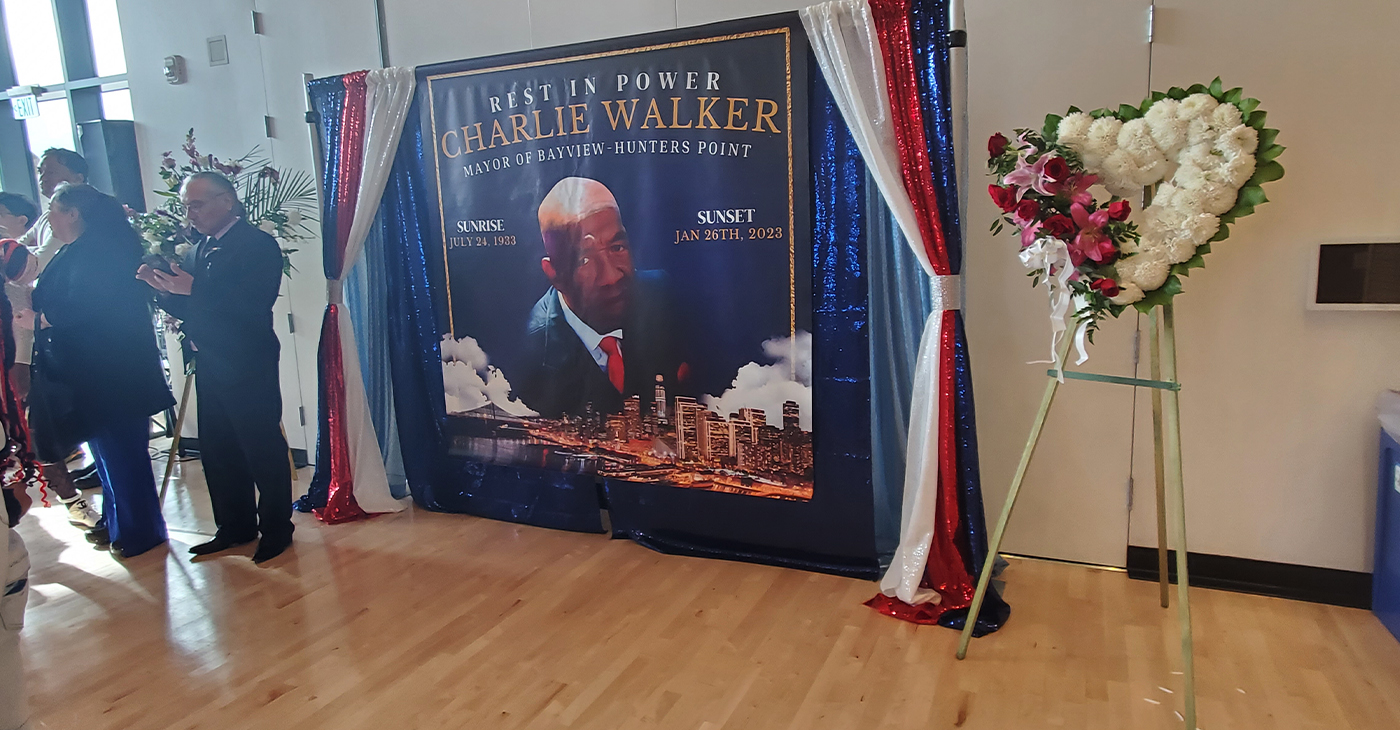
A celebration of life for the mayor of Bay View Hunters Point, businessman Charlie Walker, was held on Friday, Feb. 10 at Third Street Baptist Church in San Francisco. Walker passed away just six months shy of his 90th birthday on Jan. 26.

By Carla Thomas
A celebration of life for the mayor of Bay View Hunters Point, businessman Charlie Walker, was held on Friday, Feb. 10 at Third Street Baptist Church in San Francisco. Walker passed away just six months shy of his 90th birthday on Jan. 26.
Born in the South, Walker relocated to San Francisco in his early teens and faked his birth certificate to join the Air Force, where he served for three years. He returned to the city and started — with one truck — his first trucking business.
He went on to become such a renowned figure in the community that he became its unofficial mayor: Arching over Walker’s casket were hundreds of flowers in blue and red spelling: Mayor of BVHP, Bay View Hunters Point.
Through an all day and night series of events, Walker was remembered as a community titan who never gave up as he fought racism and blazed a legacy for his family and the community, while opening doors for fairness in contracting in San Francisco.
Eulogized by Third Baptist pastor Rev. Dr. Amos Brown, Walker was described as a fearless businessman who never gave up a fight.
Brown described one of the many times Walker spoke up for the community. To get his point across at a school board meeting where others were backing down, Brown said Walker jumped up on the table and demanded support for youth of the San Francisco Unified School District.
Story after story revealed the truth about a man that stood for racial equity in contracts and civil rights.
“Today we are celebrating a servant of the people, a champion of social justice, an entrepreneur, and our brother in ‘good trouble,’” said Brown.
Close friend, former San Francisco Mayor Willie Brown recalled the early days and their longtime friendship. Brown described Walker as extraordinary in that while Walker’s companies held some of the largest civic contracts like BART, he and his wife of 63 years, Annette Walker, demonstrated kindness by inviting people with nowhere else to go to his home for every holiday.
“He did social work and wasn’t a social worker. He was heavy duty into education, a community organizer and he was able to brilliantly drown out the noise of racism and distractions to change the city for the better,” said Willie Brown.
In the 1970s, Walker was known for chaining trucks together on construction sites where Black people had not been hired. In 1971, he secured a lucrative contract to clean up an oil spill after two oil tankers collided under the Golden Gate Bridge spilling tons of oil in the Bay.
In a 30-page commemorative booklet of his life, Walker said: “I made $5 million in 30 days.”
“America is still the place” he was often quoted as saying. In Walker’s heart, only in America could a son of sharecroppers, a grandson of slaves, with not even a high school education garner such success. “America Is Still the Place,” the book Walker wrote on that chapter in his life has been adapted into the major 2022 film, “I’m Charlie Walker,” funded by his friend Bill O’Keefe and starring actor Mike Colter as Walker.
San Francisco Mayor London Breed fondly remembered Walker as a friend, supporter and fighter who stood up to white people at a time when Blacks could suffer repercussions.
“He drew attention to the many injustices and stood up for what was right at a time when Black people could be concerned for their lives. Charlie did not back down,” she said.
For San Francisco Councilmember Shamann Walton, Walker was a mentor he referred to as “Uncle Charlie.” “He knew his power when he entered a room and no matter where he was, no matter the conversation, and no matter who was around, he was unapologetically Black and paved the way for me to do the same.”
Businessmen Shelly Tatum and Timothy Alan Simon referred to Walker as a “once-in-a-generation thought leader, businessman, advocate and revolutionary.”
“This gathering is a testament to how much he loved the community, and the community loved him,” said Simon. “His legacy will live on,” said Tatum.
Businessman Dwayne Jones, former Young Community Developers director, said, “He helped me transform my trajectory from a nonprofit director into an entrepreneur and to be unapologetically Black about it.”
Walker’s granddaughter Lyn-Tise Jones read the opening scripture at the service (2 Timothy 1:7) “God has not given us a spirit of fear, but of power, love, and a sound mind.”
“If you knew anything about my grandfather you knew he wasn’t afraid of nothing or nobody. He lived fiercely and ferociously for his family, his friends and his beloved community,” said Jones.
Walker’s granddaughter Geoffrea Morris read letters of acknowledgement from U.S. Vice President Kamala Harris, U.S. Congresswoman Barbara Lee, Gov. Gavin Newsom, Assemblymember Matt Haney and State Controller Malia Cohen.
A reading included Walker’s favorite poem entitled, “A Gentleman” written by Beverly Al-Kareem.
Family member Crystal Walker sang “Trouble of the World.”
While fighting the troubles of the world Walker blazed a trail creating businesses, opportunities, and promoting education. Walker’s dreams produced lawyers, doctors, engineers and dentists in the family.
Until her untimely death, Walker’s daughter, Yolanda Jones took up the trucking business, which was how her father started out. She had headed Yolanda’s Construction Administration and Traffic Control, where the company secured government contracts and hired and trained people of the community on the business, opening doors of opportunity to members of a sidelined community.
For Minister Abdul Rashidullah Muhammad, Walker was a welcoming bridge when his mosque moved into the neighborhood. “Charlie’s living was not in vain. He didn’t let anyone put him down. He used his time to help people,” he said.
Maestro Curtis of the Curtis Family C-Notes credited Walker with helping him create a music studio early in his career. “Walker took me to the music store and purchased everything I needed, $20,000 worth of equipment. Who does that? Because of the quality of music I was able to produce in that studio, I was signed to Earth, Wind and Fire’s label.
A procession of vehicles from Gilman Street traveled past Walker’s Bret Harte Middle School to the New Southeast Community Center along Third Street. A flatbed truck bearing Walker’s mega image with a dozen of his grandchildren in tow, led the way with police and the Kings of Cali Motorcycle Club as traffic escorts.
At the New Southeast Community Center, an art tribute in honor of Walker produced by Malik Seneferu showed the many facets of Walker’s life. From articles of clothing to photographs in Africa and meetings with heads of state, each item included a scannable QR code providing the item’s context with additional video.
Later that evening, SF Black Wallstreet presented a Lenny Williams concert in Walker’s honor. The audience danced and sang along to Williams’ hits, as the famous R&B crooner belted out “’Cause I Love You,” “This Time It’s Real,” and “You’re Still A Young Man,” among others. “Charlie was a man of the people, and we will miss him,” said Williams.










Activism
Oakland Post: Week of September 23 – 29, 2026
The printed Weekly Edition of the Oakland Post: Week of September 23 – 29, 2026

To enlarge your view of this issue, use the slider, magnifying glass icon or full page icon in the lower right corner of the browser window.
Activism
Oakland Post: Week of September 16 – 22, 2026
The printed Weekly Edition of the Oakland Post: Week of September 16 – 22, 2026

To enlarge your view of this issue, use the slider, magnifying glass icon or full page icon in the lower right corner of the browser window.
Activism
Oakland Post: Week of September 9 – 15, 2026
The printed Weekly Edition of the Oakland Post: Week of September 9 – 15, 2026

To enlarge your view of this issue, use the slider, magnifying glass icon or full page icon in the lower right corner of the browser window.


Asm. Corey Jackson Announces Launch of 24-Hour Childcare in His District

IN MEMORIAM: The Rev. Leon “Sonny” Clark, Longtime Orange County Pastor and Community Leader, Dies at 72

Poll: Becerra Widens His Lead Over Hilton; Californians Split on Wealth Tax

From Historic Memories to New Possibilities: Oakland Celebrates Coliseum 60

County Office of Education Says OUSD Finances Are Getting Healthier, Materially Stronger

LIVE FREE Sunday Dinner Brings Faith, Fellowship and Civic Conversation to Oakland

Remembering Chauncey Bailey as Student Journalists Face Threats to Truth-Telling

BLACspace Cooperative Invites Bay Area to Experience Oakland’s Black Cultural Ecosystem Through a BLAC Map Tour + Party

In Wake of Death on Doorstep, Williams Chapel Baptist Church Calls for Better Care, Funding for Unhoused

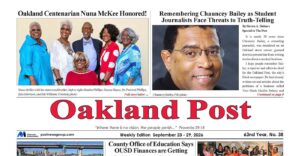
Oakland Centenarian Nuna McKee Honored!

Caribbean Nations Produce Action Plan Calling for UK Reparations Over Slavery

Oakland Post: Week of September 23 – 29, 2026

Doulas Are Helping Black California Moms Navigate Pregnancy–Even as High Mortality Rates Persist

Newsom Signs Addictive Social Media Law to Protect Kids

On Your November Ballot: Prop 38 Would Allocate $8.4 Billion to Immunology and Immunotherapy Funding

Standoff for Justice: Our Homes Are Worth Fighting For

Oakland Post: Week of August 26 – September 1, 2026

Frontier Airlines’ Return to Oakland Airport Brings Flights, Jobs and Opportunity

Gubernatorial Candidate Steve Hilton Blasts California New Tire Rules; Newsom Hits Back

Chef Sharon Lee Blends Culinary Excellence, Education and Empowerment

Jackie Wright Champions Bay Area Stories, Filmmakers and Cultural Institutions

Big City Mayors Ask for “Yes” Vote on Housing Bond Measure; Conservatives Say “No”

Gov. Newsom’s Latest Appointees Include Sacramento Advocate for Formerly Incarcerated Students; State’s New Tech Chief

Oakland Coliseum Project Opens Door for Small Businesses to Build Bigger

Misnamed ‘Parent’ PAC Seeks to Influence Oakland School Board Elections

Longtime BWOPA Member Brendalyn Goodall Appointed to California Workforce Development Board

Gov. Newsom Signs Law Shielding Immigration Aid Workers From Doxing Threats

Secretary of State Shirley N. Weber Urges Californians to Vote Early as Voter ID Battle Intensifies

From Palestine to Oakland: Seeds for Liberation Examines Shared Struggles for Freedom

IN MEMORIAM: Dolly Parton Dead at 80 — How She Built a Legacy of Love and Earned Her Place in Black Culture

The Conversation With Al McFarlane 6/23/26

Media Monday 6/22/26

LIVE! ASK ALMA! — TUES. 6.23.26 7PM EST

Car Buying Secrets: 4 Hidden Checks Before You Sign!

Is This 550 HP Charger Worth YOUR Money? AutoNetwork Review

Celebrating Juneteenth – Frederick Douglass on education and resistance

LIVE! — ASK ALMA! — TUES. 6.19.26 7PM EST

Hyundai Ioniq 5 Parking, Safety, and 360 View #shorts

2025 Ioniq 5 New Wiper & Powerful Performance! #shorts

Electric SUV Range: Is 259 Miles Enough? #shorts

EV Charging: How Fast Can You Charge an Electric Vehicle? #shorts

Biometric Cooling… Messaging Seats…Come on! 2025 Infiniti QX80 Autograph 4WD

Charged Up: Witness the Magic of a Fully Electric Car! #shorts

Range Rover Sport PHEV Included…: See What’s Inside This Luxury SUV! #shorts

Invisible Hood View: Perfect Parking with X-Ray Vision! #shorts
-
 Business4 weeks ago
Chef Sharon Lee Blends Culinary Excellence, Education and Empowerment
-
 Black History4 weeks ago
Jackie Wright Champions Bay Area Stories, Filmmakers and Cultural Institutions
-
 Community4 weeks ago
Big City Mayors Ask for “Yes” Vote on Housing Bond Measure; Conservatives Say “No”
-
 Community2 weeks ago
Misnamed ‘Parent’ PAC Seeks to Influence Oakland School Board Elections
-
 Business4 weeks ago
Longtime BWOPA Member Brendalyn Goodall Appointed to California Workforce Development Board
-
 Community4 weeks ago
Gov. Newsom Signs Law Shielding Immigration Aid Workers From Doxing Threats
-

 Activism3 weeks ago
Oakland Post: Week of September 2 – 8, 2026
-
 Featured4 weeks ago
‘Passing a Law Isn’t The Finish Line’: California Assembly Evaluates Implementation, Results
