
Activism
Councilmember Loren Taylor Supports Rezoning ‘Portion’ of Mills College for Development
The Huntington News, the Northeastern University independent newspaper, quoted Meena Ramakrishnan, a 2013 Northeastern graduate who obtained a master’s degree from Mills in 2022. “It is part and parcel of Mills’ DNA that marginalized folks are given an education. It’s part of the educational curriculum, the staff, and the faculty they hire are people of color or disabled folk or gender non-conforming people. It’s been like that for a long time, and so there is a lot of disappointment on campus that Northeastern does not share that kind of ethos and those values, and that they’re going to come in and attempt to change the fabric of Mills


By Ken Epstein
District 6 Councilmember and candidate for mayor Loren Taylor says he is in favor of office buildings, retail, and residential development on a “portion” of the 135-acre campus of Mills College at Northeastern, which is in his council district.
The proposed zoning change came to light two weeks in ago in a report to City Council. Buried in a draft plan for future housing in Oakland, submitted to City Council by Mayor Libby Schaaf’s Administration, is a map of zoning changes that would allow for higher density real estate development, including condominiums and retail.
While city staff did not say who had submitted the proposed zoning change, and Schaaf did not reply to questions from the Post, Taylor did discuss his position in a text to the Post.
“I am not opposed to rezoning a portion of the site – not all of it. (I) need to better explore the plan of the current zoning to have a definitive response,” he told the Post in a text.
“There have been several proposals submitted to my understanding, from affordable housing to small footprint corporate offices to much-needed East Oakland retail,” he continued. He added, “I haven’t seen/review(ed) them, though. As I understand it, every proposal retains the vast majority of the campus for higher education through Mills/Northeastern. (However,) I don’t know what has transpired since Northeastern took over.”
Taylor also said he did not know who requested the rezoning of Mills at Northeastern nor did he know what Schaaf’s position is on the rezoning proposal.
Mills College officially merged with Northeastern University on June 30, 2022, despite considerable opposition from students, faculty, alumnae and supporters in the community.
The map shows the entire Mills campus in East Oakland as changed from zoning designation “RM-4 Mixed Housing Type Residential – 4 Zone.”
According to the City’s definition, “The intent of the RM-4 Zone is to create, maintain, and enhance residential areas typically located on or near the City’s major arterials and characterized by a mix of single-family homes, townhouses, small multi-unit buildings at somewhat higher densities than RM-3, and neighborhood businesses where appropriate.”
City Council staff indicate that the RM-4 Zone would permit the development of the entire site with condominiums, townhouses, and retail businesses.
The current zoning of the Mills property, RM-3 Zone, has been in place for at least the past 20 years, according to a staff member in the City’s zoning division. Dramatic changes are now in the works after Northeastern University in Boston took over Mills, with pledges of a merger of many of the best aspects of both institutions.
Taylor has been outspoken in support of the takeover of Mills by Northeastern, as has Schaaf, with whom he has been closely allied.
According to an article in the Northeastern University (NU) newsletter, Taylor has been deeply involved in the merger discussions between the university and Mills.
“Taylor says he was involved in talks with the college and university as the merger evolved from idea to reality. ‘When I’ve had conversations with leadership at Mills and Northeastern,’ Taylor says, ‘I’ve always come away reassured. I hear, feel, and sense that there’s a true commitment to ensuring the legacy of what Mills had. I look forward to seeing that happen,’” the NU newsletter said.
Though the proposal is to rezone the entire 135 acres of the campus, City staff told the Post that only part of the campus was being considered for development.
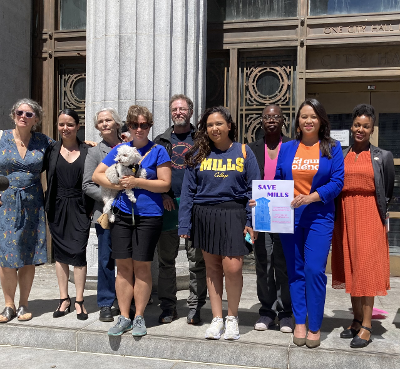
Press conference on July 19, 2022, at Oakland City Hall supports fight to save Mills College and calls for an independent state investigation of the merger with Northeastern University. “This merger was sudden, confusing, and done with very little transparency,” said Councilmember Sheng Thao, a Mills graduate. Photo courtesy of the Office of Sheng Thao.
“The undeveloped western edge of the Mills College campus adjacent to MacArthur Blvd. was identified as a potential location for the addition of infill housing. Any rezoning of that portion of the campus would only occur if the community and decisionmakers support such a change and only for the purpose of facilitating the addition of housing along this undeveloped campus edge,” according to the City’s zoning staff.
The Housing Element, including zoning changes, is scheduled – following discussion and modification – for a final decision in January.
A lawsuit against the merger between the two institutions has been filed, and the coalition of groups and individuals working to Save Mills is still pushing for a state or federal investigation of the merger.
A June 6, 2022, a headline in the Huntington News, the Northeastern University independent newspaper, stated, “Some Mills College Students, Alumni, Upset by Northeastern merger.”
The newspaper quoted Meena Ramakrishnan, a 2013 Northeastern graduate who obtained a master’s degree from Mills in 2022.
“It is part and parcel of Mills’ DNA that marginalized folks are given an education. It’s part of the educational curriculum, the staff, and the faculty they hire are people of color or disabled folk or gender non-conforming people. It’s been like that for a long time, and so there is a lot of disappointment on campus that Northeastern does not share that kind of ethos and those values, and that they’re going to come in and attempt to change the fabric of Mills.”
While Mills has been a liberal arts college for generations, “Northeastern has a reputation for science and business oriented studies, (and) it was considered a predominantly white institution until 2014, and white students still overwhelm other groups at Northeastern,” according to the news article.
The article continues: “Racist incidents at Northeastern are a cause for concern for the students of color who call Mills their home. As recently as 2019, the #HereAtNU and #NUExperience student movement saw dozens of students of color sharing their experiences with racism and discrimination at the university, with #BlackAtNU forming for students to demand improvement.”
“There were incidents where the campus police were targeting students of color, mainly Black males. So, my question is — are you bringing that foolishness here?” asked Tasha Poullard, a Mills graduate quoted in the Northeastern newspaper.
“Mills College — in my personal opinion — is one of the calmest, most serene and safe campuses I’ve ever been on,” Poullard said.














Activism
Oakland Post: Week of September 23 – 29, 2026
The printed Weekly Edition of the Oakland Post: Week of September 23 – 29, 2026

To enlarge your view of this issue, use the slider, magnifying glass icon or full page icon in the lower right corner of the browser window.
Activism
Oakland Post: Week of September 16 – 22, 2026
The printed Weekly Edition of the Oakland Post: Week of September 16 – 22, 2026

To enlarge your view of this issue, use the slider, magnifying glass icon or full page icon in the lower right corner of the browser window.
Activism
Oakland Post: Week of September 9 – 15, 2026
The printed Weekly Edition of the Oakland Post: Week of September 9 – 15, 2026

To enlarge your view of this issue, use the slider, magnifying glass icon or full page icon in the lower right corner of the browser window.



Asm. Corey Jackson Announces Launch of 24-Hour Childcare in His District

IN MEMORIAM: The Rev. Leon “Sonny” Clark, Longtime Orange County Pastor and Community Leader, Dies at 72

Poll: Becerra Widens His Lead Over Hilton; Californians Split on Wealth Tax

From Historic Memories to New Possibilities: Oakland Celebrates Coliseum 60

County Office of Education Says OUSD Finances Are Getting Healthier, Materially Stronger

LIVE FREE Sunday Dinner Brings Faith, Fellowship and Civic Conversation to Oakland

Remembering Chauncey Bailey as Student Journalists Face Threats to Truth-Telling

BLACspace Cooperative Invites Bay Area to Experience Oakland’s Black Cultural Ecosystem Through a BLAC Map Tour + Party

In Wake of Death on Doorstep, Williams Chapel Baptist Church Calls for Better Care, Funding for Unhoused

Oakland Centenarian Nuna McKee Honored!

Caribbean Nations Produce Action Plan Calling for UK Reparations Over Slavery

Oakland Post: Week of September 23 – 29, 2026

Doulas Are Helping Black California Moms Navigate Pregnancy–Even as High Mortality Rates Persist

Newsom Signs Addictive Social Media Law to Protect Kids

On Your November Ballot: Prop 38 Would Allocate $8.4 Billion to Immunology and Immunotherapy Funding

Standoff for Justice: Our Homes Are Worth Fighting For

Oakland Post: Week of August 26 – September 1, 2026

Frontier Airlines’ Return to Oakland Airport Brings Flights, Jobs and Opportunity

Gubernatorial Candidate Steve Hilton Blasts California New Tire Rules; Newsom Hits Back

Chef Sharon Lee Blends Culinary Excellence, Education and Empowerment

Jackie Wright Champions Bay Area Stories, Filmmakers and Cultural Institutions

Big City Mayors Ask for “Yes” Vote on Housing Bond Measure; Conservatives Say “No”

Oakland Coliseum Project Opens Door for Small Businesses to Build Bigger

Gov. Newsom’s Latest Appointees Include Sacramento Advocate for Formerly Incarcerated Students; State’s New Tech Chief

Misnamed ‘Parent’ PAC Seeks to Influence Oakland School Board Elections

Longtime BWOPA Member Brendalyn Goodall Appointed to California Workforce Development Board

Gov. Newsom Signs Law Shielding Immigration Aid Workers From Doxing Threats

Secretary of State Shirley N. Weber Urges Californians to Vote Early as Voter ID Battle Intensifies

From Palestine to Oakland: Seeds for Liberation Examines Shared Struggles for Freedom

IN MEMORIAM: Dolly Parton Dead at 80 — How She Built a Legacy of Love and Earned Her Place in Black Culture

The Conversation With Al McFarlane 6/23/26

Media Monday 6/22/26

LIVE! ASK ALMA! — TUES. 6.23.26 7PM EST

Car Buying Secrets: 4 Hidden Checks Before You Sign!

Is This 550 HP Charger Worth YOUR Money? AutoNetwork Review

Celebrating Juneteenth – Frederick Douglass on education and resistance

LIVE! — ASK ALMA! — TUES. 6.19.26 7PM EST

Hyundai Ioniq 5 Parking, Safety, and 360 View #shorts

2025 Ioniq 5 New Wiper & Powerful Performance! #shorts

Electric SUV Range: Is 259 Miles Enough? #shorts

EV Charging: How Fast Can You Charge an Electric Vehicle? #shorts

Biometric Cooling… Messaging Seats…Come on! 2025 Infiniti QX80 Autograph 4WD

Charged Up: Witness the Magic of a Fully Electric Car! #shorts

Range Rover Sport PHEV Included…: See What’s Inside This Luxury SUV! #shorts

Invisible Hood View: Perfect Parking with X-Ray Vision! #shorts
-
 Community2 weeks ago
Misnamed ‘Parent’ PAC Seeks to Influence Oakland School Board Elections
-

 Activism3 weeks ago
Oakland Post: Week of September 2 – 8, 2026
-

 Community2 weeks ago
Richmond Tiny House Village Farm & Garden Set to Open Gates on Sept. 26
-

 Black History2 weeks ago
OPINION: Nolan Wells’ Death One of Several Signifying Racial Terror Lives on in U.S. South
-

 Black History2 weeks ago
Latest Massacre in Haiti Reveals Cruelty U.S. Deportations
-

 Activism2 weeks ago
Oakland Post: Week of September 9 – 15, 2026
-

 Community2 weeks ago
Democratic Clubs Interview Candidates for Oakland School Board
-

 Featured2 weeks ago
‘Ready to See These Bills Become Law’: Sen. Weber’s Package of 15 Bills Advance to Gov. Newsom’s Desk
