
Activism
OP-ED: Just Say No to the A’s at Howard Terminal
The voters said they wanted the right to weigh in on whether to spend public funds on the Howard Terminal project. The Council refused to place a measure on the ballot, saying no public funds would be spent and they preferred a financial review before such a vote could be scheduled. But the City never did the financial review.

What an absolute mess! The City of Oakland promotes a baseball stadium and luxury real estate development at Howard Terminal for the Oakland A’s, but it has not completed a financial analysis of risk and benefits associated with the project. It does not know what the project will cost, how it will be paid for, how many public dollars will be spent, and how much the City is at risk for anticipated cost overruns that are likely because of changing economic conditions due to inflation.
This situation is worse than the Raiders debacle at the Oakland Coliseum. You would think that once burned, the City would make sure that would not happen again.
But here we are.
Public funds from the city, county, state, and federal government will exceed $1 billion. Worse, because of changing economic conditions, the City now admits for the first time that anticipated cost overruns could pose a risk to the city of Oakland. The City Administrator won’t say how much is at stake, because he doesn’t want to “throw numbers around.” But a source close to the A’s said some estimates have pegged the cost to the city to be more than $300 million.

Before we go further, let’s be reminded how we got here. Last spring, the voters of Oakland asked the City Council to place an advisory vote on the November ballot on whether any public funds should be spent on billionaire John Fisher’s baseball and luxury real-estate deal at Howard Terminal. That request was denied.
On April 28, 2022, Councilmember Noel Gallo convinced the City Council to unanimously vote to have an independent analysis done on the risks and benefits of the project. The analysis was scheduled to be presented to the public on Sept. 20. When the date came around for the report, the City had not done the analysis even though five months had passed since it was approved.
On Sept. 20, after the meeting started, staff sent out an e-mail with an attached 18-page report that was chock full of new data and a dire warning that “significant increases in costs are anticipated and there are not yet sufficient funds currently in-hand to cover the estimated costs of the off-site infrastructure (on the project). As a result, under the current structure, there is a risk that the City would be required to fund the remaining costs as well as any cost overruns, each of which may prove significant.”
Councilmembers were stunned. They had been assured that the City would have no risks, but the report included an admission that the City could be at risk and the amounts may prove significant. Councilmember Carroll Fife asked how much was at stake. The City Administrator refused to give an estimate.
So, again, here we are.
The voters said they wanted the right to weigh in on whether to spend public funds on the Howard Terminal project. The Council refused to place a measure on the ballot, saying no public funds would be spent and they preferred a financial review before such a vote could be scheduled. But the City never did the financial review.
This process has been a disaster. Promises made have been reneged on. Assurances that no public funds would be used, and that the City would not have risks turned out to be false. Oakland voters demanded the right to be heard on whether public finds should be spent, but they were turned down.
This is the same kind of incompetence and lack of transparency displayed during the Raiders deal. But the amounts at risk on this deal make the money spent on the Raiders look like chump change.
The Oakland City Council needs to put this on pause and figure out all the details before anything moves forward. Now, more than ever, City Council must insist on an independent financial analysis on the costs and risks of the project. Since public funds are clearly being spent, and the administration now admits Oakland has financial risks, City Council needs to revisit the question of letting the voters weigh in. As Councilmember Dan Kalb said previously, if that requires a special election, so be it.
Is the Council woke yet? They have been bullied, misled, and disrespected in this entire process. Transparency be damned! Will they finally say “enough,” or will they continue to move forward with their eyes wide shut?
It is time to Just Say No!











Activism
Oakland Post: Week of September 16 – 22, 2026
The printed Weekly Edition of the Oakland Post: Week of September 16 – 22, 2026

To enlarge your view of this issue, use the slider, magnifying glass icon or full page icon in the lower right corner of the browser window.
Activism
Oakland Post: Week of September 9 – 15, 2026
The printed Weekly Edition of the Oakland Post: Week of September 9 – 15, 2026

To enlarge your view of this issue, use the slider, magnifying glass icon or full page icon in the lower right corner of the browser window.
Activism
Oakland Post: Week of September 2 – 8, 2026
The printed Weekly Edition of the Oakland Post: Week of September 2 – 8, 2026
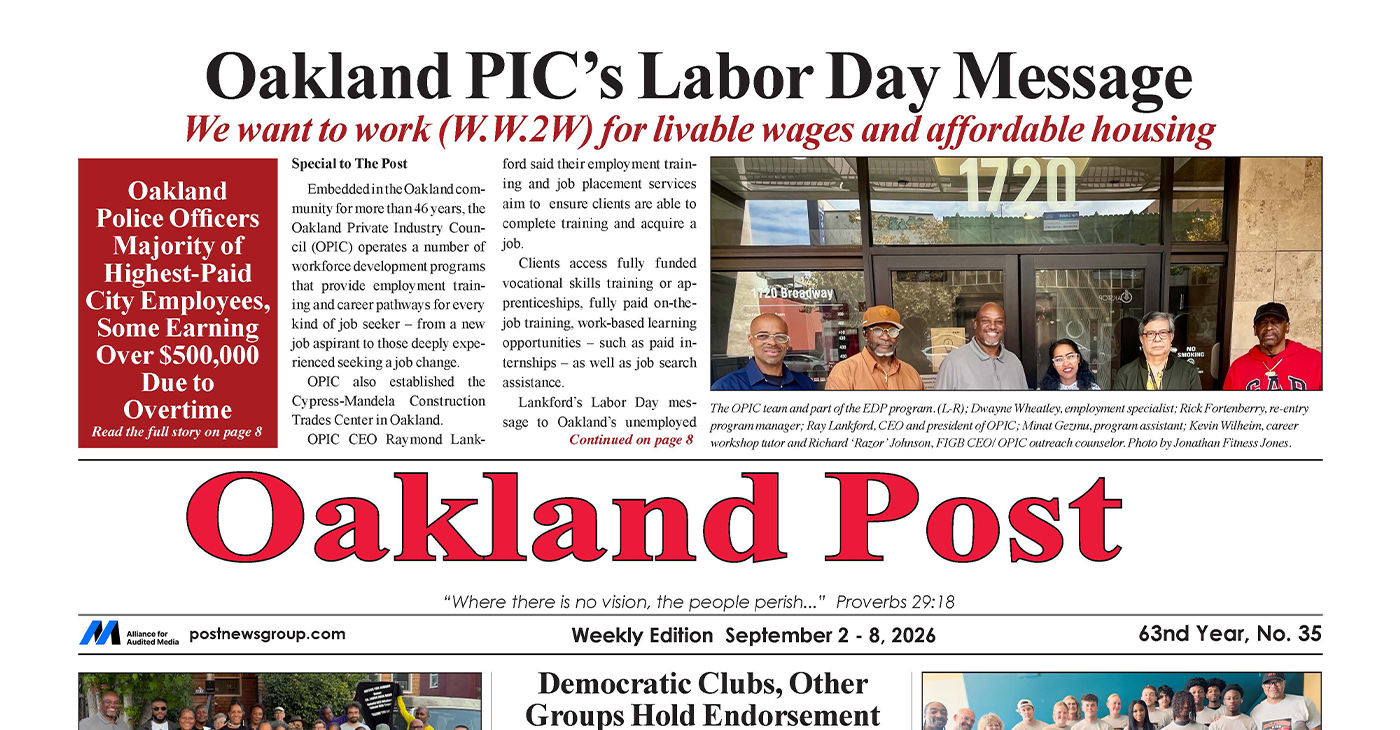
To enlarge your view of this issue, use the slider, magnifying glass icon or full page icon in the lower right corner of the browser window.



Oakland Mayor Reads to Children at Bookout Block Party at Marcus Books Store

Tradition Comes to the Streets in 11th Annual Black-Eyed Pea Festival at the Freedom Farmers Market

Attorney General Rob Bonta Continues Opposition to President Trump’s Tariff Regime

Neighborhood Empowerment Day in Deep East Oakland Brings Community Together After Recent Tragedy

Community Action Group ‘Friends of Zakiya’ Ask Sheriff for Time

Oakland Launches Aerbits Program to Identify, Report Abandoned Trash

Mayor Lee Announces $1 Million Kaiser Permanente Grant for Pilot Program to Address Homelessness, Clean Up Public Spaces throughout Oakland

Alameda County DA Ursula Jones Dickson Says Key to Optimal Use of DA’s Office Is Knowledge

Oakland Post: Week of September 16 – 22, 2026

NFL: Week Two Recap | Jalen Hurts did not fold; Caleb Williams exits game with injury

The Complete Negotiation Framework — Every Stage, Every Tactic, Every Win

Mazda CX-90 Luxury: Heated Seats & Premium Comfort! #shorts

Car Dashboard Glare: Avoid This Distraction! #shorts

Mazda CX-90 Safety: All Driver Assistance Features Explained #shorts

Subaru Outback: 19-Inch Wheels & 8.8″ Ground Clearance! #shorts

Department of Homeland Security Demands California Secretary of State Shirley N. Weber Scrub Voter Rolls

“The Power to See Threats Sooner”: Gov. Newsom, Safety Officials Showcase California’s Investments in Hi-Tech Wildfire Prevention

California Sen. Padilla Joins Colleagues to Introduce Bill Imposing Term Limits on Supreme Court Justices

Less Affluent School Districts, Including Sacramento City, Face Threat of State Takeover

Car Wash Workers Cope with Lingering Impacts of ICE Raids

ESSAY: California Can Close Its Colorectal Cancer Gap

As Part of Your Back-to- School Checklist, Vaccinate

Oakland ‘Port Serves as a Powerful Engine for Good Jobs and Economic Development

Gov. Newsom Announces $109.6 Million in Funding for 278 Supportive Homes in Bakersfield, Contra Costa, Sacramento and Fresno

California Hispanic Chambers of Commerce Unveils: ‘Powering the Future’ Theme for 47th Annual Statewide Convention

Congresswoman Simon Demands Investigation into Trump’s Abuse of Emergency Powers for Coal Export Terminal in West Oakland

Four Candidates, Including Incumbent Barbara Lee, Qualify for Oakland Mayor’s Race

Oakland Post: Week of August 12 – 18, 2026

From Blueprint to Breakthrough: Tackling Affordable Housing in Oakland

Oakland Observes Black August with Block Parties, Film Showings, Workshops

The Conversation With Al McFarlane 6/23/26

Media Monday 6/22/26

LIVE! ASK ALMA! — TUES. 6.23.26 7PM EST

Car Buying Secrets: 4 Hidden Checks Before You Sign!

Is This 550 HP Charger Worth YOUR Money? AutoNetwork Review

Celebrating Juneteenth – Frederick Douglass on education and resistance

LIVE! — ASK ALMA! — TUES. 6.19.26 7PM EST

Hyundai Ioniq 5 Parking, Safety, and 360 View #shorts

2025 Ioniq 5 New Wiper & Powerful Performance! #shorts

Electric SUV Range: Is 259 Miles Enough? #shorts

EV Charging: How Fast Can You Charge an Electric Vehicle? #shorts

Biometric Cooling… Messaging Seats…Come on! 2025 Infiniti QX80 Autograph 4WD

Charged Up: Witness the Magic of a Fully Electric Car! #shorts

Range Rover Sport PHEV Included…: See What’s Inside This Luxury SUV! #shorts

Invisible Hood View: Perfect Parking with X-Ray Vision! #shorts
-

 Commentary3 weeks ago
Standoff for Justice: Our Homes Are Worth Fighting For
-

 Activism3 weeks ago
Oakland Post: Week of August 26 – September 1, 2026
-

 Business3 weeks ago
Gubernatorial Candidate Steve Hilton Blasts California New Tire Rules; Newsom Hits Back
-

 Business3 weeks ago
Frontier Airlines’ Return to Oakland Airport Brings Flights, Jobs and Opportunity
-

 Business3 weeks ago
Chef Sharon Lee Blends Culinary Excellence, Education and Empowerment
-

 Education3 weeks ago
Gov. Newsom’s Latest Appointees Include Sacramento Advocate for Formerly Incarcerated Students; State’s New Tech Chief
-

 Business3 weeks ago
Oakland Coliseum Project Opens Door for Small Businesses to Build Bigger
-

 Community3 weeks ago
Big City Mayors Ask for “Yes” Vote on Housing Bond Measure; Conservatives Say “No”
