
Bay Area
New Vaccination Mandate for First Responders
Unvaccinated first responders will need to receive their first dose of the COVID vaccine by March 1 and complete their primary series no later than April 15. In addition, personnel will need to be up-to-date with a booster shot within 15 days of becoming booster-eligible to continue working in higher-risk settings and interact with the public. Stating April 15, unvaccinated or unboosted first responders will be prohibited from entering higher-risk settings or interacting with the public in the course of their work unless they have a qualifying exemption. First responders without a medical or religious exemption can no longer “test out” of vaccination requirements.

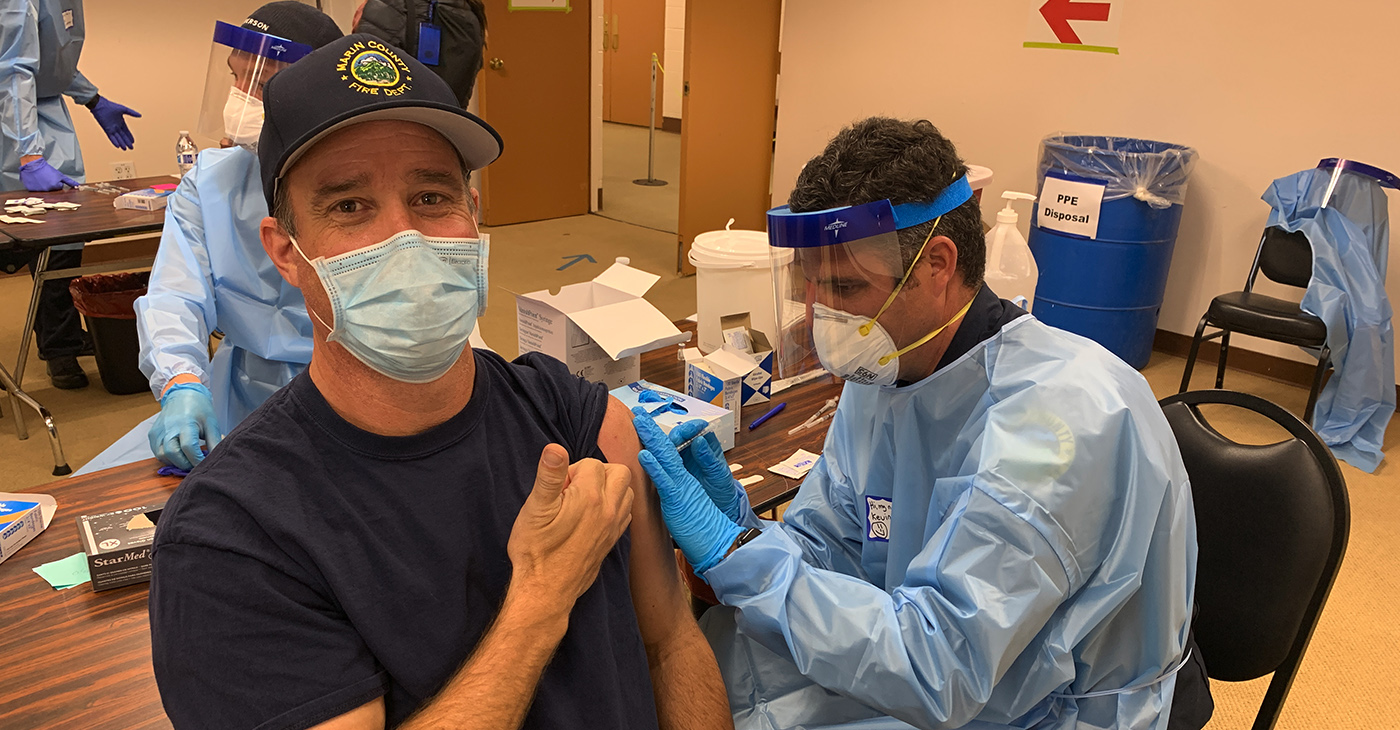
Marin issues order directed to law enforcement, firefighters, medical personnel
Courtesy of Marin County
Marin County personnel in the fields of law enforcement, firefighting and emergency medical response must be fully vaccinated and boosted to work in Marin County’s higher-risk settings, according to a new Marin County health order taking effect at 12:01 a.m. on Feb. 10.
Unvaccinated first responders will need to receive their first dose of the COVID vaccine by March 1 and complete their primary series no later than April 15. In addition, personnel will need to be up-to-date with a booster shot within 15 days of becoming booster-eligible to continue working in higher-risk settings and interact with the public. Stating April 15, unvaccinated or unboosted first responders will be prohibited from entering higher-risk settings or interacting with the public in the course of their work unless they have a qualifying exemption. First responders without a medical or religious exemption can no longer “test out” of vaccination requirements.
Recent COVID-19 outbreaks have been traced to unvaccinated first responders, according to Marin County Public Health records. As of Feb. 7, Marin County Public Health was managing multiple, preventable outbreaks in vulnerable, higher-risk settings. Those settings include those in which the first responders work with people who are at higher risk of severe illness, hospitalization, or death from COVID-19, including congregate settings. Among active outbreaks countywide, there is one at the Marin County Jail, nine at skilled nursing facilities (“nursing homes”), nine at residential care facilities for the elderly, and 19 at other group living facilities.
“These outbreaks have been amplified by contact with unboosted staff, an inadequate testing cadence, and a highly contagious variant,” said Dr. Lisa Santora, the County’s Deputy Public Health Officer. “It is critical to protect our public safety and health care systems from the Omicron variant as well as future waves of COVID-19 activity.”
First responders included in the Public Health order include police officers, Sheriff’s deputies, probation officers, part-time and full-time firefighters and emergency medical services (EMS) personnel, and those providing pre-hospital medical care. The order also applies to first responders who routinely interact with the public.
Marin has one of the highest COVID-19 vaccination rates of any county in the nation with 94.9% of those ages 5 and over having completed a vaccine series.
“While highly vaccinated, Marin County is experiencing waning community immunity,” Santora added. “It has been more than one year since many first responders completed their primary COVID-19 vaccine series.”
Evidence indicates that the Omicron variant is significantly more transmissible than prior virus variants and that individuals who have had only their initial vaccine series and are eligible for the booster are susceptible to the Omicron variant.
Santora said it’s critical to ensure all individuals working in higher-risk settings are both vaccinated and boosted when eligible. Protecting frontline workers from infection is essential to staffing our critical infrastructure, including public safety and health care systems. Individuals working in higher-risk settings can also expose highly vulnerable individuals who are at increased risk of severe illness and death.
For the time being, workers in those first-responder roles who are not fully vaccinated or not up-to-date with a booster must comply with the following if they have not tested positive for COVID-19 in past 90 days:
- use a fit-tested N95 mask at all times when around other people, except when eating, bathing, or sleeping; and,
- undergo twice weekly testing; and,
- when practicable, avoid using indoor breakrooms or cafeterias and avoid eating indoors or sleeping indoors when others are present.
For more information, visit Coronavirus.MarinHHS.org.








Activism
Oakland Post: Week of September 9 – 15, 2026
The printed Weekly Edition of the Oakland Post: Week of September 9 – 15, 2026

To enlarge your view of this issue, use the slider, magnifying glass icon or full page icon in the lower right corner of the browser window.
Activism
Oakland Post: Week of September 2 – 8, 2026
The printed Weekly Edition of the Oakland Post: Week of September 2 – 8, 2026
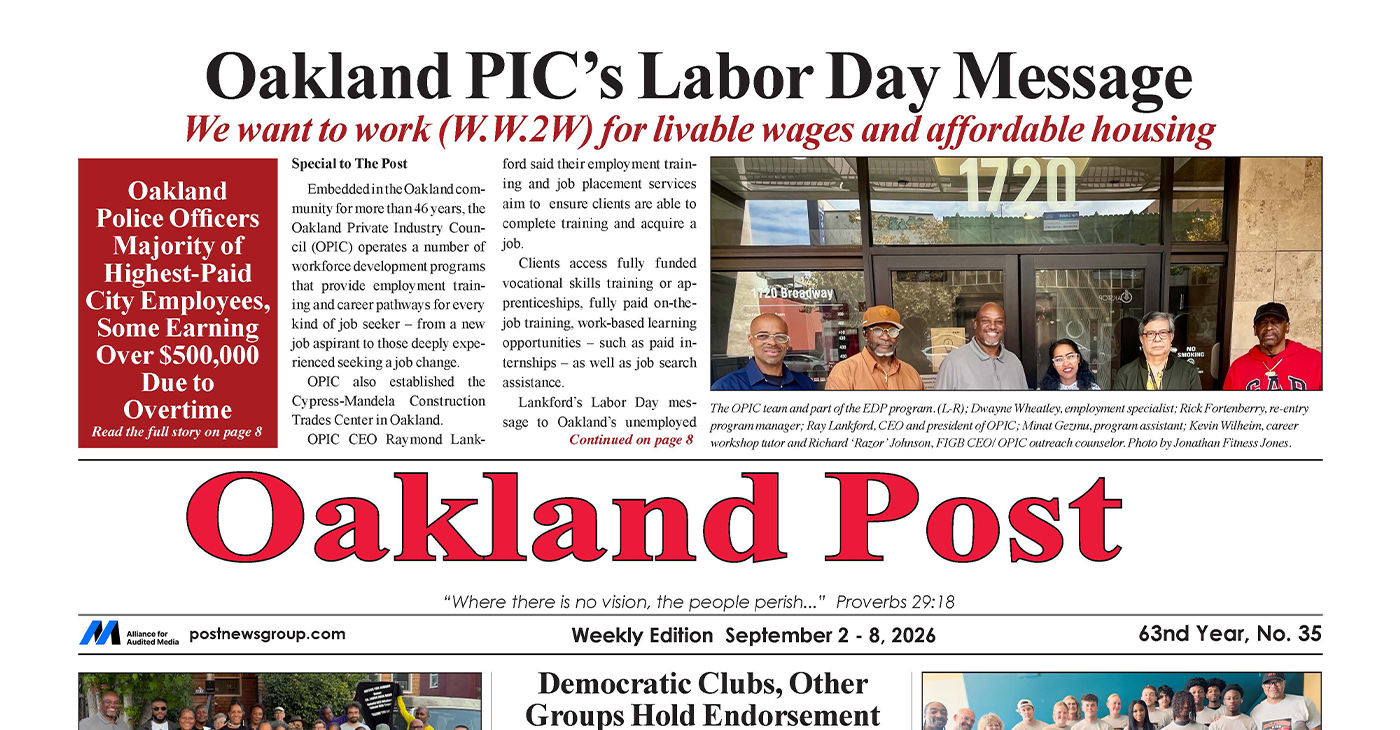
To enlarge your view of this issue, use the slider, magnifying glass icon or full page icon in the lower right corner of the browser window.
Activism
Youth-Led Black August Event Brings Past to Present at East Oakland Boxing Association
The mission of Youth Alive! Is to “break the cycle of violence, heal trauma, and uplift a thriving community of leaders, to save lives in Oakland and beyond” by serving “as mentors, youth leaders, counselors, case managers, intervention specialists and violence interrupters,” working “to help violently wounded people heal themselves and their community.”

Youth-Led Black August Event Brings Past to Present at East Oakland Boxing Association
The East Oakland Boxing Association (EOBA) and Youth Alive! came together on Aug. 21 to share with their community all that Black August means to them.
Held on EOBA’s patio at 816 98th Ave. in Deep East Oakland, the two organizations hosted their second annual Black August Experience, featuring a food tasting, financial literacy and mindfulness workshops, and voter registration with the League of Women Voters Oakland (LWV).
Black August is known as a time to uphold the legacy of prisoners who protested their conditions by fasting, fighting, and educating themselves on the economic and political circumstances that contributed to their incarceration.
According to its website, “EOBA is a multi-service youth and community development hub that goes far beyond the ring. While rooted in the discipline of boxing, for nearly 40 years EOBA has also integrated robust programs in workforce development, food justice, afterschool enrichment, financial literacy, mentorship, and wellness.”.
The mission of Youth Alive! Is to “break the cycle of violence, heal trauma, and uplift a thriving community of leaders, to save lives in Oakland and beyond” by serving “as mentors, youth leaders, counselors, case managers, intervention specialists and violence interrupters,” working “to help violently wounded people heal themselves and their community.”
Through Coro California, another leadership organization serving young people across the state for 80 years, they gained a broader understanding of Black August.
EOBA Executive Director Dawna Williams spoke about how much she learned about Black August from the youth who created it. “I let them educate me,” she said. Instead of talking about prison reform and mass incarceration, Williams and youth interns found that Black August meant so much more. “We would have done a disservice if we had just focused on who the people were and what their situation was…We tried to take their message from back in the day and make it relevant to the young people today. What do they need to know?”
Youth interns created and placed posters around the patio to help participants understand how traditional Black foodways, civic engagement, financial literacy, and the power of education are relevant to Black resistance today.
An EOBA member described Black August with Youth ALIVE! as “a whole vibe. “This year we added the Fun Zone for the kids, because you really cannot go wrong with a Fun Zone. I also loved seeing everyone chillin’ in the outdoor lounge, catching some Vitamin D and just enjoying a Friday evening together.”
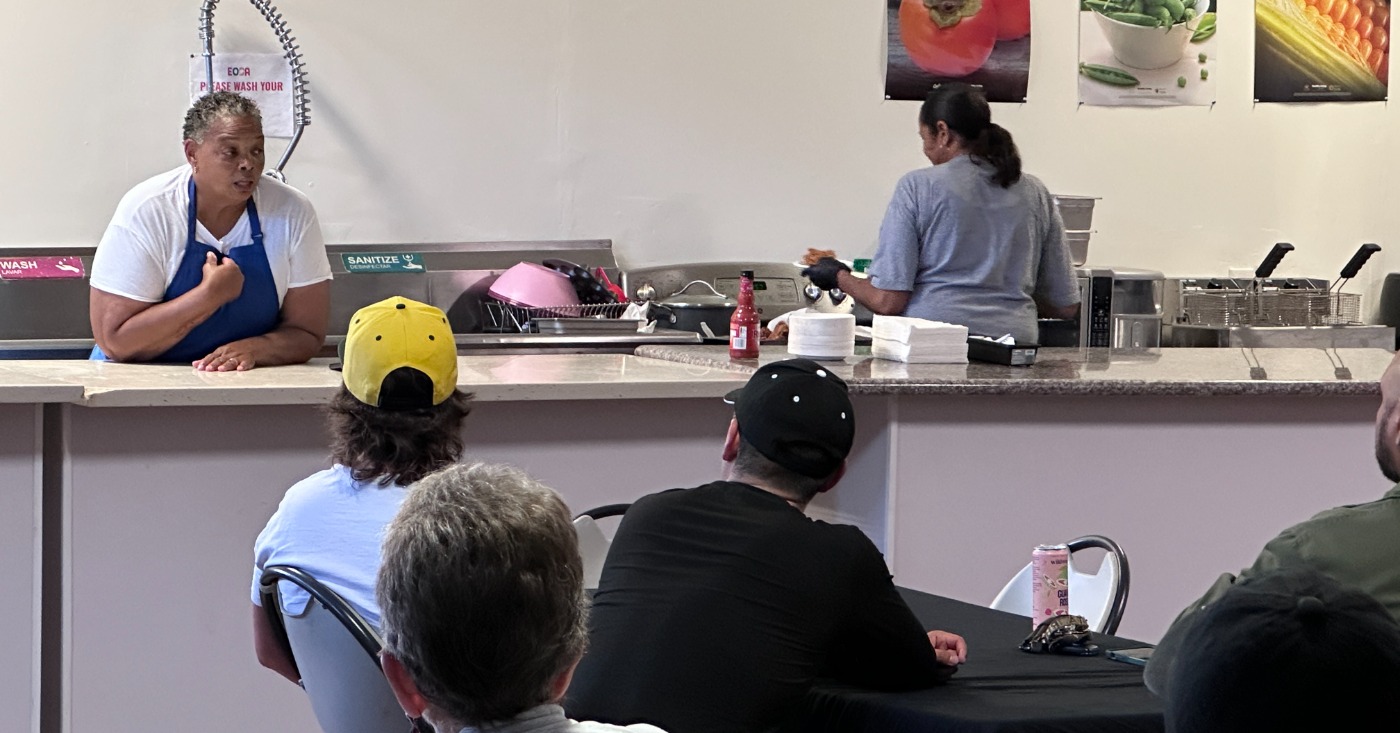
The food tasting, a popular event from last year, featured traditional Black foods such as black-eyed peas, johnny cakes, and fried chicken. Led by Williams, the tasting included a talk about how these traditional foods were made and why they are forms of Black resilience.
The “‘Plate of History’ was a favorite of the online writers. “Fun, educational, and did I mention delicious? Our Taste of History cook, Angela Southall, served up some good eats while connecting food to history and culture.”
The writer also commended the “League of Women Voters Oakland for their civic leadership and for getting our young people informed, ready, and registered to vote.”
Overall, it was a “good Friday event in East Oakland,” the writer said.
Upcoming Black August events: Building Opportunities for Self-Sufficiency (BOSS), will host “Black August: The Arc of Liberation” at Oakland City Hall on Sat. Aug. 29, from 11 a.m. to 3 p.m.
The websites for East Oakland Boxing Association, Youth Alive! and CORO are sources for this report.
Jana Lang is an Oakland resident, teacher, gardener and poet participating in the Propel News Initiative.




Event Preview: ‘Fashion v. Fascism’ – A Runway Revolution Is Coming to the Bay Area

Port of Oakland, Army Corps Sign Historic Harbor Design Agreement

Democratic Clubs Interview Candidates for Oakland School Board

Nuna Phillips-McKee Celebrates 100 Years: ‘A Century of Faith, Family and God’s Amazing Grace!’

D.A. Ursula Jones Dickson: Terminix to Pay $3.15 Million Over Illegal Disposal of Pesticides, Customer Records

REPORT: Community Level Policy Is Impacting Homelessness and Drug Abuse in California

OPINION: AI Needs to Know Who Is the Boss
Goldi-Locs and Two (or Three) Bears in the Forest in California Hills

Election Watch 2026: 85% of Eligible Voters in California Are Registered

Don’t Let scammers Crash Your School Year

BOOK REVIEW — Curved Air: A Biography of Sickle Cell Anemia and the Quest to Cure the First Molecular Disease

California’s Legal Cannabis Market Hits $8 Billion as State Touts Progress on Fighting Drugs, Crime

Blacks and Latinos Clash Over LA’s Barrio Run; Mayor Karen Bass Calls for Dialogue Across Racial, Neighborhood Lines

Asm. Smallwood-Cuevas’s Bill Repealing ‘Racist’ CalWORKs ‘Man-in-the-House’ Rule Clears Legislature

Asm. Smallwood-Cuevas’s Bill Repealing ‘Racist’ CalWORKs ‘Man-in-the-House’ Rule Clears Legislature

Department of Homeland Security Demands California Secretary of State Shirley N. Weber Scrub Voter Rolls

“The Power to See Threats Sooner”: Gov. Newsom, Safety Officials Showcase California’s Investments in Hi-Tech Wildfire Prevention

California Sen. Padilla Joins Colleagues to Introduce Bill Imposing Term Limits on Supreme Court Justices

Less Affluent School Districts, Including Sacramento City, Face Threat of State Takeover

Car Wash Workers Cope with Lingering Impacts of ICE Raids

ESSAY: California Can Close Its Colorectal Cancer Gap

As Part of Your Back-to- School Checklist, Vaccinate

Oakland ‘Port Serves as a Powerful Engine for Good Jobs and Economic Development

Gov. Newsom Announces $109.6 Million in Funding for 278 Supportive Homes in Bakersfield, Contra Costa, Sacramento and Fresno

California Hispanic Chambers of Commerce Unveils: ‘Powering the Future’ Theme for 47th Annual Statewide Convention

Congresswoman Simon Demands Investigation into Trump’s Abuse of Emergency Powers for Coal Export Terminal in West Oakland

Four Candidates, Including Incumbent Barbara Lee, Qualify for Oakland Mayor’s Race

Oakland Post: Week of August 12 – 18, 2026

From Blueprint to Breakthrough: Tackling Affordable Housing in Oakland

Oakland Observes Black August with Block Parties, Film Showings, Workshops

The Conversation With Al McFarlane 6/23/26

Media Monday 6/22/26

LIVE! ASK ALMA! — TUES. 6.23.26 7PM EST

Car Buying Secrets: 4 Hidden Checks Before You Sign!

Is This 550 HP Charger Worth YOUR Money? AutoNetwork Review

Celebrating Juneteenth – Frederick Douglass on education and resistance

LIVE! — ASK ALMA! — TUES. 6.19.26 7PM EST

Hyundai Ioniq 5 Parking, Safety, and 360 View #shorts

2025 Ioniq 5 New Wiper & Powerful Performance! #shorts

Electric SUV Range: Is 259 Miles Enough? #shorts

EV Charging: How Fast Can You Charge an Electric Vehicle? #shorts

Biometric Cooling… Messaging Seats…Come on! 2025 Infiniti QX80 Autograph 4WD

Charged Up: Witness the Magic of a Fully Electric Car! #shorts

Range Rover Sport PHEV Included…: See What’s Inside This Luxury SUV! #shorts

Invisible Hood View: Perfect Parking with X-Ray Vision! #shorts
-

 Commentary3 weeks ago
Standoff for Justice: Our Homes Are Worth Fighting For
-

 Activism3 weeks ago
Oakland Post: Week of August 26 – September 1, 2026
-

 Business3 weeks ago
Gubernatorial Candidate Steve Hilton Blasts California New Tire Rules; Newsom Hits Back
-

 Business3 weeks ago
Frontier Airlines’ Return to Oakland Airport Brings Flights, Jobs and Opportunity
-

 Business3 weeks ago
Chef Sharon Lee Blends Culinary Excellence, Education and Empowerment
-

 Education3 weeks ago
Gov. Newsom’s Latest Appointees Include Sacramento Advocate for Formerly Incarcerated Students; State’s New Tech Chief
-

 Business3 weeks ago
Oakland Coliseum Project Opens Door for Small Businesses to Build Bigger
-

 Community3 weeks ago
Big City Mayors Ask for “Yes” Vote on Housing Bond Measure; Conservatives Say “No”
