
Activism
COMMENTARY: The Push for Voting Rights Now Is the Fight Against Jim Crow 2.0
The inability to pass voting rights comes on the same week as MLK Day in America and serves as a reminder. Setbacks are all temporary, the fight is constant. The memory of Dr. King motivates us to stay true to the dream.


By Emil Guillermo
Because he was dreaming.
Joe Biden thought he could get Democratic Senators Joe Manchin and Kyrsten Sinema to unite with 48 other Democrats to pass both the Freedom to Vote Act and the John Lewis Voting Rights Advancement Act.
The Freedom to Vote Act would make voting a federal holiday and make voting easier, not harder. It would also make sure the redistricting process would be fair and uniform and reflect population gains. Asian Americans and other people of color wouldn’t be left out by gerrymandering.
The John Lewis Voting Rights Advancement Act simply restores the teeth of federal oversight to make sure states don’t pass harmful election laws that cut minorities out of the process. We’re trying to get back to the ideals of the original law.
Both bills prove that the threat to democracy is real. Democracy is not an abstract ideal. You see it when you go to vote. And when you are stopped from casting a vote, that’s as real as it gets. You have been rendered voiceless and uncountable.
In a democracy, that shouldn’t happen. That’s why the proposed voting rights legislation should be a no-brainer.
In that Atlanta speech, Biden asked another no-brainer question: “Do you want to be on the side of Dr. King or George Wallace?”

Do you want to be with a person of love, or one of hate?
Hard to believe in 2022 that’s still a hard question for some.
Biden needed to get around the Republicans’ certain filibuster intended to block the legislation. That would require all 50 Senate Democrats to vote to change the filibuster rule.
And, of course, the same two people who blocked Biden on his baby “New Deal,” a.k.a. “Build Back Better” plan are in the way: Manchin of West Virginia and Sinema of Arizona.
Sinema this time supplied the dagger to kill voting rights.
“While I continue to support these bills,” Sinema said, “I will not support separate actions that worsen the underlying disease of division infecting our country.”
But, of course, in signaling she would allow the Republicans to filibuster, Sinema was doing just that: worsening the “underlying disease of division infecting our country.”
It’s unclear what Sinema wants in negotiation — beyond the power of a presidential takedown.
But it leaves Biden celebrating his first year in office with a party he can’t unite when he needs it, and a country that grades him with an approval rating in the low 40s.
Further, the inability to pass voting rights comes on the same week as MLK Day in America and serves as a reminder. Setbacks are all temporary, the fight is constant. The memory of Dr. King motivates us to stay true to the dream.
Vice President Kamala Harris had the best prescription moving forward: Expose the 50 Republicans in the Senate by name who failed to uphold your voting rights. And further expose Manchin and Sinema and any other Democrats who join them.
“I don’t think anyone should be absolved from the responsibility of preserving and protecting our democracy,” Harris told NBC News. “Especially when they took an oath to protect and defend the Constitution.”
Voting rights was the issue in Selma. And it’s the issue now. Biden called it Jim Crow 2.0. Sadly, in 2022, the fight continues. There’s still much to overcome.
Emil Guillermo is a journalist and commentator. See his show on www.amok.com














Activism
Oakland Post: Week of September 16 – 22, 2026
The printed Weekly Edition of the Oakland Post: Week of September 16 – 22, 2026

To enlarge your view of this issue, use the slider, magnifying glass icon or full page icon in the lower right corner of the browser window.
Activism
Oakland Post: Week of September 9 – 15, 2026
The printed Weekly Edition of the Oakland Post: Week of September 9 – 15, 2026

To enlarge your view of this issue, use the slider, magnifying glass icon or full page icon in the lower right corner of the browser window.
Activism
Oakland Post: Week of September 2 – 8, 2026
The printed Weekly Edition of the Oakland Post: Week of September 2 – 8, 2026
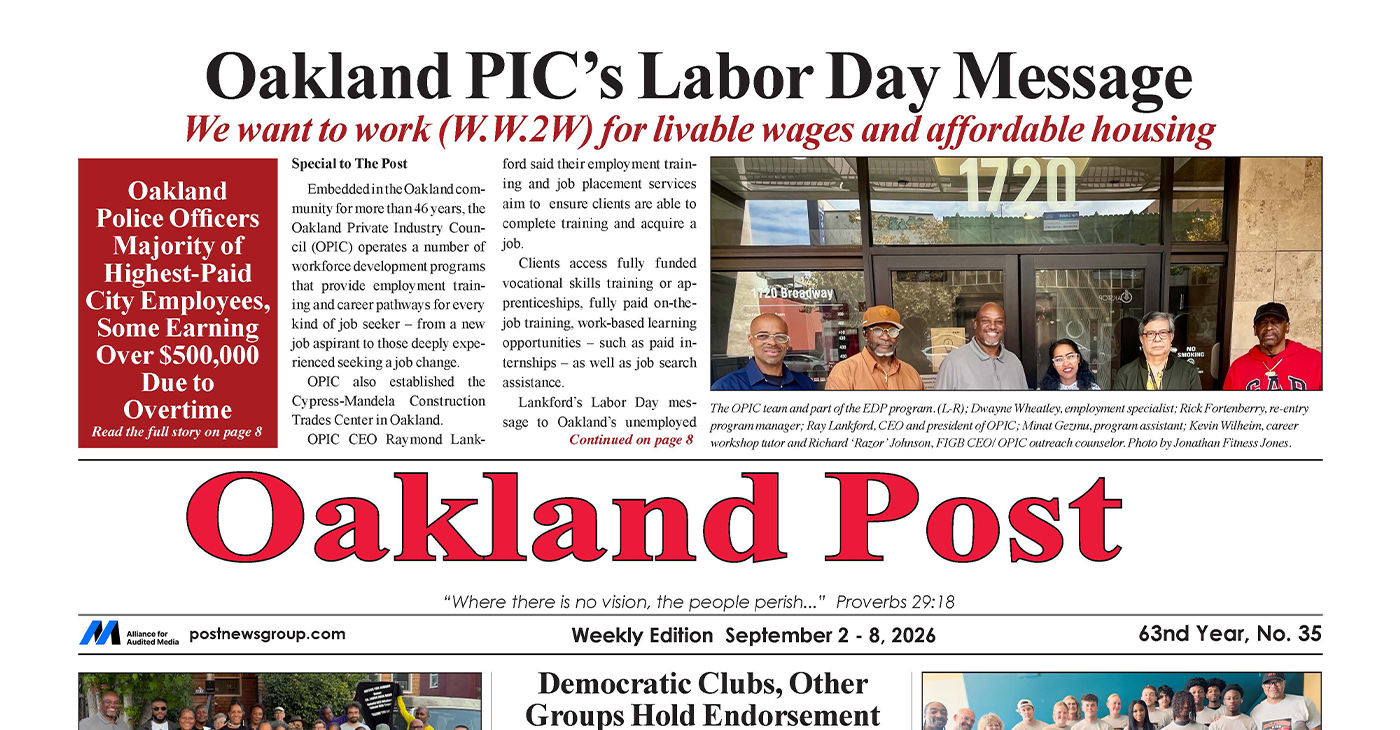
To enlarge your view of this issue, use the slider, magnifying glass icon or full page icon in the lower right corner of the browser window.



Doulas Are Helping Black California Moms Navigate Pregnancy–Even as High Mortality Rates Persist

Newsom Signs Addictive Social Media Law to Protect Kids

On Your November Ballot: Prop 38 Would Allocate $8.4 Billion to Immunology and Immunotherapy Funding

Ask California: Golden State Releases New AI Chatbot

Asm. Isaac Bryan’s Bill Banning California Police From ICE Side Jobs Reaches Newsom’s Desk

Assemblymember LaShae Sharp-Collins’s Bill Would Pause Law Enforcement’s Use of Shock Gloves Pending Study

BOOK REVIEW: ‘Laws of Solomon’ Reveals Tender Heart of Former Child Soldier

OPINION: The New American Fear – From 9-11 to AI

Passing for White, Fighting for Black America: The Courage of Walter White

Oakland People’s Arms Embargo Coalition Demands End to Military Shipments Thru Oakland

Barbara Lee Mourns Gloria Steinem, Remembers a Friendship Rooted in Equality

Event Preview: ‘Fashion v. Fascism’ – A Runway Revolution Is Coming to the Bay Area

Two Looming Threats Every Alameda County Elder Should Know About

Oakland Mayor Reads to Children at Bookout Block Party at Marcus Books Store

Tradition Comes to the Streets in 11th Annual Black-Eyed Pea Festival at the Freedom Farmers Market

Less Affluent School Districts, Including Sacramento City, Face Threat of State Takeover

ESSAY: California Can Close Its Colorectal Cancer Gap

California Hispanic Chambers of Commerce Unveils: ‘Powering the Future’ Theme for 47th Annual Statewide Convention

Four Candidates, Including Incumbent Barbara Lee, Qualify for Oakland Mayor’s Race

Oakland Post: Week of August 12 – 18, 2026

From Blueprint to Breakthrough: Tackling Affordable Housing in Oakland

Oakland Observes Black August with Block Parties, Film Showings, Workshops

COMMENTARY: Why Local School Tax Measure G1 Will Not Be on the November Ballot

Standoff for Justice: Our Homes Are Worth Fighting For

Returning to Its Roots, the Oakland Black-Eyed Pea Festival Partners with the Freedom Farmers Market Sept. 12

NPRC Scores First Advocacy Victory: David Shaw Finally Gets His Wish to ‘Go Home’

Oakland Post: Week of August 26 – September 1, 2026

Frontier Airlines’ Return to Oakland Airport Brings Flights, Jobs and Opportunity

Gubernatorial Candidate Steve Hilton Blasts California New Tire Rules; Newsom Hits Back

Chef Sharon Lee Blends Culinary Excellence, Education and Empowerment

The Conversation With Al McFarlane 6/23/26

Media Monday 6/22/26

LIVE! ASK ALMA! — TUES. 6.23.26 7PM EST

Car Buying Secrets: 4 Hidden Checks Before You Sign!

Is This 550 HP Charger Worth YOUR Money? AutoNetwork Review

Celebrating Juneteenth – Frederick Douglass on education and resistance

LIVE! — ASK ALMA! — TUES. 6.19.26 7PM EST

Hyundai Ioniq 5 Parking, Safety, and 360 View #shorts

2025 Ioniq 5 New Wiper & Powerful Performance! #shorts

Electric SUV Range: Is 259 Miles Enough? #shorts

EV Charging: How Fast Can You Charge an Electric Vehicle? #shorts

Biometric Cooling… Messaging Seats…Come on! 2025 Infiniti QX80 Autograph 4WD

Charged Up: Witness the Magic of a Fully Electric Car! #shorts

Range Rover Sport PHEV Included…: See What’s Inside This Luxury SUV! #shorts

Invisible Hood View: Perfect Parking with X-Ray Vision! #shorts
-
 Commentary4 weeks ago
Standoff for Justice: Our Homes Are Worth Fighting For
-
 Activism4 weeks ago
Oakland Post: Week of August 26 – September 1, 2026
-
 Business4 weeks ago
Frontier Airlines’ Return to Oakland Airport Brings Flights, Jobs and Opportunity
-
 Business4 weeks ago
Gubernatorial Candidate Steve Hilton Blasts California New Tire Rules; Newsom Hits Back
-
 Business4 weeks ago
Chef Sharon Lee Blends Culinary Excellence, Education and Empowerment
-

 Education4 weeks ago
Gov. Newsom’s Latest Appointees Include Sacramento Advocate for Formerly Incarcerated Students; State’s New Tech Chief
-

 Community4 weeks ago
Big City Mayors Ask for “Yes” Vote on Housing Bond Measure; Conservatives Say “No”
-

 Business4 weeks ago
Oakland Coliseum Project Opens Door for Small Businesses to Build Bigger
