
Activism
OPINION: A Great Way to ‘Listen to Black Women’ Is to Elect Them
Recent reports also show that Black candidates are faring especially well in Senate fundraising in the 2022 cycle. While summary numbers might mask persistent hurdles, these data indicate that Black candidates might be better financially positioned for electoral success in the next election.

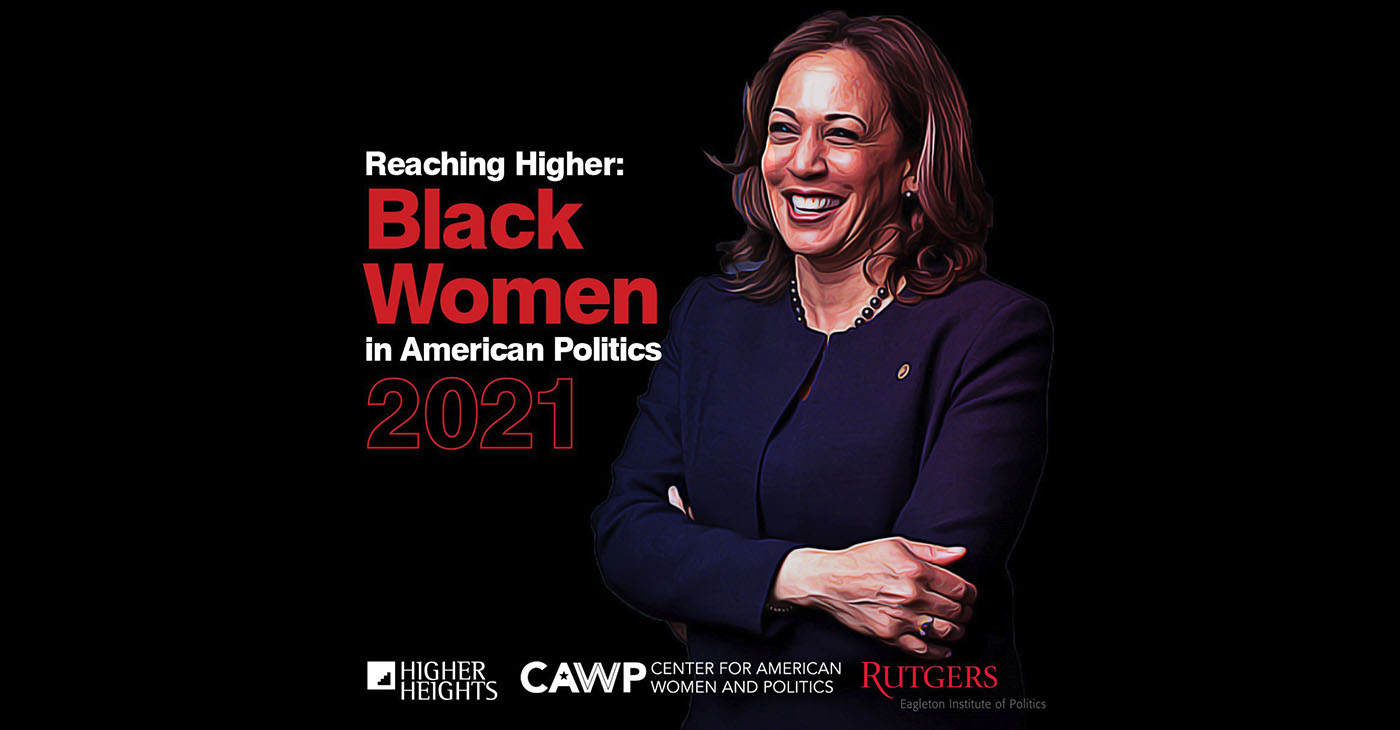
By Kelly Dittmar and Glynda C. Carr
Listen to Black women, they say. Support Black women, they tweet. The praise of Black women in recent years is evident in words, but public statements and hashtags must translate into action. And that action should include efforts to elect Black women.
Seven years ago, our organizations joined forces to spotlight the status of Black women in American politics. Since our first report, we have seen — and hopefully contributed to — great progress.
In that time, 17 new Black women were elected to Congress, including the second Black woman to ever serve in the U.S. Senate and the first Black women to represent their states from Connecticut, Delaware, Massachusetts, Missouri, Minnesota, New Jersey, Utah, and Washington. The number of Black women state legislators has risen by nearly 50%.
Black women have made tremendous strides in representation as big-city mayors, with 12 Black women taking office for the first time as mayors in the top 100 most populous cities from mid-2014 to present.

Today, Black women are mayors of eight major cities, including Atlanta, Boston, Charlotte, Chicago, New Orleans, San Francisco, Washington, D.C., and St. Louis. Just two weeks ago, Elaine O’Neal was elected as mayor of Durham, N.C.; she will take office in early December. And, of course, with Kamala Harris’ 2020 election as vice president, a Black woman now serves in the second-highest position in U.S government.
Progress for Black women in elective office is not measured in numbers alone. The effects of Black women’s political representation are evident in both disrupting white- and male-dominated institutions and making policy change.
Research at the state legislative and congressional levels has shown how Black women’s identities shape policy contributions and behaviors in ways that give voice to underrepresented groups and perspectives.
Five years ago, Representatives Bonnie Watson-Coleman (D-NJ), Robin Kelly (D-IL), and Yvette Clark (D-NY) created the Congressional Caucus on Black Women and Girls to promote public policy that “eliminates significant barriers and disparities experienced by Black women.”
Just this year, representatives Lauren Underwood (D-IL) and Alma Adams (D-AL), with Senator Cory Booker (D-NJ), have pushed for “momnibus” legislation to address the crisis in Black maternal health. And in late summer, Representative Cori Bush (D-MO) slept on the stairs of the U.S. Capitol as part of a relentless push to extend the eviction moratorium — which disproportionately affects Black and Brown Americans.
Black women have also been at the forefront of changing the actual institutions in which they serve. Bush’s efforts on the eviction moratorium included calls for institutional change, such as ending the filibuster, in hopes that it would clear the way for a policy agenda that would better serve Black communities.
And in a July 2020 floor speech, Representative Ayanna Pressley (D-MA) made clear that patriarchy is “very much at home in the halls of this powerful institution” and called on her colleagues to build the world that all girls and women deserve, beginning with the institution of Congress.
Black women’s gains in representation should not mask the persistent hurdles they must navigate to find electoral success.
Research demonstrates that Black women are among those women more likely to be discouraged from running for office, confront disparities in campaign fundraising, navigate distinct politics of appearance, and are evaluated by voters and media alike in ways that both rely on and perpetuate damaging stereotypical biases.
Recent reporting has also revealed more than ever before the abuse that Black women face as both candidates and officeholders, abuse that is often rooted in the confluence of racism and misogyny and leads not only to personal harm but also to decisions to abandon political careers.
And while many Black women have navigated these hurdles en route to electoral success, Black women’s underrepresentation in elective office persists, especially in the Republican Party and offices elected statewide.
Today, just three Black Republican women serve as state legislators and no Black Republican women serve in statewide or congressional offices. Former Representative Mia Love (R-UT), the only Black Republican woman ever elected to Congress, was defeated in election 2018.
Her decision to stand up against then President Donald Trump in defense of Haitians specifically, and immigrants more broadly, damaged her chances for re-election and illustrated a distinct challenge she faced in giving voice to her own identity and experience while also aligning with the politics of her party. This challenge persists in today’s GOP, creating unique conditions for Black Republican women who decide to run.
Just two Black women have ever served in the U.S. Senate, and there are no Black women senators serving today amidst key debates over the economy, infrastructure, the environment, voting rights, criminal justice, and immigration.
Black women also hold just six of 310 statewide elective executive offices in the U.S., roles that are key to shaping state policy agendas and outcomes. Just 17 Black women have ever held statewide elected executive offices in 14 states, and no Black woman has ever served as governor.
The 2022 election offers some opportunities to address these gaps. With more than a year before Election Day, the number of Black women who have announced major-party candidacies for U.S. Senate has already exceeded the previous record of 13.
Recent reports also show that Black candidates are faring especially well in Senate fundraising in the 2022 cycle. While summary numbers might mask persistent hurdles, these data indicate that Black candidates might be better financially positioned for electoral success in the next election.
At least five Black women have announced major-party gubernatorial candidacies in this cycle, one short of the previous high. And there remains time for more Black women to step forward, including former Georgia House Minority Leader and organizer Stacey Abrams (D-GA), who is the only Black woman who has ever won a major-party gubernatorial nomination.
Candidacies neither ensure nomination nor election, but it’s a start. These Black women — and others who are launching political campaigns — are doing what they can to create a more representative democracy.
But their success relies on others, including those who issued public directives to support Black women over the past 18 months. You can support Black women on the campaign trail with your time and your money, and you can support Black women at the ballot box with your vote.
You can listen to Black women by ensuring they have seats at policymaking tables where their voices, expertise, and perspectives can inform substantive change. It’s time to translate words into actions.
Kelly Dittmar is an associate professor of Political Science at Rutgers-Camden and Director of Research and Scholar at the Center for American Women and Politics, a unit of the Eagleton Institute of Politics at Rutgers University. Glynda C. Carr is CEO and co-founder of Higher Heights for America.










Activism
Oakland Post: Week of September 30 – October 6, 2026
The printed Weekly Edition of the Oakland Post: Week of September 30 – October 6, 2026
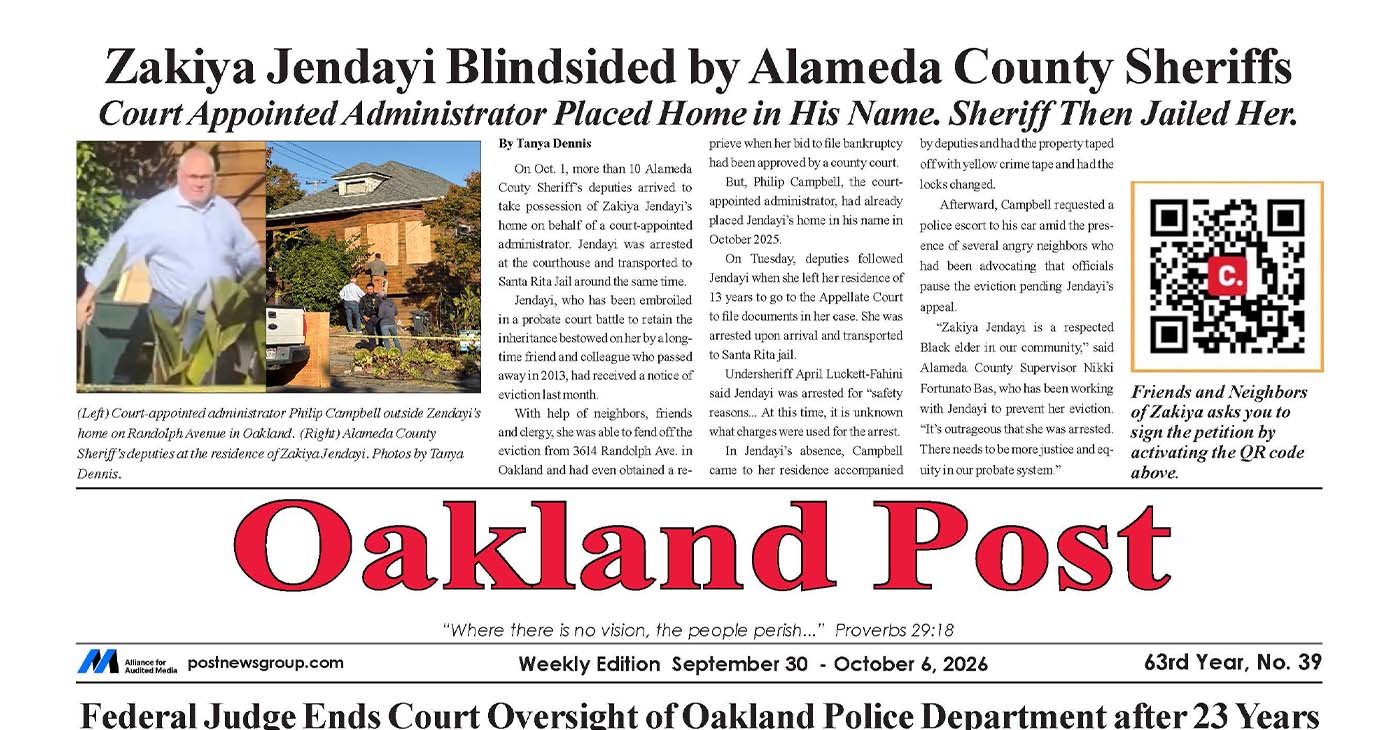
To enlarge your view of this issue, use the slider, magnifying glass icon or full page icon in the lower right corner of the browser window.
Activism
Oakland Post: Week of September 23 – 29, 2026
The printed Weekly Edition of the Oakland Post: Week of September 23 – 29, 2026

To enlarge your view of this issue, use the slider, magnifying glass icon or full page icon in the lower right corner of the browser window.
Activism
Oakland Post: Week of September 16 – 22, 2026
The printed Weekly Edition of the Oakland Post: Week of September 16 – 22, 2026

To enlarge your view of this issue, use the slider, magnifying glass icon or full page icon in the lower right corner of the browser window.


OP-ED: Proposition 44 Would Put a Price on Trust

OP-ED: Proposition 40: It’s Time to Play Chess, Not Checkers

Listening as a Lifeline: A Doula’s Witness to Black Maternal Health

New Protections for Ticket Buyers: Gov. Newsom Signs Assemblymember Isaac Bryan’s Bill

‘We Don’t Talk Trash — We Pick Up Trash!’

Zakiya Jendayi Arrested, Locked Out of Home by Sheriff’s Deputies

Oakland Post: Week of September 30 – October 6, 2026

Asm. Corey Jackson Announces Launch of 24-Hour Childcare in His District

IN MEMORIAM: The Rev. Leon “Sonny” Clark, Longtime Orange County Pastor and Community Leader, Dies at 72

Poll: Becerra Widens His Lead Over Hilton; Californians Split on Wealth Tax

From Historic Memories to New Possibilities: Oakland Celebrates Coliseum 60

County Office of Education Says OUSD Finances Are Getting Healthier, Materially Stronger

LIVE FREE Sunday Dinner Brings Faith, Fellowship and Civic Conversation to Oakland

Remembering Chauncey Bailey as Student Journalists Face Threats to Truth-Telling

BLACspace Cooperative Invites Bay Area to Experience Oakland’s Black Cultural Ecosystem Through a BLAC Map Tour + Party

Standoff for Justice: Our Homes Are Worth Fighting For

Oakland Post: Week of August 26 – September 1, 2026

Frontier Airlines’ Return to Oakland Airport Brings Flights, Jobs and Opportunity

Gubernatorial Candidate Steve Hilton Blasts California New Tire Rules; Newsom Hits Back

Chef Sharon Lee Blends Culinary Excellence, Education and Empowerment

Jackie Wright Champions Bay Area Stories, Filmmakers and Cultural Institutions

Misnamed ‘Parent’ PAC Seeks to Influence Oakland School Board Elections

Oakland Coliseum Project Opens Door for Small Businesses to Build Bigger

Big City Mayors Ask for “Yes” Vote on Housing Bond Measure; Conservatives Say “No”

Gov. Newsom’s Latest Appointees Include Sacramento Advocate for Formerly Incarcerated Students; State’s New Tech Chief

Longtime BWOPA Member Brendalyn Goodall Appointed to California Workforce Development Board

Gov. Newsom Signs Law Shielding Immigration Aid Workers From Doxing Threats

Secretary of State Shirley N. Weber Urges Californians to Vote Early as Voter ID Battle Intensifies

Oakland Post: Week of September 2 – 8, 2026

IN MEMORIAM: Dolly Parton Dead at 80 — How She Built a Legacy of Love and Earned Her Place in Black Culture

The Conversation With Al McFarlane 6/23/26

Media Monday 6/22/26

LIVE! ASK ALMA! — TUES. 6.23.26 7PM EST

Car Buying Secrets: 4 Hidden Checks Before You Sign!

Is This 550 HP Charger Worth YOUR Money? AutoNetwork Review

Celebrating Juneteenth – Frederick Douglass on education and resistance

LIVE! — ASK ALMA! — TUES. 6.19.26 7PM EST

Hyundai Ioniq 5 Parking, Safety, and 360 View #shorts

2025 Ioniq 5 New Wiper & Powerful Performance! #shorts

Electric SUV Range: Is 259 Miles Enough? #shorts

EV Charging: How Fast Can You Charge an Electric Vehicle? #shorts

Biometric Cooling… Messaging Seats…Come on! 2025 Infiniti QX80 Autograph 4WD

Charged Up: Witness the Magic of a Fully Electric Car! #shorts

Range Rover Sport PHEV Included…: See What’s Inside This Luxury SUV! #shorts

Invisible Hood View: Perfect Parking with X-Ray Vision! #shorts
-
 Community3 weeks ago
Misnamed ‘Parent’ PAC Seeks to Influence Oakland School Board Elections
-
 Activism4 weeks ago
Oakland Post: Week of September 2 – 8, 2026
-

 Activism3 weeks ago
Oakland Post: Week of September 9 – 15, 2026
-

 Community3 weeks ago
Richmond Tiny House Village Farm & Garden Set to Open Gates on Sept. 26
-

 Black History3 weeks ago
Latest Massacre in Haiti Reveals Cruelty U.S. Deportations
-

 Black History3 weeks ago
OPINION: Nolan Wells’ Death One of Several Signifying Racial Terror Lives on in U.S. South
-

 Business2 weeks ago
Mayor Lee Announces $1 Million Kaiser Permanente Grant for Pilot Program to Address Homelessness, Clean Up Public Spaces throughout Oakland
-

 Community3 weeks ago
Democratic Clubs Interview Candidates for Oakland School Board
