
Activism
City Report Calls for End of ‘Historic, Racially Exclusive Membership’ of Construction Unions
Local data, submitted by unions in July 2020, indicate that “numerous disparities” under PLA’s currently exist in Oakland. However, data was submitted to the city by only 10 out of 28 of the building trades. Presumably these may have been the unions with better results.


By Ken Epstein
The City of Oakland’s Department of Race & Equity recently issued a report calling for construction unions to abandon their historic, racially exclusive membership policies if they want the city to sign a contract guaranteeing the unions receive the lion’s-share of construction jobs on city-funded projects.
The City Council has been under behind-the-scenes pressure for several years from both building trades unions and their allied community groups to sign a binding contract, called a Project Labor Agreement (PLA), guaranteeing most jobs on city projects will go to union members.
Most building trades craft unions have failed to report numbers of Black and women members of their organizations. They also have not taken steps to eliminate the barriers to entry nor the sometimes-hostile work environments that keep African Americans and women out of union construction jobs.
So far, the 70-page racial equity analysis report, “Improving the Effectiveness of Project Agreements,” which examines current conditions and makes proposals for change, has been largely ignored by the media and most Oakland accountability activists.
The report was completed in in December 2020 by the Estolano Advisors and the San Francisco Foundation and submitted to the City Council by the Department of Race and Equity.

The San Francisco Foundation convened an advisory committee of representatives of public agencies, community-based organizations and the Alameda County Building Trades to examine strategies to diversify the construction workforce through PLA’s. Also supporting the study were Julian Gross of Renee Public Law Group, Junius Williams Consulting and others.
Local data, submitted by unions in July 2020, indicate that “numerous disparities” under PLA’s currently exist in Oakland. However, data was submitted to the city by only 10 out of 28 of the building trades. Presumably these may have been the unions with better results.
- 98% of current members in the data sample are male;
- 25% of building trades members lives in Alameda County (not necessarily in Oakland), and 75% do not;
- Union members in the samples were 54% white, 35% Hispanic/Latino, 5% Black, 3% Asian, and 4% other or unknown.
- Journey workers (the most skilled and highest paid) represent 79% of members, while 21% are apprentices;
These survey results confirm “that current data from the trade affiliates does not fully capture the landscape of the local construction workforce because trade affiliates do not collect data consistently and are not mandated to collect and report it,” according to the report.
The ongoing economic disparity in opportunities for women and African Americans in the building trades are national in scope and historically conditioned, according to a report to the City Council by Darlene Flynn, director of the Department of Race and Equity:
“Inequity in outcomes is the result of over 200 years of institutional policy and practice that excluded BIPOC Black, Indigenous, People of Color) groups from fair and equitable access to living wage employment and wealth building.”
“Government has a responsibility to right historical wrongs in which it participated, and the City of Oakland has made a commitment to address disparities through intentional equity strategies in all the City does,” Flynn said in her report.
One chart in the report shows that although Black workers comprise 12% of the nation’s workforce, they obtain roughly a flat 6% of the jobs in construction for 25 years, from 1995 to today.
National unemployment rates underscore the inequities. In July 2021, overall unemployment during the pandemic remained at 6.5%. White unemployment was lower at 5.1%, Black unemployment was significantly higher at 10.1% and Hispanic/Latino joblessness stood at 8.4%
The report listed some of the persistent barriers that at present maintain the underrepresentation of Black and female building trade membership:
- “Vastly different, opaque, sometimes subjective entry process for each trade (somewhat like trying to get accepted into an exclusive fraternity);
- Disparities in participation and success rates in apprenticeship programs, mainly for Black and women workers;
- BIPOC members disproportionately hired into lower-paid apprenticeship programs;
- Small and local contractors, many non-union but hire more women and African Americans, are often shut out of city contracting under PLA’s;
- Poor reporting of race and gender data for unions, and “ineffective/inconsistent monitoring of contractor obligations;”
- Poor funding for pre-apprenticeship programs;
- Unwelcoming worksite culture for under-represented groups, lack of mentorship support for underrepresented groups;
- Lack of public accountability for equity outcomes.
This is the first of a series of articles on Project Labor Agreements and racial equity analysis. Future articles will focus on concerns of Black construction workers and small contractors in Oakland and solutions that would produce more equitable outcomes.












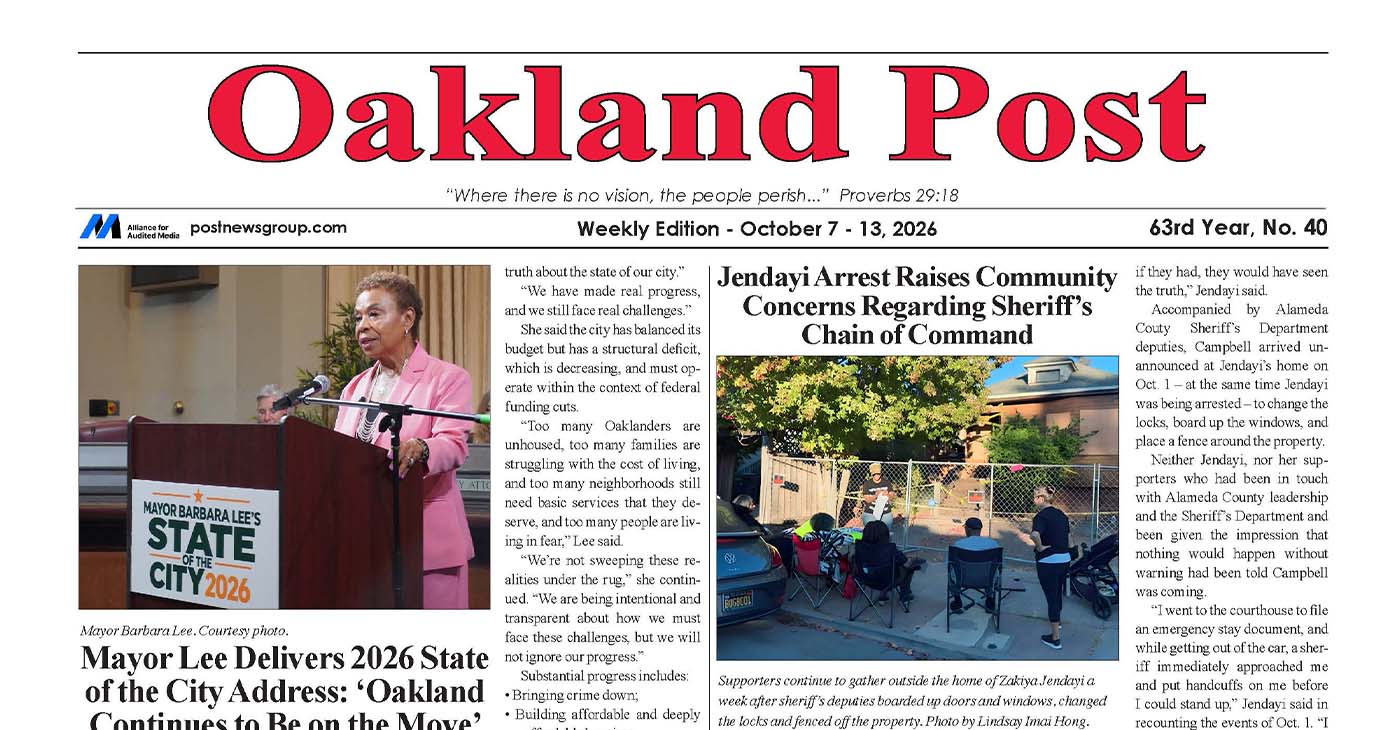
To enlarge your view of this issue, use the slider, magnifying glass icon or full page icon in the lower right corner of the browser window.

Activism
Oakland Post: Week of September 30 – October 6, 2026
The printed Weekly Edition of the Oakland Post: Week of September 30 – October 6, 2026
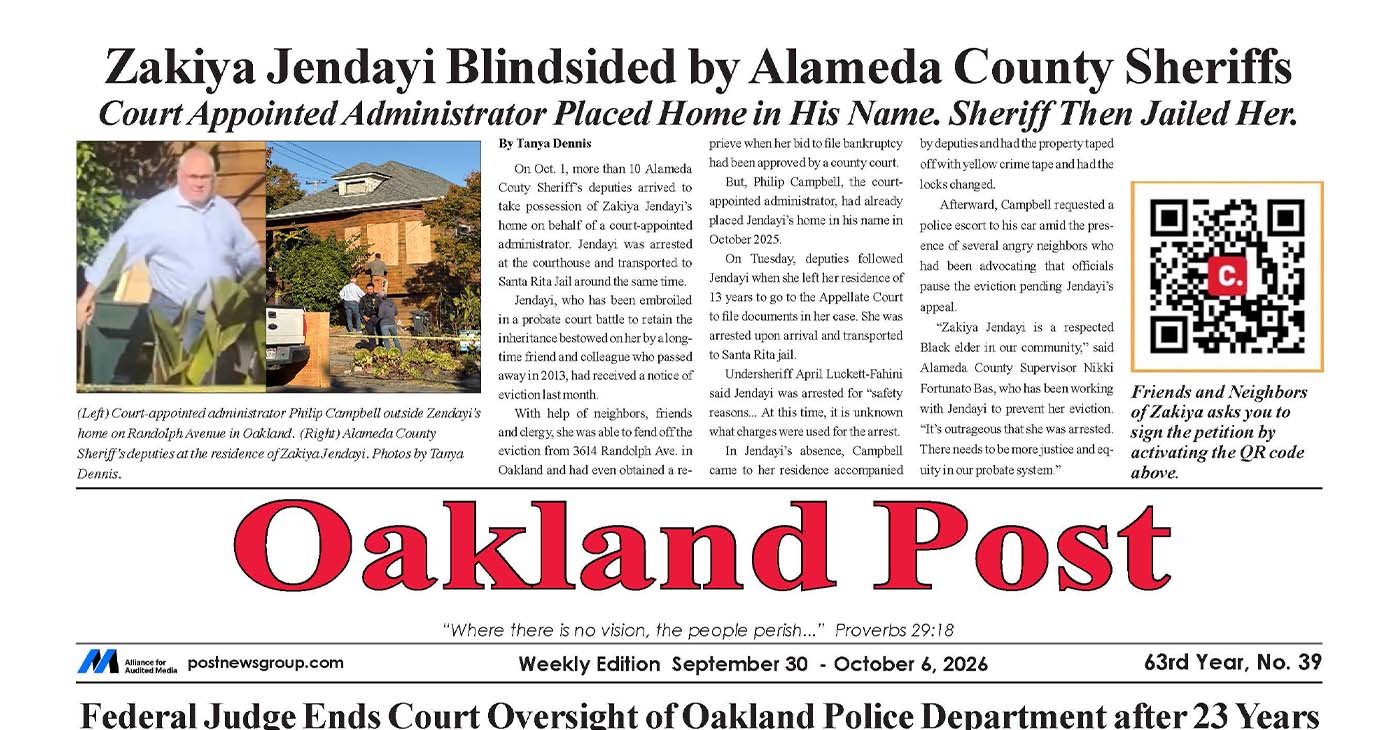
To enlarge your view of this issue, use the slider, magnifying glass icon or full page icon in the lower right corner of the browser window.
Activism
Oakland Post: Week of September 23 – 29, 2026
The printed Weekly Edition of the Oakland Post: Week of September 23 – 29, 2026

To enlarge your view of this issue, use the slider, magnifying glass icon or full page icon in the lower right corner of the browser window.


WCCUSD Joins Statewide Organic School Food Purchasing Cooperative

Democrats, Community Groups Back Measure EE to Change How Oakland Is Governed

Four Tips to Help You Plan a Holiday “Staycation”

Veterans Housing Project Proposed for South Richmond
PRESS ROOM: Transformative Justice Coalition 2026 Voting Rights Champion Awards Reception ‘Yesterday Is Today: The Battle For Voting Rights

Mayor Lee Delivers 2026 State of the City Address: ‘Oakland Continues to Be on the Move’

Oakland Awarded More than $14 Million in State Funding

Jendayi Arrest Raises Community Concerns Regarding Sheriff’s Chain of Command

Marin County Supes Expand Small Business Options with Home Kitchen Pilot Program

Allen Temple Baptist Church Hosts Free Prostate Cancer Screenings on Oct. 17

AC Transit Labor Unions Back Director Joel Young

Locals Can Get Locally Grown Produce Delivered Through Urban Tilth

‘ICE-Free Marin’ Supporters Press Supervisors as County Drafts Enforcement Restrictions

Oakland Post: Week of October 7 – 13, 2026

Ghana’s Ministry of Foreign Affairs Publishes Global Circle’s Vatican Reparations Call in Special Edition Alongside Heads of State

Misnamed ‘Parent’ PAC Seeks to Influence Oakland School Board Elections

Oakland Post: Week of September 2 – 8, 2026

Oakland Post: Week of September 9 – 15, 2026

Richmond Tiny House Village Farm & Garden Set to Open Gates on Sept. 26

Latest Massacre in Haiti Reveals Cruelty U.S. Deportations

OPINION: Nolan Wells’ Death One of Several Signifying Racial Terror Lives on in U.S. South

Poll: Becerra Widens His Lead Over Hilton; Californians Split on Wealth Tax

Mayor Lee Announces $1 Million Kaiser Permanente Grant for Pilot Program to Address Homelessness, Clean Up Public Spaces throughout Oakland

County Office of Education Says OUSD Finances Are Getting Healthier, Materially Stronger

Democratic Clubs Interview Candidates for Oakland School Board

Oakland People’s Arms Embargo Coalition Demands End to Military Shipments Thru Oakland

Oakland Post: Week of September 16 – 22, 2026

BLACspace Cooperative Invites Bay Area to Experience Oakland’s Black Cultural Ecosystem Through a BLAC Map Tour + Party

Two Looming Threats Every Alameda County Elder Should Know About

Zakiya Jendayi Arrested, Locked Out of Home by Sheriff’s Deputies

The Conversation With Al McFarlane 6/23/26

Media Monday 6/22/26

LIVE! ASK ALMA! — TUES. 6.23.26 7PM EST

Car Buying Secrets: 4 Hidden Checks Before You Sign!

Is This 550 HP Charger Worth YOUR Money? AutoNetwork Review

Celebrating Juneteenth – Frederick Douglass on education and resistance

LIVE! — ASK ALMA! — TUES. 6.19.26 7PM EST

Hyundai Ioniq 5 Parking, Safety, and 360 View #shorts

2025 Ioniq 5 New Wiper & Powerful Performance! #shorts

Electric SUV Range: Is 259 Miles Enough? #shorts

EV Charging: How Fast Can You Charge an Electric Vehicle? #shorts

Biometric Cooling… Messaging Seats…Come on! 2025 Infiniti QX80 Autograph 4WD

Charged Up: Witness the Magic of a Fully Electric Car! #shorts

Range Rover Sport PHEV Included…: See What’s Inside This Luxury SUV! #shorts

Invisible Hood View: Perfect Parking with X-Ray Vision! #shorts
-
 Economy3 weeks ago
Poll: Becerra Widens His Lead Over Hilton; Californians Split on Wealth Tax
-
 Business3 weeks ago
Mayor Lee Announces $1 Million Kaiser Permanente Grant for Pilot Program to Address Homelessness, Clean Up Public Spaces throughout Oakland
-
 Business3 weeks ago
County Office of Education Says OUSD Finances Are Getting Healthier, Materially Stronger
-
 Uncategorized3 weeks ago
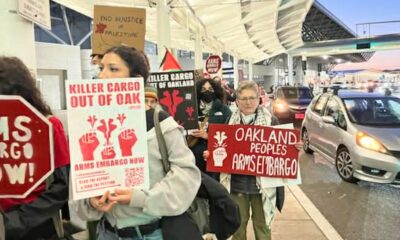
Oakland People’s Arms Embargo Coalition Demands End to Military Shipments Thru Oakland
-
 Activism3 weeks ago
Oakland Post: Week of September 16 – 22, 2026
-
 Art3 weeks ago
BLACspace Cooperative Invites Bay Area to Experience Oakland’s Black Cultural Ecosystem Through a BLAC Map Tour + Party
-
 Community3 weeks ago
Two Looming Threats Every Alameda County Elder Should Know About
-
 Lead Story2 weeks ago
Zakiya Jendayi Arrested, Locked Out of Home by Sheriff’s Deputies
