
Activism
Opinion: John Lewis, C.T. Vivian Together Helped Start Voting Rights Movement, Died on Same Day in Atlanta Commentary

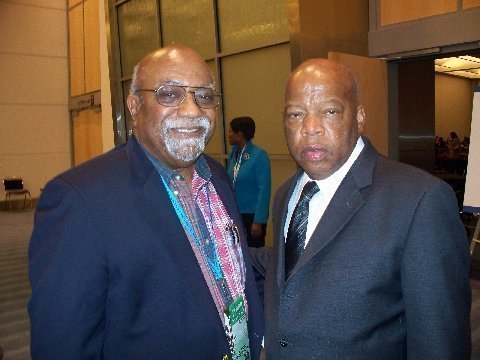
The news of the passing of two veteran Civil Rights leaders and giants John Lewis and C.T.Vivian, on the same day, jolted the nation’s consciousness, especially around the need for Blacks and other minorities to continue to register, vote and fully participate in the census to assure our voices are heard. They were considered “prophetic activist pathfinders” in the biblical tradition of Jeremiah “running to and fro through the streets, looking for a man to execute justice.”
They together added their voices, “made trouble” and were persecuted along with Daisy Bates, Septima Clark, Rev. Dr. Martin Luther King, Jr., Medgar and Myrlie Evers, Andrew Young, Fannie Lou Hamer, Rev. Ralph Abernathy, Ella Baker, Rev. Hosea Williams, Dorothy Height, Rev Joseph Lowery, Rosa Parks, Rev. James Lawson, Diane Nash, Rev. James Bevel and Rev. Jesse Jackson helped to birth the Civil Rights movement of the 60’s, and they both died on the same day to join the pantheon of pioneering prophetic voices.
The news of their passing jolted the nation’s consciousness, especially around the need for Blacks and other minorities to continue to register, vote, and fully participate in the census to assure our voices are heard.
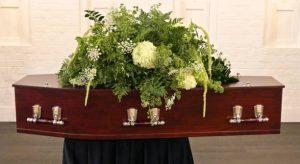
They gave their lives to make sure we are counted so that we can benefit when the roll is called in the upcoming November election — and when the trillions of federal dollars are distributed in 2021.
John Lewis, a minister and an Atlanta congressman from Alabama, shed blood in Selma to earn his civil rights icon status. He continued his indefatigable dedication for voting rights, from his participation in SNCC and VEP (Voter Education Project) until the day he died at 80 in Atlanta. Lewis had collaborated with Vivian while studying theology in Nashville, and the two of them were among the original 1961 Freedom Riders seeking to expose racism and to integrate southern facilities.
C.T. Vivian, a minister and Southern Christian Leadership Conference organizer who pioneered the politics of constructive confrontation behavior in employing voter registration strategies, also shed blood in Selma one month before Lewis, when he confronted Sheriff Clark. Both he and Lewis attracted national media coverage for their courageous challenges. Their sacrifices woke up the nation to the fact that Black votes mattered.
Their struggles and deaths remind us of the courageous volunteerism of the students and activists, who were mostly white, and had worked side-by-side with the Black faith-based community in 1964 and were among those arrested and killed for the right of Blacks to vote. Vivian, 95, like Lewis, was an activator who stirred the pot of activism that motivated organizers like Rev. William Barber and Stacey Abrams. He too died in Atlanta just hours before Lewis.
Lewis and Vivian joined Rev. Joseph Lowery, who also died this year at 98 in Atlanta, the birthplace of Dr. King.
I had the opportunity to march and work with both ministers Lewis and Vivian since the 1965 Selma, Alabama Voting Rights March 1965 as a student, reporter, faith-based organizer and field director for the Southern Elections Fund and the Southern Regional Council, also headquartered in Atlanta.
While my wife Gay Plair Cobb and I lived in Atlanta from 1973 to 1977. Gay was director of the Department of Labor’s Women Bureau in Atlanta before serving in Washington, D.C. with former Secretary of Labor Alexis Herman. We rented the home of Jane Bond and Howard Moore and utilized our residence for many “organizing gatherings and meetings” with many people from the network of civil rights activists.
The Southern Elections Fund (SEF) was headed by the legendary Julian Bond who was also a Student Non-Violent Coordinating Committee (SNCC) founder and member of the Georgia Legislature. Bond served as SEF Chair while Yancey Martin, who was a top advisor to Senator McGovern’s Presidential Campaign, was the Director. My job was to travel throughout the 11 southern states of the old confederacy to help organize voting and election strategies for Blacks. We helped raise funds and provided voter strategies for hundreds of Blacks, including Mississippi congressman Bennie Thompson (see SEF Ebony March 1975, story www.postnewsgroup.com).
I hope faith-based leaders, the Congressional Black Caucus, civil Rights activists and the participants in the Black Lives Matter Movement will dedicate their efforts to monitor the electoral process and demand that the DigiTech companies not become complicit with efforts by those who seek to suppress the Black vote. When I delivered the commencement address at Holy Names University, I challenged the students and the University — since it is in the heart of Oakland with a history of civil rights activism — to commit themselves to the causes of voting, census and ethnic studies in our schools. The passing of Lewis, Vivian and Lowery should resurrect a spirit of activism in all of us.
The Post will continue to provide information on voter suppression tactics. We will monitor social media and any attempts to discourage the Black vote.



Activism
Oakland Post: Week of September 30 – October 6, 2026
The printed Weekly Edition of the Oakland Post: Week of September 30 – October 6, 2026

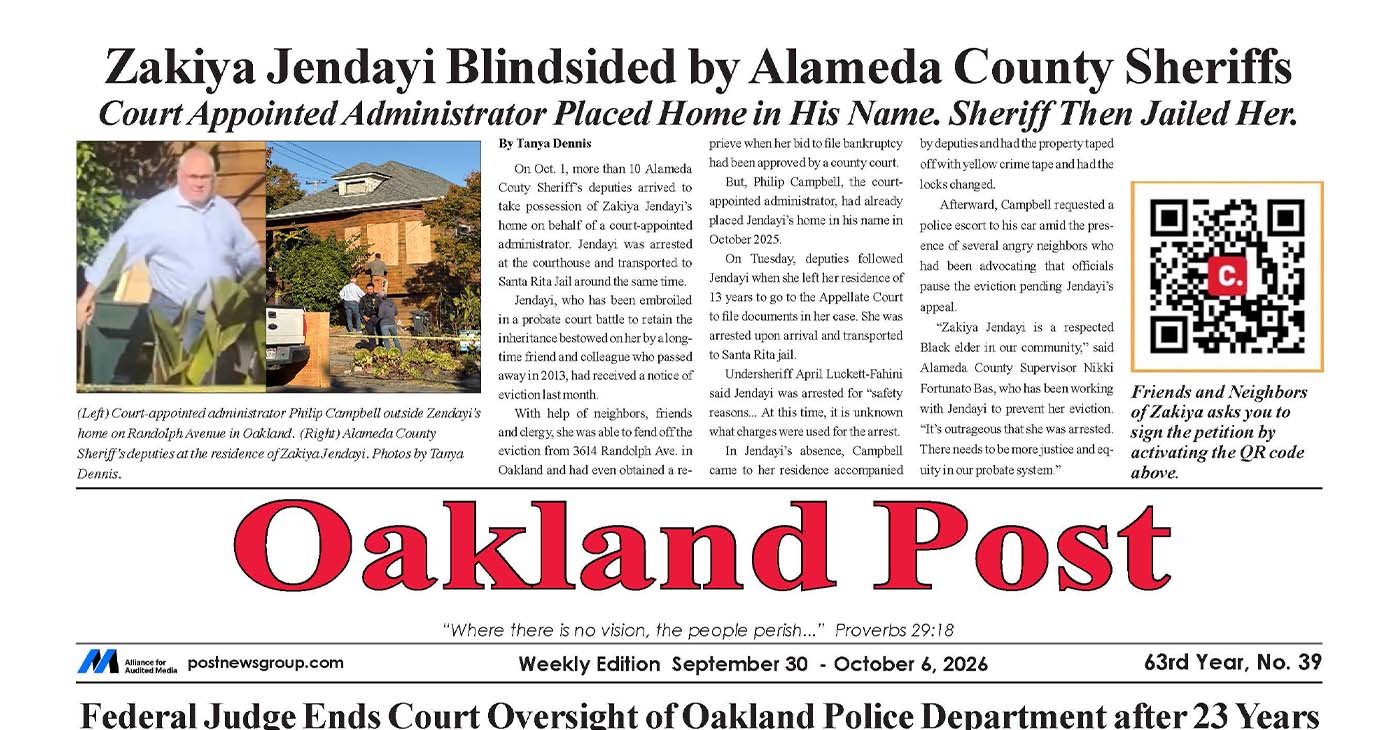
To enlarge your view of this issue, use the slider, magnifying glass icon or full page icon in the lower right corner of the browser window.

Activism
Oakland Post: Week of September 23 – 29, 2026
The printed Weekly Edition of the Oakland Post: Week of September 23 – 29, 2026

To enlarge your view of this issue, use the slider, magnifying glass icon or full page icon in the lower right corner of the browser window.
Activism
Oakland Post: Week of September 16 – 22, 2026
The printed Weekly Edition of the Oakland Post: Week of September 16 – 22, 2026

To enlarge your view of this issue, use the slider, magnifying glass icon or full page icon in the lower right corner of the browser window.



Listening as a Lifeline: A Doula’s Witness to Black Maternal Health

New Protections for Ticket Buyers: Gov. Newsom Signs Assemblymember Isaac Bryan’s Bill

‘We Don’t Talk Trash — We Pick Up Trash!’

Zakiya Jendayi Arrested, Locked Out of Home by Sheriff’s Deputies

Oakland Post: Week of September 30 – October 6, 2026

Asm. Corey Jackson Announces Launch of 24-Hour Childcare in His District

IN MEMORIAM: The Rev. Leon “Sonny” Clark, Longtime Orange County Pastor and Community Leader, Dies at 72

Poll: Becerra Widens His Lead Over Hilton; Californians Split on Wealth Tax

From Historic Memories to New Possibilities: Oakland Celebrates Coliseum 60

County Office of Education Says OUSD Finances Are Getting Healthier, Materially Stronger

LIVE FREE Sunday Dinner Brings Faith, Fellowship and Civic Conversation to Oakland

Remembering Chauncey Bailey as Student Journalists Face Threats to Truth-Telling

BLACspace Cooperative Invites Bay Area to Experience Oakland’s Black Cultural Ecosystem Through a BLAC Map Tour + Party

In Wake of Death on Doorstep, Williams Chapel Baptist Church Calls for Better Care, Funding for Unhoused

Oakland Centenarian Nuna McKee Honored!

Standoff for Justice: Our Homes Are Worth Fighting For

Oakland Post: Week of August 26 – September 1, 2026

Frontier Airlines’ Return to Oakland Airport Brings Flights, Jobs and Opportunity

Gubernatorial Candidate Steve Hilton Blasts California New Tire Rules; Newsom Hits Back

Chef Sharon Lee Blends Culinary Excellence, Education and Empowerment

Jackie Wright Champions Bay Area Stories, Filmmakers and Cultural Institutions

Misnamed ‘Parent’ PAC Seeks to Influence Oakland School Board Elections

Oakland Coliseum Project Opens Door for Small Businesses to Build Bigger

Big City Mayors Ask for “Yes” Vote on Housing Bond Measure; Conservatives Say “No”

Gov. Newsom’s Latest Appointees Include Sacramento Advocate for Formerly Incarcerated Students; State’s New Tech Chief

Longtime BWOPA Member Brendalyn Goodall Appointed to California Workforce Development Board

Gov. Newsom Signs Law Shielding Immigration Aid Workers From Doxing Threats

Secretary of State Shirley N. Weber Urges Californians to Vote Early as Voter ID Battle Intensifies

Oakland Post: Week of September 2 – 8, 2026

IN MEMORIAM: Dolly Parton Dead at 80 — How She Built a Legacy of Love and Earned Her Place in Black Culture

The Conversation With Al McFarlane 6/23/26

Media Monday 6/22/26

LIVE! ASK ALMA! — TUES. 6.23.26 7PM EST

Car Buying Secrets: 4 Hidden Checks Before You Sign!

Is This 550 HP Charger Worth YOUR Money? AutoNetwork Review

Celebrating Juneteenth – Frederick Douglass on education and resistance

LIVE! — ASK ALMA! — TUES. 6.19.26 7PM EST

Hyundai Ioniq 5 Parking, Safety, and 360 View #shorts

2025 Ioniq 5 New Wiper & Powerful Performance! #shorts

Electric SUV Range: Is 259 Miles Enough? #shorts

EV Charging: How Fast Can You Charge an Electric Vehicle? #shorts

Biometric Cooling… Messaging Seats…Come on! 2025 Infiniti QX80 Autograph 4WD

Charged Up: Witness the Magic of a Fully Electric Car! #shorts

Range Rover Sport PHEV Included…: See What’s Inside This Luxury SUV! #shorts

Invisible Hood View: Perfect Parking with X-Ray Vision! #shorts
-
 Community3 weeks ago
Misnamed ‘Parent’ PAC Seeks to Influence Oakland School Board Elections
-
 Activism4 weeks ago
Oakland Post: Week of September 2 – 8, 2026
-

 Community3 weeks ago
Richmond Tiny House Village Farm & Garden Set to Open Gates on Sept. 26
-

 Activism3 weeks ago
Oakland Post: Week of September 9 – 15, 2026
-

 Black History3 weeks ago
Latest Massacre in Haiti Reveals Cruelty U.S. Deportations
-

 Black History3 weeks ago
OPINION: Nolan Wells’ Death One of Several Signifying Racial Terror Lives on in U.S. South
-

 Community3 weeks ago
Democratic Clubs Interview Candidates for Oakland School Board
-

 Business2 weeks ago
Mayor Lee Announces $1 Million Kaiser Permanente Grant for Pilot Program to Address Homelessness, Clean Up Public Spaces throughout Oakland
