
Politics
CBO: Deficit to Shrink to Lowest Level of Obama Presidency


In this March 4, 2014 file photo, copies of President Barack Obama’s proposed fiscal 2015 budget are set out for distribution on Capitol Hill in Washington. The Congressional Budget Office says the federal budget deficit will shrink this year to its lowest level since President Barack Obama took office. CBO says the deficit will be $468 billion for the budget year that ends in September. Thats slightly less than last years $483 billion deficit. As a share of the economy, CBO says this years deficit will be slightly below the historical average of the past 50 years. (AP Photo/J. Scott Applewhite, File)
STEPHEN OHLEMACHER, Associated Press

WASHINGTON (AP) — Solid economic growth will help the federal budget deficit shrink this year to its lowest level since President Barack Obama took office, according to congressional estimates released Monday.
The Congressional Budget Office also projects a 14 percent drop in the number of U.S. residents without health insurance, largely because of Obama’s health law.
In a report released Monday, CBO says the deficit will be $468 billion for the budget year that ends in September. That’s slightly less than last year’s $483 billion deficit.
The official scorekeeper of Congress projects solid economic growth for the next few years, with unemployment dropping slightly.
“In CBO’s estimation, increases in consumer spending, business investment and residential investment will drive the economic expansion this year and over the next few years,” the report said.
CBO also cited wage increases, rising wealth and the recent decline in oil prices.
For future years however, CBO issued a warning: Beyond 2018, deficits will start rising again as more baby boomers retire and enroll in Social Security and Medicare. By 2025, annual budget deficits could once again top $1 trillion, unless Congress acts.
At that point, Social Security benefits would account for one-quarter of all federal spending, said CBO Director Douglas Elmendorf.
“The underlying point is that we have a handful of very large federal programs that provide benefits to older Americans,” Elmendorf said. “And with the rising number of older Americans and a rising cost of health care, those programs get much more expensive.”
CBO says the number of U.S. residents without health insurance will drop from 42 million last year to 36 million this year, largely because of Obama’s health law. These numbers don’t include people who are in the U.S. illegally, who are ineligible for subsidies under the health law.
The report says 19 million people will have health insurance because of the law, which could make it harder for congressional Republicans to make good on promises to repeal it.
Obama inherited an economy in recession when he took office. The annual deficit topped $1 trillion for each of his first four years in office, including a record $1.4 trillion in 2009.
As a share of the economy, CBO says this year’s deficit will be slightly below the historical average of the past 50 years.
The federal budget deficit became a big issue during Obama’s early years in office. In 2011, Obama and congressional Republicans struck a deal that resulted in significant spending cuts at many government agencies. At the start of 2013, Obama persuaded Congress to further address the deficit by raising taxes on top earners.
The White House said Monday that Congress still has more to do. “CBO’s longer-term budget and economic projections confirm the need for Congress to act to strengthen our economy for the middle class while putting our debt and deficits on a sustainable trajectory, including by making the investments that will accelerate economic growth and generate good new jobs for our workers to fill,” Deputy Press Secretary Eric Schultz said in a statement.
Declining budget deficits, however, could reduce pressure on Congress to continue addressing the government’s finances.
“Over the last few years as deficits have fallen, so too has the effectiveness of Republican rhetoric about a ‘big government’ boogeyman,” said Sen. Charles E. Schumer, D-N.Y. “Now is the time for Republicans to join with Democrats to invest in constructive programs that help middle-class Americans climb the ladder and achieve the American dream.”
Republicans, however, signaled that they aren’t done cutting spending.
“Thanks to Republicans’ efforts to cut spending this year’s deficit is projected to be smaller, but in order to balance the budget we must address the true drivers of our debt,” said Cory Fritz, a spokesman for House Speaker John Boehner, R-Ohio. “Real, robust economic growth won’t occur until we solve our government’s spending problem.”
CBO projects that the economy will grow at an annual rate of 3 percent in both 2015 and 2016. In later years, however, CBO projects slower economic growth as more baby boomers retire and the labor force grows more slowly than it did in the 1980s and 1990s.
CBO projects the unemployment rate will gradually decrease to 5.3 percent in 2017. It is now 5.6 percent.
“CBO’s report is important, but it only tells us part of the story,” said Sen. Bernie Sanders, a Vermont independent and the ranking minority member of the Senate Budget Committee. “What we must never forget is that tens of millions of Americans today are struggling to keep their heads above water economically while the disparity between the rich and everyone else is growing wider every day.”
The budget agency bases its budget projections on current law, assuming that temporary provisions will be allowed to expire. However, many temporary laws are routinely extended, including dozens of temporary tax breaks and a provision that prevents steep cuts in Medicare payments to doctors.
Future budget deficits would be higher if those provisions are continued. For example, if dozens of temporary tax breaks are extended, they would add $1 trillion to the deficit over the next decade.
___
Follow Stephen Ohlemacher on Twitter: http://twitter.com/stephenatap
Copyright 2015 The Associated Press. All rights reserved. This material may not be published, broadcast, rewritten or redistributed.








Business
OP-ED: Proposition 44 Would Put a Price on Trust
The danger in Proposition 44 is not only its 90 percent figure. It is that the meaning of “qualifying” spending will be worked out later. A clinic preparing a budget today may not know whether a navigator, health educator, transportation program, outreach worker, technology upgrade, or other patient-support service will be counted the way it expects. Yet the financial consequence of getting it wrong could be immediate.




Business
OP-ED: Proposition 40: It’s Time to Play Chess, Not Checkers
Proposition 40 would impose a one-time 5 percent tax on the wealth of Californians with more than $1 billion in assets. Most of that money would go toward health care, with the remainder supporting food assistance and education-related programs.

Activism
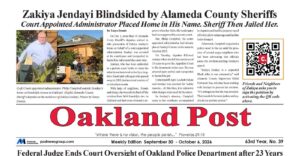
Oakland Post: Week of September 30 – October 6, 2026
The printed Weekly Edition of the Oakland Post: Week of September 30 – October 6, 2026

To enlarge your view of this issue, use the slider, magnifying glass icon or full page icon in the lower right corner of the browser window.



OP-ED: Proposition 44 Would Put a Price on Trust

OP-ED: Proposition 40: It’s Time to Play Chess, Not Checkers

Listening as a Lifeline: A Doula’s Witness to Black Maternal Health

New Protections for Ticket Buyers: Gov. Newsom Signs Assemblymember Isaac Bryan’s Bill

‘We Don’t Talk Trash — We Pick Up Trash!’

Zakiya Jendayi Arrested, Locked Out of Home by Sheriff’s Deputies

Oakland Post: Week of September 30 – October 6, 2026

Asm. Corey Jackson Announces Launch of 24-Hour Childcare in His District

IN MEMORIAM: The Rev. Leon “Sonny” Clark, Longtime Orange County Pastor and Community Leader, Dies at 72

Poll: Becerra Widens His Lead Over Hilton; Californians Split on Wealth Tax

From Historic Memories to New Possibilities: Oakland Celebrates Coliseum 60

County Office of Education Says OUSD Finances Are Getting Healthier, Materially Stronger

LIVE FREE Sunday Dinner Brings Faith, Fellowship and Civic Conversation to Oakland

Remembering Chauncey Bailey as Student Journalists Face Threats to Truth-Telling

BLACspace Cooperative Invites Bay Area to Experience Oakland’s Black Cultural Ecosystem Through a BLAC Map Tour + Party

Standoff for Justice: Our Homes Are Worth Fighting For

Oakland Post: Week of August 26 – September 1, 2026

Frontier Airlines’ Return to Oakland Airport Brings Flights, Jobs and Opportunity

Gubernatorial Candidate Steve Hilton Blasts California New Tire Rules; Newsom Hits Back

Chef Sharon Lee Blends Culinary Excellence, Education and Empowerment

Jackie Wright Champions Bay Area Stories, Filmmakers and Cultural Institutions

Misnamed ‘Parent’ PAC Seeks to Influence Oakland School Board Elections

Oakland Coliseum Project Opens Door for Small Businesses to Build Bigger

Big City Mayors Ask for “Yes” Vote on Housing Bond Measure; Conservatives Say “No”

Gov. Newsom’s Latest Appointees Include Sacramento Advocate for Formerly Incarcerated Students; State’s New Tech Chief

Longtime BWOPA Member Brendalyn Goodall Appointed to California Workforce Development Board

Gov. Newsom Signs Law Shielding Immigration Aid Workers From Doxing Threats

Secretary of State Shirley N. Weber Urges Californians to Vote Early as Voter ID Battle Intensifies

Oakland Post: Week of September 2 – 8, 2026

IN MEMORIAM: Dolly Parton Dead at 80 — How She Built a Legacy of Love and Earned Her Place in Black Culture

The Conversation With Al McFarlane 6/23/26

Media Monday 6/22/26

LIVE! ASK ALMA! — TUES. 6.23.26 7PM EST

Car Buying Secrets: 4 Hidden Checks Before You Sign!

Is This 550 HP Charger Worth YOUR Money? AutoNetwork Review

Celebrating Juneteenth – Frederick Douglass on education and resistance

LIVE! — ASK ALMA! — TUES. 6.19.26 7PM EST

Hyundai Ioniq 5 Parking, Safety, and 360 View #shorts

2025 Ioniq 5 New Wiper & Powerful Performance! #shorts

Electric SUV Range: Is 259 Miles Enough? #shorts

EV Charging: How Fast Can You Charge an Electric Vehicle? #shorts

Biometric Cooling… Messaging Seats…Come on! 2025 Infiniti QX80 Autograph 4WD

Charged Up: Witness the Magic of a Fully Electric Car! #shorts

Range Rover Sport PHEV Included…: See What’s Inside This Luxury SUV! #shorts

Invisible Hood View: Perfect Parking with X-Ray Vision! #shorts
-
 Community3 weeks ago
Misnamed ‘Parent’ PAC Seeks to Influence Oakland School Board Elections
-
 Activism4 weeks ago
Oakland Post: Week of September 2 – 8, 2026
-

 Activism3 weeks ago
Oakland Post: Week of September 9 – 15, 2026
-

 Community3 weeks ago
Richmond Tiny House Village Farm & Garden Set to Open Gates on Sept. 26
-

 Black History3 weeks ago
Latest Massacre in Haiti Reveals Cruelty U.S. Deportations
-

 Black History3 weeks ago
OPINION: Nolan Wells’ Death One of Several Signifying Racial Terror Lives on in U.S. South
-

 Business2 weeks ago
Mayor Lee Announces $1 Million Kaiser Permanente Grant for Pilot Program to Address Homelessness, Clean Up Public Spaces throughout Oakland
-

 Community3 weeks ago
Democratic Clubs Interview Candidates for Oakland School Board
